Committee Insights | 7.13.23 | Know Your Hazards – Occupational Health and Safety Considerations in Cannabinoid Ingredient Manufacturing
NCIA’s #IndustryEssentials webinar series is our premier digital educational platform featuring a variety of interactive programs allowing us to provide you timely, engaging and essential education when you need it most.
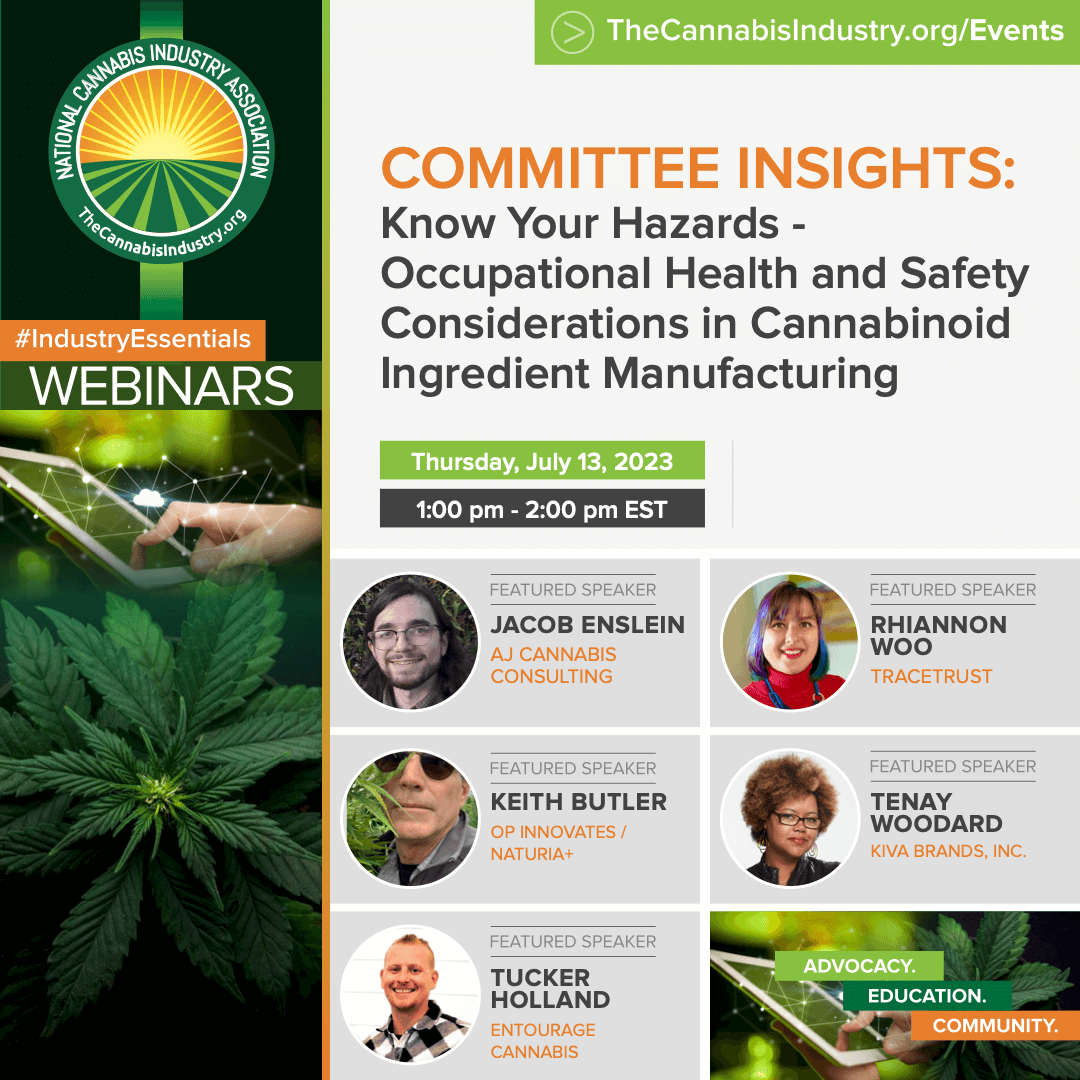
In this edition of our NCIA Committee Insights series, originally aired on July 13, we were joined by members of NCIA’s Cannabis Manufacturing, Scientific Advisory and Hemp Committees for an in-depth discussion highlighting the occupational health and safety considerations to make during the manufacture of cannabinoids and provide recommendations for mitigating risk.
There is no mistaking that manufacturing cannabinoids is here to stay. It is more and more prevalent to see historically plant/naturally derived bulk ingredients being manufactured in a controlled environment in the lab or through innovative processes like precision fermentation. It is likely that bulk ingredient manufacturing of cannabinoids will go this route too.
For cannabinoids like HHC, that do not exist naturally in the plant or in high enough quantities to be commercially viable for extraction, it is most certainly the case that manufacture of these compounds will occur in the lab. To produce these compounds safely, we can luckily look toward existing regulations and occupational health and safety guidelines for producing novel ingredients for use in foods and non-foods.
Learning Objectives:
• Recognizing common occupational safety hazards associated with manufacturing cannabinoids and recommendation to mitigate these hazards
• Learning the different occupational safety considerations between isolation and purification of naturally occurring cannabinoids and the manufacture (synthesis) of cannabinoids in the lab
• Understanding the special safety considerations that processes like hydrogenation and others have and why these are critical to mitigating liability for your business
Safeguarding Consumers in the Cannabinoid Product Landscape (Part III):
Know Your Hazards – Occupational Health and Safety Considerations in Cannabinoid Ingredient Manufacturing (Part IV): https://bit.ly/3rEUeKP
Concepts for Regulatory Consideration – Shifting the Conversation from “Cannabis vs. Hemp” to “The Cannabinoids” (Part V): https://bit.ly/3P3r5AW
Committee Insights | Meet the Minors (Novel, Minor, Synthetic Cannabinoids – Part II)
In this edition of our NCIA Committee Insights series, originally aired on May 11, 2023, we were joined by members of NCIA’s Cannabis Manufacturing, Scientific Advisory and Hemp Committees for an in-depth discussion of the most talked about minor, novel, and synthetic cannabinoids.
What scientific publications exist for each compound? What do we know about each molecule’s physiological, psychoactive, and therapeutic effects?
You’ll find out during this informative session featuring leading chemical experts, manufacturers and product development specialists. Along with audience members they explored these compounds from various perspectives to examine their implications for consumers, medical practitioners, patients, producers and regulators.
Learning Objectives:
• Molecular Structures and Identification of novel, minor, and synthetic compounds
• Published Physiological and Psychoactive effects of these compounds
• Perceived therapeutic effects
• Opportunity to ask about other new compounds not in presentation.
Safeguarding Consumers in the Cannabinoid Product Landscape (Part III):
Know Your Hazards – Occupational Health and Safety Considerations in Cannabinoid Ingredient Manufacturing (Part IV): https://bit.ly/3rEUeKP
Concepts for Regulatory Consideration – Shifting the Conversation from “Cannabis vs. Hemp” to “The Cannabinoids” (Part V): https://bit.ly/3P3r5AW
Member Blog: Hydrocarbon v. Solventless – Which is Better?
by Jessica McKeil, cannabis writer for Agrify
The cannabis industry regularly pits solventless extraction against hydrocarbon extraction. Across social media and online forums, the debate ranges in both directions. But with a global cannabis concentrate market hitting $1.7 billion USD in 2022 (Market and Research), it’s clear that no single extraction technology is driving this remarkable growth.
Instead, a variety of extraction techniques, including solvent-based and solventless, allow producers to navigate an ever-evolving landscape and pivot as needed in response to consumer demands and market prices.
Rather than asking if hydrocarbon or solventless is the better option, it makes more sense to consider both extraction technologies together as a total, harmonious strategy.
Limitations of a Single Extraction Method
According to BDSA, the top three influences over consumer purchasing decisions are high THC content, taste and flavor, and, finally, low price point. When we apply these considerations to the world of cannabis concentrates, no extraction technique captures all three.
These often conflicting consumer demands layered with other industry influences mean that choosing a single extraction technology to apply across all markets is impossible, especially if long-term growth is the goal.
A new market may prefer the low price points and high THC offered by hydrocarbon extraction. A mature market may demand better flavor and allow for the premium pricing of solventless extracts. But there are nuances within even these basic assumptions. Investing in a single extraction technology will limit your ability to scale and survive in an always-evolving marketplace.
Let’s look at the limitations of hydrocarbon extraction. There is an initial barrier to entry thanks to the significant capital expense for not just equipment, but the buildout of extraction booths, and the requirement for highly skilled staff. Additionally, hydrocarbon extraction is an incredibly competitive category, especially in newer markets. While you’ll have the flexibility to process just about any biomass, it’s more challenging to differentiate by quality to capture a premium price point.
Solventless extraction has lower upfront costs and also eliminates the need for highly skilled engineers, architects, and even the fire marshall inspection required for hydrocarbon facilities. But solventless only works with high-quality flower and a limited spectrum of genetics. Should harvest quality not meet expectations, solventless extractors have little recourse to recoup costs. Plus, not all markets can bear the premium price point of rosin extracts.
Limitless Production: Harmony of Solventless and Hydrocarbon
Cannabis, as a global commodity, is unsurprisingly seeing consistent upward growth. Yet the fluctuations within each product category and each regulatory market are much more challenging to predict. No matter what state we look at, consumer tastes evolve, regulatory and taxation burdens change, and available biomass quality remains highly variable.
A dual approach to cannabis extraction with solventless and hydrocarbon technologies guarantees flexibility and offers a type of production insurance to weather ongoing market volatility.
First and foremost, having both extraction options on the table allows brands to make real-time production decisions in response to the available biomass and whether or not price, high THC, or flavor is driving sales.
If high-quality flower is available and the market can bear the premium price point, solventless is the definitive choice. As per BDSA Retail Sales Tracking, “Rosin’s share of dabbable dollar sales has grown significantly in mature markets (CA, CO, OR, MI, IL), from 8% in January 2021 to 16% in October 2022.” Even in markets with price compressions, solventless can help secure market share.
But, not all markets are ready for high-priced premium extractions, Illinois being a primary example. Despite its relative maturity and the recent numbers from BDSA, the uniquely high flower prices mean that rosin concentrates are priced out of reach for most consumers at roughly $120 per gram. In this case, it may make more sense to focus on selling quantity rather than selling premium quality, which is where hydrocarbon offers a smart alternative.
Hydrocarbon is also a winning strategy for dealing with lower-quality biomass. No matter the quality of the input, provided the extraction process is controlled, hydrocarbon extraction in combination with distillation is an effective crop insurance.
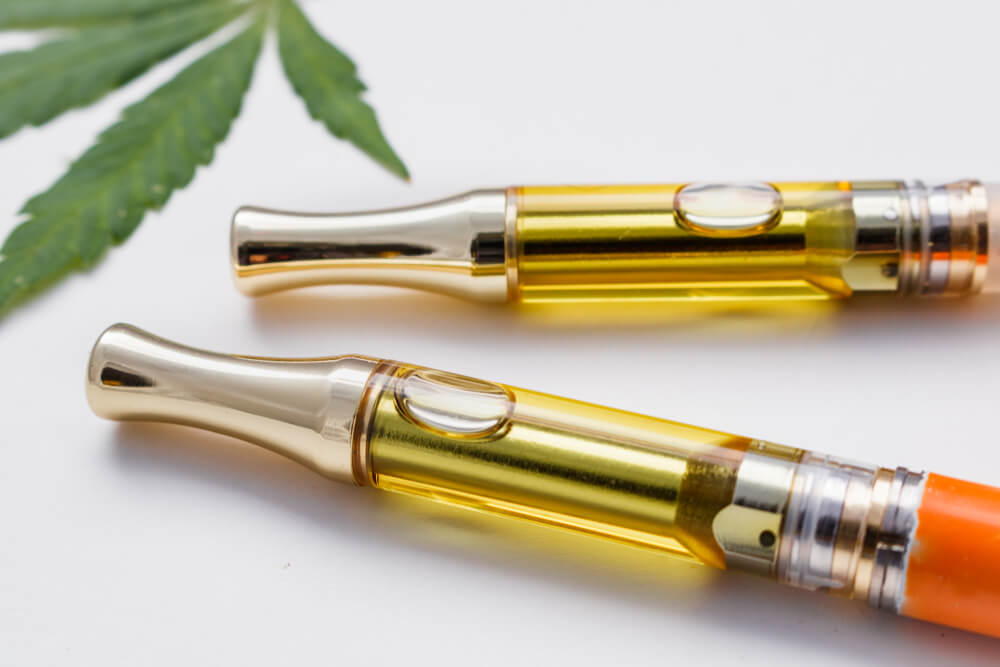
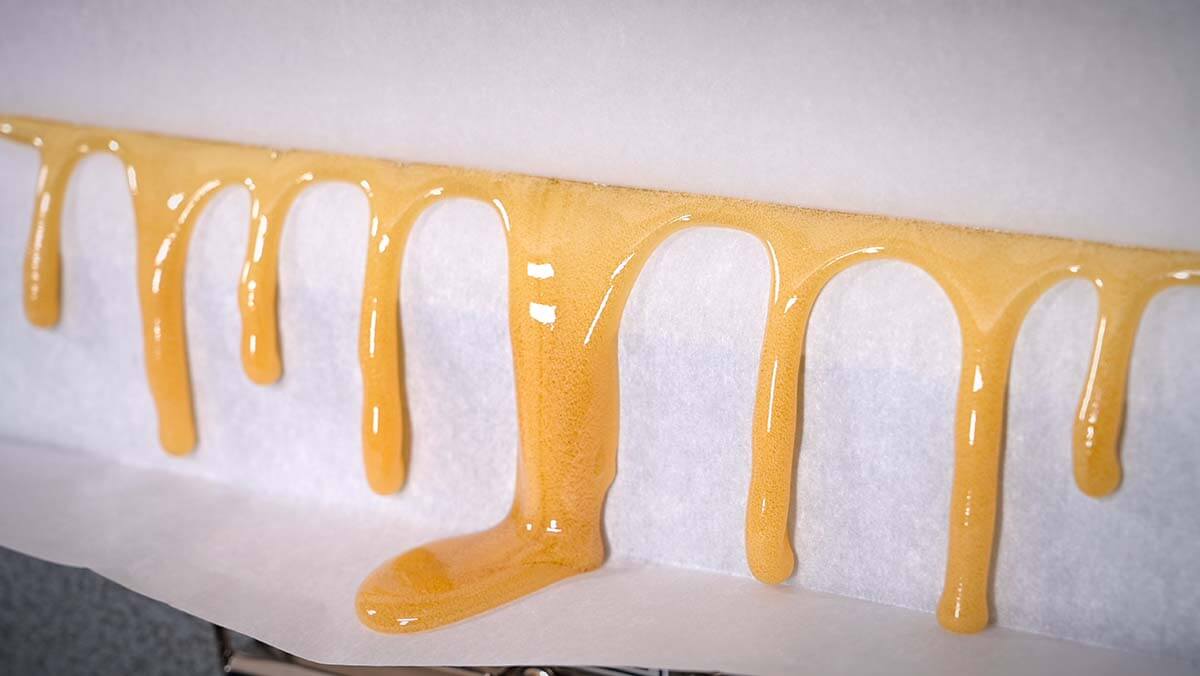
Hydrocarbon extraction is more versatile than its solventless counterpart, allowing for a wider variety of finished products. It’s possible to create an entire range of products, including shatters, waxes, resins, sauces, and more. Plus, hydrocarbon-extracted crude oil is more easily formulated into consumer packaged goods like edibles and vape carts.
Building production around a dual-extraction strategy, combining solventless and hydrocarbon techniques, is a proven approach. The industry’s leading multi-state operators, including Curaleaf, Trulieve, and Viola Brands, to name a few, have already broadened their SKU portfolios to offer both hydrocarbon and solventless products. This has allowed them to adapt successfully to changing consumer tastes, market conditions, and other influences, no matter where they operate.
Jessica McKeil is a cannabis writer for Agrify based in British Columbia, Canada. Her focus on cannabis tech, scientific breakthroughs, and extraction has led to bylines with Cannabis & Tech Today, Terpenes and Testing, and Analytical Cannabis, among others. She is the owner and lead-writer of Sea to Sky Content, which provides content and strategy to the industry’s biggest brands including Agrify.
Agrify includes extraction brands Precision Extraction and PurePressure, which provide extraction technologies to help producers create the products customers want. From planning and equipment to installation and training, they help operators build out flexible, nimble extraction strategies geared toward long-term viability. Precision Extraction offers best-in-class hydrocarbon extraction, ethanol extraction, distillation, and lab equipment plus vacuum ovens by Cascade, along with extraction lab rooms, pods, and design services for any size operation. PurePressure encompasses solventless extraction, from industry leading rosin presses to hash washing equipment and consumables. Together, Precision Extraction and PurePressure by Agrify offer the full array of options needed to nimbly navigate the volatile cannabis market—no matter operator size. For more information visit https://precisionextraction.com/contact-us/ or https://gopurepressure.com/pages/contact-us.
Committee Blog: Everything You Wanted to Know About Cannabis Facilities but Were Afraid to Ask Field Guide – Part 5 – General
by NCIA’s Facilities Design Committee Jacques Santucci, Brian Anderson, David Vaillencourt, and David Dixon
Continuing our five-part series on the behind-the-scenes workings of the legal cannabis industry. This series focuses on all of the inner dealings and industry advice from established professionals to craft this unlimited How-to-Guide to assist you in setting up your own facility. These articles cover cultivation, extraction, infused products, and retail facilities as well as support activities. In general, remember to be compliant with all local rules and regulations and contact a licensed contractor and industry expert.
Part Five, General: Top Things to Consider When Planning Your Support Area for Cannabis Facilities
All parts of a facility are important when you are planning and designing your project, including cultivation, extraction, and retail. And let’s not forget the general services and the core structure of the facility. Your design must account for safety and security as well as employee relations and administration. Listed below are a number of guidelines that an operator should consider from a general standpoint as they are in the process of designing their operation. Always remember to be compliant with all local rules and regulations.
Employee Lockers
Production and facility lockers need to be separate for male and female and it will have a minimum square foot per employee requirement. Knowing your employee count and the number of shifts will allow you to calculate the minimum space needed.
Employee Break Room and Locker Space
Consider a break room that can host all employees for breaks and lunches, with a sink, fridge, microwave, and tables and chairs. This will help employee productivity and retention. Where the break room is located is important to keep employees separated from internal business practices while eating and resting. This area can also be a space for coat hangers and small bag lockers when a specific locker is not required or available. The gowning area is used as the dividing line in a mix-used facility.
Employee Access Control
You need to limit doors access and key sets for employees as part of your overall security plan. Additionally, do not forget about appropriate labels for doors and the need for access to space only. The idea is to prevent unauthorized personnel from accessing the extraction space and complaining about the local regulatory body.
Safety and Injury Handing
An adequate number of First Aid and Burn Kits should be fully stocked and readily available to all of your employees, at all times. Ideally, these kits will be within a 10-15 second walking distance from workstations.
IT Rooms and Setup
Regardless of the facility type, you will need appropriate secured areas for servers, security equipment, and other IT racks, as well as camera systems with specific features for night, license plate reading abilities, and more. Specific HVAC might be needed for this room.
Safety and Employee Showers
Emergency showers are determined by code and the type of activities performed at the location. Eye wash stations may also be required or suggested.
Emergency showers are located in the facility where corrosives and skin irritants could pose harm to employees and require immediate remediation. It could be considered as a benefit to employees so they can eliminate any odors as they leave the facility. Calculate the number of employees and determine based on the code requirements for the number of showers needed.
Emergency Eye Wash
Eye wash stations are to be located within 10-15 seconds’ walking distance for a potential risk area. Check local requirements for additional needs.
Security Entrance: Facility Safety
Consider the flow at the entrance of your facility, to optimize not only security but also the comfort of the visitors and employees as well as environmental control. And think about the comfort of your employees as they enter the facility, such as awnings. Create a separate mantrap-style entrance to allow for better safety at the entrance point, to monitor visitors as well as avoid weather-related issues (i.e. wet areas due to rain or snow, temperature variance due to heat, etc.). Check for compliance with local rules and regulations.
Security Camera: Minimum Area of Coverage
You should have 100% minimum security coverage; any area where cannabis products will exist. And keep in mind it is best that the security room has its own dedicated HVAC system.
Security Camera: Minimum Data Storage
The basic security footage storage requires are 90-days of on-site storage, then five years of off-site storage. Off-site data storage for future legal needs is 1080p minimum.
Security Alarm: Monitoring
Make sure a reputable company is monitoring your facility’s security. Redundancy might not be needed. In compliance with local rules and regulations.
Office Space
Do not forget that your employees, at least at the management level and above will need space to do paperwork and hold staff meetings. Plan to have a minimum of 90 square feet of office space available for each manager and meeting space. Try not to underestimate the need for administrative space (i.e. payroll, human resources, accounting, marketing, etc.) and plan for general storage space. Your basic corporate services need the appropriate space to run the business efficiently, in a confidential manner.
Parking
When it comes to parking, consider the flow of the employees and your customers as you design your facility so you have adequate parking for all, in a safe and secure manner. Remember to reserve spaces for handicapped drivers as well as motorcycles.
Janitorial and Facility Maintenance
Keep in mind how you will keep your facility clean and in working order at all times. Avoid dusty surfaces, standing water, and all environmental and other hazardous issues. Consider enough storage for janitorial and facility maintenance items, including a workbench if necessary.
Landscaping
Remember considerations for the environment around your facility. Certain plant types and species are known to both harbor insects and pests that may be beneficial or harmful to cannabis plants. This will result in long-lasting effects on your plant health. Proper considerations of landscape design can become beneficial to your overall integrated pest management program and to your operation. Material used around your cannabis facility will also have an impact. We recommend using crushed stones around a building for example.
NCIA Director of Communications Bethany Moore checks in with what’s going on across the country with the National Cannabis Industry Association’s membership, board, allies, and staff. Join us every other Thursday on Facebook for NCIA Today Live.
Committee Blog: Everything You Wanted to Know About Cannabis Facilities But Were Afraid to Ask Field Guide – Part 3 – Extraction
by members of NCIA’s Facilities Design Committee Jacques Santucci, Brian Anderson, David Vaillencourt, and David Dixon
Continuing our five-part series on the behind-the-scenes workings of the legal cannabis industry. This series focuses on all of the inner dealings and industry advice from established professionals to craft this unlimited How-to-Guide to assist you in setting up your own facility. These articles cover cultivation, extraction, infused products, and retail facilities as well as support activities. In general, remember to be compliant with all local rules and regulations and contact a licensed contractor and industry expert.
Part Three, Food: 10 Things to Consider When Planning Your Manufacturing of Infused Products (MIPs) Operations
Food safety and handling practices are an issue for any industry working with or processing products for human consumption and often come with strict guidelines that need to be followed. In the cannabis industry, edibles and other processed or infused products Manufactured Infused Products (MIPs) are ready-to-eat foods, so many states are regulating them as foods under the cGMP requirements of 21CFR117. We feel this is likely the approach that will be appropriate when cannabis becomes federally legal. These 10 things should be considered as you begin to plan your facility. Always remember to be compliant with all local rules and regulations.
Sanitary Design and Operation
A production room is straightforward, conceptually: design the space so walls, floors, and ceilings can be washed and sanitized, then verified (ATP swabs) to confirm the cleaning process is effective. To facilitate cleaning, everything needs to be pulled away from the walls, the ceiling needs to be solid and the walls need to be sealed. Insulated metal panels (IMP) are a cavity-free construction that is seeing wide acceptance in the industry. To keep the space clean during operation, slope the floors to spot drains, install coves along with the floor/wall interface and avoid ledges and traps for water or dust.
Employee Hand Washing
A stringent internal process for sanitation and washing of hands is crucial. Make sure that lavatories are available throughout your facility for proper sanitation. Confer with the municipal board of health for locations and quantity. Generally locate any place where employees are handling consumable products or encounter the potential for microbiological.
Boot Washing
Sanitation includes making sure all boots/shoes are free of contaminants. Employee captive corporate footwear programs prevent contamination potential from non-business-related employee activities.
Cart Washing
For carts that transport ingredients and materials, it is important to prevent floor debris getting transferred from one area to another. Two areas of concern; are wheels and cart shelves. Either wheel or shelf area can be addressed from multiple washing devices specific to each type of cart used.
Product Storage
Food safety temperature and humidity separation of products are an important factor. The purpose is to store food products at such a temperature and humidity level to prevent the growth of undesirable bacteria.
Allergen cross-contamination
Make sure to arrange products to avoid cross-contamination of open and unopened products. Keep the first pallet off the floor at a height of 6” AFF to avoid picking up contaminants. OHSA SHARP may apply how to organize products.
You can design barriers to keep contamination from entering a room.
Limit contamination by having and always renewing Personal Protective Equipment (PPE), since the adjacent hallways may transport raw biomass. Test all ingredients, including THC, to ensure that everything is microbiologically safe. Wipe down, or unpackage ingredients, materials, and supplies before bringing them into the ‘clean environment’ room. Wear specific scrub, clean boots, and wash off any carts entering the room.
Employees entering the food production space
Contaminants can enter via the employees. It is essential to have all employees and agents clean up before entering the food production space. You must provide facilities to wash and sanitize hands as well as boots. Continuous training of employees and monitoring adherence to the procedures is important. Your procedure will include how sanitation is necessary, where are smocks hung, how are shoes cleaned, etc. Typical controls are in the FDA Food Code for jewelry, open sores, illness, etc.
Food Safety Inherent in the Recipes
Complete a Food Safety Hazard Analysis to know if you need to implement an upstream preventative control, such as for chocolate, or if you need to manage a thermal kill-step such as cooking the gummies mass. Low water activity, high acid, or a natural biocide additive, can all be considered.
Control for Allergens
MIPS often contain soy, flour, eggs, dairy, peanuts, tree nuts, coconut, and perhaps others. Each has special considerations for allergen separations and allergen cleaning.
Ware Washing and Clean Parts Storage Room
Don’t Underestimate the Ware Washing and Clean Parts Storage Room. Adjacent to your MIPs production room, consider building a washroom with a commercial dishwasher for utensils, kettles, wetted parts, trays, molds, etc. You might install a three-compartment sink. And make sure to safely store clean items, so they dry and do not get recontaminated prior to use. This room is maintained at negative pressure to the MIPs production room.
Plan for the Pantry
Store ingredients, materials, and supplies in a pantry off the MIPs room can be considered. It is much easier to clean the MIPs room if such items are stored outside production. If you pre-weight, or decant in the pantry, cardboard and plastic are kept out of production. It is a great idea to provide a door also to the adjacent hallway to drop off ingredients, then your staff can enter from the MIPs room. Special care is taken when storing opened products.
Keeping Final Products Food-Safe
The best practice might be to put products such as chocolate bars into primary film envelopes or fin-seal gummies while still in the MIPs room. Often, subsequent packaging is done where there are other possible contaminants such as open bud, pre-rolls, chipboard or corrugated, etc. If the food products are already protected by primary packaging, you will greatly reduce the risk of recontamination.
HVAC, Humidity Control, and Filtration
HVAC, Humidity Control, and Filtration are critical. The MIP production room should be air-conditioned and filtered to at least MERV 14. Cook kettles may be a source of humidity that could be placed under a commercial hood. Cooling and tempering of chocolates and cooling and drying of gummies/jellies have their own special considerations. And consider provide enough HVAC capacity to dry out the production room after a heavy cleaning.
Airlocks and Room Pressurization
Airlocks and room pressurization should be planned properly based on your goals, budget and facility. The MIPs room pressure should be positive to all other adjacent rooms: washroom, pantry, extraction, corridors, lab. There are a wide variety of approaches to airlocks, from a pharma approach with air showers down, to just a door with sufficient air supply to the production room to ensure that it is always positive to the adjacent hallway.

 Jessica McKeil is a cannabis writer for
 by NCIA’s Facilities Design Committee