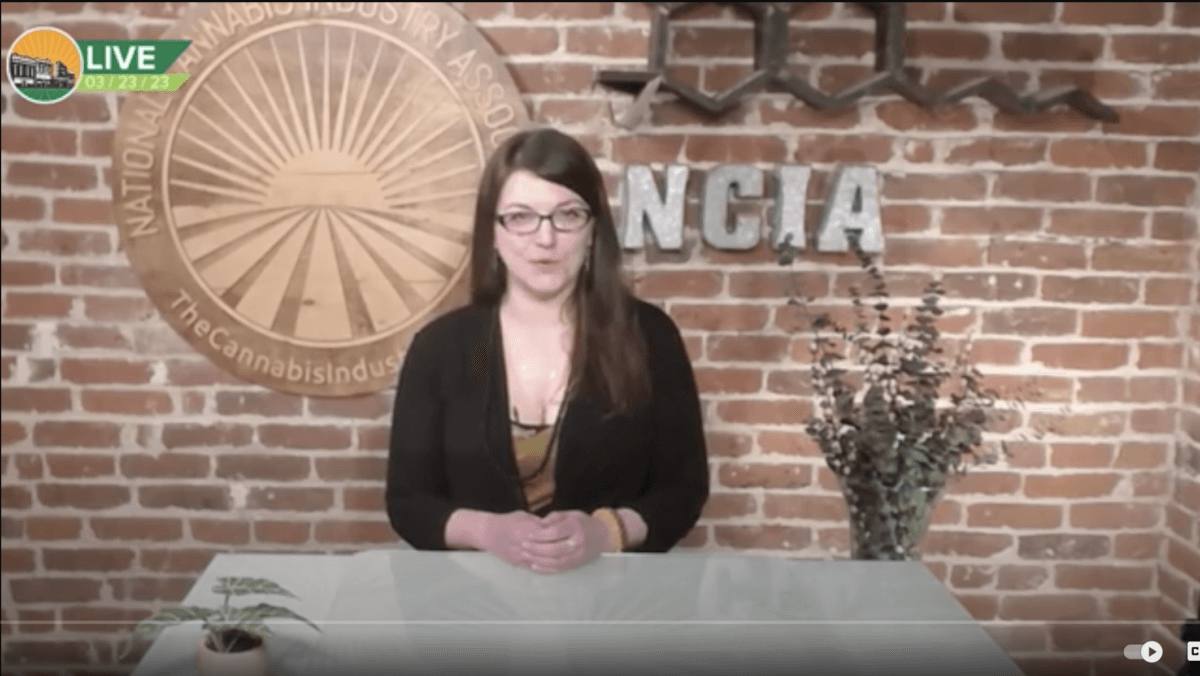
Join NCIA Director of Communication Bethany Moore for an update on what’s going on with NCIA and our members. This week we look back on our Colorado Caucus, joined by video by Governor Jared Polis, and look forward to the remainder of our city events coast-to-coast leading up to Lobby Days in May.
And They’re Off! 118th Congress Begins with Eyes on the House
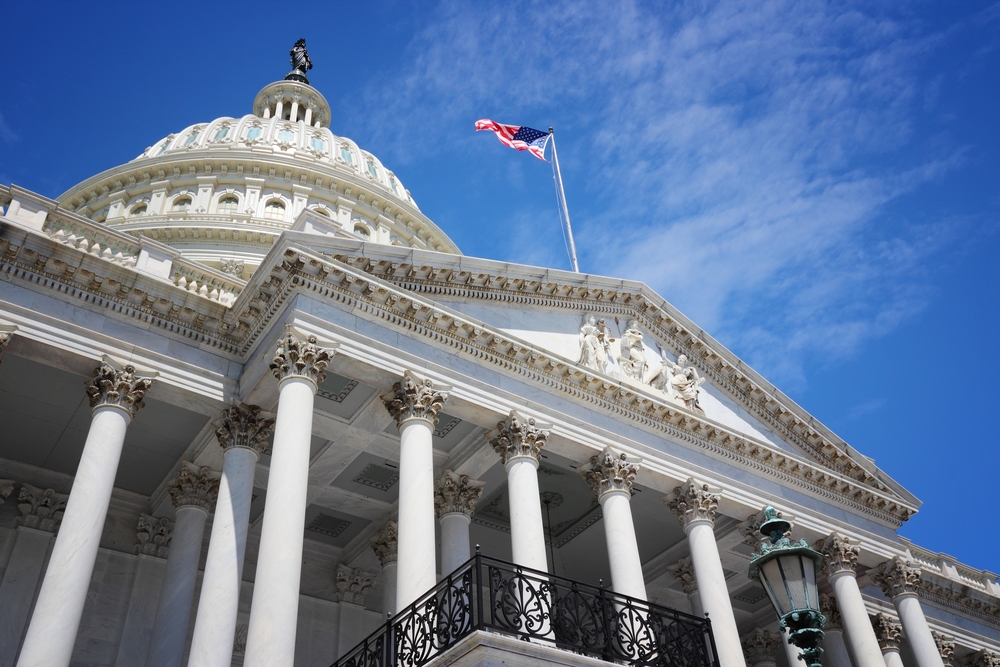
Photo By CannabisCamera.com
by Michelle Rutter Friberg, NCIA’s Deputy Director of Government Relations
After November’s midterms, a runoff Senate election in Georgia, and last week’s speakership drama, the 118th Congress has finally begun.
Last year was an historic year: from the enactment of the first federal standalone cannabis reform since the adoption of the Controlled Substances Act of 1971 to President Biden’s marijuana reform announcement in the fall. In addition, three states (Rhode Island, Maryland, and Missouri) took action to legalize adult-use marijuana and regulate cannabis. Nearly half of the U.S. population – more than 155 million people – now live in jurisdictions with some form of legalized adult-use marijuana.
At the federal level, members of Congress introduced a wealth of policies aimed to end the antiquated federal cannabis prohibition and address the harm caused by the discrepancies between state and federal laws and regulations. This tremendous bipartisan momentum for cannabis reform sets the stage for a productive 2023 and 118th Congress.
However, as you may have seen or heard on the news, the 118th Congress was off to a slow (to say the least) start as arguments over the Speaker of the House position escalated over the course of the week. After days of negotiations and a multitude of concessions, Rep. Kevin McCarthy (R-CA) eked out a victory in the wee hours of Saturday morning to become Speaker. The contentious and historic fight for the Speakership largely confirmed expectations for this Congress: With House Republicans’ narrow four-seat majority, governing is going to be difficult and messy. This will undoubtedly make cannabis reform a challenge, but one that NCIA is ready to rise to.
The House returned Monday for week two of the 118th Congress, while the Senate remains in recess through January 23, with a few pro forma sessions scheduled over the coming weeks. House Republicans will now move to finalize organizing for the new Congress: the Steering Committee have already begun meeting to determine chairmanships for a number of committees including Ways and Means and Small Business. Once these chairmanships are resolved, the Steering Committee will turn to populating committees with new members – most committees have several openings – and may begin to populate some this week. The exact numbers will be determined by the final ratios between Republicans and Democrats, but we’re expecting a mirror image of the ratios used in the 117th Congress.
All of these decisions will have a substantial impact on cannabis reform, as Leadership and committee chairs determine what legislation is considered. While Republicans’ slim majority in the House brings a number of challenges, it will also undoubtedly provide a number of opportunities for reform and negotiation.
by Michelle Rutter Friberg, NCIA’s Deputy Director of Government Relations
Photo By CannabisCamera.com
You may have seen this week that there were a number of Senate confirmation hearings, and cannabis was a topic of discussion in some! But what are confirmation hearings, and what happened in them this week?
In Article II, Section 2, Clause 2 of the Constitution is the Appointments Clause, which empowers the President to nominate and, with the advice and consent of the Senate, appoint public officials. In layman’s terms, advice and consent essentially means confirmation.
As of publication, cannabis was brought up before two nominees this week: Attorney General nominee Merrick Garland, and Deputy Secretary of Treasury nominee, Adewale Adeyamo.
On Monday, President Biden’s nominee for Attorney General, Merrick Garland, appeared before the Senate Judiciary Committee. Before this, Garland’s position on cannabis was relatively unknown — he had ruled in a 2012 federal lawsuit case over DEA’s denial of a marijuana rescheduling petition and was one of three judges in the U.S. Court of Appeals for the District of Columbia Circuit panel that upheld the denial.
However, Garland’s position on cannabis became more clear this week — at least in how he views the Department of Justice’s role in enforcement and arrest disparities. While before the Senate Judiciary Committee on Monday, Garland was asked about marijuana arrest disparities by notorious cannabis champion Sen. Cory Booker (D-NJ). Sen. Booker asked:
“One big thing driving arrests in our country is marijuana arrests. We had in 2019 more marijuana arrests for possession then all violent crime arrests combined. When you break out that data and segregate along racial lines it’s shocking that an African-American has no difference in usage or selling than someone who is white in America, but their likelihood of being arrested for doing things that two of the last four presidents admitted to doing is three to four times higher than somebody white. Is that evidence that within the system there is implicit racial bias, yes or no?”
Garland responded: “It is definitely evidence of disparate treatment within the system, which I think does arise out of implicit bias. Unconscious bias may be, sometimes conscious bias.”
As Sen. Booker continued to question Garland about bias in the criminal justice system, Garland proactively brought marijuana back up, saying:
“The marijuana example is a perfect example. Here is a nonviolent crime that does not require us to incarcerate people and we are incarcerating at significantly different rates in different communities. That is wrong and it’s the kind of problem that will then follow a person for the rest of their lives. It will make it impossible to get for — to get a job and will lead to a downward economic spiral.”
Garland later continued:
“We can focus our attention on violent crimes and other crimes that put great danger in our society and not allocate our resources to something like marijuana possession. We can look at our charging policies and stop charging the highest possible offense with the highest possible sentence.”
But that wasn’t the only time the likely-soon-to-be Attorney General talked about cannabis. Freshman Senator Jon Ossoff (D-GA) asked Garland about equal justice, and highlighted the fact that “Black Americans continue to endure profiling, harassment, brutality, discrimination in policing and prosecution, sentencing, and incarceration.” While responding as to how his Justice Department would combat this, Garland said:
“One important way I think is to focus on the crimes that really matter, to bring our charging and arresting on violent crime and others that deeply affect our society. And not have such an overemphasis on marijuana possession, for example, which has disproportionately affected communities of color and damaged them far after the original arrest because of the inability to get jobs.”
During the “lightning round” of questions, Sen. Booker brought cannabis up again — this time, about enforcement and the now-rescinded Cole Memo. The Senator asked Garland, “Do you think the guidance in the Cole Memorandum should be reinstated, that the Justice Department respects states’ decisions?” Garland responded:
“I do remember it and I have read it. This is the question or prioritization about resources and prosecutorial discretion. It does not seem to me a useful use of limited resources that we have to be pursuing prosecutions in states that have legalized and are regulating the use of marijuana either medically or otherwise. I don’t think that is a useful use.”
This was, without a doubt, the most “cannabis positive” response from an Attorney General nominee in history! But the Judiciary Committee wasn’t the only one curious about cannabis this week!
Next, we move to the Senate Finance Committee, where Deputy Secretary of the Treasury nominee Adewale Adeyamo was being questioned Tuesday. During this hearing, Sen. Catherine Cortez Masto (D-NV) asked, “Do you believe Treasury should seek to update FinCEN’s 2014 guidance on the Bank Secrecy Act’s expectations for financial institutions that provide services to cannabis related industries, and if so, what changes do you recommend?” Adeyamo responded:
“Senator, I look forward, if confirmed, to talking to my colleagues at Treasury about this important issue and thinking through what changes may be needed and doing this in a way that’s consistent with the agency and the President’s guidance. In doing that I look forward to consulting with you and members of this Committee on our path forward.”
To be blunt, this is a really big deal! These questions show that the upper chamber of Congress is taking cannabis policy seriously, and expects the topic to be taken up by various agencies over the next four years. You can continue to count on the NCIA team to keep you updated, advocate on your behalf, and work with Congress and the Biden Administration to create a flourishing, responsible, diverse, and equitable cannabis industry.
Video: NCIA Today – Special Episode with NCIA’s Michael Correia On The Historic MORE Act House Vote
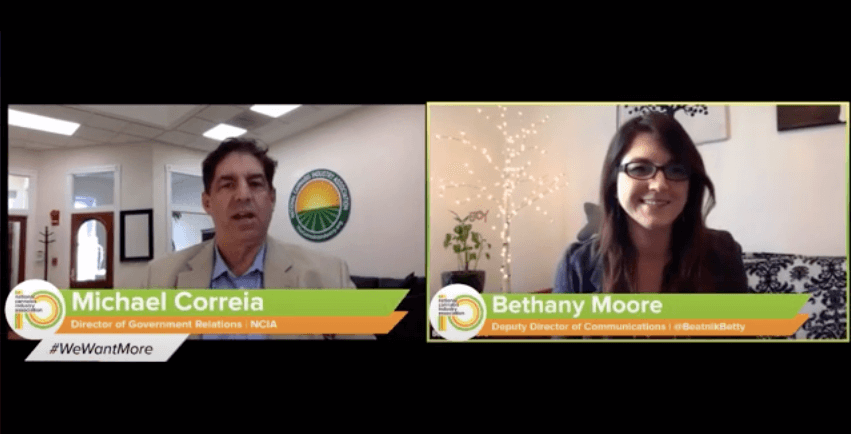
Join NCIA Deputy Director of Communications Bethany Moore and our Government Relations Director Mike Correia for a quick discussion about last week’s historic passage of the MORE Act.
On Friday, December 4, the House of Representatives made history by voting to approve H.R. 3884, the Marijuana Opportunity, Reinvestment, and Expungement (MORE) Act.
The MORE Act would remove marijuana from the federal Controlled Substances Act and work to repair the social and personal harms caused by federal marijuana enforcement. This is the first time since marijuana was made federally illegal that either chamber of Congress has held a floor vote on- or approved- a bill to make the substance legal again.
The final vote count of 228-164 fell mostly along party lines, with five Republicans crossing the aisle to support, and six Democrats voting to oppose.
This monumental victory shows just how far Congress has come over the years. Although this vote more closely aligns the House of Representatives with the majority of voters who overwhelmingly support cannabis legalization, the Senate is a different story.
Senate Race Runoffs in the Peach State
By Michelle Rutter Friberg, NCIA’s Deputy Director of Government Relations
As you’ve probably heard by now, which party controls the Senate won’t be known until January 5 — but those results could quite literally determine if marijuana will become federally legal over the next few years.
In Georgia, no candidate can advance through a primary or a general election system without first earning more than 50% of the votes. If no one does, the top two vote getters advance to a runoff election, ensuring that one will earn the majority of votes cast.
This year, the state’s two Senate races — one regular, the other a special election to fill the remainder of a retired senator’s seat — have gone to a runoff. The first will be between incumbent Sen. David Perdue (R) and Democrat Jon Ossoff; the latter will be between Republican Sen. Kelly Loeffler and Democrat Rev. Raphael Warnock. If Democrats win both seats, the Senate will be tied 50-50, and Vice President-elect Kamala Harris would be the tie breaking vote.
It can’t be overstated that the Democrats have an uphill (but not impossible!) battle ahead. In November, Sen. Perdue garnered 86,000 more votes than Ossoff, while Warnock benefited from the fact that two Republicans — both Sen. Loeffler and Rep. Doug Collins — were on the ballot in his race, splitting the party’s votes.
And of course, it’s 2020, so I would be remiss not to mention the pandemic! The runoff is taking place in an off-election year in (what will likely still be) the middle of a serious surge of COVID-19 cases. On top of that, Republicans historically have a stronger track record of turning out in runoffs in the state.
Despite all of that, Democrats are working hard to turn out the vote and organize early. In addition to relying heavily on both first-time voters and Black voters, Democrats are also hopeful that young voters will be the key to winning the runoff in January. Ossoff recently said:
“There are 23,000 young people here in Georgia who will become eligible to vote just between the November election and this January 5 runoff, and a decade of organizing, much of this work led by Stacey Abrams, has put the wind in our sails here in Georgia. What we’re feeling for the first time in four years is hope.”
As I said before, which party controls the Senate could quite literally be the difference between whether or not cannabis could become federally legal in the next one to two years. Senate Minority Leader Chuck Schumer (D-NY) was interviewed in October and said:
“I’m a big fighter for racial justice, and the marijuana laws have been one of the biggest examples of racial injustice, and so to change them makes sense. And that fits in with all of the movement now to bring equality in the policing, in economics, and in everything else. Our bill is, in a certain sense, at the nexus of racial justice, individual freedom and states’ rights.”
Schumer was referencing the bill he introduced, the Marijuana Freedom and Opportunity Act, which would remove cannabis from the Controlled Substances Act, allowing states to set their own policies. It also includes provisions to help funding to cannabis businesses owned by women and people of color through the Small Business Administration; funding studies on traffic safety, impairment detection technology, and health effects of cannabis; restricting advertising that could appeal to children; and setting aside $100 million over five years to help states develop streamlined procedures for expunging or sealing prior cannabis convictions.
Time is of the essence. Voters must be registered by December 7 in order to participate in the runoff election. If you’re in Georgia, or know anyone who is a resident, please check out the Cannabis Voter Project to learn more and make sure you’re ready to vote. If you can, consider making a donation to the Ossoff campaign or the Warnock campaign. The future of cannabis legalization in this country depends on it!
This site uses cookies. By using this site or closing this notice, you agree to the use of cookies and our privacy policy.