Navigating the Cannabis Landscape: Federal Cannabis Reform Outlook for 2024
A month into 2024, Congress is (still) grappling with a number of urgent, must-pass bills related to issues like border security, aid for Ukraine and Israel, and the federal budget. At a time when the government seems more dysfunctional than ever, it’s important to remember that this chaos results in cannabis issues (and unfortunately, many others) having difficulty in gaining traction in Congress. As a result, cannabis legislation and priorities have been slow moving so far this year- but I feel confident that there’s light at the end of the tunnel!
SAFE Banking
To recap: the ever-elusive SAFE Banking Act was reintroduced in 2023 by Senators Jeff Merkley (D-OR) and Steve Daines (R-MT) alongside Representatives Earl Blumenauer (D-OR) and Dave Joyce (R-OH). Soon after, the Senate Committee on Banking, Housing, and Urban Affairs held a hearing titled “Examining Cannabis Banking Challenges of Small Businesses and Workers” discussing both the bill and the topic of cannabis banking broadly.
As the momentum for SAFE Banking increased, so did some Senators’ concerns– primarily surrounding a provision that would bar federal banking regulators from taking discriminatory enforcement action against any industry.
As a result, an updated version of the bill called the SAFER (Secure and Fair Enforcement Regulation) Banking Act was introduced, marked up by the Committee, and passed out of Committee by a vote of 16-14 in late September 2023.
That brings us to 2024. Although SAFER has not been scheduled for a floor vote yet, NCIA is cautiously optimistic on its chances this year — whether that be as a standalone bill or attached to another larger financial services related package. That being said, the bill will undoubtedly face an uphill battle no matter how it arrives at the GOP-controlled House of Representatives.
Other Congressional News
Outside of SAFE(R) Banking, there has been some additional congressional cannabis news in 2024 including a Senate letter urging descheduling, a bicameral letter regarding Chinese-related illicit grow operations, and a new Congressional Research Service (CRS) report on the impact of moving cannabis from Schedule I to III in the federal Controlled Substances Act.
In late January, Senators Elizabeth Warren (D-MA) and John Fetterman (D-PA), led nine of their Democratic colleagues (including Senate Majority Leader Chuck Schumer [D-NY]), in sending a letter to Attorney General Merrick Garland and Drug Enforcement (DEA) Administrator Anne Milgram. The letter urged Milgram and Garland to remove marijuana from Schedule I of the Controlled Substances Act entirely, commonly known as descheduling.
Then, just days ago, Senators Joni Ernst (R-IA) and Angus King (I-ME) alongside Congressmen Pete Sessions (R-TX), Jared Golden (D-ME), and David Valadao (R-CA) led 48 of their colleagues in calling on Attorney General Merrick Garland to prevent any national security risk and end any illicit human trafficking connected to Chinese-linked marijuana farms in the United States.
In the bipartisan, bicameral letter, the lawmakers pointed out that Chinese nationals (some with potential ties to the Chinese Communist Party), are operating marijuana farms across the country and even potentially engaging in human and drug trafficking in conjunction with these operations. The lawmakers asked the Department of Justice for a briefing on the topic by the end of the month and posed several specific questions for the agency.
In mid-January, the Congressional Research Service (CRS) released a new report titled “Legal Consequences of Rescheduling Marijuana” that primarily focused on “Legal Consequences If Marijuana Moved to Schedule III” and considerations for Congress. CRS works for members of Congress and their committees and staff on a confidential, nonpartisan basis and is highly regarded here in Washington, D.C.
Biden Administration
In 2022, the Biden Administration announced that it would ask the Secretary of Health and Human Services (HHS) and the Attorney General to initiate the administrative process to review how marijuana is scheduled under federal law.
As a result, in August 2023, news broke that the Department of Health and Human Services (HHS) recommended to the Drug Enforcement Administration (DEA) that cannabis be rescheduled and placed in Schedule III, meaning that it has moderate to low abuse potential, a currently accepted medical use, and a low potential for psychological dependence. Since then, the DEA has been conducting their review of where marijuana should be placed in the Controlled Substances Act, which will then be followed by a public comment period.
To be clear, NCIA supports ending the criminalization of our industry by removing cannabis (including THC) from the federal Controlled Substances Act altogether so that our businesses are treated like all other lawful American businesses. That being said, it’s likely that the DEA will follow the HHS recommendations and choose to place marijuana in Schedule III.
While NCIA continues to draft our response to the inevitable announcement — whatever it may be — we also want to hear from our members about their views on this critical issue. If you are a member of NCIA, check your inbox for a link to our online survey in order to make your voice heard. If your business isn’t yet a member but you want to get off the sidelines of the cannabis reform movement, join today! NCIA is proudly the only organization focused on representing independent businesses in our nation’s capital and the work we do moving policy reforms forward is only possible because of the hundreds of businesses that make up our membership.
It goes without saying that 2024 is shaping up to be a big one for federal cannabis policy reform. Stay connected and engaged by attending one of our upcoming Stakeholder Summits where you can engage and learn from state officials, federal policymakers, and even me!
If you really want to play a bigger role in advancing cannabis policy reform, we hope you’ll also join us in Washington, D.C. for our 12th Annual Cannabis Industry Lobby Days this May. See you there!
Breaking Down the Recent Cannabis Rescheduling Recommendation
For more than fifty years, the federal government has maintained that cannabis is a Schedule I drug, meaning that it has a high potential for abuse and no accepted medical value. That changed last week (somewhat) when the Department of Health and Human Services (HHS) recommended to the Drug Enforcement Administration (DEA) that cannabis be placed in Schedule III, meaning that it has moderate to low abuse potential, a currently accepted medical use, and a low potential for psychological dependence.
Why now?
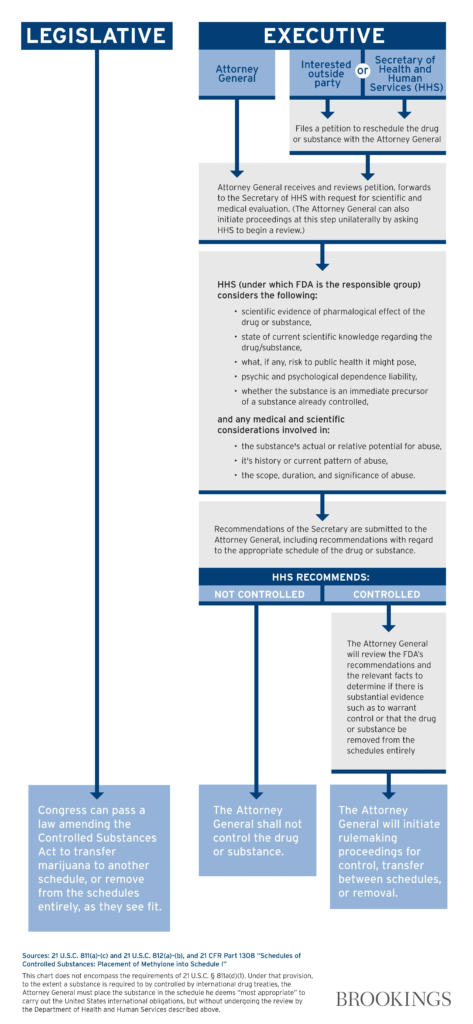
In October 2022, the Biden Administration announced that it would ask the Secretary of HHS and the Attorney General to initiate the administrative process to review expeditiously how marijuana is scheduled under federal law. As the Brookings Institute outlined years ago, the Executive process for rescheduling is much more complex than the Legislative path.
It’s no secret that the presidential election is barely more than a year away, and the President seems to be looking to make good on his campaign promise to reform the nation’s marijuana laws.
What does this mean?
First off, it’s critical to note that HHS’ recommendation to DEA is just that: a recommendation. It is non-binding. The DEA may come to the same conclusion that HHS did, but is not required to.
If cannabis is moved to Schedule III of the Controlled Substances Act, one positive outcome would be that 280E would no longer apply to plant-touching businesses, removing an incredibly punitive and debilitating provision in the tax code.
According to NCIA’s board chair emeritus, Khurshid Khoja, Esq., “…it’s important to remember that rescheduling would not apply the federal Food Drug and Cosmetic Act (FDCA) to marijuana for the first time—it applies right now, and like the federal Controlled Substances Act (CSA), would continue to apply after rescheduling. But absent any statutory authority permitting FDA to do otherwise, the FDCA would continue to apply after descheduling too, just as it does to hemp products.”
Others claim that the shift to Schedule III would have minimal impact on businesses and individuals. Here at NCIA, we’re cautiously optimistic but recognize that moving cannabis to schedule III could have some limited benefit but does nothing to align federal law with the 38 U.S. states which have already effectively regulated cannabis for medical or adult use.
What now?
Now that HHS has made their recommendation, the DEA will begin its scheduling review process.
Many are divided about what a move to Schedule III would actually look like. Yes, there would be the elimination of 280E, but what about enforcement priorities? Interstate commerce? Criminal penalties? There are so many unknowns.
NCIA has previously produced a common sense, workable roadmap for that federal comprehensive reform and provided detailed feedback on legislative efforts. It is time for Congress to follow the will of the American people. Don’t get me wrong, there’s no doubt that this recommendation is a step in the right direction and is long overdue. But we can’t lose sight of the ultimate goal: removing cannabis from the Controlled Substances Act entirely.
Have questions?
Join NCIA on September 14 at 1 pm ET for an engaging webinar where we will unpack all your questions! Register today and don’t miss your chance to hear more about what this means for the cannabis industry and your business.
Senate to Consider SAFE Banking as the White House “Cleans” House
by Morgan Fox, NCIA’s Director of Media Relations
It has been quite a busy month in Washington when it comes to cannabis, but two of the more recent developments have garnered quite a bit of attention in the last couple of weeks and deserve a closer look.
First, a bipartisan group of lawmakers reintroduced the Secure and Fair Enforcement (SAFE) Banking Act in the U.S. Senate. This legislation, which was introduced by Sens. Jeff Merkley (D-OR) and Steve Daines (R-MT) along with 27 original cosponsors (up to 30 as of this writing), would protect banks and other financial institutions from federal prosecution simply for providing services to cannabis businesses that are operating in compliance with state laws.
This legislation was reintroduced in the House earlier this month to expected fanfare, understandable given that it has already passed in that chamber and continues to enjoy overwhelming support. In fact, it was the first-ever standalone cannabis policy reform legislation to ever be brought to a floor vote – and pass – in that chamber, and was approved twice more in pandemic relief legislation that unfortunately was not approved by the Senate.
This last fact has caused advocates to more carefully scrutinize the prospects of Senate passage. After this bill flew through the House late in 2019, its movement through the Senate quickly came into question after the Senate Banking Committee voiced concerns about the bill. There was also not much indication of priority by Senate leadership to call cannabis bills for committee hearings, which became even more stark with the onset of COVID-19 when almost every other issue took an immediate back seat. Concerns about Senate support were further compounded by the unfair and politically motivated attacks by some Republicans against Democrats for their inclusion of SAFE Banking language in coronavirus relief packages.
However, a new year brings new opportunities. With the contentious 2020 elections in the rearview mirror, and a renewed focus on economic recovery, supporting small businesses, and public safety, we need to use a different calculus when examining the chances of SAFE Banking in the Senate, and that is giving us plenty of reasons to be hopeful.
Let’s look at the numbers: there are currently 36 states with comprehensive medical or adult-use cannabis laws and either existing or soon-to-be-implemented regulated cannabis markets, all of which would directly benefit from this legislation. That means there are 72 senators whose constituents are being put in harm’s way or face limited business growth opportunities thanks to lack of access to financial services in the cannabis industry, including 25 Republicans (six of whom are already sponsors plus one GOP member from a non-regulated state). With just a few more Republican senators on board, this bill would theoretically be able to beat a filibuster, provided there was unanimous Democratic support.
Does this kind of representation guarantee all 72 of those lawmakers will support cannabis banking reform? Of course not. Legislators on both sides of the aisle frequently do not support legislation that is in their constituents’ best interests. However, it does greatly increase the chances of passage and provides additional incentives for hesitant senators.
In addition, Republican lawmakers have been more openly supportive of incremental reforms like the SAFE Banking Act than they have been of more comprehensive descheduling legislation that NCIA is working to pass, such as the MORE Act. In fact, some observers are confident that there was enough bipartisan support in the Senate to pass SAFE Banking in the last Congress, were it not for the pandemic and the obstruction of cannabis policy reforms by then-Senate Majority Leader Mitch McConnell.
The new landscape in the upper chamber has given us a lot of reasons to be optimistic about SAFE Banking this year. Democratic control of the Senate, tie-breaker voting power in the hands of pro-legalization Vice President Kamala Harris, the prioritization of cannabis policy reform by Senate Majority Leader Chuck Schumer and other members of Senate leadership, more Republican original cosponsors, and the increasing support of voters in conservative and swing states have given this legislation the best chances of being approved in the Senate since its first introduction.
The other federal cannabis story making headlines was the suspension, reassignment, and dismissal of a number of employees in the White House that was supposedly based at least in part on past cannabis consumption, despite recent guidance from theOffice of Personnel Management which advised federal employers not to view past cannabis use as an automatic disqualifier for otherwise qualified job candidates. While the White House was quick to defend itself and point to other factors involved in individual cases, this move clearly sent the wrong message to employers across the country and called into question the Biden Administration’s stated support for at least marginal cannabis reforms.
Does this mean that Pres. Biden will veto comprehensive cannabis policy reform or other related legislation when it reaches his desk? Extremely doubtful. However, this unfortunate incident is indicative of the continuing stigma that cannabis consumers face, and an ongoing disconnect between public opinion, policy, and leadership.
This isn’t just a government employment issue, either; it is alive and (un)well in the private sector. Even in states where cannabis is legal for adults, many employers continue to enact strict anti-cannabis policies, limit their hiring pools, and punish qualified workers for off-duty cannabis consumption. This despite ample evidence that cannabis is not associated with decreases in productivity or increases in workplace injuries.
There has been some progress in recent years on this front. Recent court cases have finally begun siding with medical cannabis patients who were wrongfully terminated for using the medicine that works best for them, after years of ruling in favor of employers. More and more states are instituting employee protections, at least for patients. Yet as more states consider “banning the box” — a policy which prevents prospective employers from asking about past cannabis convictions – or institute laws against pre-employment drug screening as a condition of job offers, discrimination against cannabis consumers and people who work in the industry remains a major problem of not only policy, but culture. Ultimately, employers will need to get over the stigma and false assumptions they have about cannabis and develop better internal policies to match the growing reality of legal and accepted cannabis in the United States.
One thing is certain: as we get closer to ending prohibition, the complexity and nuance of this issue are sure to grow. Stay tuned for more updates as reform efforts continue to heat up in our nation’s capital!
Senate Confirmation Hearings: Cannabis Edition
by Michelle Rutter Friberg, NCIA’s Deputy Director of Government Relations
Photo By CannabisCamera.com
You may have seen this week that there were a number of Senate confirmation hearings, and cannabis was a topic of discussion in some! But what are confirmation hearings, and what happened in them this week?
In Article II, Section 2, Clause 2 of the Constitution is the Appointments Clause, which empowers the President to nominate and, with the advice and consent of the Senate, appoint public officials. In layman’s terms, advice and consent essentially means confirmation.
As of publication, cannabis was brought up before two nominees this week: Attorney General nominee Merrick Garland, and Deputy Secretary of Treasury nominee, Adewale Adeyamo.
On Monday, President Biden’s nominee for Attorney General, Merrick Garland, appeared before the Senate Judiciary Committee. Before this, Garland’s position on cannabis was relatively unknown — he had ruled in a 2012 federal lawsuit case over DEA’s denial of a marijuana rescheduling petition and was one of three judges in the U.S. Court of Appeals for the District of Columbia Circuit panel that upheld the denial.
However, Garland’s position on cannabis became more clear this week — at least in how he views the Department of Justice’s role in enforcement and arrest disparities. While before the Senate Judiciary Committee on Monday, Garland was asked about marijuana arrest disparities by notorious cannabis champion Sen. Cory Booker (D-NJ). Sen. Booker asked:
“One big thing driving arrests in our country is marijuana arrests. We had in 2019 more marijuana arrests for possession then all violent crime arrests combined. When you break out that data and segregate along racial lines it’s shocking that an African-American has no difference in usage or selling than someone who is white in America, but their likelihood of being arrested for doing things that two of the last four presidents admitted to doing is three to four times higher than somebody white. Is that evidence that within the system there is implicit racial bias, yes or no?”
Garland responded: “It is definitely evidence of disparate treatment within the system, which I think does arise out of implicit bias. Unconscious bias may be, sometimes conscious bias.”
As Sen. Booker continued to question Garland about bias in the criminal justice system, Garland proactively brought marijuana back up, saying:
“The marijuana example is a perfect example. Here is a nonviolent crime that does not require us to incarcerate people and we are incarcerating at significantly different rates in different communities. That is wrong and it’s the kind of problem that will then follow a person for the rest of their lives. It will make it impossible to get for — to get a job and will lead to a downward economic spiral.”
Garland later continued:
“We can focus our attention on violent crimes and other crimes that put great danger in our society and not allocate our resources to something like marijuana possession. We can look at our charging policies and stop charging the highest possible offense with the highest possible sentence.”
But that wasn’t the only time the likely-soon-to-be Attorney General talked about cannabis. Freshman Senator Jon Ossoff (D-GA) asked Garland about equal justice, and highlighted the fact that “Black Americans continue to endure profiling, harassment, brutality, discrimination in policing and prosecution, sentencing, and incarceration.” While responding as to how his Justice Department would combat this, Garland said:
“One important way I think is to focus on the crimes that really matter, to bring our charging and arresting on violent crime and others that deeply affect our society. And not have such an overemphasis on marijuana possession, for example, which has disproportionately affected communities of color and damaged them far after the original arrest because of the inability to get jobs.”
During the “lightning round” of questions, Sen. Booker brought cannabis up again — this time, about enforcement and the now-rescinded Cole Memo. The Senator asked Garland, “Do you think the guidance in the Cole Memorandum should be reinstated, that the Justice Department respects states’ decisions?” Garland responded:
“I do remember it and I have read it. This is the question or prioritization about resources and prosecutorial discretion. It does not seem to me a useful use of limited resources that we have to be pursuing prosecutions in states that have legalized and are regulating the use of marijuana either medically or otherwise. I don’t think that is a useful use.”
This was, without a doubt, the most “cannabis positive” response from an Attorney General nominee in history! But the Judiciary Committee wasn’t the only one curious about cannabis this week!
Next, we move to the Senate Finance Committee, where Deputy Secretary of the Treasury nominee Adewale Adeyamo was being questioned Tuesday. During this hearing, Sen. Catherine Cortez Masto (D-NV) asked, “Do you believe Treasury should seek to update FinCEN’s 2014 guidance on the Bank Secrecy Act’s expectations for financial institutions that provide services to cannabis related industries, and if so, what changes do you recommend?” Adeyamo responded:
“Senator, I look forward, if confirmed, to talking to my colleagues at Treasury about this important issue and thinking through what changes may be needed and doing this in a way that’s consistent with the agency and the President’s guidance. In doing that I look forward to consulting with you and members of this Committee on our path forward.”
To be blunt, this is a really big deal! These questions show that the upper chamber of Congress is taking cannabis policy seriously, and expects the topic to be taken up by various agencies over the next four years. You can continue to count on the NCIA team to keep you updated, advocate on your behalf, and work with Congress and the Biden Administration to create a flourishing, responsible, diverse, and equitable cannabis industry.
What To Watch: The Executive Branch Edition
by Michelle Rutter Friberg, NCIA’s Deputy Director of Government Relations
Photo By CannabisCamera.com
Last week, I wrote about what to expect during the 117th Congress. This week, I want to highlight the incoming Biden Administration, and the various agencies and Cabinet officials that could affect cannabis policy going forward over the next four years.
The tradition of the Cabinet dates back to the beginnings of the Presidency itself. Established in Article II, Section 2, of the Constitution, the Cabinet’s role is to advise the President on any subject he may require relating to the duties of each member’s respective office. The Cabinet includes the Vice President and the heads of 15 executive departments — the Secretaries of Agriculture, Commerce, Defense, Education, Energy, Health and Human Services, Homeland Security, Housing and Urban Development, Interior, Labor, State, Transportation, Treasury, and Veterans Affairs, as well as the Attorney General.
Here’s my breakdown of the top three agencies I’ll be watching:
Treasury Department
In February 2014, the Treasury Department issued guidance to clarify Bank Secrecy Act (BSA) expectations for financial institutions seeking to provide services to marijuana-related businesses. However, over the last seven years, the policy landscape surrounding cannabis has changed dramatically — at the time this guidance was issued, only Colorado and Washington had legalized adult-use cannabis. Now, there are 15 states plus the District of Columbia that allow for the adult-use of cannabis and 36 states with medical cannabis laws.
Incoming President Biden has nominated former Federal Reserve Chairwoman Janet Yellen for the post of Treasury Secretary. Though her position on cannabis is relatively unknown, it’s definitely possible that this guidance could be updated or expanded. Additionally, if the SAFE Banking Act is passed by Congress, the Treasury Department would then be in charge of ensuring that the implementation of that legislation goes smoothly.
Department of Justice (DoJ)
Here’s the big one everyone in cannabis will be watching: the Department of Justice. President Biden has selected Merrick Garland as his nominee for Attorney General, and everyone seems to be wondering the same thing: could there be a new “Garland Memo” ala the Cole Memo?
If you’ll remember, during the Obama Administration in 2013, the Department of Justice issued the Cole Memo, which outlined enforcement priorities for the Department as states were beginning to set their own cannabis policies. Under the Trump Administration, that memo was rescinded in January 2018 by then-Attorney General, Jeff Sessions.
It’s certainly possible that a Garland DoJ could unveil a new cannabis-related memo. Outside of enforcement priorities, the Department could also direct other agencies to reevaluate their policies around cannabis and housing, immigration, and the armed forces.
Small Business Administration (SBA)
In 2018, the Small Business Administration (SBA) came out with a notice to all employees and lenders that updated their policies surrounding marijuana businesses. They stated, “Because federal law prohibits the distribution and sale of marijuana, financial transactions involving a marijuana-related business would generally involve funds derived from illegal activity. Therefore, businesses that derive revenue from marijuana-related activities or that support the end-use of marijuana may be ineligible for SBA financial assistance.” They then went on to outline the ineligibility of direct and indirect marijuana businesses, as well as hemp-related businesses (this was pre-2018 Farm Bill) to participate in SBA programs.
This could all change under a Biden Administration, however. The President-elect has tapped Isabel Guzman as Small Business Administrator — she currently serves as the director of California’s Office of the Small Business Advocate. While her position on marijuana is unknown, I’m incredibly hopeful for reform under Guzman — her familiarity with small businesses in California means she is surely well informed on the struggles the cannabis industry faces.
These are just a few of the agencies that I’m watching, but there are many others to keep an eye on: the Veterans Administration, Health and Human Services, and FDA, just to name a few. And, as always, NCIA will be working to advance positive reforms within the executive branch at every opportunity.
Make sure you’re subscribed to NCIA’s CannaBusiness Leader to stay up to date on the latest and find me over on NCIA Connect with any questions or feedback!
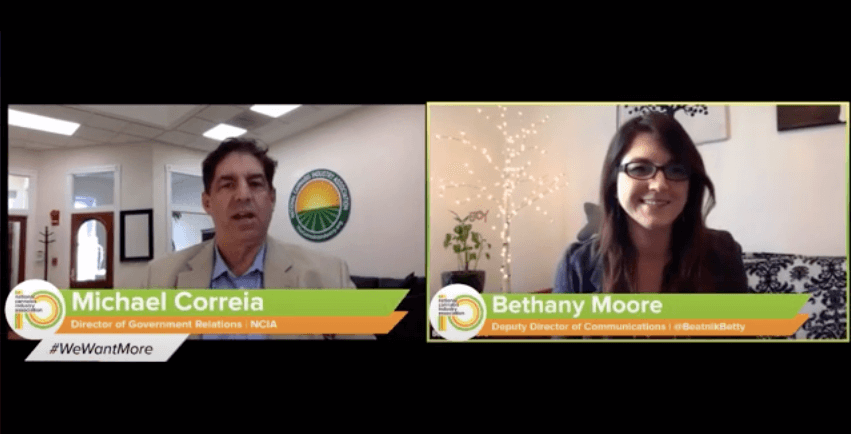
Video: NCIA Today – Special Episode with NCIA’s Michael Correia On The Historic MORE Act House Vote
Join NCIA Deputy Director of Communications Bethany Moore and our Government Relations Director Mike Correia for a quick discussion about last week’s historic passage of the MORE Act.
On Friday, December 4, the House of Representatives made history by voting to approve H.R. 3884, the Marijuana Opportunity, Reinvestment, and Expungement (MORE) Act.
The MORE Act would remove marijuana from the federal Controlled Substances Act and work to repair the social and personal harms caused by federal marijuana enforcement. This is the first time since marijuana was made federally illegal that either chamber of Congress has held a floor vote on- or approved- a bill to make the substance legal again.
The final vote count of 228-164 fell mostly along party lines, with five Republicans crossing the aisle to support, and six Democrats voting to oppose.
This monumental victory shows just how far Congress has come over the years. Although this vote more closely aligns the House of Representatives with the majority of voters who overwhelmingly support cannabis legalization, the Senate is a different story.
 It has been quite a busy month in Washington when it comes to cannabis, but two of the more recent developments have garnered quite a bit of attention in the last couple of weeks and deserve a closer look.

Follow NCIA
Newsletter
Facebook
Twitter
LinkedIn
Instagram
News & Resource Topics
–
This Just In
NCIA Applauds Reintroduction of SAFE Banking Following Lobby Days
Beyond Rescheduling: Inside NCIA’s 14th Annual National Cannabis Industry Lobby Days