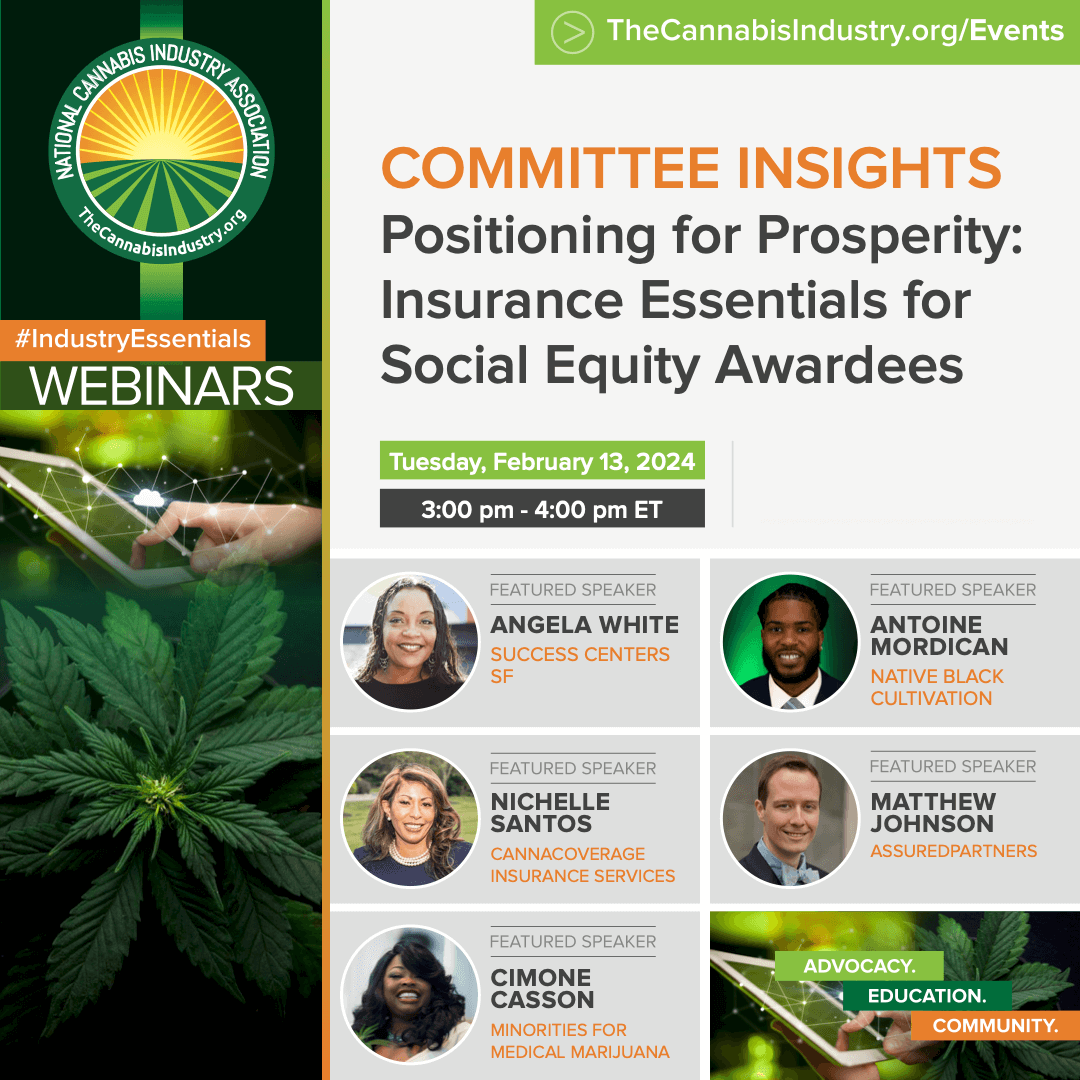
Webinar Release: Positioning for Prosperity – Insurance Essentials for Social Equity Awardees
In our ongoing commitment to providing timely and essential education to the cannabis industry, the National Cannabis Industry Association (NCIA) recently hosted a thought-provoking webinar titled “Positioning for Prosperity: Insurance Essentials for Social Equity Awardees.” In collaboration with NCIA’s Risk Management & Insurance Committee (RMIC), this webinar delved into the critical considerations surrounding insurance needs within the cannabis industry.
Led by a panel of esteemed experts, the discussion navigated the intricate landscape of insurance coverage, specifically tailored to address the needs of social equity awardees. From exploring the advantages and disadvantages of social equity programs to addressing challenges such as information inaccessibility and skyrocketing premiums, the webinar provided valuable insights for businesses seeking to navigate the insurance landscape.
Key topics included:
Defining social equity awardees and discussing their advantages and disadvantages in the industry and market.
Exploring the unique coverage needs for social equity awardees.
Examining real-life examples of what has and hasn’t worked in the cannabis industry regarding insurance coverage.
Understanding the differences between state requirements and optimal coverage for cannabis businesses.
Exploring other financial requirements that help social equity awardees establish sustainable companies.
Throughout the webinar, participants gained insights into how to position their businesses for success in the evolving cannabis landscape while gaining a deeper understanding of the vital role organizations like CANNRA play in progressive policy improvement.
Missed the webinar? Don’t worry! You can watch the full recording on our YouTube channel below.
At NCIA, we remain committed to providing valuable resources, education, and insights to empower businesses and individuals within the cannabis industry. Stay tuned for more updates, webinars, and events designed to support your journey in the cannabis space.
Thank you to our panelists, attendees, and the RMIC for their contributions to making this webinar a success.
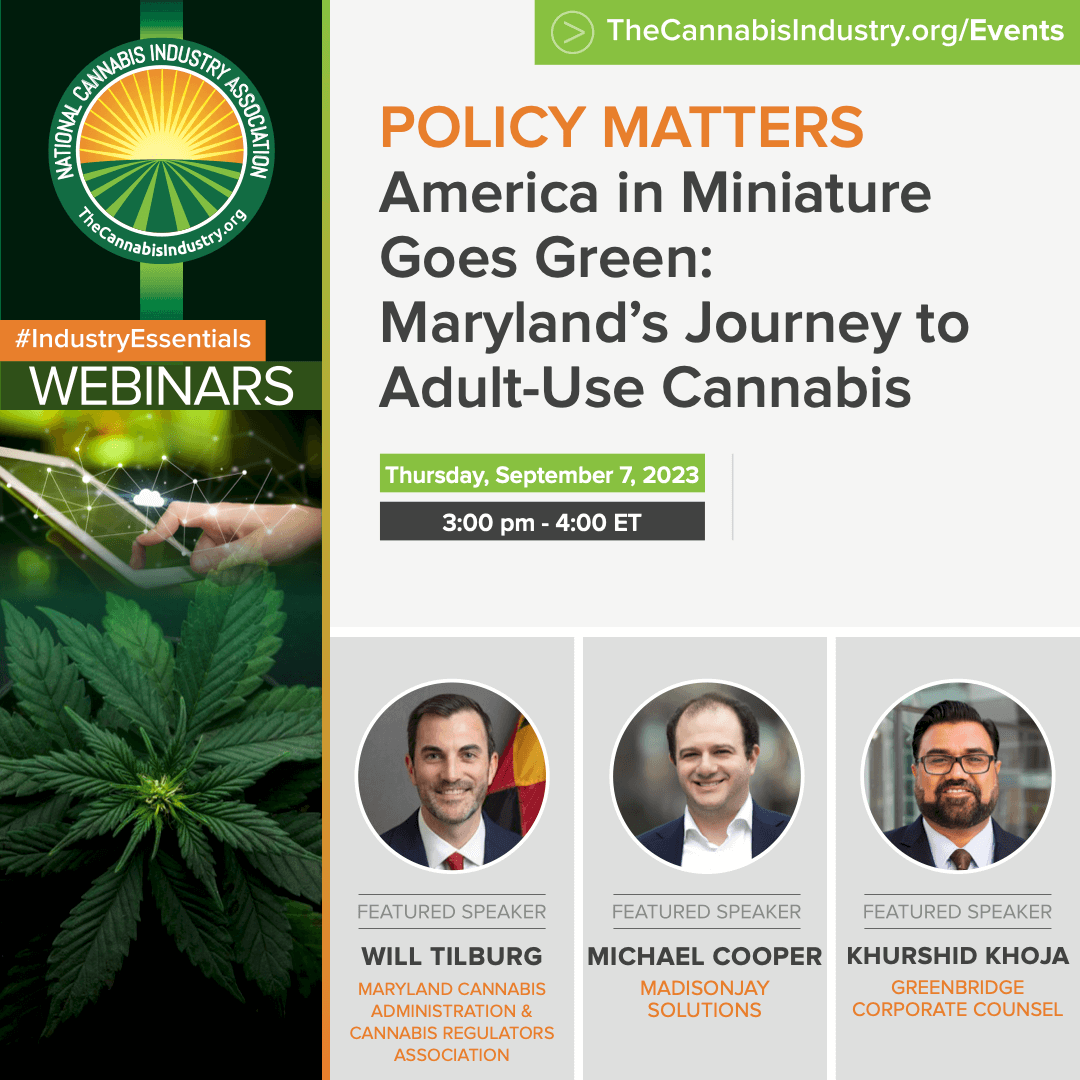
America in Miniature Goes Green: Maryland’s Journey to Adult-Use Cannabis | 9.7.23 | Policy Matters
Introducing “Policy Matters” – an insightful new #IndustryEssentials webinar series dedicated to unraveling the intricate world of regulatory and policy dynamics within the cannabis industry. As the cannabis landscape continues to evolve, staying informed about the latest regulations and policies impacting Main Street cannabis operators is crucial for success. Join us for a series of engaging discussions where regional regulators, industry leaders, legal experts, and policy influencers come together with NCIA leadership to shed light on the most pressing issues facing cannabis professionals.
Are you curious about the intricacies of launching an adult-use cannabis market in record time? In the debut episode of our new Policy Matters webinar series we delved into the strategic aspects of designing a thriving cannabis market while meeting regulatory standards. In this exclusive session, NCIA Policy Co-Chairs Khurshid Khoja and Michael Cooper were joined by Will Tilburg, Director of the Maryland Cannabis Administration and President of the Cannabis Regulators Association, to explore invaluable insights into the objectives that drive cannabis regulators and the pitfalls they strive to avoid. Discover the pressing enforcement challenges that are top of mind for cannabis regulators in 2023 and gain a clear understanding of the evolving landscape.
Don’t miss this opportunity to gain an understanding of how policy matters in the fast-paced cannabis sector. Stay informed, stay ahead, and be part of the conversation that’s shaping the future of cannabis policy. Tune in today and empower yourself with the knowledge to thrive in this dynamic industry.
03:40 – Launching an Adult Use Market in 2023 | Were there lessons from the existing medical market and others around the nation that you identified as important, both success stories and pitfalls to avoid?
07:23 – Launching an Adult Use Market in 2023 | What allowed you to move so efficiently and what lessons would you highlight for industry and regulators in new markets rolling-out in the future?
12:48 – Launching an Adult Use Market in 2023 | What are some priorities you have for the months ahead?
16:55 – Launching an Adult Use Market in 2023 | What advice would you give to future regulators on building relationships within the executive branch to prioritize these issues?
22:20 – Social Equity | Can you talk about reserving the first round of adult-use cannabis licenses exclusively for social equity applicants and other recent milestones or developments working with the Office of Social Equity?
28:56 – Social Equity | How has Maryland worked to make its medical cannabis industry more equitable and ensure these goals aren’t undercut as they have been with similar licensing preferences in other states?
34:04 – Enforcement | How did the state set up its enforcement plan? How do you strike a balance in a new market between a complete absence of enforcement and protecting public health?
37:34 – Enforcement | What are some key enforcement priorities for you looking ahead?
41:40 – CANNRA | Can you talk about the Cannabis Regulators Association (CANNRA) purpose, membership, and goals?
44:39 – CANNRA | What are the priorities or goals for your tenure as CANNRA president?
47:20 – Federal Reform & Regulation | What is Maryland doing to address the hemp-derived cannabinoids issue as it relates to protecting public health and unfair competition with adult-use cannabis licensees?
52:10 – Federal Reform & Regulation | As a state regulator, how did you receive the recent HHS recommendation for rescheduling of cannabis to Schedule III?
56:34 – Federal Reform & Regulation | What is the optimal division of labor between state and federal government if cannabis is completely descheduled in the future?
Behind Closed Doors: NCIA at CANNRA’s June Conference
The discussion about the future of cannabis legalization is ongoing, to say the least. Recently, Cannabis Regulators Association (CANNRA) held a two-day conference in early June to gather Marijuana government regulators, trade associations, and businesses. The Cannabis Regulators Association (CANNRA) is a national nonpartisan organization of government cannabis regulators that provides policymakers and regulatory agencies with the resources to make informed decisions when considering whether and how to legalize and regulate cannabis.
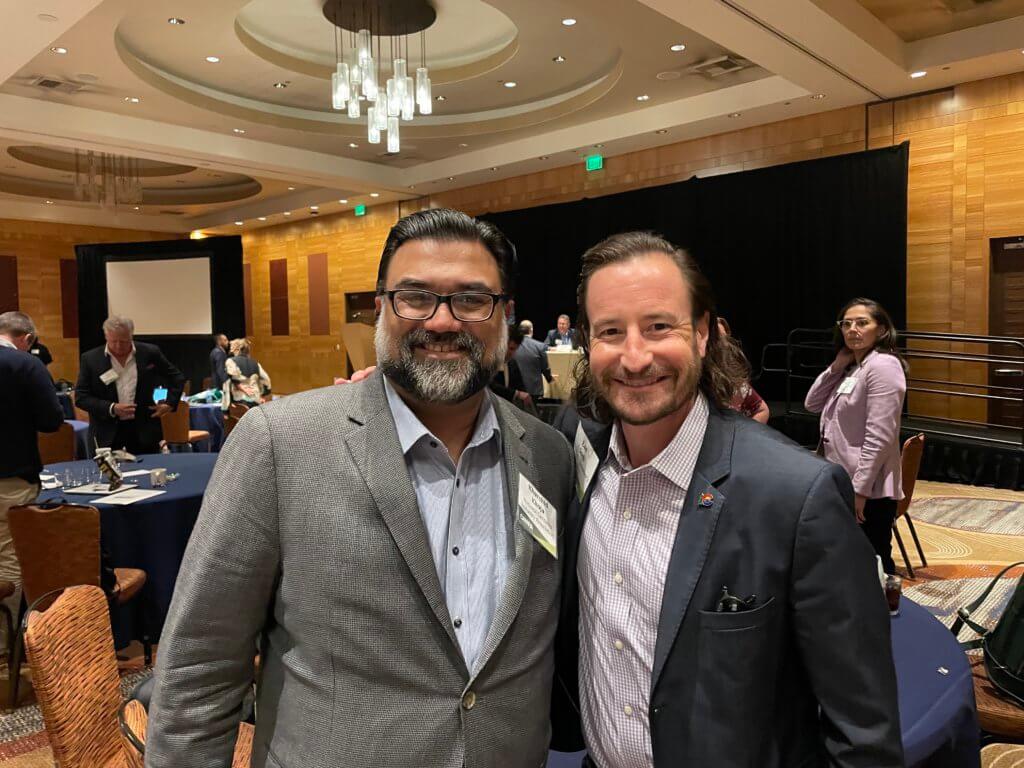
Representatives from NCIA participated in the conference – NCIA Board Members Khurshid Khoja (Chair Emeritus) and Michael Cooper (Board Secretary), and we caught up with them in this blog interview to better understand the goals and outcomes of the event.
From a bird’s eye view, what was the overall goal of this conference?
MC: The conference was an opportunity for regulators from around the nation to hear directly from stakeholders on the current and future challenges that face these markets and different models of regulation to tackle them.
KK: I’ll add that our own goals, as the current Policy Co-chairs for NCIA, were to better understand the priorities of state and local cannabis regulators across the country, and anticipate future developments in cannabis policy early on, so we could take that back to the NCIA membership and the staff – especially Michelle Rutter Friberg, Mike Correia, and Maddy Grant from our amazing government relations team.
Let’s talk about who was invited to participate in these panel discussions. From cannabis industry associations to those who regulate cannabis, who else was there?
KK: Michael and I each spoke on a panel. The other speakers included reps from federal trade associations, lobbyists, vendors, and ancillary companies who were helping to underwrite the event (along with NCIA). Given that CANNRA is a non-profit that doesn’t receive any funding from their member jurisdictions, and has a single paid full-time staff member, I thought they were still able to obtain a fairly diverse and interesting set of speakers at the end of the day – including NCIA Board and Committee alums Ean Seeb, Steve DeAngelo, Amber Senter and David Vaillencourt (representing the Colorado Governor’s Office, LPP, Supernova Women and ASTM, respectively), as well as folks from Code for America, Americans for Safe Access, and the Minority Cannabis Business Association, U.S. Pharmacopeia, NIDA, the CDC, and the Alcohol and Tobacco Tax and Trade Bureau, representatives of the pharmaceutical, hemp, tobacco and logistics industries, and public health officials.
Were there any organizations or sectors of the industry that were not in attendance, whether they weren’t invited or just didn’t participate, and why is it important to note the gaps of who was not represented?
MC: No licensed businesses were invited. Instead, organizations that represent industry members were invited. As a result, we felt it was crucial to inform these discussions with the perspective of the multitude of small and medium-sized businesses otherwise known as Main Street Cannabis that have built this industry and continue to serve as its engine.
KK: Sadly, we did not have an opportunity to hear from members of the Coalition of Cannabis Regulators of Color. I can’t speak to why that was, but it was unfortunate for us nonetheless. And while we had some public health officials there, I know that CANNRA Executive Director Dr. Schauer would have preferred to see more of them in attendance.
Across the spectrum of policy and regulations and legislative goals, what topics were covered in the panel discussions across the two-day conference?
KK: We covered a ton, given the time we had, including the federal political and policy landscape; interstate commerce; the impact of taxes on the success of the regulated market; social equity and social justice; preventing youth access; regulation of novel, intoxicating and hemp-based cannabinoids; the prospects for uniform state regulations; technological solutions to improve compliance and regulatory oversight; and delivery models.
What information or perspectives did NCIA bring to the panel discussions that were unique from other participants? What does NCIA represent that is different from the other voices at the event?
MC: There really are a wide variety of perspectives on how best to regulate this industry. We felt it was essential that NCIA give a voice to Main Street Cannabis, the small businesses that so many adult-use consumers and medical patients rely upon. We emphasized, for example, that these are often businesses that cannot simply operate in the red indefinitely, but provide essential diversity (in the background and life experience of operators as well as in product selection and choice). NCIA wants to make sure that the future of cannabis isn’t simply the McDonalds and Burger Kings of cannabis. There are times when consumers want that, but there are also times when they want something unique and different. And it’s crucial that policy not destroy the small and medium-sized, frequently social equity-owned, businesses that provide those choices.
What else was interesting to you about this gathering of minds? Were you surprised by anything, or was there anything you heard that you disagreed with?
MC: There are a ton of different perspectives and approaches to cannabis, and that’s no surprise to anyone who has followed these issues closely because the tensions are very clear in the policy debates that are ongoing.
As the voice for the industry, we sought to urge an approach grounded in reality. Americans want these products. That’s clear from the ballot box and public polling. The question should be about how to encourage Americans to purchase regulated, tested versions of these products.
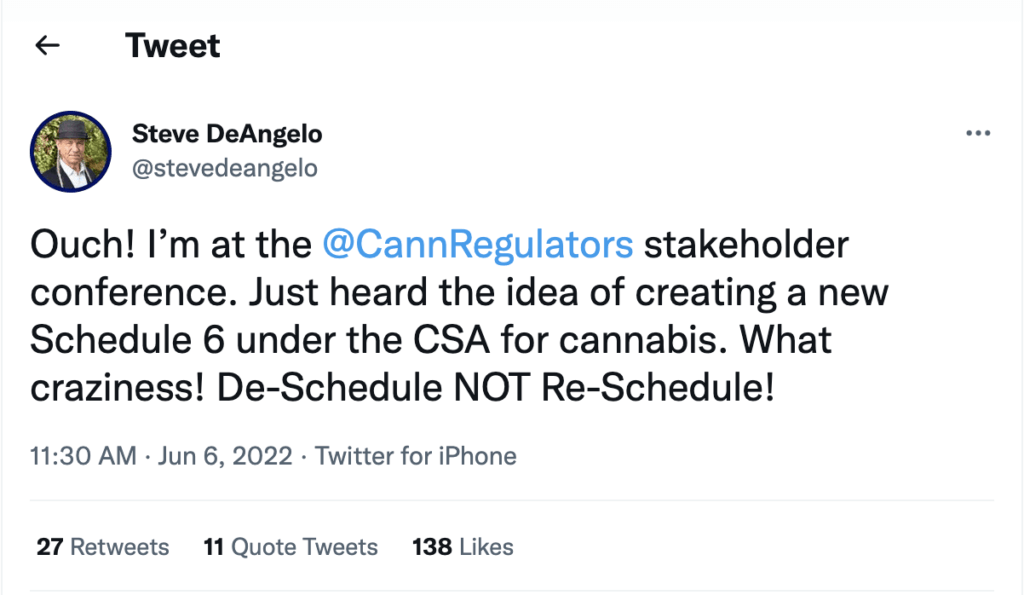
KK: There was definitely stuff we didn’t agree with – some of it from folks that we otherwise largely agree with. For example, our good friend Steve Hawkins of the USCC shocked a few of us in the audience when he seemed to indicate some receptivity to re-scheduling cannabis on an interim basis, rather than moving to de-scheduling immediately. I think that while rescheduling may benefit scientific research and pharmaceutical development, it could ring the death knell for Main Street Cannabis businesses. NCIA has consistently advocated for de-scheduling rather than re-scheduling.
After two days of panels, did anything new come through these discussions, or were any accomplishments achieved?
KK: I think there’s a growing recognition that addressing social equity solely through preferential licensing and business ownership for the few isn’t enough and that the licensing agencies and regulators that execute social equity policies have a very limited (and often underfunded) arsenal to comprehensively redress the harm caused by federal, state and local governments prosecuting the war on drugs. In my remarks, I said it was time for us to start discussing additional forms of targeted reparation and had a number of regulators approach me afterward to continue the discussion. Candidly, I expected my remarks to fall on deaf ears. They didn’t. That was very encouraging.
MC: There was definite progress. At the end of the day, these cannabis regulators are working hard to try to get this right. But in such a new area, and with so many competing perspectives and voices, their job isn’t easy. We were heartened to see the level of engagement from regulators on these points, including follow-ups to get more information on some of the pain points we identified for small and equity businesses in the industry.
It was definitely rewarding to provide NCIA and our members’ perspectives in a forum like this, and we’re looking forward to continuing to further strengthen NCIA’s relationship with CANNRA and regulators around the country.
Committee Blog: ‘Corporate to Cannabis Crossover’ – An Interview with Portland’s Cannabis Czar, Dasheeda Dawson
by Elise Serbaroli of Strimo, interview conducted May 2021
Elise Serbaroli is a member of the NCIA’s State Regulations Committee, “Informing Local Governments” subcommittee, which aims to bridge knowledge gaps between operators and regulators in the cannabis industry. This is done through interviews with current cannabis regulators in various U.S. states, sharing best practices and lessons learned.
Dasheeda Dawson is a cannabis regulator in Oregon and co-founder of the Cannabis Regulators of Color Coalition (CRCC). As cannabis czar for the City of Portland, she is the highest government official overseeing and advising on cannabis regulation for the municipality. Ms. Dawson brings an incredible breadth of experience to the cannabis space. A self-proclaimed “corporate to cannabis crossover”, she is perfectly positioned to navigate and lead the complexity that is the legal cannabis industry. Before becoming a best-selling author (“How to Succeed in the Cannabis Industry”), she held leadership roles at Victoria’s Secret and Target. Her career is built off of a solid educational foundation, including a Princeton degree (Molecular Biology & African-American studies) and an MBA from Rutgers.
Can you tell us how you got into the cannabis industry?
For the five years prior to formally getting into the industry, I was what you would call a “closeted cannabis consumer/patient.” I have early signs of MS and my mom was actually the one that insisted I give it a try. At the time, I was working at Target in Minnesota. Cannabis was my saving grace for maintaining productivity and overall capabilities. My mom passed away unexpectedly in 2016 and it jolted me out of the standard corporate trajectory I had been on. I ended up moving to Arizona and became a medical cannabis patient there, jumping into the advocacy side of the industry. Arizona legalized adult-use this past November!
From Target to Cannabis Czar! Did you always plan on becoming a regulator?
Certainly not! Straight out of the gate, I got a lot of work as a consultant in the industry, using everything that I had done in my corporate career, including business strategy and supply chain management. I had owned everything for my categories at Target and when you’re the business owner, you lead and oversee the entire cross-functional team. I applied that to the cannabis space as quickly as I could, working for a lot of clients and gaining an entrepreneurial education from working with large cannabis enterprise clients, small operators, multi-state operators, Native American tribes, even government. I gained the truest sense of how NOT to do it. In a corporate role, you usually write a report about what you have learned, insights, etc., and then you move forward. My workbook, now in its 3rd edition, was really built off of those lessons learned.
When COVID hit, my book tour was abruptly stopped overnight! At the same time, I was selected to become the Cannabis Program Supervisor for the City of Portland. I was only the third Black woman at the time to be selected to oversee a cannabis regulatory office. I believe that now there are more, but women and people of color are scarce in these positions. Most of the regulators are white men, many of whom come from another regulatory agency, like liquor or law enforcement. In order to assure that cannabis regulation is equity-centered, you need people at the table that will center equity. This last year has been amazing. I have a lot of runway and support to be exactly who I am, which is the Weed Head (TM). I refuse to be anything else and I’m in a bureau that allows me to do that.
What exactly is a cannabis czar?
On the state level, the Oregon Liquor Control Commission is currently passing legislation to become the Oregon Liquor AND CANNABIS Commission (OLCC), primarily because cannabis is providing substantial revenue for the state. Most of those people are liquor regulators, and they have organized a sub-group, focused only on cannabis. It started off with four people and now there are 50!
As Portland’s cannabis czar, I am a municipality leader, similar to Cat Packer in Los Angeles, and operate independently of the OLCC. Portland represents approximately 40% of the total cannabis revenue for the state and I oversee the entire cannabis program, including regulatory, licensing, compliance, community impact, and equity initiatives for Portland’s medical and adult-use programs.
In the city of Portland, cannabis regulation and oversight was placed in the Office of Community and Civic Life, as opposed to in the Office of Finance and Revenue or the Office of Business Development Services, which is where they license other businesses. This placement is partly due to the idea at the time that the cannabis industry was going to be disruptive to the community. Many individuals were worried about safety for communities. Our office has been trying to decrease the stigma and canna-phobia around the plant, offering education and equity initiatives. We were the first city to have community reinvestment grants tied to our cannabis tax revenue. These grants are administered through the SEED (Social Equity and Educational Development) Initiatives and grant fund.
CRCC and CannRa are two independent organizations, which happened to both launch at the same time. This caused some confusion in the industry. They are not mutually exclusive memberships! In fact, two of our founding members are also founding members of CannRa. The regulators roundtable was the predecessor of CannRa and that association aggregates insights and learnings state by state. The Oregon Liquor Control Commission (state-level) is a member of CannRa.
CRCC centers equity and support of legalization, while also aggregating insights and learnings state by state. If you are a regulator of color, at the state or local level, it makes sense to join the Cannabis Regulators of Color Coalition. We know that legalization is a requirement to start to undo the harm done through the war on drugs.
Centering equity involves re-thinking how we regulate this industry. One challenge is getting people to realize that this is a regulatory agency, like any other government regulatory agency. The Department of Motor Vehicles (DMV), a regulatory agency, gives out licenses and adjusts to assure that no group is precluded from access (adjusting for wheelchairs, visual and hearing impairments, etc.). Yet, in cannabis, we are regulating the industry without dealing with the inequities in the industry. Some of these inequities are directly linked to the historical prohibition of cannabis and the war on drugs, which we define as the racially-biased enforcement of cannabis prohibition.
Supporting equity also includes gender inequities, economic inequities, and disability inequities, to mention a few, that will positively impact everyone in the industry, including and especially patients themselves. Exclusionary practices would not be tolerated if it was an agency like the DMV. With cannabis, we are over-regulating the industry and excluding many people from participating, which is to the detriment of the market and the community. CRCC is focused on equity-centered regulation for the cannabis industry.
What is one thing that you would like to see in the legislation for cannabis businesses at the federal level?
Well, there’s a misconception about the size of companies in this industry. As an industry, we have to be careful about supporting legislation that only benefits large corporations. More than 75% of cannabis businesses have annual revenue of $2 million or less. Compared to small businesses in other industries, for example, in agriculture ($6 million or less) and retail ($14 million or less), cannabis businesses are very small, so everyone needs to push for legislation to benefit these small businesses in whatever regulatory framework is set up on a federal level. This is one step in leading the industry towards a more equitable path.
One aspect of inequity is how cannabis businesses of different sizes are treated. On average, very small cannabis companies have an after-tax rate of 70%, so when you’re going to the table for the regulatory framework, push back on the tax structure, push back on mechanisms that are inherently disadvantageous to small businesses. Surprisingly or not, most Black, Indigenous, or Latinx businesses are also small businesses, so you are positively impacting racial equity.
If you, as a cannabis business, think you’re a big fish, trust me, Big Tobacco, Big Alcohol, Big Pharma, Big CPG (“consumer packaged goods”) – Target has $70 billion in annual revenue – are coming, so a big fish in this cannabis pond is setting itself up to be eaten by much bigger fish and bigger sharks. If we leave back doors open for the larger cannabis businesses, we’re leaving that same back door open for a Walmart or an Amazon. Large corporations are already investigating and supporting cannabis. They plan years in advance for large takeovers and once it starts, it’s a stampede of well-financed, organized strategic efforts.
At a state level, the industry and those who want to support the industry, need to be careful to not overtax the small businesses and to vote to provide a framework of support mechanisms for small cannabis businesses.
What are some examples of frameworks that support or negatively impact small cannabis businesses?
Some of the early legalization efforts required vertical integration. Because of the way the state and local jurisdictions are regulating and taxing, forcing vertical integration is not a small-business-friendly approach to licensing. This was the case in some earlier states, but we’re also seeing newer states like Georgia taking this approach.
By breaking up the licensing into different parts of the supply chain (like California), you open up possibilities for smaller businesses to operate. If the state is giving out micro-business licenses, there should also be a track to grow into a larger size so that there is no ceiling on those businesses’ growth prospects. For example, in New Jersey, advocates fought to amend provisions that failed to create a way to sell out of a micro-license for a growth event.
Everybody has a different opinion depending on which economist you talk to about how you tax up and down the supply chain. I’d like to see states have tiered tax by production weight. Once you start doing it by the percentage of THC, you’re negatively impacting businesses and patients. It’s meant to be a deterrent and is an example of the government intending to overregulate in an area that it doesn’t fully understand. But usually, those penalties wind up impacting the smaller craft businesses. Too many people are assuming that consumption in the adult-use market is just for recreational purposes, but there are plenty of small niche operators aimed at a specific medical community and they are producing small batches, for example, with high THC, but their clientele may be negatively impacted, simply as a function of the way the tax law was written.
Thanks, Dasheeda, for taking the time to speak with us! If readers want to get involved in changing legislation and connecting with regulators, where should they start?
It’s certainly a long and hard process when dealing with big issues and change. For operators, NCIA is a good place to start. There is also the M4MM and the MCBA. Folks should really try to connect with the local- and state-relevant organizations. Building and operating in coalitions can be very powerful. On a national level, be sure that any group you are part of is actually going to D.C. and is having conversations with the legislators, because at the end of the day, whether it’s cannabis or any other business, you need to be involved with influencing the policies that impact your industry. Everything starts with the law and civic engagement.
Elise Serbaroli leads Global Business Development at Strimo, where she provides cannabis businesses with software solutions around inventory management, cost accounting, QA, and compliance. She’s back in the USA after over a decade of experience in Spain, Germany, Switzerland and Ecuador.
Understanding the importance of efficiency, scalability, and profitability, Elise created solutions to financial and legal processes for the R&D team at CPW, a joint venture of two of the world’s largest food companies, Nestlé & General Mills. As a systems coordinator, she gained a deep appreciation for food safety, GMPs and regulatory compliance. Her supply chain software experience builds off of her Business Development role at Tradeshift, the world’s largest network for digital B2B payments.

 MC
MC
 by Elise Serbaroli of
 Elise Serbaroli leads Global Business Development at
Follow NCIA
Newsletter
Facebook
Twitter
LinkedIn
Instagram
News & Resource Topics
–
This Just In
DOJ Reschedules Medical Cannabis to Schedule III & Announces June 2026 Hearing on Broader Rescheduling
National Cannabis Industry Association (NCIA) to Convene Industry Leaders in Washington for Annual Lobby Days, Bringing Together a Unified Voice for Federal Cannabis Reform