Overcoming Information Barriers: Data Silos in the Cannabis World

As the cannabis industry rides the waves of rapid globalization and acceptance, it is evolving into a multi-billion-dollar sector. And with this sudden influx of money, has also come an influx of data.
Unfortunately, the industry is evolving and growing faster than many businesses can keep up with, leading to roadblocks and obstacles that many businesses don’t have the infrastructure in place to adapt around. One such pressing issue is the compartmentalization of data within businesses, or “data silos”
When these silos occur, information is isolated from other systems, limiting accessibility and collaboration, and making it nearly impossible for data-driven decision-making.
The implications of siloed data
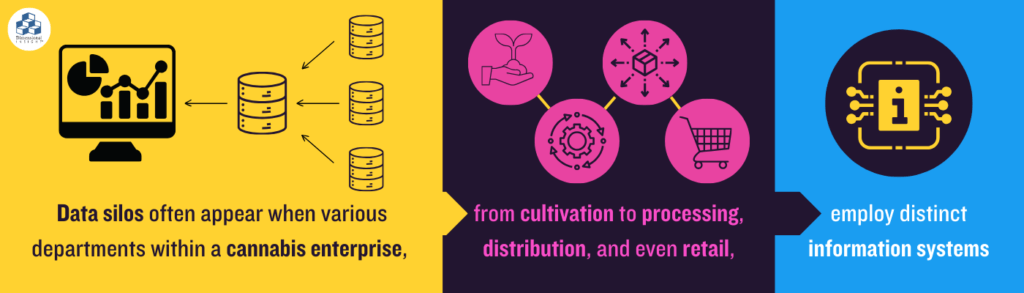
Data silos often appear when various departments within a cannabis enterprise, from cultivation to processing, distribution, and even retail, employ distinct information systems. Different facets of a business often utilize different tools and solutions, each with their own data infrastructure and programming. Although taking on multiple solutions can ease the initial burden for businesses trying to build their tech stack, this approach can lead to major processing hurdles later down the road.
The biggest drawback of this isolated data environment is limiting cross-departmental collaboration. Let’s paint a scenario: without a unified data system, cultivators might not be able to synchronize their production schedules with the sales trends identified by their retail and distributor outlets. This misalignment can lead to stock shortages, resulting in lost sales and disappointed customers. Conversely, it might also lead to overproduction, and in turn expired products and heavy storage expenditures over time.
Root Causes of Data Silos in Cannabis
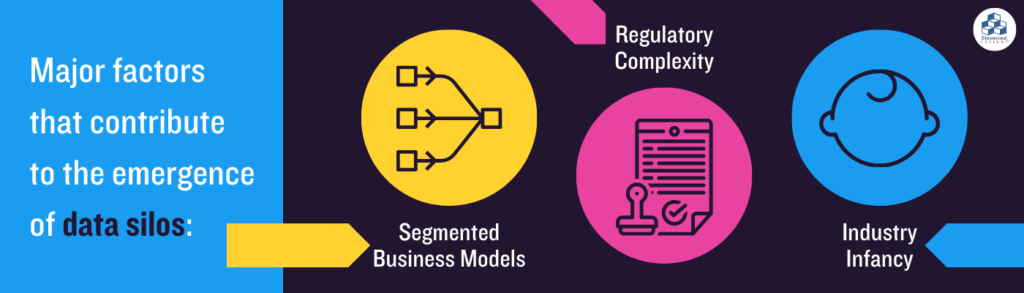
To tackle this challenge head-on, it’s essential to first understand where it comes from. There are several major factors that contribute to the emergence of data silos:
- Segmented Business Models: As cannabis businesses expand, they often segment into specialized units. Each of these units, with their unique operational needs, can inadvertently craft their own data management methods, leading to isolated data pools. Dispensaries may be employing different systems for their point-of-sale (POS), inventory management, ordering, and digital marketing. Without integrating the above systems, managers and C-suite individuals can’t properly align their supply-chain with sales strategies. Likewise, suppliers and distributors often lack transparency between the products they’re pushing out and what’s actually selling on retail shelves.
- Regulatory Complexity: The cannabis industry is heavily regulated, and these regulations can vary widely from one jurisdiction to another. A lack of central federal guidelines means each state is left up to its own devices to determine how businesses remain compliant, and this problem is only compounded as we delve down into individual counties and territories. Different stages of the supply chain also have different data they must report, making it extremely difficult for vertically integrated businesses to ensure they’re covered on all fronts. With these varying regulatory demands, different departments may adopt distinct data tracking systems, further deepening the data divide.
- Industry Infancy: The relative newness of the cannabis industry means there’s a continual influx of specialized technological solutions. Very little in the industry is standardized at this point, meaning each solution has its own approach to both data governance as well as data definitions. While these tools might be tailored to address specific needs, they can sometimes exacerbate data isolation if not chosen with integration in mind.
Challenges presented by data silos
Persisting with data silos introduces several operational hurdles. On a macro scale, isolated data complicates streamlining processes across the business chain. It introduces inconsistencies, creating a ripple effect that might not only compromise the quality of end products, but the efficiency in getting them into consumer hands.
Additionally, the overhead of managing multiple data systems can strain resources, both in terms of manpower and finances. Within the tightly regulated framework of the cannabis industry, these inconsistencies can magnify into compliance violations. This can lead to hefty fines, reputational damage, or in extreme cases, business closures. It takes just one failed audit to incur devastating losses, especially for smaller businesses that lack the capital to cushion heavier blows.
Strategies to overcome data silos
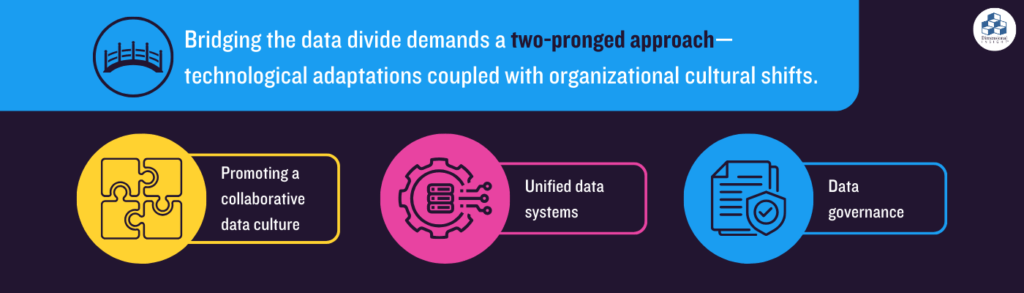
Bridging the data divide demands a two-pronged approach—technological adaptations coupled with organizational cultural shifts.
- Promoting a collaborative data culture: The first step is to build an organizational ethos that places immense value on data-driven decision-making. Staff and management alike need to prioritize the value of data and adopt the mindset that “data is key.”
Such a culture should incentivize cross-departmental collaborations, fostering an environment where data sharing becomes the norm rather than the exception.
- Unified data systems: Technological investments play a pivotal role. By adopting systems like industry-specific ERPs or advanced data integration tools, businesses can usher in a centralized data management paradigm. Such platforms not only facilitate data integration but also enhance analytics capabilities.
- Data governance: Instituting a robust data governance framework ensures there are clear policies regarding data access and manipulation. This promotes data integrity and accuracy, striking a balance between facilitating data accessibility as well as maintaining regulatory compliance.
The role of data analytics
In today’s digital age, analytics may just be the cannabis industry’s biggest ally. Contemporary analytics solutions, especially those leveraging cloud technology, offer robust platforms to centralize, integrate, and analyze data. This allows businesses to harness insights from seed-to-sale and empower their overarching business strategies. By breaking down data silos, the cannabis industry can ensure operational agility and enhance customer satisfaction, positioning itself for sustained growth in a rapidly evolving landscape.
Member Blog: Move Over Cannabis ERP – This is How You Breakdown Information Silos

As a licensed cannabis company, managing multiple data sources, systems, and processes that must remain in sync and compliant 24/7 comes with challenges not faced by traditional businesses.
Like every other business, however, you rely on a variety of software systems like inventory management, sales tracking, customer relationship management, financial systems, and more. And when these systems don’t communicate well, several issues you’re probably familiar with rise to the surface.
Maybe you’ve had to manually input data from one system into another or get custom code to get different systems to communicate, but these are time-consuming, error-prone, and inefficient. Let’s take a quick look at some of the other problems you’re likely to run into.
Data Inconsistencies: When systems don’t share information, it creates ‘data silos’ with discrepancies occurring everywhere. For example, your inventory system shows you’re out of a particular cannabis product, but a sales system shows overstock and offers the product at a steep discount. These inconsistencies lead to confusion, inefficiencies and lost profits.
Reduced Productivity: Employees manually entering and transferring data between systems is time-consuming and prone to error– the extra effort kills productivity. Don’t forget, staff need to fix those manually input errors manually when they could be working on more important things.
Poor Decision-Making: Blindspots can seriously impact decision-making without a unified view of your business data. If sales data is kept separate from inventory data, as in the example above, making accurate forecasts and planning for future needs is next to impossible.
Customer Dissatisfaction: Customer data should be shared between systems to maintain customer service. A customer could unknowingly purchase a back-ordered product or receive discount promotions for products they’ve already purchased, or the customer service team might need access to a customer’s full history when dealing with inquiries or complaints. It’s easy to see how conflicting or inaccessible customer data could lead to a bad customer experience.
Regulatory Compliance: In this industry, compliance with regulatory requirements is crucial. When integrated tracking and reporting systems are in play, ensuring compliance and avoiding fines or other penalties is much easier.
Increased Costs: The time and effort needed to rectify data inconsistencies and errors increase operational costs, especially when, for example, a cannabis company tries to add additional software to bridge the gaps between two systems. In the end, those two systems may communicate seamlessly, but you’re still left with data silos everywhere.
Cannabis ERP a Traditional Approach?
Until recently, what recommended solution effectively managed the following cannabis business activities?
- Human resources
- Accounting
- Cultivation
- Manufacturing
- Distribution
- Sales teams
- Marketing
- Retail
A platform called cannabis ERP, right? But there are a few single-suite disadvantages to an ERP solution by itself:
- Difficult to select a single solution that fits the needs of the whole company
- Longer implementation
- Larger up-front Cost
- Longer ROI
- Requires shared vision by the entire company
- Tied to one vendor’s vision & priorities
While a cannabis ERP may still be a great option for some companies, for a growing number of cannabis operators, cross-platform compatibility is a non-negotiable feature in today’s increasingly interconnected digital landscape. So what is the solution?
The New Approach to Cross-Compatibility
Cloud APIs (aka Application Programming Interfaces) are how you achieve cross-platform compatibility because they provide a set of rules and protocols that govern how different software components should interact. This makes it possible for other software systems, which may be built on various platforms and programming languages, to communicate and work together effectively.
In general terms, cannabis businesses might consider the following integrations for their operations:
- Seed-to-Sale Tracking API: This type of API integration facilitates the tracking of cannabis plants from cultivation to the final sale, which is important for regulatory compliance. They can assist with inventory management, plant batch tracking, waste tracking, and sales reporting.
- Point of Sale (POS) API: These APIs connect the POS system with other business applications like ERPs, CRM, or eCommerce platforms. They facilitate real-time inventory updates, sales data analysis, customer behavior tracking, and regulatory reporting.
- eCommerce API: These APIs integrate online sales platforms with other business applications. They can help manage online orders, update inventory in real-time, and streamline shipping and customer service.
- Laboratory Testing API: These APIs are useful for pulling test results directly from third-party labs into the company’s main system. They help ensure product quality and regulatory compliance by tracking potency, contaminants, and other metrics.
- Payment Processing API: This type of API integration helps cannabis businesses connect with payment gateways that can handle the unique regulations of the cannabis industry. They manage transactions, refunds, and customer data related to payments.
- Regulatory Reporting API: These APIs automatically compile and report data to state or national regulatory bodies. This can simplify compliance with the complex regulations that apply to the cannabis industry.
- Customer Relationship Management (CRM) API: These APIs help integrate CRM platforms with other business applications, allowing companies to streamline customer communication, manage leads, track customer behavior, and more.
- Supply Chain Management API: These APIs allow cannabis businesses to connect their systems with those of their suppliers or distributors, helping to streamline order placement, inventory updates, and other aspects of the supply chain.
Cloud APIs allow different software systems to communicate with each other in a standardized way, automating the sharing of data and functions between systems. With cloud APIs, operators can significantly reduce data silos, cross-platform incompatibility, and integration challenges and move toward a best-of-breed approach.
So, What’s it Really Mean to be Best-of-Breed?
The best-of-breed phrase describes software or technology considered the best or most superior within its specific category, niche, or industry and implies that a software system excels in features, functionality, and performance compared to its competitors.
So instead of picking an all-in-one software like a cannabis ERP, you can choose any software you want, and cloud APIs will connect them.
Imagine having to assemble a dream team for the Olympics. Not just any team… a dream team. Of course, you’d want to select the best players for each position to create the best possible teams, the individuals who consistently perform for the team. Where would you start?
Choosing the top performers for their respective roles puts your team in a position for the highest chance of success. Think about it, when each player brings a unique set of skills and expertise to their job, they ultimately level up to the team’s overall performance.
Similarly, a best-of-breed solution is like selecting the top-performing individual software systems for your organization’s specific needs and then connecting platforms to form the best available suite of tools for each function.
Seamless Integration: High-Performing Tech Stack for Cannabis Operations
Integrating your preferred systems for tracking inventory, sales, compliance with regulations, etc., is no longer the same headache it once was. With cloud APIs enabling software, applications, and services, you can operate effectively across multiple platforms and systems.
Communicating between systems is important for several reasons:
- Greater reach and accessibility: Cross-platform compatibility allows a software or service to be used by a larger user base as it operates on multiple different systems rather than being confined to just one.
- Efficiency and cost-effectiveness: By ensuring their solutions are cross-platform compatible, developers write code once and deploy it across multiple platforms, which saves time and resources in development and maintenance.
- Improved user experience: With cross-platform compatibility, users interact with a service or application on the platform of their choice, leading to a better user experience.
Cannabis has so many different verticals within, and so many different pieces of specific software need to talk to each other, you need someone to integrate your cloud, a partner that you can grow with.
Canna Suite’s Cloud API is made specifically for seamless communication among your preferred tech stack.
Canna Suite’s Best-of-Breed Advantages
- It’s a growth strategy, improving decision-making and transparency with software solutions that fit today’s and future needs
- Companies can buy software in phases
- A modularized software approach grows and changes with you
- Supports flexibility and high-growth
- Rolled out in non-sequential phases
- Departmental decision making
- One partner, but not tied to one system
- Functional-specific support
The one size fits all methodology has passed with the increased adoption of cloud technology with the Best of Breed approach saving you time and money. With superior levels of accuracy, transparency, and automation, you can finally streamline business processes that allow you to capitalize on growth.
Canna Suite’s single-partner approach for software selection, integration, support, and reporting means you can select different software solutions that fit each department’s needs. If you’d like to learn more about breaking down your data silos, check out our recorded webinar.

Follow NCIA
Newsletter
Facebook
Twitter
LinkedIn
Instagram
News & Resource Topics
–
This Just In
How THCa Vapes Are Changing Consumer
Announcing NCIA’s 2026-2028 Board of Directors