NCIA (and myself personally!) have been talking about the SAFE Banking Act for years.
After the Senate Banking Committee’s hearing on the topic of financial services and the cannabis industry in May, it became clear that in order for the bill to continue on in the legislative process and receive a markup that changes to a few sections needed to be made.
As a result, a slightly new (and improved?) version of the bill was introduced as the SAFER (S. 2860: Secure and Fair Enforcement Regulation) Banking Act last month. Most of the changes in the bill pertained to Section 10, which bars federal banking regulators from taking discriminatory enforcement action against any industry (not just cannabis).
Once SAFER was formally introduced, the Senate Banking Committee announced that a markup was scheduled for September 27. It’s important to note that this was the firsttime ever that a Senate committee held a markup on a pro-cannabis bill.
During the markup session, multiple amendments were offered. The first, offered by Chairman Brown (D-OH) was what’s known as a “manager’s amendment” and primarily made technical changes to the bill. That amendment also made changes so that the Treasury secretary would be given one year (instead of 180 days) to issue updated guidance to financial institutions that work with cannabis businesses that was first released during the Obama administration in 2014. It also stipulated that federal home loan banks are now included under a list of financial institutions that would be protected from being penalized by federal regulators simply for working with state-legal cannabis businesses.
Another amendment, from Sen. Warnock (D-GA) would have created a 5-year sunset for the legislation unless a report from the Treasury Department certified that it had decreased the racial wealth gap and ameliorated other negative economic impacts of the war on drugs. This amendment ultimately failed.
Additionally, amendments from Senators Hagerty (R-TN), Rounds (R-SD), Crapo (R-ID) were also offered but were ruled out of order, withdrawn, and failed, respectively.
Republican members of the committee voiced concern that the bill allowed for financial institutes to utilize reputational risk to de-bank certain accounts they do not align with ideologically and argued that no financial regulator should be able to pressure any financial entity to refuse to provide service to a lawful entity.
Some Democrat members, particularly Sen. Warnock (D-GA), voiced concern that the bill does not adequately address the disproportionate impacts of marijuana criminalization and its exacerbation of the racial wealth gap in the United States. Other members of the committee encouraged amendments and future legislation intended to improve the quality of life for those most negatively impacted by marijuana criminalization in addition to creating safer conditions for banks and other financial institutions. Sen. Warnock was the lone Democrat who voted “No” on the bill during the markup.
Ultimately, the bill passed out of the committee markup by a bipartisan vote of 14-9. This sets the stage for a full Senate floor vote, which Majority Leader Schumer (D-NY) has committed to scheduling as soon as possible, with the possibility of adding the HOPE and GRAM Acts to the bill before passage.
I don’t know about you, but I’m not done making history yet! Stay tuned for the latest on the SAFER Banking Act and how you can help get the bill passed!
With recreational marijuana legalized in 23 states, Washington D.C. and Guam, the public continues to broadly favor legalization for medical and recreational purposes. Why then, is it still a challenge for the cannabis industry to access financial services? The short answer: cannabis banking is risky for financial institutions (FIs), and bankers are committed to avoiding unnecessary risk. Historically, FIs have worked to keep funds associated with illegal activity out of their banks and credit unions, so FIs are sensitive to conflicting state and federal cannabis laws. For example, many FIs are regulated by federal agencies, but marijuana is a Schedule I controlled substance.
Navigating the Challenges
However, there are many banks and credit unions that have taken this risk for a variety of reasons, including creating new sources of income, a desire to serve the unbanked in their communities, and supporting the social equity initiatives in the cannabis industry. These FIs are usually discreet about their cannabis banking programs, and it’s often hard to identify them through your typical approach: prowling websites, Google searches or even trade shows (although this has improved over the past 12 to 18 months).
Fortunately, the best approach is also a well-trusted option: word of mouth. Contact lawyers, accountants and bookkeepers in your area. If they represent or work with other local marijuana related businesses (MRBs), they may know who they are banking with or know someone who does. You should also consider contacting the FIs directly, even if you don’t know if they are working with MRBs. You might be surprised to find that they do, and if they don’t, they might redirect you to another FI in the area. Finally, organizations like the PBC Conference team, provide resources to aid your search, including a Cannabis Banking Directory published annually.
Focus your search on credit unions, community banks, and regional banks. We are entering a new phase of cannabis banking with some FIs offering more than just a place to park your cash. A growing number now offer loans, payroll services, business insurance, etc., so take time to see what’s available, compare multiple FIs’ programs, and find the best match for your cannabis-related business’ (CRB) needs.
Be Prepared
Every action taken by an FI, regardless of their location or asset size, is closely scrutinized by state and federal banking regulators, and law enforcement agencies. They want to make sure that banks and credit unions are only working with legitimate and legal state CRBs. Therefore, you can expect an FI to require a combination of the following:
Driver’s license or other acceptable state-issued identification for all account holders
Information on all beneficial owners of the company, not just those who own a percentage of the company above a certain percentage threshold (such as 20%)
Tax returns for the previous year for both the company and the beneficial owners
Financial information such as profit and loss accounts and capitalization tables
A copy of any required state licenses
Operational data such as projected annual sales and number of patients/customers
Corporate formation documents such as articles of incorporation and business plans
Sales transaction data (store reports or invoices) for the past thirty days
Behind the scenes of cannabis banking, FIs must do a lot to ensure that they are onboarding only legitimate CRBs; from collecting and analyzing market transactions to conducting reporting. This means that FIs often have additional staff to fulfill their compliance duties and they invest in software to automate some of their monitoring. FIs invest heavily in banking cannabis and account fees help offset those expenses. This means you can expect to pay account setup fees and monthly account maintenance fees to help cover these costs. Prices have come down in recent years. The days of paying $5,000 per month for an easy deposit account are long gone, but the fees will remain high as long as a lot of oversight and reporting falls on FIs.
Embrace the Journey
FIs are far savvier about detecting MRB activity among their existing customer/member accounts. At this point, it’s not a question of “if” your FI will find out you’re an MRB, but when. Few things are more disruptive to a business than getting a letter from your FI informing you that your account will be closed in thirty days. Don’t put yourself in that position. Additionally, you may be missing out on vital financial and business services by staying “under the radar” and not having a transparent relationship with a bank or credit union. Start looking for a cannabis-friendly bank or credit union today!
Member Blog: The Evolution of Cannabis-Friendly Banks and Credit Unions
If you are a cannabis-related business (CRB) looking for banking services, that search is becoming less demanding. With the U.S. cannabis market expected to exceed $70 billion by 2030, financial institutions are increasingly becoming aware of the opportunity to boost their bottom lines, while supporting the safety and economic development of their local communities. As friendlier cannabis banking legislation emerges from Washington, D.C., we expect to see thousands of financial institutions actively serving the industry, up from the approximately 250 banks and credit unions serving the industry today.
Early on, smaller credit unions were among the most prevalent pioneers in the industry. Even today, most banks and credit unions that are cannabis-friendly are less than $1 billion in size. That trend is changing rapidly, though, and with it, an increased level of sophistication is supporting the cannabis ecosystem. In fact, at least two banks with assets larger than $50 billion on the East and West Coast respectively have entered the market and by all accounts, have booming portfolios.
When looking for a banking partner, CRBs should consider a few key questions:
Does the bank or credit union have an existing cannabis portfolio?
What are the fees for service?
Can the financial institution provide ACH services for business-to-business transactions?
How does it handle cash deposits?
Deposit taking is the primary focus of cannabis-friendly financial institutions however there is activity in a few key areas relevant to the industry.
Lending
Fast-growing industries like cannabis are always in need of growth capital, and the banking sector has been slow to fill this void. The exception to this is in mature markets (such as Oregon, Colorado, and Massachusetts) where banks and credit unions in search of low-cost deposits are increasingly offering lending to attract legal cannabis operators to their institutions. While interest rates are still higher than typical business loans and generally require personal guarantees, the advent of cannabis lending is a welcomed relief to founders and others who have historically had to part with equity to meet capital needs.
Fortunately, lending is increasingly becoming mainstream. By our estimates, 50 or so banks and credit unions have opened their wallets in this regard, with most of the lending activity tied to commercial real estate. Equipment financing has also become more prevalent, and operating lines of credit are extended rarely to those firms with deep operational experience and more substantial balance sheets.
Payments
Until federal legalization occurs, the payments space will continue to include workarounds created by fintech entrepreneurs and others. ACH wallets tied to loyalty programs are often seen in medical markets, and until the end of 2022, cashless ATMs had widespread adoption on the adult-use side.
Most recently, PIN-based debit solutions running on the regional debit rails are gaining traction, and these options pass compliance hurdles that were not present with cashless ATMs. With their advent, merchants are also seeing an increase in sales of 20% or so as compared to cash-only environments.
Access to banking and financial services in the cannabis industry has come a long way in the last decade yet has a long way to go. There is a real advantage for early movers to provide services and we expect more and more financial institutions to recognize the opportunity and get involved.
Summer Recess & Cannabis Progress: Cannabis News from the Capitol and Expectations for the August Break
by Michelle Rutter Friberg, NCIA’s Director of Government Relations
After NCIA’s 11th Annual Cannabis Industry Lobby Days concluded in May, cannabis news from Washington, D.C. has been relatively slow. Curious about what’s next before August recess begins? Keep reading to see what may happen ahead of the break and for a recap on where we’re at now.
SAFE Banking
Last month, just before NCIA’s Lobby Days, the Senate Banking, Housing, and Urban Affairs Committee held a hearing titled “Examining Cannabis Banking Challenges of Small Businesses and Workers”. Witnesses included the bill’s lead sponsors, Senators Jeff Merkley (D-OR) and Steve Daines (R-MT), as well as Ademola Oyefes (International Vice President and Director of Legislative and Political Action Department, United Food and Commercial Workers International Union [UFCW]), Michelle Sullivan (Chief Risk & Compliance Officer, Dama Financial), Dr. Kevin Sabet (President/CEO, Smart Approaches to Marijuana [Project SAM]); and Cat Packer (Vice Chair, Cannabis Regulators of Color Coalition).
My takeaways from the hearing: no new talking points from Project SAM, surprised by DAMA’s comments (they’ve since walked their testimony [which many saw as opposition to the bill] back), and most importantly of all: the real need for SAFE so that we can stop talking about access to financial services and start talking about legalizing and regulation cannabis in a smart and equitable way.
As for what’s next? Banking Committee Chairman Sen. Sherrod Brown (D-OH) recently shared that SAFE Banking would be scheduled for a markup after a few other bills received theirs. The good news? That process has begun. The bad news? Still no formal news on when SAFE’s markup will be. I’m expecting it to be after the Fourth of July break but before members leave D.C. for their annual, month-long August recess.
Appropriations
For years, advocates have looked to the appropriations process as a way in which to enact cannabis reform at the federal level.
In 2014, a provision that protected medical cannabis patients, programs, and businesses from federal interference (known as the “Rohrabacher-Farr” amendment) was included in the federal budget and became law. Since then, the provision has been included in appropriations bills and remains the law of the land.
NCIA has (and continues to) lobby on behalf of expanding this provision to include adult-use businesses and to also use the appropriations process to enact other reforms like allowing Washington, D.C. to commercialize adult-use cannabis sales.
House GOP negotiators heightened the stakes earlier this week when they announced they would mark up their FY2024 spending plans to levels lower than the budget caps set as part of a deal struck between President Biden and Speaker Kevin McCarthy (R-CA). This will undoubtedly make the already contentious budget-process even more volatile.
Maryland
On July 1, adult-use cannabis sales will begin in Maryland. Cannabis became legal for those over 21 in Virginia in 2021, while D.C. legalized cannabis for adults via Initiative 71 in 2014 (but have been unable to begin sales due to congressional interference). Legal sales in the District’s neighboring states means that members of Congress will surely be more exposed to the benefits of regulation.
So, while it’s been relatively quiet in D.C. in June, stay tuned in July for a possible first-ever Senate markup of SAFE Banking! As always, NCIA will continue to advocate on behalf of your business and keep you updated on the latest.
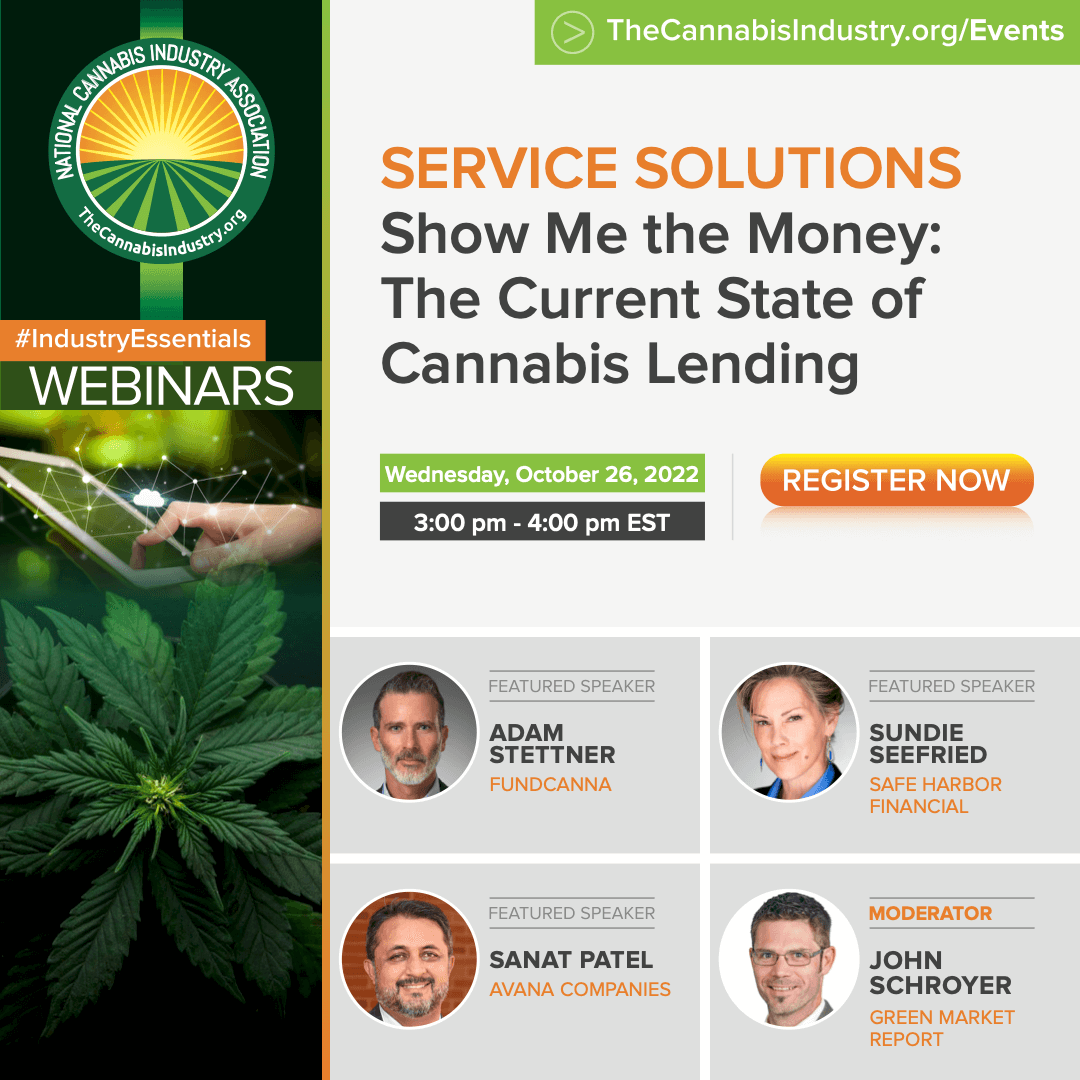
Service Solutions | 10.26.22 | Show Me the Money – The Current State of Cannabis Lending
NCIA’s Service Solutions series is our sponsored content webinar program which allows business owners the opportunity to learn more about premier products, services and industry solutions directly from our network of established suppliers, providers and thought leaders.
In this edition originally aired on Wednesday, October 26, 2022 we were joined by the experts from cannabis-focused financial institutions FundCanna, Safe Harbor Financial, and AVANA Companies to dive deep into the current state of cannabis lending with leading industry journalist John Schroyer of Green Market Report.
A decade after California and Colorado became the first adult use states, the regulated U.S. cannabis market encompasses over 70,000 cannabis-related businesses. Shockingly, most of those businesses still lack easy access to debt and other forms of growth and operating capital. From federal prohibitions and the impact of IRS regulation 280e, to state and local taxation issues, the costs of operating a regulated cannabis company continue to remain nearly unendurable.
Learn what may change in the coming six to 12 months so you’ll know how to access debt capital most cost-effectively in this ever evolving environment. No matter your place in the industry or the supply chain from cultivators, manufacturers, vendors, suppliers, distributors and retailers this conversation will provide the insights to meet your financial needs.
At the conclusion of the discussion our panel hosted a moderated Q&A session to provide NCIA members an opportunity to interact with leading minds from the financial services space, join today to contribute to future conversations!
Panelists:
Adam Stettner
Founder & CEO
FundCanna
Sundie Seefried
Founder and CEO
Safe Harbor Financial
02:13 – Equity vs. Debt: With equity dried up, should cannabis companies be looking at debt financing to grow now?
07:28 – Equity vs. Debt: What do borrowers need to do before approaching a debt provider (vs. an equity provider)?
13:25 – Equity vs. Debt: What can cannabis companies or entrepreneurs do to improve their overall credit worthiness prior to seeking capital?
17:16 – How has the interest rate increases by the Federal Reserve impacted capital markets (and the industry at large) in 2022?
26:07 – Audience Q&A: “If there’s “no reason not to have banking” for your cannabis business how can I easily (and inexpensively) establish and maintain a compliant bank account?”
28:56 – Lending: What significant lending challenges are your clients currently facing within the industry?
33:56 – Lending: What advice can you provide business owners for evaluating lenders that you should (or shouldn’t) work with and tips for avoiding predatory lending practices?
39:05 – Cannabis Reform: What impact do you expect President Biden’s recent announcement will have on the industry?
49:32 – Audience Q&A: “Are your financial institutions planning to offer lending and banking services in New York, New Jersey and other new markets?”
51:42 – Audience Q&A: “With the mindset of “Investors are betting on the Jockey not the Horse.” What type of CEO or founding team would be a red flag or not a viable investment?”
55:19 – Audience Q&A: “How can I start to shift my retail company from being primarily a cash-only business?”
During a recent webinar, we polled the audience on their current positions on offering financial services – traditional financial services – to direct marijuana-related businesses (MRBs). The results, as you might imagine, were mixed but we identified one common theme: The vast majority have taken action to address cannabis banking issues. This has been the theme we’ve been championing for years. The dichotomy between state and federal cannabis laws has placed our financial institutions in a precarious position: Bank the cannabis industry, be first to the market in doing so, create a non-traditional revenue stream and help to solve public safety and other logistical issues by solving the all-cash conundrum OR continue to watch from the periphery as others take the leap?
We see the number of financial institutions – banks and credit unions – that offer financial services to cannabis businesses expanding, but not to the level suggested by FinCEN SAR data. There remains a critical need for financial services within the cannabis industry.
Why the hesitancy in tackling this issue?
The current regulatory environment is a critical factor. As it stands, our industry is relying primarily upon the FinCEN guidelines to offer financial services to cannabis-related businesses. These guidelines, coupled with a surge of proposed legislation and a regulatory perspective on risk-based risk-taking, have allowed financial institutions across the country to effectively provide financial services to cannabis-related businesses. There is a key term we’ve been using: cannabis-related businesses. Within this term, we encompass direct and indirect marijuana-related businesses, hemp, and CBD entities. The majority of those polled feel more comfortable with hemp and CBD entities primarily due to the passage of the 2018 Farm Bill. Getting into the intricacies of how the Farm Bill and the USDA’s resulting interim final rule have added a layer of complexity to banking hemp and CBD businesses is more than we can cover in this blog post. Let’s focus instead on those providing financial services to direct MRBs, those that are state-legal, licensed cultivators, extractors, and dispensaries.
It IS possible to actively bank direct MRBs, to offer stable banking services that bring the cash off the street and provide a means for these businesses to operate more effectively and efficiently, and surely in a less costly manner than an all-cash business. The regulators are not criticizing financial institutions for providing financial services to MRBs; they review these services as they would any higher-risk, complex activity. When an institution takes on too much too fast or does not have sufficient controls to know whether it actually has a higher risk or complex business concentration within its customer base, the regulators will be critical… as they should be.
So, what are they looking for?
This goes back to the theme we mentioned: Financial institutions actively addressing cannabis banking issues.
Every financial institution, whether it intends to bank direct or indirect MRBs, hemp or CBD should have a Cannabis Banking Program that assesses the inherent risks of doing so, speaks to the controls necessary to effectively manage those risks, and determine whether they are well-positioned, or have a risk-appetite for, providing financial services to the cannabis industry. Conversely, if a financial institution that has no appetite for, or does not reflect sufficient regulatory health to bank cannabis, it must establish effective controls to ensure that position can be maintained.
But, this post is about empowerment. It is about speaking to the regulatory environment in which we find ourselves. It is about providing the perspective that banking marijuana, hemp and CBD CAN be done effectively, safely and soundly. Yes, there is a significant level of infrastructure needed to do so. Yes, it does come with the need for ongoing, strong risk management and control enforcement. Yes, it can be a bit scary. By establishing a Cannabis Banking Program, comprised of a comprehensive risk assessment that drives an equally comprehensive policy, a financial institution can provide financial services across the spectrum of marijuana, hemp and CBD, and undergo regulatory scrutiny with confidence. Moreover, such a program has become a regulatory expectation to support a financial institution’s cannabis position. This is also not a program where a financial institution will set it and forget it. The risk assessment and policy must remain dynamic as legislation evolves, as regulatory perspective changes, and as a financial institution’s position or outlook may shift.
This is an industry that has already proven prolific. This is a time that will be ingrained within our nation’s history. Let’s be remembered as those who championed the issues, established the country’s infrastructure, and set the standard for those who follow.
As a former Federal bank regulator and seasoned consultant, Angela’s knowledge of regulatory compliance, risk management and investment advisory services has established her reputation as a leading resource within the financial consulting industry, spanning consumer protection and anti-money laundering statutes, fraud and cannabis banking issues.
Angela is the Managing Partner and Co-Founder of Sterling Compliance, LLC, a consumer compliance consulting firm based out of Pittsburgh, Pennsylvania. Sterling specializes in consumer protection and anti-money laundering compliance within the community banking industry and enjoys a significant online presence with a client base spanning the coasts.
In December 2019, Angela joined Integrated Compliance Solutions, LLC (ICS) upon the ICS acquisition of Sterling Compliance as an independent operating subsidiary. Angela oversees the firm’s Compliance Strategies division, of which cannabis banking is a significant component. ICS is a financial technology, banking compliance and innovative payments solution provider helping financial institutions with complex solutions. In joining the ICS team, Angela has continued the firm’s mission of bringing its complete SEED-TO-BANK™ solution to financial institutions and cannabis-related businesses throughout the United States, and has expanded the firm’s industry engagement as a well-respected authority on the regulatory and compliance issues surrounding cannabis banking.
Guest Post: Cash Management in the Cannabis Industry
Jeff Foster, Co-Founder, Jane, LLC
Interviewed by Vinnie Fiordelisi, Sr. Director of Corporate Communications, Jane, LLC
Jeff Foster, co-founder of Jane
For nearly two decades, Jeff Foster has worked with some of the world’s largest retailers and financial institutions to define, design, and implement e-commerce and retail payment processing and risk management solutions. Here he shares some advice and insights on cash management and financial services in the cannabis industry.
What is the state of cash management in the cannabis industry?
It’s a real mess. Employee theft is even higher than in bars and restaurants. Many of the dispensary owners we talk to say it’s as high as 10-15% of sales. Robberies are a real threat. The cash reconciliation process is time-consuming, costly, and susceptible to human error. But the biggest issue is it’s almost impossible to run a multi-million dollar business with all cash.
What are the common problems you hear from dispensary owners when it comes to them doing business effectively and simply?
The cannabis business has the most complicated legal and regulatory framework in the history of retail and many of the dispensary owners are first-time entrepreneurs. Combine these two things, further complicate it by a lack of banking and a business that is bustling seven days a week, and you find it extremely difficult to navigate this constantly evolving landscape.
What challenges do dispensaries face as it relates to financial services?
What challenges don’t they have? Very few have access even to depository banking, much less checking. Most cannot process credit or debit cards legitimately so they are on a strictly cash basis. So imagine having to make payroll, pay rent, or buy hundreds of thousands of dollars worth of product without the ability to write a check or send a wire. Most of the dispensary owners we talk to spend as much as 25% of their time simply managing this process. With full access to banking and financial services those same tasks would take almost no time at all.
Where do the federally regulated banks stand on working with cannabis businesses?
Marijuana is still a Schedule I drug, selling it is a felony, and the Bank Secrecy Act prevents banks from taking deposits known to be a result of a crime. This obviously makes the landscape particularly treacherous for a federally chartered bank.
I do believe more and more banks will get involved in the marijuana business. We are seeing it with the financial institutions we are working with in Colorado for our Triple Play program. There is too much momentum and popular acceptance to put the genie back in the bottle. So it is important for marijuana retailers to be prepared. Banks that do accept cannabis businesses are going to be very cautious and only accept clients that are unquestionably above board and fully transparent.
Any final advice for dispensary owners?
Yes, for dispensaries accepting Visa and MasterCard, my advice is to stop unless and until you have signed a contract that includes the name of the bank. I’ve been in payment processing for almost 20 years and our other company currently processes over $3 billion annually in Visa/MasterCard for some of the largest retailers in the world, so I have some knowledge on the subject. There are very few sponsor banks in the U.S. who will knowingly accept a merchant in the cannabis business and both Visa and MasterCard strictly prohibit utilizing a bank outside of the U.S. for domestic transactions.
Unfortunately some dispensary owners have been led to believe that if they have a terminal and their deposits show up in the bank that “it’s working.” Well that may be true, but I can nearly guarantee there is a break in the chain somewhere and that broken link can lead to fines in the hundreds of thousands of dollars and expulsion from the Visa/MasterCard network for life…just for a start.
Banking is coming. Credit card processing is coming. Dispensary owners need to focus on running their businesses within the framework established by the Department of Justice, the Financial Crimes Enforcement Network and their state and local laws regarding the sale of marijuana. If they do that, and remain patient, they will be first in line as legitimate financial services finally arrive.
Jeff Foster is co-founder of Jane, LLC, a Sponsoring level member of NCIA since July 2014. For nearly two decades, Jeff has worked with some of the world’s largest retailers and financial institutions to define, design and implement e-commerce and retail payment processing and risk management solutions. Jeff co-founded Jane after recognizing the overwhelming need for cash management and financial services solutions in the legal cannabis industry. As an innovator in financial services, Jeff is a sought-after expert and speaker. He has been quoted in numerous publications including; The Wall Street Journal, Business Week, The Financial Times, The Washington Post and The Washington Business Journal and has appeared on Bloomberg Television and ABC News. Jeff also speaks at countless financial services and cannabis trade shows globally, where he advocates and educates on everything from strategy and trends to best practices.
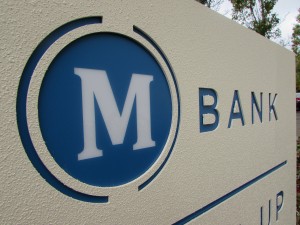
NCIA Member Profile: MBank
In the course of less than a week at the end of January, Oregon-based MBank went from announcing that they would be doing business with cannabis companies in Colorado to breaking the news that they would be retreating from Colorado for the time being, unable to support the infrastructure required to offer these services in the state. As NCIA’s first bank member, we sat down with CEO Jef Baker to ask a few questions and get to know them better.
Cannabis Industry Sector:
Financial Services
NCIA Sustaining Member Since:
December 2014
One of MBank’s brick and mortar locations in Lake Grove, Oregon.
How does MBank uniquely serve the cannabis industry?
One of MBank’s goals is to serve the underserved. We recognize that serving the cannabis industry very much meets that objective. With that mission in mind, we set about figuring out how to provide banking services. We’re a little unique in that way as a bank has to be creative and innovative in order to go about solving problems.
Why should cannabis industry professionals looking for financial services use MBank?
While we recognize there are very few banks legitimately operating in this space and therefore few good choices for cannabis industry professionals, our hope is people choose to bank with us for the same reason anyone does. That means they understand what we’re about and hopefully appreciate wanting to partner with someone that has a vision they agree with. Beyond wanting to change the status quo with regards to banking, we also take great pride in customer service through treating people with respect.
NCIA’s primary mission includes advocating for equal access to banking, but many banks in this country are reluctant or not willing to work with cannabis business owners. What are your thoughts on the future of banking in the cannabis industry? How will this situation improve for the industry going forward?
Smaller banks will most likely lead the way as they tend to embrace innovation a little more than larger institutions. As banks successfully demonstrate their ability to serve this industry, more banks will follow. If there are additional changes at the federal level, that most likely would generate more banks entering this space.
What are some of the challenges that banks have to deal with to do business with the cannabis industry?
CEO Jef Baker inside one of MBank’s Oregon locations.
Our challenge is to make sure we support and serve customers who understand that compliance is critical. We feel it is extremely important to ensure we implement strong policies and procedures, especially for new lines of business. The systems created are not designed to be intrusive or overbearing, but they are developed to help us manage risk, as we interpret it, as well as those that regulate us.
Do you still want to do business in Colorado, or other states?
The reason we are one of the first banks to so aggressively enter this space is part of our mission is to serve a completely underserved market. We very much want to serve customers in Colorado but have discovered we need to build our program to better handle the huge volume there.
How do you characterize your relationship with regulators on marijuana banking?
It is our belief that regulators do not object to their banks providing services to the cannabis industry. We believe they do have a high expectation of their banks developing strong compliance programs in this area. This is new and we are all learning together. It is critical for us to have a strong relationship with our regulators.
Why did you join NCIA?
MBank currently offers banking services for the cannabis industry in Oregon.
We believe this organization wants to see the cannabis industry be treated fairly by helping ensure that quality banking services are available. That is right in line with our mission of serving the underserved. Our position is not one that supports legalization or advocacy for legal matters (that is for others), but rather a focus on providing an industry banking services they deserve, which means both access to services as well as treating people with respect. We believe NCIA is an organization that will allow us to further and pursue that vision.
If you are a member of NCIA and would like to contribute to the NCIA blog, please contact development officer Bethany Moore by emailing bethany@thecannabisindustry.org.





 As a former Federal bank regulator and seasoned consultant, Angela’s knowledge of regulatory compliance, risk management and investment advisory services has established her reputation as a leading resource within the financial consulting industry, spanning consumer protection and anti-money laundering statutes, fraud and cannabis banking issues.


Follow NCIA
Newsletter
Facebook
Twitter
LinkedIn
Instagram
News & Resource Topics
–
This Just In
How THCa Vapes Are Changing Consumer
Announcing NCIA’s 2026-2028 Board of Directors