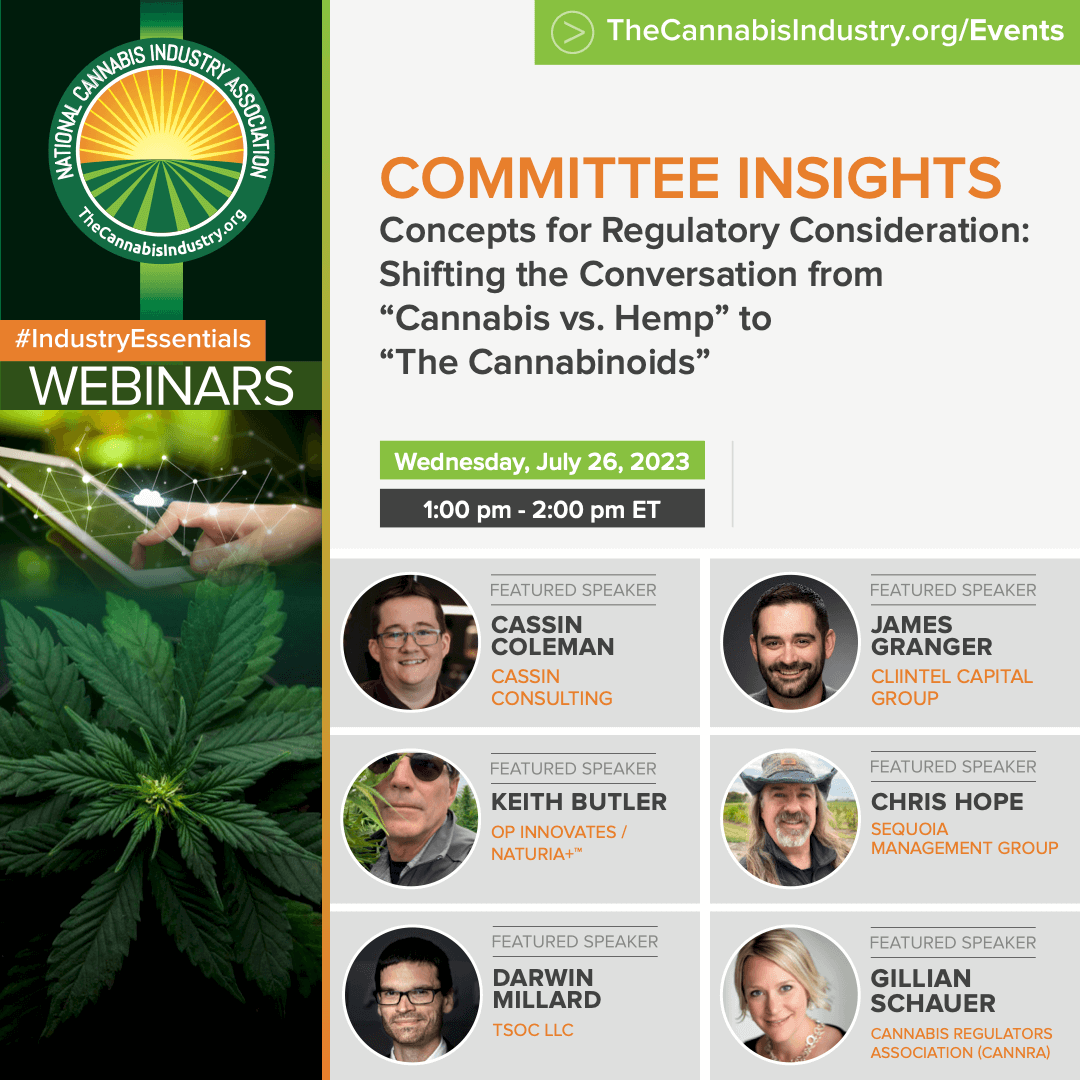
Committee Insights | 7.26.23 | Concepts for Regulatory Consideration – Shifting the Conversation from “Cannabis vs. Hemp” to “The Cannabinoids”
NCIA’s #IndustryEssentials webinar series is our premier digital educational platform featuring a variety of interactive programs allowing us to provide you timely, engaging and essential education when you need it most.
In this edition of our NCIA Committee Insights series, originally aired on July 26, we were joined by leading cannabinoid product manufacturers and Cannabis Regulators Association (representing cannabis and hemp regulators across more than 40 states and U.S. territories) to examine different approaches to regulating consumer products containing cannabinoids across the US and discuss the potential for harmonized regulations in the future.
Regulating the cannabinoids is difficult enough, but throw in the challenges associated with cannabinoids derived from marijuana or hemp and the challenges can get even more complicated. Not to mention the debate between intoxicating and non-intoxicating cannabinoids and how to address the risks to public health and safety from these different types of cannabinoids. Then you have the proverbial “cherry on top” with how to address cannabinoids, both naturally occurring and novel, being produced by genetically modified organisms and scientists in the lab. There has got to be a logical way to solve this problem.
One potential solution is shifting the conversation away from cannabis vs. hemp and toward the constituents of concern, the cannabinoids. By regulating the cannabinoids, we can focus the debate on what matters, how to regulate cannabinoid ingredients in a way that is proportional to the level of risk to public health and safety. This ensures we have both a functional and vibrant cannabinoid products market and the means to protect consumers.
Learning Objectives:
• Learn about the similarities and differences between marijuana and hemp regulations for consumer products containing cannabinoids
• Find out what a consumer product containing cannabinoids is and how this concept can be used to promote more common sense regulations
• Listen to new perspectives on the challenges facing the cannabinoid-containing consumer products space and how to more efficiently regulate this marketplace
Curious about the complex world of cannabinoid regulation? Sit back and settle in for an insightful webinar where we delve into the challenges (and solutions!) surrounding cannabinoids derived from marijuana and hemp.
Safeguarding Consumers in the Cannabinoid Product Landscape (Part III):
Know Your Hazards – Occupational Health and Safety Considerations in Cannabinoid Ingredient Manufacturing (Part IV): https://bit.ly/3rEUeKP
Committee Insights | Safeguarding Consumers in the Cannabinoid Product Landscape
NCIA’s #IndustryEssentials webinar series is our premier digital educational platform featuring a variety of interactive programs allowing us to provide you timely, engaging and essential education when you need it most.
In this edition of our NCIA Committee Insights series, originally aired on June 13, we were joined by members of NCIA’s Cannabis Manufacturing, Scientific Advisory and Hemp Committees for an in-depth discussion of the current cannabinoid testing & labeling landscape alongside complications compounding consumer safety and product manufacturing concerns.
Consumer products that contain cannabinoids are a popular new consumer product category sweeping the United States. Whether these consumer products are manufactured using cannabinoids derived from cannabis or hemp, consumers deserve to know what they are consuming.
Truth in labeling is critical to providing cannabinoid content information to a consumer so they can make an informed purchase decision and in ensuring consumer safety. However, with so many different label content requirements from state to state for consumer products containing cannabinoids, this lack of consistency can lead to potential risks to the end consumer.
This is especially true when the majority of cannabinoid product manufacturers are dependent on third-party data during product manufacturing and compliance testing. This interdependence between testing laboratories and product manufacturers makes it all the more important that label content requirements are both achievable from a manufacturing standpoint without being overly burdensome for regulators to verify and do not endanger public health and safety.
In this webinar, our panelists explored about the current state of America’s somewhat-monitored cannabinoid-product marketplace, and examined several of the issues related to cannabinoid quantification, cannabinoid content declarations, and label claim verification and how these relate to consumer safety.
Learning Objectives:
• Learn about the potential risks associated with untested, unlabeled products both for the business owner and as a consumer
• Review the current landscape of cannabinoid testing requirements, how they vary state to state and the role 3rd party labs play in the picture
• Understand the nuances with label content compliance and implications on label claims
• Explore data integrity issues preventing consumers from making informed decisions
• Share best practices for what the the industry should do, what consumers can do and what regulators need to do
Panelists:
Paul Coble
Technology Attorney
Harris Bricken Sliwoski LLP
Matthew Johnson
Vice President, Risk Services
QuadScore Insurance Services
Safeguarding Consumers in the Cannabinoid Product Landscape (Part III): https://bit.ly/3Xc9Lx6
Know Your Hazards – Occupational Health and Safety Considerations in Cannabinoid Ingredient Manufacturing (Part IV): https://bit.ly/3rEUeKP
Concepts for Regulatory Consideration – Shifting the Conversation from “Cannabis vs. Hemp” to “The Cannabinoids” (Part V): https://bit.ly/3P3r5AW
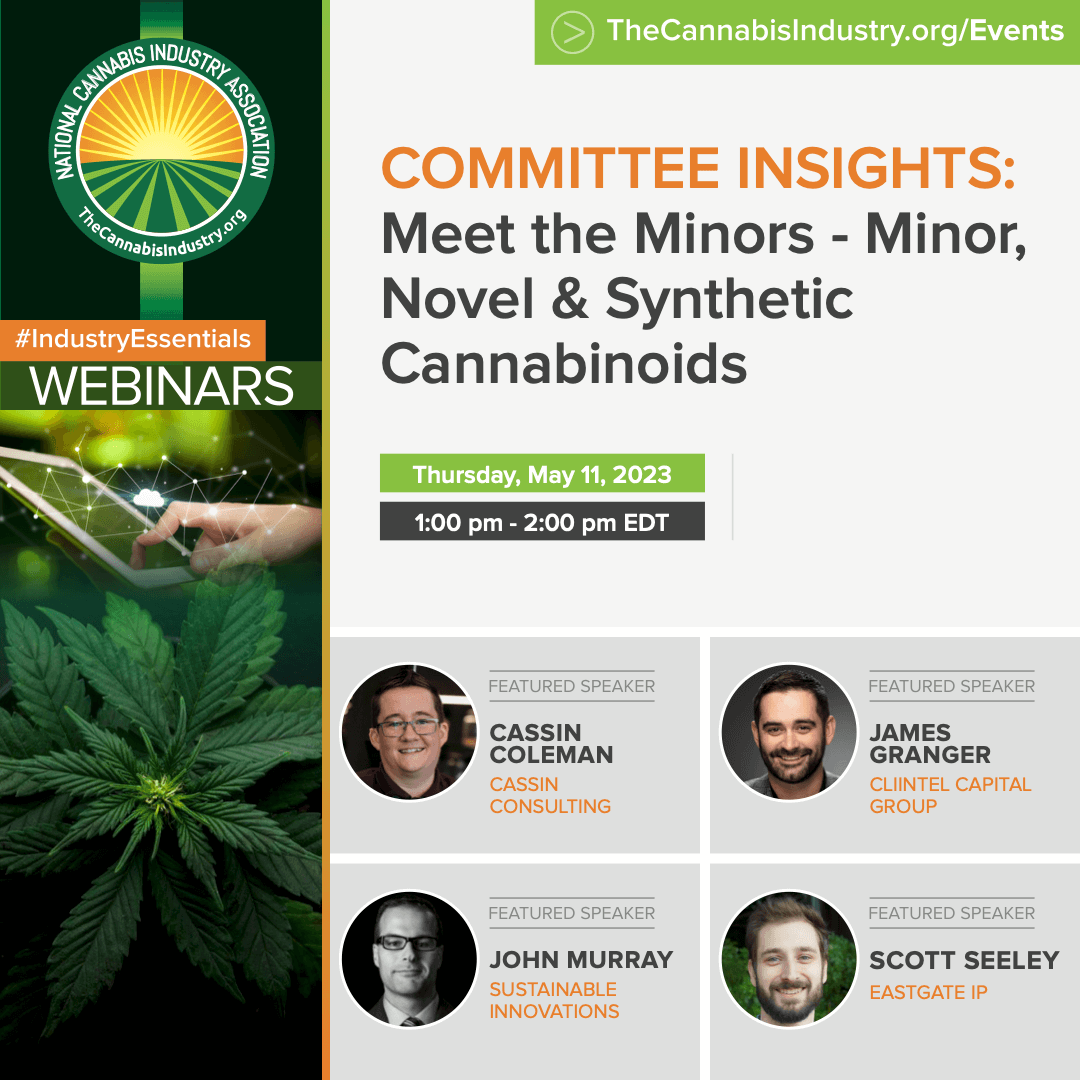
Committee Insights | Meet the Minors (Novel, Minor, Synthetic Cannabinoids – Part II)
In this edition of our NCIA Committee Insights series, originally aired on May 11, 2023, we were joined by members of NCIA’s Cannabis Manufacturing, Scientific Advisory and Hemp Committees for an in-depth discussion of the most talked about minor, novel, and synthetic cannabinoids.
What scientific publications exist for each compound? What do we know about each molecule’s physiological, psychoactive, and therapeutic effects?
You’ll find out during this informative session featuring leading chemical experts, manufacturers and product development specialists. Along with audience members they explored these compounds from various perspectives to examine their implications for consumers, medical practitioners, patients, producers and regulators.
Learning Objectives:
• Molecular Structures and Identification of novel, minor, and synthetic compounds
• Published Physiological and Psychoactive effects of these compounds
• Perceived therapeutic effects
• Opportunity to ask about other new compounds not in presentation.
NCIA’s #IndustryEssentials webinar series is our premier digital educational series featuring a variety of interactive programs allowing us to provide you timely, engaging and essential education when you need it most.
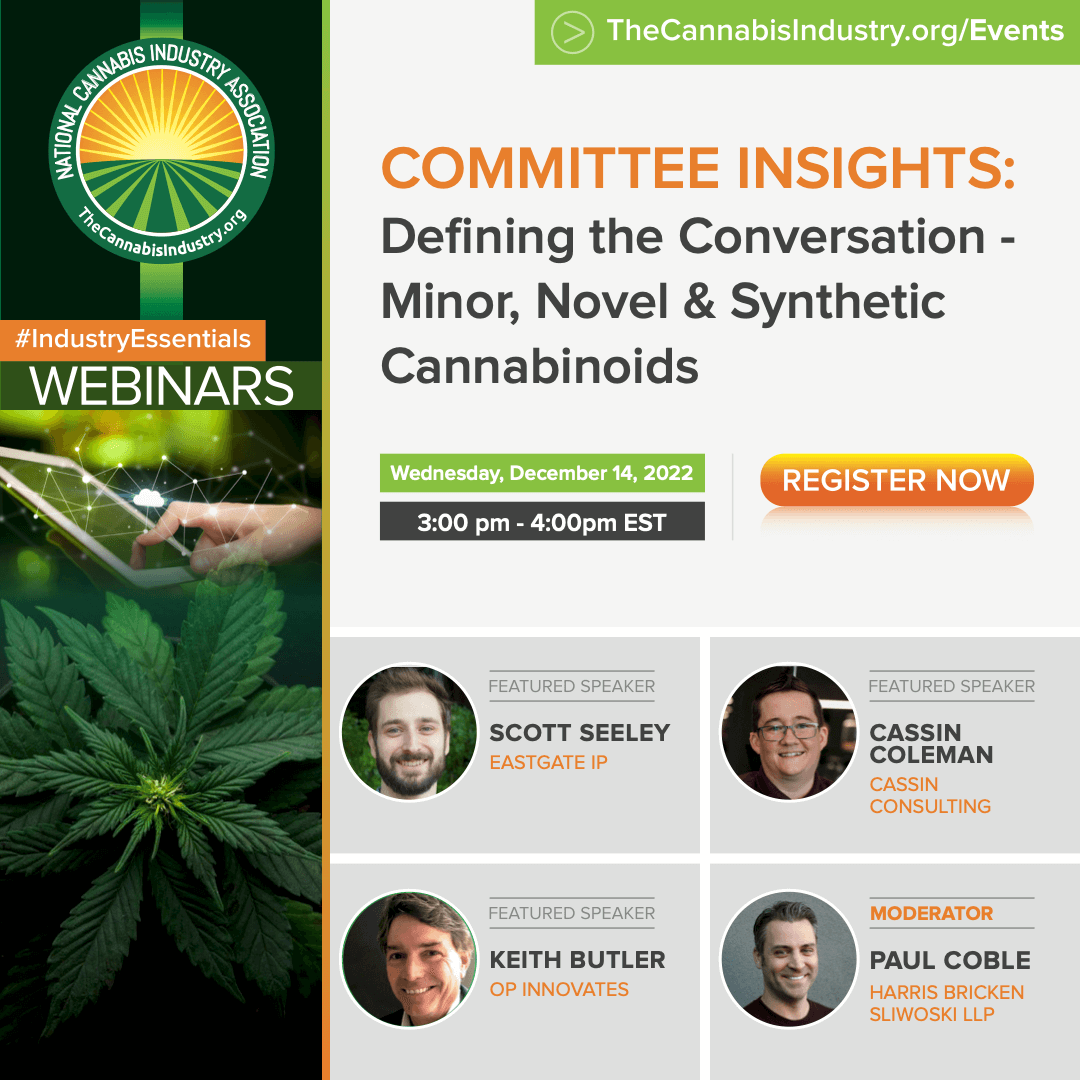
In this edition of our NCIA Committee Insights series, originally aired on December 14 and produced in collaboration by NCIA’s Cannabis Manufacturing Committee, Scientific Advisory Committee and Hemp Committee we introduced and framed the myriad regulatory, scientific, linguistic, and ethical issues that come with the rise of minor, novel, and synthetic cannabinoids.
Learning Objectives:
• Understand the role of minor, novel, and synthetic cannabinoids in the cannabis industry and the unique issues relating to their current status.
At the conclusion of the discussion our panel hosted a lengthy moderated Q&A session so our network could get all their burning questions answered by these leading manufacturing, biochemical, and legal professionals from the hemp and cannabis industries.
Panelists:
Scott Seeley
Biochemist and Patent/TM Attorney @Eastgate IP
Cassin Coleman
Founder
Cassin Consulting
Keith Butler
CEO
OP Innovates / Hemp Mellow
Paul Coble
Intellectual Property Attorney
Harris Bricken Sliwoski LLP
There is more to cannabis than THC and CBD. As our understanding (and commercialization) of cannabis evolves, new compounds like CBG, delta-8-THC, THCv, and others are coming onto the scene. These various “minor” cannabinoids, however, bring with them a host of new issues.
Over the next few months this collaboration will continue to explore these issues with various subjects ranging from basic and advanced overviews of these molecules, regulatory recommendations, risk management and compliance concerns all the way to consumer and manufacturer safety. Stay up to date and be the first to know when additional follow-up sessions are scheduled by signing up via the form below.
From Lab to Label: Safeguarding Consumers in the Cannabinoid Product Landscape (Part III): https://bit.ly/3Xc9Lx6
Know Your Hazards – Occupational Health and Safety Considerations in Cannabinoid Ingredient Manufacturing (Part IV): https://bit.ly/3rEUeKP
Concepts for Regulatory Consideration – Shifting the Conversation from “Cannabis vs. Hemp” to “The Cannabinoids” (Part V): https://bit.ly/3P3r5AW
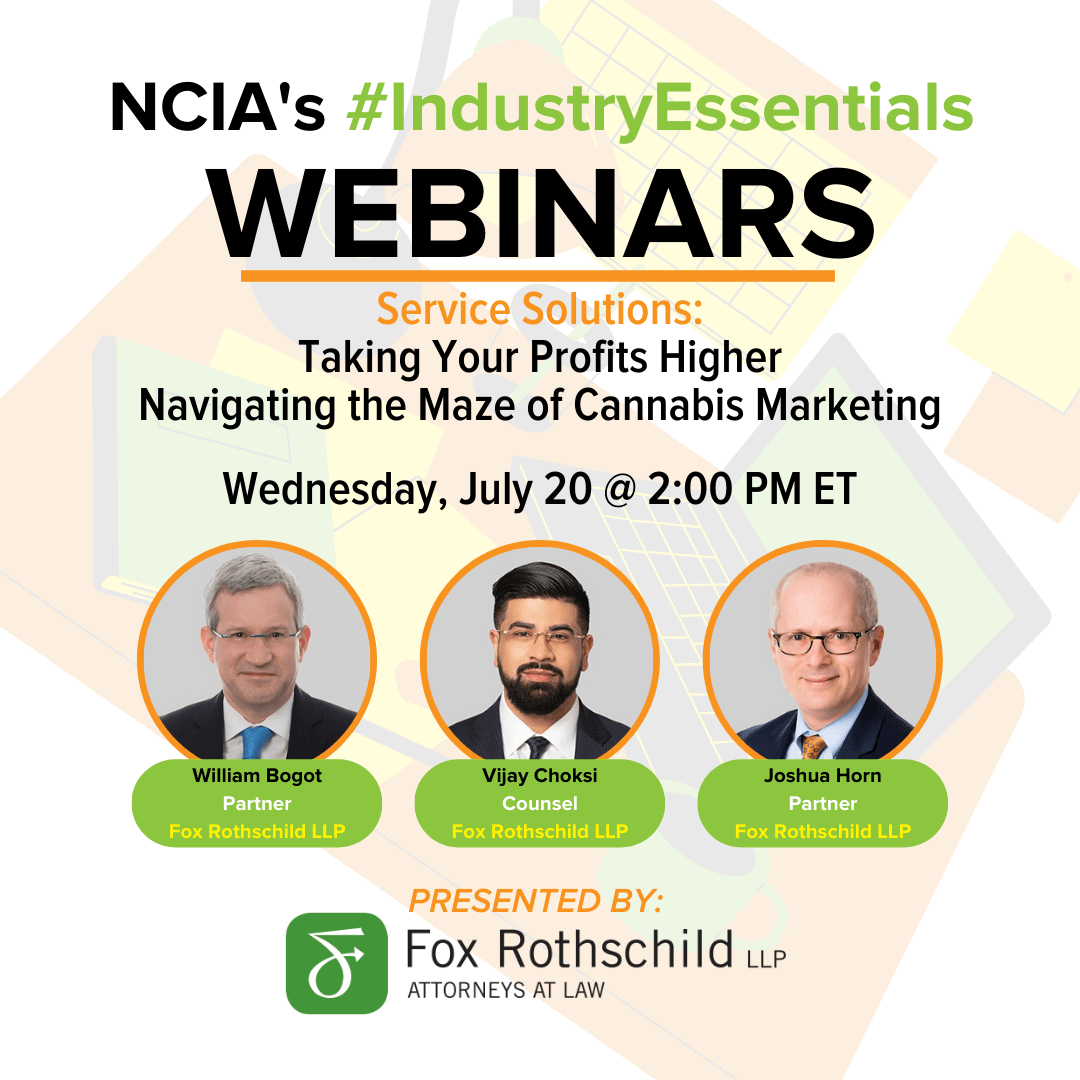
Service Solutions: Taking Your Profits Higher – Navigating the Maze of Cannabis Marketing
NCIA’s Service Solutions series is our sponsored content webinar program which allows business owners the opportunity to learn more about premier products, services and industry solutions directly from our network of established suppliers, providers and thought leaders.
In this edition originally aired on Wednesday, July 20, 2022 we were joined by Fox Rothschild LLP whose national cannabis team discussed discussed how agencies and companies can comply when marketing products.
A successful business relies on marketing and advertising to grow and bring in new customers. But what happens when those promotional efforts are heavily regulated or even restricted? These are questions and hurdles cannabis businesses face, but there are ways to navigate this maze.
04:04 – How is marketing & advertising cannabis different than other industries?
07:45 – How is marketing & advertising for cannabis different from state to state?
13:40 – Are these state restrictions for cannabis OK under the First Amendment and do similar state constitutional free speech protections exist or apply here?
15:25 – Virginia State Board of Pharmacy & Thompson Case
16:26 – Central Hudson Case & The Four-Part Test for Commercial Speech
19:57 – Equal Protection Challenges on the Horizon
26:00 – California Cannabis Consumption Event Permitting Process
31:39 – How is marketing & advertising for hemp-based CBD products different than other industries?
37:28 – What is a curative healthcare claim and how can cannabis (or CBD-based) companies develop creative methods to comply while still distinguishing themselves?
41:40 – What trends and challenges do you see on how cannabis products are being advertised and sold?
There’s been a lot of positive press lately about the success of the cannabis industry in Nevada, and with good reason. The cannabis industry contributed more than $110 million dollars in FY19 to state coffers and is poised to overtake the mining industry in annual tax contributions; all of this in just its second year of operations. But while the tax-generating retail industry continues to steam ahead, much of the business and opportunity in the balance of the industry remains on hold (since early October). The responsible moratorium has largely been erased from public awareness by the intervening holiday season and the ongoing success of tax collections over projections.
Unfortunately, while this suspension was necessary in light of the surrounding circumstances, its indefinite duration has created market instability at a time when cannabis-friendly markets are competing for business and tax dollars. Regrettably, this uncertainty has made Nevada look more like the nearly paralyzed California market. The time has come to complete the necessary work, end this moratorium and let the critical behind-the-scenes elements of our nationally leading industry get back to work.
For those that don’t recall, the present moratorium was announced by the Nevada Department of Taxation on October 17, 2019 following the recommendations of a task force initiated by the Governor. The launch of the task force was in response to two scandals: one involving the awarding of retail licenses earlier in the year and the second being the discovery that the foreign nationals identified in a national campaign finance scandal (involving former New York Mayor Rudy Giuliani), had sought to invest in and seek influence over the local cannabis industry.
Few can argue the need for a regulatory pause given the state of affairs last October, and I believe the Governor’s response was the single most effective way to stifle inappropriate corporate activity. By the simple administrative step of freezing all pending and future license transfers, the state was able to get the lawyers involved in these transactions to shut them down. The final step in almost any merger or acquisition transaction became temporarily unlawful. There’s no need for a police force when every lawyer in the industry can be deputized.
This Friday will mark ninety days since the moratorium was put into place, and would be a fine time to release this de facto suspension of all mergers, acquisitions, sales, financing, etc. After a decade and a half of practice in transactional law, I can tell you that the “invisible hand” of the market that most of us rely upon to guide capitalism isn’t invisible to the people in the transactional trenches. If the machinery behind the scenes is seized up for too long, inevitably, even the very of the supply chain (i.e. retail) will suffer.
Many capital rich companies, who only recently became comfortable with the cannabis space, are looking to deploy resources into the cannabis industry. The mechanisms to do so, and to create the jobs and economic development desired by the state and its taxpayers, are restricted to mergers, acquisitions and equity investment. Capital markets are not static. They are as dynamic as the cultures they serve and forcing them all to the sidelines for an extended period owing to the misdeeds of a small number of them, is painting with too broad a brush. It is perhaps due to the recent legality of the cannabis industry and its vestigial stigma that a transactional moratorium has been tolerated for as long as it has. It is difficult to imagine a comparable capital markets freeze in any other industry.
In the ten years I have called Las Vegas home, I have watched our city and, indeed, our state, transform from side show to main event – as we are no longer content to ride shotgun to California’s success. We Nevadans have proven capable of, and even better equipped for, leading in multiple industries, including cannabis.
To that end, we are, or certainly should be, capable of completing an “extended review” of the license transfer process as well as developing a “more thorough and appropriate vetting process” in ninety days. Ostensibly, freezing all pending transfers was undertaken to ensure that those aspiring licensees were subject to such “more thorough” process. It is difficult to imagine, however, how this process could presently be incomplete. If anything, as the state is writing the rules as it goes, it makes sense to at least unlock the “pending” transfers and provide some guidance as to the expected timeline for future transfer approvals.
We spent most of 2019 advising clients to avoid cannabis transactions in California, as the regulatory structure there is widely agreed to be in disarray. During most of that time, we were able to credibly suggest Nevada as an alternative market, free from such chaos, and capable of sustaining robust merger and acquisition activity without issue. However, as large and popular adult-use markets (e.g. Chicago, IL; Detroit, MI) open and expand, and agriculturally experienced markets expand into hemp and CBD production, we are left to advising clients that their dollars are better spent elsewhere.
However, there is still time to start the new year and new decade with a local cannabis market that is looking to lead and provide prototypical regulatory and compliance guidance, as it was prior to last October. If we don’t, we can’t expect other cannabis-legal states or businesses choosing between them to wait for us to figure it out. And when federal legalization undoubtedly arrives, the loss of time in developing the Nevada market will no longer be treated trivially.
Glenn H. Truitt, Esq. is the Managing Partner of Ideal Business Partners, a boutique multi-disciplinary professional firm focusing on serving businesses in the cannabis, hemp and CBD spaces. He is a graduate of the U.S. Naval Academy and Stanford Law School, is licensed to practice in California and Nevada and has been practicing for 15 years.


 Glenn H. Truitt, Esq. is the Managing Partner of
Follow NCIA
Newsletter
Facebook
Twitter
LinkedIn
Instagram
News & Resource Topics
–
This Just In
NCIA Applauds Reintroduction of SAFE Banking Following Lobby Days
Beyond Rescheduling: Inside NCIA’s 14th Annual National Cannabis Industry Lobby Days