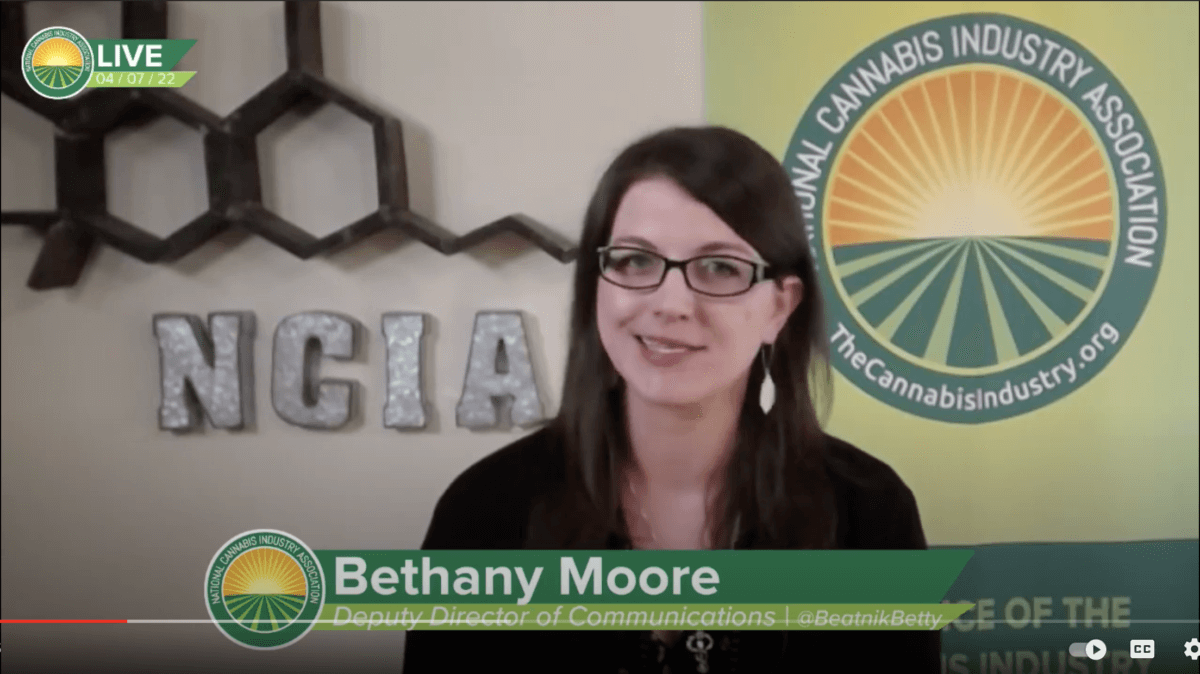
NCIA Deputy Director of Communications Bethany Moore checks in with what’s going on across the country with the National Cannabis Industry Association’s membership, board, allies, and staff. Join us every other Thursday on Facebook for NCIA Today Live.
This episode of NCIA Today is brought to you by Senseon Secure Access, offering concealed protection, monitoring, and workflow management for dispensaries. Senseon is ready to provide you with an exceptional customer experience, plus improved efficiency and compliance, not to mention slim and modular aesthetics. Learn more about their security solutions and cost benefits at Senseon.com.
Continuing Conversations on Capitol Hill
by Madeline Grant, NCIA’s Government Relations Manager
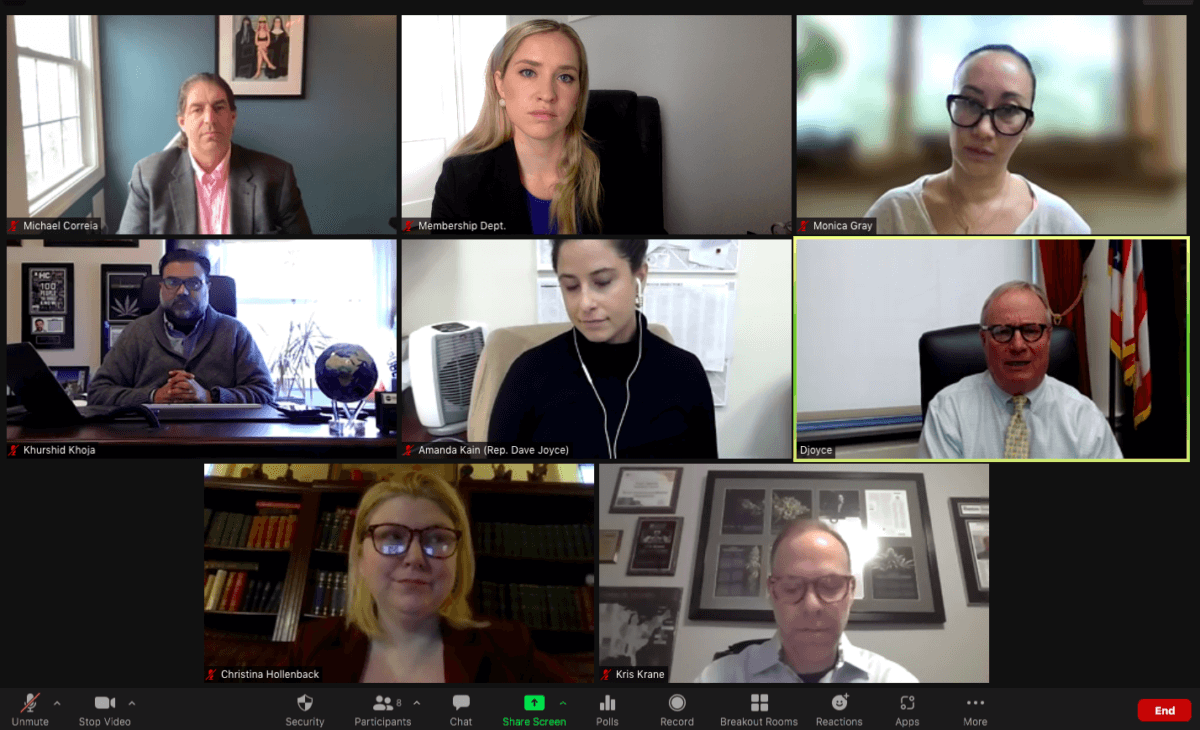
The National Cannabis Industry Association (NCIA) held its very first Virtual Mini Lobby Days with NCIA’s Evergreen Roundtable members. Before the pandemic and closure of our Nation’s Capital, the Government Relations team planned an in-person annual fly-in every spring, the Annual Cannabis Industry Lobby Days, for all NCIA members. For our first Virtual Mini Lobby Days, it was important to facilitate conversations between our Roundtable and Capitol Hill offices. The Evergreen membership tier is for leading businesses looking to make a meaningful investment in shaping policy for the cannabis industry. Evergreen members receive exclusive access to private briefings from members of Congress, inside information from NCIA’s government relations team, and many more opportunities to participate in the national conversation around cannabis policy.
Now more than ever we’ve seen more comprehensive legislation being introduced at the federal level, on both sides of the aisle, so we wanted to focus on meetings with our cannabis champions but also educate all congressional offices on Capitol Hill. We were able to meet with representatives, senators, committee staff, office staff, and much more. Evergreen members were able to share information, stories, and data to Hill offices.
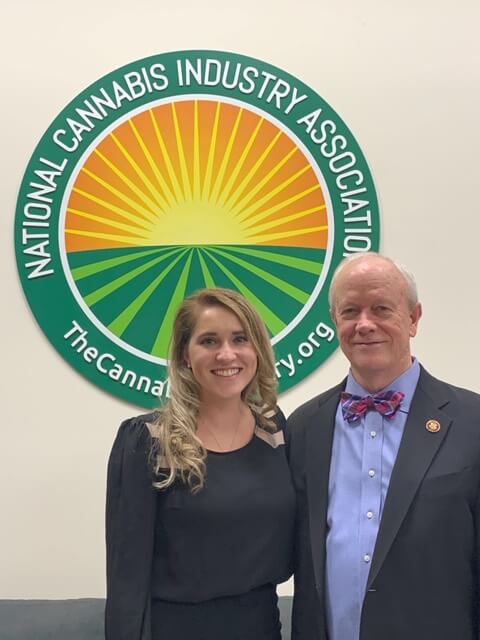
The NCIA team, Monica Gray with Nice Guys Delivery, Khurshid Khoja with Greenbridge Corporate Counsel, and Christina Hollenback with The People’s Ecosystem meeting with Congressman Dave Joyce (OH-14), a co-chair of the Congressional Cannabis Caucus.
As we hopped on our zoom calls, our main focus was education. The Evergreen Roundtable was able to share stories from their personal experiences in the cannabis industry and directly relate these experiences to the importance of cannabis policy reform. The dichotomy around incremental versus comprehensive cannabis policy reform was a central focus in discussion. As around thirty meetings took place throughout the week, the Government Relations team and Evergreen Roundtable caught up with friends, gained valuable insight, and continued to educate Congress. We took this opportunity to show our support and gratitude for all the representatives and senators who constantly support cannabis policy reform. Furthermore, we educated congressional offices with data, testimonials, and research to highlight the necessity for cannabis policy reform at the federal level. There is no doubt that reform is needed for the cannabis community and NCIA will continue to be a resource to all congressional offices.
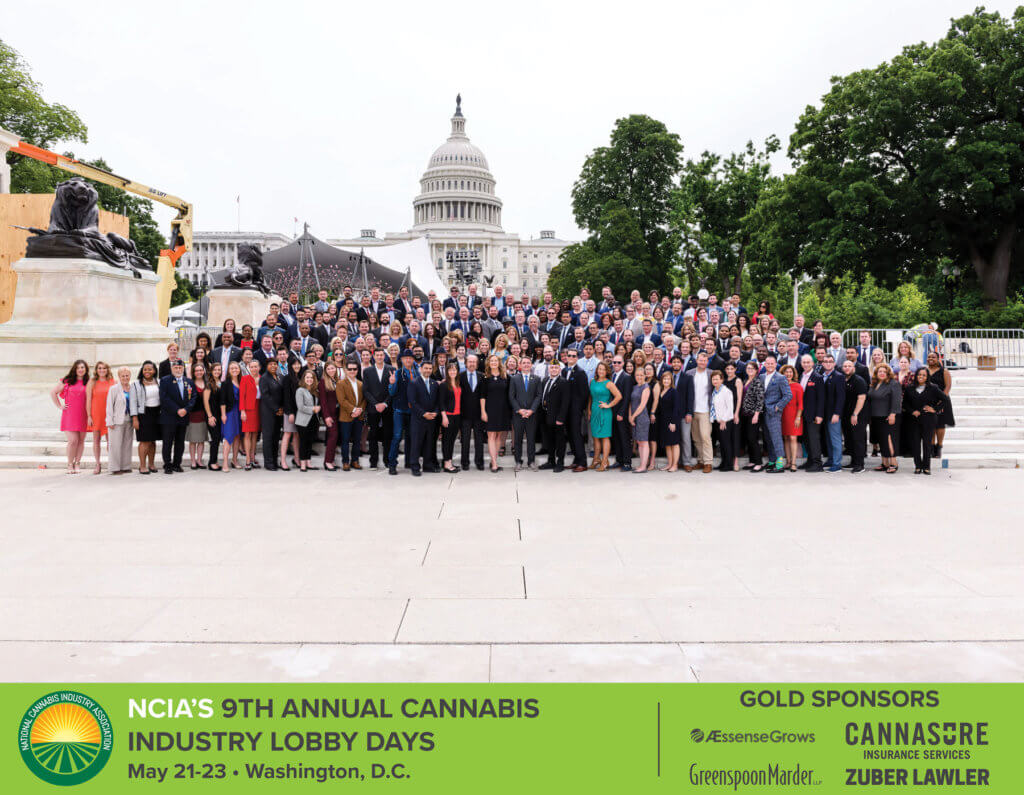
NCIA’s 9th Annual Cannabis Industry Lobby Days in 2019 May 21-23 2019.
As we monitor the full opening of Capitol Hill, stay tuned for updates regarding NCIA Lobby Days. The Government Relations team is looking forward to our next Mini Lobby Days later this year for all Evergreen members. If you’re interested in learning more or getting involved in our policy work please feel free to reach out to Madeline@TheCannabisIndustry.org.
SAFE Banking Act Passed by House of Reps. Again in Bipartisan Vote
Legislation would allow state-legal cannabis businesses fair access to financial services
Today is fourth time the House has approved cannabis banking reform
The House of Representatives approved legislation again today that would provide safe harbor for financial service providers to work with cannabis businesses that are in compliance with state laws. The Secure and Fair Enforcement (SAFE) Banking Act, or H.R. 1996, was reintroduced in March by Reps. Ed Perlmutter (D-CO), Steve Stivers (R-OH), Nydia Velazquez (D-NY), and Warren Davidson (R-OH), and had 177 total cosponsors by the time of the vote. The legislation was approved by a vote of 321-101, including a majority of voting Republicans.
This is the fourth time that the House has approved the language of the SAFE Banking Act, initially as the first standalone cannabis policy reform bill ever passed by either chamber of Congress in 2019 and two more times last year as part of pandemic relief packages that were not approved in the Senate.
“We are incredibly grateful to the bill sponsors who have been working with us for the last eight years to make this sensible legislation become law and have shepherded it through the House time and again,” said Aaron Smith, co-founder and chief executive officer of the National Cannabis Industry Association. “The SAFE Banking Act is vital for improving public safety and transparency and will improve the lives of the more than 300,000 people who work in the state-legal cannabis industry. It will also help level the playing field for small businesses and communities with limited access to capital. It is time for the Senate to start considering the companion legislation without delay.”
Advocates are hopeful that Senate Banking Committee Chair Sherrod Brown (D-OH) will take up the bill in the near future so that it can begin to move through the upper chamber as soon as possible and become law before the end of the year.
The SAFE Banking Act would protect financial institutions from federal prosecution for providing banking and other services to cannabis businesses that are in compliance with state law, as well as help address serious public health and safety concerns caused by operating in predominantly cash-only environments. The legislation would improve the operational viability of small businesses by helping them reduce costs associated with lack of access to banking and increasing options for traditional lending that many small businesses in other fields rely upon. It would also mandate a study on diversity in the cannabis industry.
Laws making cannabis legal for adults have been passed in 18 states as well as the District of Columbia and the territories of CNMI and Guam, and 36 states as well as several territories have comprehensive medical cannabis laws. The substance is legal in some form in 47 states.
###
The 117th Congress – What To Watch
Before we dive into what to watch this Congress, we’d like to acknowledge the totally unacceptable and disgusting violence that besieged the Capitol recently. You can read NCIA’s statement on the insurrectionhere.
by Michelle Rutter Friberg, NCIA’s Deputy Director of Government Relations
Photo By CannabisCamera.com
We’re barely halfway through January, and it already feels like so much has happened in 2021! We at NCIA anxiously watched along with the rest of the country to see who would be victorious in the Georgia Senate races and, subsequently, which party would control the U.S. Senate. Both of the Democrats, Rev. Raphael Warnock and Jon Ossoff defeated their Republican opponents and won their races —- ensuring that the Senate will be split 50-50 with Vice President-elect Harris being the tiebreaker.
The 117th Congress has barely begun, but after Inauguration Day on January 20th, things will really take off here in the nation’s capital. Keep reading to see my answers to FAQ’s for the new Congress:
Whatever happened to the SAFE Banking Act?
During the 116th Congress, the SAFE Banking Act (H.R. 1595/S. 1200) became the first cannabis-related bill to be passed by a chamber of Congress. In September of 2019, SAFE came to the House Floor under a suspension of the rules and passed by a whopping 321-103. While the bill had a hearing in the Senate Banking Committee back in the summer of 2019, it never received a markup or moved further than that. In addition to the bill itself, the SAFE Banking Act was also included in not one, but two COVID-19 relief packages passed by the House, colloquially known as HEROES I & II.
This session, the SAFE Banking Act will be back, and with even better chances to pass! The bill will be reintroduced in both the House and Senate in the next 1-2 months and we expect little to no changes to the text. Additionally, we’re also continuing to work with our Hill champions on this issue to see if we can get the language included in the next COVID-19 relief package — something that both President-elect Biden and Democratic leadership has said is pretty much priority number one.
In the meantime, keep an eye out for reintroduction and for how many cosponsors the bill has when it’s dropped — when the 116th Congress ended, SAFE had already passed the House as but also had 33 Senate cosponsors — that’s one-third of the entire chamber!
What’s next for the MORE Act and comprehensive cannabis reform? Is legalization on the horizon?
Cannabis policy ended the year on a high note (no pun intended!) when the Marijuana Opportunity, Reinvestment, and Expungement Act (H.R. 3884), commonly known as the MORE Act, passed out of the House of Representatives by a vote of 228-164.
As I mentioned earlier, all eyes were on the Georgia Senate races as we strategized over what could be possible for the 117th Congress depending on the outcome. With the results in, we now have a better idea about what’s possible with comprehensive reform, but there’s still a lot of unknowns. We know that the MORE Act will be reintroduced sometime in the coming months in both the House and Senate. In the Senate, the lead sponsor was Kamala Harris, who is now Vice President-elect, which means another Senator will have to pick up the torch. I can’t share with you who it’s going to be just yet, but trust me when I say they will be a wonderful lead and are a true champion for cannabis reform!
A reintroduced MORE Act will likely have a good number of edits and changes, but the underlying intent of the bill will be the same: to remove cannabis from the Controlled Substances Act and help repair the harms the war on drugs has done — specifically to communities of color.
We also know that comprehensive reform, in general, has a better chance of advancing given that Democrats now control the Senate. Sen. Schumer (D-NY) was quoted in October as saying if he’s reinstalled as Majority Leader he “will put this bill in play,” and “I think we’ll have a good chance to pass it”, talking about his own bill, the Marijuana Freedom and Opportunity Act (S. 1552).
All of that being said, legalization, or the passage of comprehensive reform is far from a done deal. Legislation requires 60 votes for passage in the Senate, and we have a lot of hard work to do to get to that level of support in the upper chamber. In the House, Democrats have an even slimmer majority now than during the 116th Congress, so we also have to make sure we don’t lose support there.
What about appropriations?
You’ve been involved in cannabis for a long time if you remember when the appropriations process was the only way to get Congress to talk about this issue. But now, with Democrats controlling both chambers, you may be hearing more about these amendments again.
Appropriations bills are legislation in Congress that “appropriates,” or sets aside, federal funds to be divided between specific federal government departments, agencies, and programs. Read more about this process and why it matters for cannabishere.
Over the last few years, the House has continued to pass marijuana-related amendments but were unable to get through the Senate due to Republican control and a “gentleman’s agreement” between the Chair and Ranking Member of the Senate Appropriations Committee. But now, all of that will change.
In the past, appropriations amendments have been introduced that touch on a multitude of issues: research, veterans, medical and adult-use cannabis, hemp, banking… the list goes on! In this session, expect to see cannabis-related amendments included in the final budget. Just remember that budget bills must be passed annually, so anything that comes into law this way must be renewed again next year!
What’s going to happen at the committee level?
If you’re following cannabis policy at the federal level, definitely keep your eyes on what’s happening in various congressional committees. Given who controls both chambers, all of the committees will now be chaired by Democrats, which means you’re going to see a lot of cannabis-related bills come up for hearings and markups. Some I’ll be keeping my eye on, including both chambers’ appropriations, financial services, tax, and judiciary committees.
The opportunities for reforming our outdated cannabis laws have never been brighter than they are right now as we begin the 117th Congress. Bills are going to begin dropping left and right — and that’s because there’s a ton of excitement, enthusiasm, and optimism about what we can accomplish over the next two years.
Want to learn more about what’s possible? Make sure your company is an active member of NCIA and register for our next members-only webinar with our government relations team on Wednesday, January 27, or, if you can’t make it, hop on over to NCIA Connect to chat with us and learn more about what we’re working on in D.C.!
Historic Victory in the House: The MORE Act
by Madeline Grant, NCIA’s Government Relations Manager
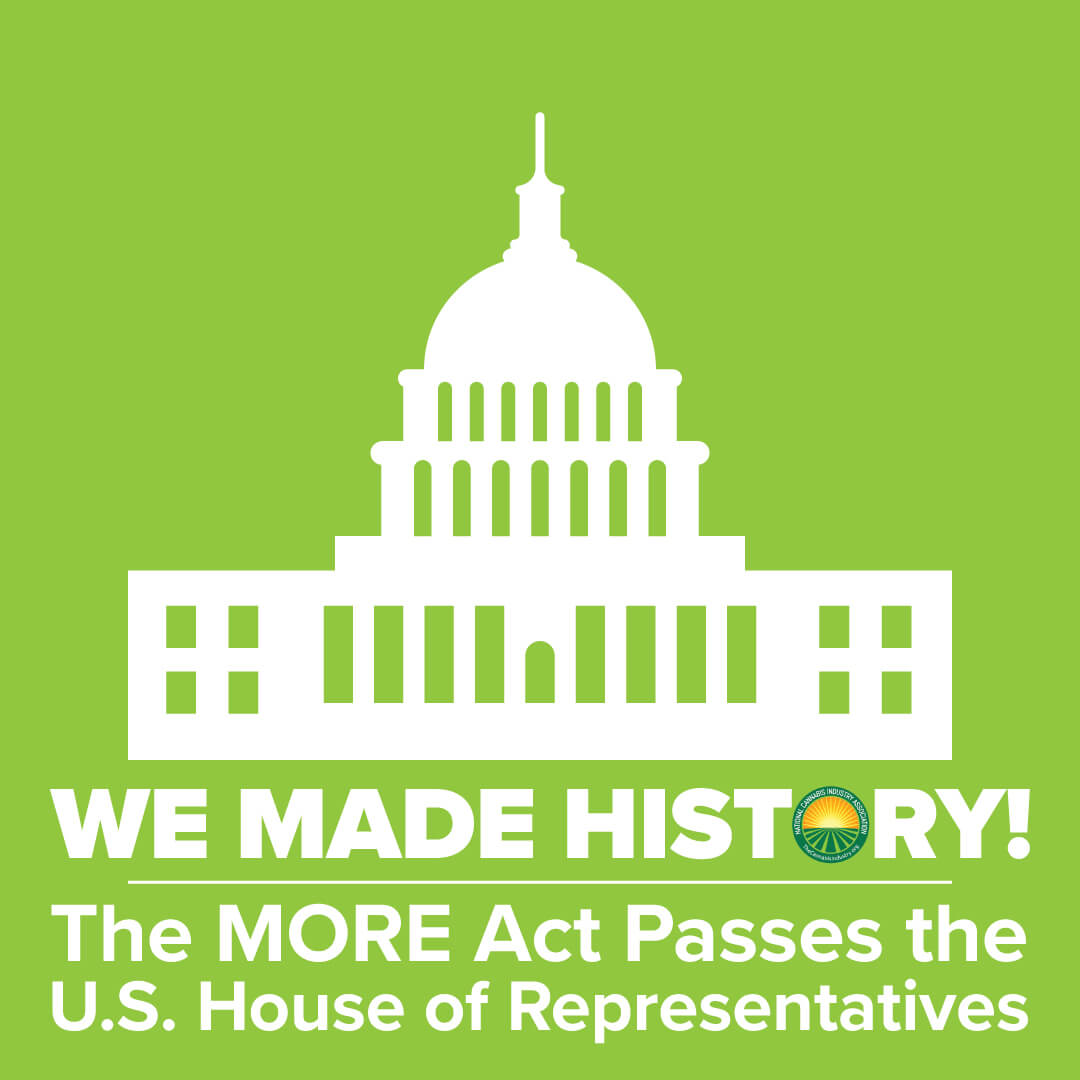
On Friday, December 4, the House of Representatives made history by voting to approve H.R. 3884, the Marijuana Opportunity, Reinvestment, and Expungement (MORE) Act. The MORE Act would remove marijuana from the federal Controlled Substances Act and work to repair the social and personal harms caused by federal marijuana enforcement. This is the first time since marijuana was made federally illegal that either chamber of Congress has held a floor vote on- or approved- a bill to make the substance legal again. The final vote count of 228-164 fell mostly along party lines, with five Republicans crossing the aisle to support, and six Democrats voting to oppose.
This monumental victory shows just how far Congress has come over the years. Although this vote more closely aligns the House of Representatives with the majority of voters who overwhelmingly support cannabis legalization, the Senate is a different story.
As we have seen over and over again, the Senate Republicans continue to obstruct cannabis reform measures. The House passed the SAFE Banking Act in September 2019 and included the SAFE Banking language in two COVID-19 relief packages, however, there has been little activity on these topics in the Senate. Republican Senators have repeatedly spoken out in opposition of bringing up cannabis policy amidst the pandemic, stating that it’s not the time or place. But as I mentioned before, it’s also important to note that the House has passed not one, but two COVID relief packages in the last 6+ months that the Senate (namely, Leader McConnell) has refused to take up. That being said, despite a global pandemic, support for cannabis reform remains strong, a recent Gallup poll showed a record 68% of Americans support making cannabis legal. On Election Day, voters in Arizona, Montana, and New Jersey approved measures to regulate cannabis for adults, while Mississippians overwhelmingly approved a medical cannabis referendum, and voters in South Dakota passed both adult-use and medical initiatives. The vote and passage of the MORE Act on the House show that House leadership is listening.
The MORE Act, sponsored by the House Judiciary Committee Chairman Jerry Nadler (D-NY) and 120 cosponsors, would not only mitigate the federal-state conflict by removing cannabis from the Controlled Substances Act, but it would also require the expungement of past federal cannabis convictions. The bill would also establish a Cannabis Justice Office to administer a program to reinvest resources in the communities that have been most heavily impacted by prohibition, funded by a tax on state-legal cannabis commerce. It would also allow the Small Business Administration to provide loans and grants to cannabis-related businesses and support state and local equity licensing programs, permit doctors within the Veterans Affairs to recommend medical cannabis to patients in accordance with applicable state laws, and prevent discrimination based on cannabis consumption during immigration proceedings.
When the House version of the MORE Act was originally introduced in 2019, it was referred to eight Committees (with the Judiciary Committee being primary). Each Committee had provisions of the bill that fell under its jurisdiction and had authority to hold hearings and or amend specific jurisdictional provisions. Two Committees (Energy and Commerce and Ways and Means) were expected to be very active on language affecting regulations and taxes. The Energy and Commerce Committee even held a legislative hearing on MORE in January, and were expected to hold more… and then COVID hit… and priorities changed.
Before the Floor vote, the main sponsor of MORE, Judiciary Chairman Jerry Nadler, offered a “manager’s amendment.” The majority of the language was taken straight from H.R. 1120/S. 420: the Marijuana Revenue and Regulation Act. It included a graduated tax, and language on federal permitting and bonding. During debate, Congressional leaders gave assurances to include the cannabis industry advocates in future discussions and listen to cannabis industry concerns. Although passage of the MORE Act is historic, no legislation is perfect and NCIA staff will continue working with congressional champions to improve MORE and eventually get it passed into law.
Now, as we near the end of the 116th Congress, the NCIA team will continue to work and strategize various ways forward in Washington, D.C– on SAFE Banking, the MORE Act, and beyond. As we see more and more legislative victories each Congress, it is important to relish in our success and continue to propel the momentum forward (we could all use a moment to celebrate after 2020!). The MORE Act vote, being the most comprehensive cannabis bill on Capitol Hill, gives us the momentum to accomplish more in the next congressional session. Thank you to each and everyone one of you who took the time to call your Representative. Stay tuned for the 117th Congress!
Supporting Our Cannabis Champions
by Madeline Grant, NCIA Government Relations Manager
With all the action in the 116th Congress so far, NCIA strives to support as many cannabis champions on Capitol Hill as possible. It is key to keep Members of Congress that support cannabis reform in the halls of Congress, as they will continue to push the momentum forward through legislation, committee activity, and education. Our NCIA-PAC Leadership Circle members make this support possible, as their contributions go straight towards Members of Congress. Below are a few events and fundraisers where we utilized PAC funds to support our issues and Members on the Hill.
NCIA staff attended Congressman Ed Perlmutter’s fundraiser in celebration of the passage of the Secure and Fair Enforcement (SAFE) Banking Act on the House side. Rep. Perlmutter is the lead sponsor of the SAFE Banking Act and because of his leadership and hard work over the years, we are seeing more success this congress than ever before!
As we are approaching the Holiday season, Members of Congress are getting festive. NCIA hosted Congressman McNerny’s Holiday Party. Our D.C. staff is making use of our new office, as we’ve hosted a handful of holiday parties this year full of conversations, hot chocolate, and cookies for all.
Another festive holiday party hosted at our D.C. office with Congressman Earl Blumenauer. The Congressman gave everyone a mini fruit cake, a famous annual tradition in the Blumenauer office. With all the momentum this congress, Congressman Blumenauer has been one of our biggest champions in cannabis reform.
Mike and I attended Rep. Porter’s lunch fundraiser this year. It is always a pleasure discussing policy issues with the congresswoman. As a freshman Member of Congress, Rep. Porter has been fighting for the cannabis industry since day 1. We had the pleasure of meeting the Congresswoman when she entered into California’s 45th district race and continue to support her with NCIA’s PAC funds.
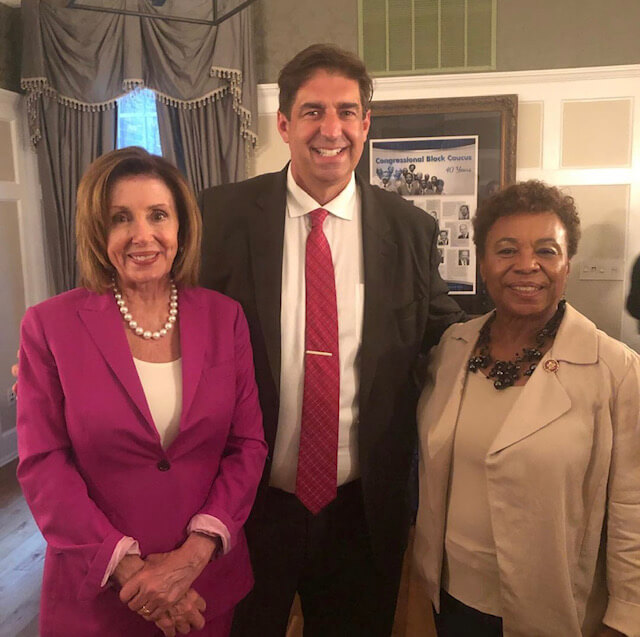
Our Director of Government Relations, Michael Correia, attended Rep. Lee’s birthday this past July. He was able to spend some time with Speaker Pelosi and Rep. Lee while discussing cannabis reform. As you know, the momentum in the 116th congress has been momentous so it’s important to thank the Members of Congress that helped make it happen.
How do we support our champions?
NCIA’s Political Action Committee (PAC) supports our champions on Capitol Hill. With NCIA-PAC funds we are able to contribute PAC dollars to the Members of Congress above and many more. These funds go to their campaigns to help them get reelected and stay to fight for us on Capitol Hill. If you are interested in learning more or getting involved with the NCIA-PAC, please send an email to Madeline@TheCannabisIndustry.org. Thank you to our PAC Leadership Circle members that help support cannabis reform on Capitol Hill- without you, we would not be able to support our champions.
By The Numbers: NCIA Members Make It Happen In The Halls Of Congress
by Michelle Rutter, NCIA Government Relations Manager
While 2017 has had some political unknowns, one thing is for sure: cannabis legislation in Congress has more support than ever — and NCIA members have helped make that happen.
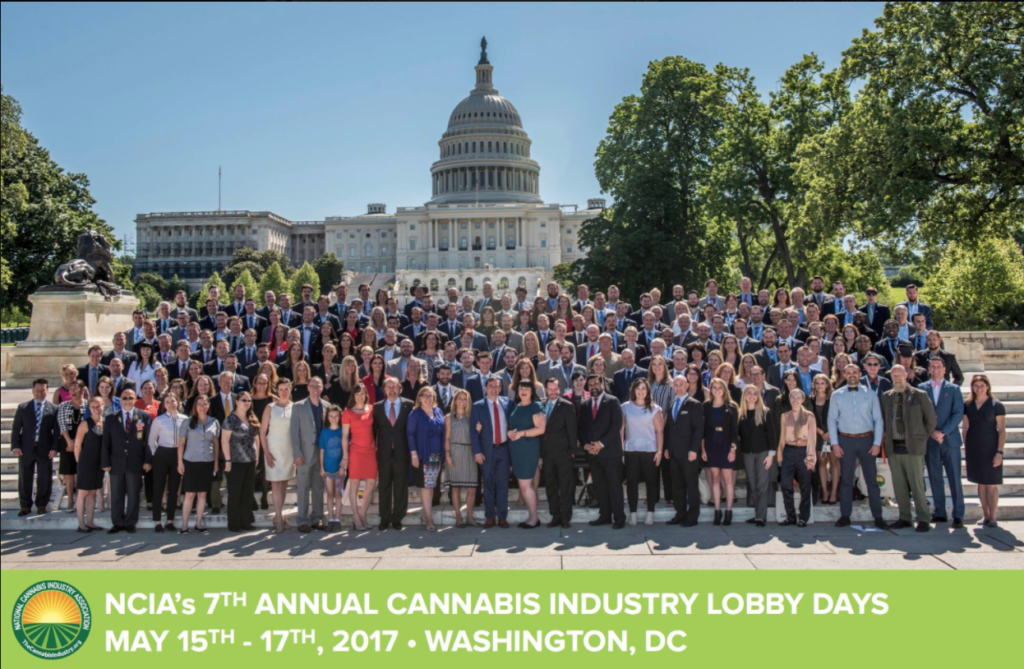
In mid-May, NCIA held its 7th Annual Cannabis Industry Lobby Days in Washington, D.C., where 250 industry professionals came together on Capitol Hill to attend more than 300 scheduled meetings. Since then, there has been a substantial increase in the number of cosponsors on cannabis-related bills compared to the last congressional session.
Last session, during the 114th Congress, Rep. Ed Perlmutter (D-CO) introduced the Marijuana Businesses Access to Banking Act, which would have created a safe harbor for financial institutions to serve marijuana-related businesses. At the end of the two-year session, the bill had 39 cosponsors.
Earlier this year, during the 115th Congress, Rep. Perlmutter introduced his new bill, the Secure and Fair Enforcement (SAFE) Banking Act (H.R. 2215). That bill currently has 47 cosponsors with nearly a year and a half left in the session to gain more support. Since NCIA’s Lobby Days in May, the SAFE Banking Act has added 18new cosponsors.
There has also been a substantial increase in the number of cosponsors on the House of Representatives bill that addresses the 280E tax problem. Last session, Rep. Earl Blumenauer (D-OR) introduced the Small Business Tax Equity Act, which ended the session with 18 cosponsors.
This year, NCIA was successful in helping secure Rep. Carlos Curbelo’s (R-FL) leadership on the Small Business Tax Equity Act of 2017 (H.R. 1810), which has been instrumental in gaining the 25 cosponsors the bill currently has. That legislation has gained 13new cosponsors since NCIA’s annual Lobby Days.
In addition to an increase in cosponsorship of cannabis-related bills, there’s also been an uptick in support for appropriations amendments at the committee level. At the end of July, the Senate Appropriations Committee adopted an amendment that would allow the Department of Veterans Affairs (V.A.) to recommend medical cannabis in states. That amendment passed by a vote of 24-7 — the most votes this measure has ever received in the Senate.
As the appropriations process continues through the summer, it’s likely that more cannabis-related amendments will be brought up and voted on, including votes dealing with protections for medical marijuana businesses and banking. NCIA is confident that if congressional leadership allows these measures to be voted upon, they will receive unprecedented levels of support.
The industry’s united voice makes a difference on Capitol Hill, and it can be seen in the numbers. To learn more about NCIA’s annual Cannabis Industry Lobby Days, you can click here.

 by Madeline Grant, NCIA’s Government Relations Manager





Follow NCIA
Newsletter
Facebook
Twitter
LinkedIn
Instagram
News & Resource Topics
–
This Just In
How THCa Vapes Are Changing Consumer
Announcing NCIA’s 2026-2028 Board of Directors