Member Blog: Key Metrics to Track & Mistakes to Avoid for Cannabis Retail Success in 2022

by Gary Cohen, Cova Software
Despite the pandemic, the cannabis industry has proven to be recession-proof and has grown exponentially over the past few years. Cannabis retail sales in the US are projected to top $30 billion in 2022, and as more states jump onto the legal bandwagon, competition will intensify. As such, dispensary owners must ensure that they are using data and analytics strategically to measure the health of their business. Many cannabis retailers fail because they don’t track crucial dispensary metrics or make avoidable mistakes.

Cannabis dispensary metrics are the data points that you must track regularly to help in better decision-making. Business intelligence reports generated via these metrics help you monitor your daily dispensary operations and create projections for future sales and required inventory. A robust cannabis POS system with advanced analytics and reporting capabilities collects information from various sources and unifies them into a single repository so that you can extract maximum insights for the growth of your retail business. By tracking some of the following important metrics, you can implement strategies to increase dispensary profits, enhance employee productivity, forecast inventory, and elevate the customer experience.
Cannabis Sales & Profits Metrics
- Number of Products Sold per Transaction
- Average Sales Value
- Total Sales for a Period
By tracking the average basket size and transaction value, you can evaluate your customer buying habits and ideal price points and create your marketing and promotional campaigns or upsell opportunities accordingly. Implementing strategies will help you increase these metrics, manage inventory and employees efficiently during your busiest sales periods, and thus, grow your dispensary profits.
Staff Productivity & Dispensary Traffic
- Individual Budtender Sales
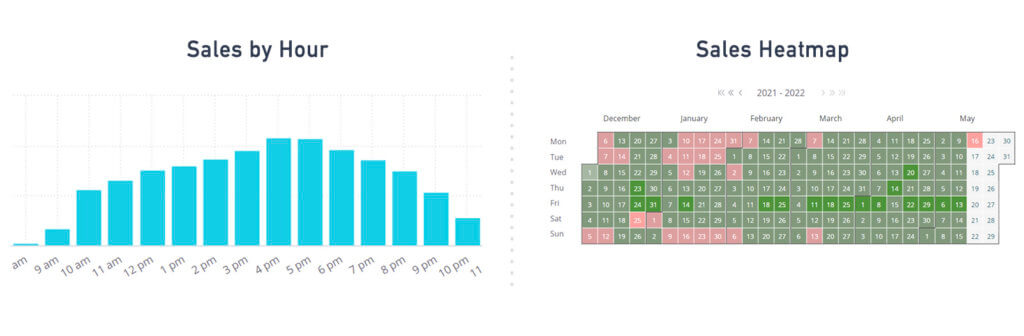
- Busiest Sales Days/Hours
- Discounts and Refunds
Tracking individual budtender sales on your POS system will help you determine your top performers and aid in staff scheduling. Those employees who have higher sales per transaction must be scheduled during your busier hours of the day, and those who may not be performing can be offered training on strategies like deals, upsells, cross-sells, and bundles. Also, potential fraud can be identified by tracking discounts or refunds offered by employees.
Target Market & Customer Retention
- Customer Demographics
- New vs Returning Customers
- Customer Lifetime Value
Segmenting your target market helps design a more customized experience based on age, location, values, buying behavior, etc. By tracking each customer’s average number of transactions over a period of time, you can determine their lifetime value and better tailor your dispensary’s promotions and upselling strategies through targeted marketing campaigns. These metrics help curate an enhanced shopping experience and increase customer retention.
Inventory & Product Performance
- Inventory Turnover
- Shrinkage
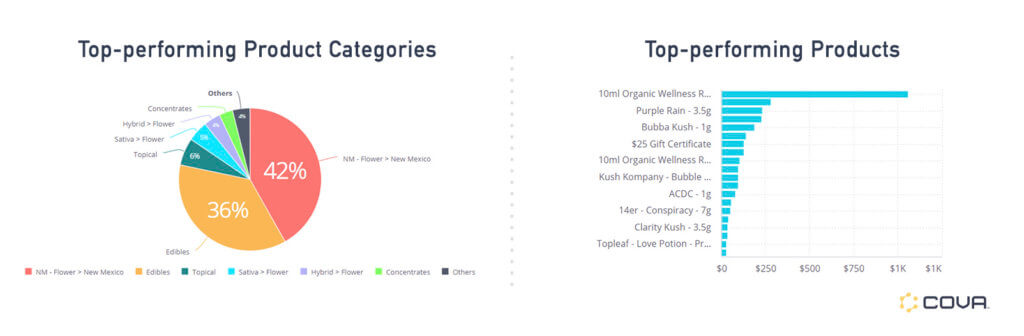
- Top-selling Product Categories
Inventory turnover measures the number of times you sold through your entire inventory in a given period and allows you to determine how much of your cash flow is tied up in inventory. Shrinkage is the difference between the inventory you have on paper and the actual inventory in stock and helps you identify theft. Also, tracking your top-selling and lowest-performing products or categories can help in crafting strategic promotions and better inventory planning decisions.
Keep up With Changing Times
Successful cannabis retailers track top-selling products, profit per product, and all other metrics highlighted above, and use this data to make business decisions. If you have a robust and flexible cannabis retail platform that offers you these detailed data insights and can scale and adapt when needed, your dispensary will always stay ahead of the curve.
Learn in detail about all the mistakes to avoid and secrets to succeed in the cannabis retail industry by downloading Cova Software’s e-book, “Why Some Cannabis Retailers Fail”, which presents cautionary tales of what not to do if you want to thrive in the dispensary business.
 Gary Cohen is the CEO of Cova Software, the fastest growing technology brand in the cannabis industry. Cohen’s focus has been driving the company’s overall strategy, including its vision, go-to-market plan, and strategic development. Since joining the cannabis industry in 2016 and launching Cova commercially in 4q17, Cohen has led Cova to dominate the enterprise sector for dispensary Point of Sale, while forging client relationships with hundreds of single-store retailers across North America.
With Cova’s cannabis POS and its excellent integrations with eCommerce and delivery services, the online order automatically pops up for the budtender to tender the sales, and the POS system updates inventory once payment is approved. Cova offers multiple eCommerce solutions to choose from, as per your needs and budget, and you can legally sell cannabis online stress-free while staying compliant with strict government regulations.
Member Blog: Cannabis Trends in 2022

by Jennifer Spanos, CannaBusiness ERP
As we approach the end of Q1 2022 and prepare to enter Q2, it’s become clear that this is going to be an important year for the cannabis industry. Cannabis business professionals and investors looking for signs of growth or stagnation in the industry will certainly be interested to see how things unfold. With that in mind, CannaBusiness ERP has put together a list of the top cannabis trends for 2022, and those trends appear to be pointing to more growth. However, it’s clear that difficulties for the cannabis sector are still imminent.
Cannabis Trends for 2022
It almost goes without saying that the cannabis industry is complex and not without its fair share of challenges as the most highly regulated industry on the market. For businesses looking to grow, keeping up with complicated and evolving regulations can be stressful enough on a business in and of itself. Cannabis cultivators, processors, and consultants can look to cannabis industry trends to inform their operational decisions.
Increased legalization in the United States
Support for legalization in the USA continues to rise. In fact, a 2021 Gallup poll found that 68% of Americans are in favor of legalizing cannabis. Not only is this a record number of supporters, but this percentage also reflects a growing sentiment among Americans regarding the use of legal cannabis.
The changing tide towards legalization is clear – more states passed legislation to legalize cannabis either medicinally or recreationally in 2021, with several more introducing legalization bills in 2022. Because states operate independently of each other, every state will have its own policies as well as regulatory and compliance requirements, which can make things very confusing for cannabis businesses, especially multi-state operators (MSOs).
The National Cannabis Industry Association (NCIA) provides a map with state-by-state policies, which is one helpful tool for businesses looking to capitalize on expansion opportunities made possible as more states legalize cannabis. CannaBusiness ERP’s Guide to Expanding Into New Markets is another great resource for MSOs that provides state-by-state information, including Nevada, New York and Pennsylvania, and useful advice to consider when expanding into new cannabis markets.
Sales will continue to increase in 2022
Leading cannabis business experts are predicting strong sales growth this year due to the growth in legalized markets for cannabis. In fact, legal cannabis sales reached $19.5 billion in 2020, and experts are projecting sales to reach $30 billion in 2022. Washington State alone, which legalized cannabis ten years ago in 2012, is expected to generate $1.5 billion in sales, up from $1.2 billion sales in 2020. But Washington’s projected sales are small when you compare them to California’s projected sales of $7.6 billion. And as more states legalize cannabis, more sales will surely follow.
Another contributing factor to increased cannabis sales is related to increased demand and a growing number of product types. More consumers are learning why cannabis can be beneficial to them, including more restful sleep, lowering stress, lessening pain symptoms, and recreational use. Additionally, with so many products on the market, cannabis consumers have many options to choose from, ranging from edibles to tinctures to topical ointments and more.
Cannabis experts are predicting a growth in cannabis consumption lounges – the cannabis equivalent of a bar or restaurant that allows consumers to use cannabis on-site. According to the Cannabis Industry Journal, the popularity of these lounges is growing because they provide consumers with a legal and safe space to consume cannabis. Just as with alcohol, the lounges are regulated according to laws set by each state.
Increasing sales means cannabis businesses are at a critical junction and need to scale operations to meet the growing demand. One way cannabis growers and processors can capitalize on the demand is by streamlining the business end-to-end with cloud-based cannabis business management software. Otherwise known as Cannabis Cloud ERP, it manages production, cultivation, compliance, inventory, financials and traceability, sales, purchasing, and more, all in one system that lives in the Cloud.
Increased legislative bills and pressure for federalization
Under U.S. Federal Law in the Controlled Substances Act, cannabis is still considered a Schedule I substance. However, as the number of states legalizing cannabis either recreationally, medicinally or both has increased, so too has broader support for federalization in the U.S. government. In fact, there are several bills in the U.S. congressional houses that may positively impact the cannabis industry, especially with banking challenges.
Due to the Schedule I federal classification of cannabis, many banks will not work with cannabis companies, creating tedious banking hurdles that are difficult to solve. The National Law Review writes, “Yet, in comparison to other industries, legitimate licensed cannabis-related businesses remain hobbled by the difficulties they face in accessing traditional banking and financial services – largely due to the fact that ‘marijuana’ is still considered illegal on the federal level under the Controlled Substances Act (“CSA”). Currently, financial institutions (including federally insured banks) are hesitant, and oftentimes unwilling, to work with cannabis-related businesses due to fear of reprisal from federal banking regulators.”
Congressional representatives have introduced a decent amount of bills geared towards making much-needed changes to banking processes for cannabis, such as the SAFE Banking Act of 2021, passed by the U.S. House of Representatives in April 2021. It is currently awaiting action in the U.S. Senate with broad support from both sides of the aisle. If it passes both chambers of Congress, the act will allow cannabis companies to have business-critical access to banking and financial services and would reduce their need to operate as cash-only businesses and remove yearly challenges with tax accounting and reconciliation.
In addition to the SAFE Banking Act, there are other bills like U.S. Senate Majority Leader Chuck Schumer’s Cannabis Administration and Opportunity Act (CAOA), which is a push for federal cannabis legalization as well as an equity play. If passed, it is a measure towards ensuring small businesses and minority-owned businesses have access to financial services.
However, even with the tide of public opinion and legal momentum shifting in the industry’s favor, there remains a challenge with the U.S. tax code. Due to IRS Code Section 280E, if a business is trafficking certain controlled substances, like cannabis, that business is unable to deduct business expenses on their taxes. California has taken steps to address this by signing bills that help cannabis businesses overcome this code, but this is still a prohibitive factor for cannabis companies across the U.S.
Fortunately, cannabis companies that invest in a comprehensive Cannabis Cloud ERP solution with a reputable and experienced industry partner are better able to handle any hurdles that come their way.
Increased Merger and Acquisition (M&A) activity
Merger and Acquisition (M&A) activity has been steady in the industry and 2022 will see even more M&A activity. According to MJBizDaily’s article, “Marijuana M&A sizzled in 2021 and is poised for a hot 2022. Marijuana merger and acquisition activity proceeded at a torrid pace in 2021 – and could accelerate in 2022 – thanks to lower interest costs and pressure on larger companies to expand their footprints and boost revenue.”
Citing prominent cannabis acquisitions in 2021, such as Jazz Pharmaceuticals’ acquisition of GW Pharma (for $7.2 billion) and Trulieve’s acquisition of Harvest Health (for $2.1 billion), it is apparent that M&A is not going to slow down. According to Business of Cannabis, several deals are already taking place in 2022. Massachusetts-based Curaleaf acquired Arizona-based Bloom Dispensaries for $211 million, adding a total of 13 Arizona dispensaries and 121 dispensaries nationwide to Curaleaf’s portfolio.
For cannabis companies dealing in M&As and becoming Multi-state Operators (MSOs), it is essential to have a comprehensive, full-suite Cannabis Cloud ERP system that can run all the companies in one system. It is a crucial ingredient to manage their M&A transactions and handle their financial statements, compliance, business transactions, and more.
Most important of all, cannabis companies need to choose the right cannabis ERP.
 Jennifer Spanos is the VP of Product and Vertical Strategy at CannaBusiness ERP. She has 14+ years of experience in cannabis and food manufacturing software and operations, working to maximize the efficiency and profitability of customers’ businesses.
CannaBusiness ERP: The Right Cannabis Business Management Software. Cannabis companies can grow their business with an ERP solution designed for the cannabis industry and for MSOs expanding into new markets. Learn how CannaBusiness ERP can set businesses on the right path. Manage financials, operations, quality, compliance, traceability, customers and more.
CannaBusiness ERP is cannabis business management software that is built-in Sage X3 and configured by NexTec industry experts to deliver a complete cannabis business solution. Our specialization in developing solutions for the cannabis cultivation and processing industry has resulted in some of the most respected companies around the world managing their day-to-day operation using CannaBusiness ERP.
To learn more about the fast-paced movement in cannabis legalization and how Cannabis Cloud ERP software can help your company keep pace, reach out to us. We’d love to show you what CannaBusiness ERP can do for your business.
Member Blog: Expanding into New Cannabis Markets

by Jennifer Spanos, VP of Product and Vertical Strategy at CannaBusiness ERP.
According to Grand View Research, Inc., the global legal cannabis market is expected to do two things: Reach USD 70.6 billion by 2028 and expand at a CAGR of 26.7% from 2021 to 2028. Support for federalizing cannabis and increased sales—during a global pandemic and a recession—have transformed the cannabis industry’s status as that of a relative newcomer into that of a seasoned player. As new markets begin to emerge, cultivators and processors are eyeing the possibility of becoming multi-state operators (MSOs).
Which states look promising for cannabis company expansion, how do they go about doing it, and what part does cannabis business software play in the process? The answers are provided in Cannabis: Guide to Expanding Into New Markets.
The Who, What, Where and When of Expanding in New Cannabis Markets
Anyone ready and willing to take on the complexities of a cannabis-related business is welcome to do so. However, there are challenges. Investopedia provides a list of these challenges, including (but not limited to) competing against other more established industries, such as alcohol and tobacco, that are joining the fray; facing the stigma of selling, producing, and distributing a newly legalized drug; and complying with the differing laws on legality, use, distribution and growth in states.
If someone is ready to take the plunge, the guide offers a list of 10 states MSOs should focus their attention on, such as Nevada, New York, and Pennsylvania. It also highlights the pros and cons of each state’s legalization efforts. For example, here’s what it says about New York, which legalized adult-use cannabis this year:
“With adult-use cannabis officially legalized in the state as of March 2021, the New York market is predicted to be one of the biggest to watch for over the next few years. Sales in the state are expected to begin in 2022 and huge growth is expected in both the recreational and medical cannabis markets.”
For existing large-scale cannabis companies, these states represent expansion opportunities. To expand, they need to get a new license or acquire an existing cannabis company. Or do both.
However expansion occurs, challenges and benefits exist. For instance, a challenge for companies securing new licenses is the need to set up brand-new operations and production processes.
“Even if an MSO is successful in another market, rules around taxes, packaging, and serial numbers vary from state to state, so new business practices will likely have to be built from the ground up,” the guide notes. “On top of this, MSOs vying for new licenses will also need a mother plant, seedlings, equipment, people, and more to get the business off the ground.”
A benefit for companies going through the acquisition route is that they are acquiring a company that has licensing in place and has established processes for state rules and regulations.
Irrespective of expansion benefits and challenges, cannabis companies looking to successfully manage their businesses must implement cannabis business management software.
The ‘How To’ of Successfully Expanding Into New Markets
With cannabis ERP software, MSOs can juggle multi-site, multi-company, and multi-state requirements. But, as the guide cautions, they need to realize that not all ERP solutions have the width and depth of functionality that is needed to support MSO expansion. MSOs’ research and evaluation process should lead them to a full-scale, true ERP software solution that operates as a single, unified system.
The right cannabis ERP software provides finance, operations, and seed-to-sale capabilities. Here are some featural highlights to consider:
- Costing
- Compliance reporting
- Recall management
- Inventory control
- Multi-company features
- Traceability
- Robust Business Intelligence (BI) functionality
MSO cultivators and processors also should look for cannabis software that is flexible and adaptable to the changing needs of an expanding business, implementing only the features they need for their business now. As an MSO expands, such as adding a cultivation operation or purchasing an edibles manufacturer, the cannabis software’s built-in functionality will make it a seamless endeavor.
Jennifer Spanos is the VP of Product and Vertical Strategy at CannaBusiness ERP. She has 14+ years of experience in cannabis and food manufacturing software and operations, working to maximize the efficiency and profitability of customers’ businesses.
CannaBusiness ERP is a solution built in Sage X3 and delivered by NexTec industry experts. Over the past 25 years, their ERP and business process experts have helped organizations across North America streamline business operations and lower costs. Specializing in developing solutions for the cannabis cultivating and processing industry has resulted in some of the most respected cannabis companies around the world managing their day-to-day operations and delivering products off of the CannaBusiness ERP platform. CannaBusiness ERP by NexTec is the go-to answer for cannabis cultivators and processors seeking a software platform built to help you grow.
NexTec’s CannaBusiness ERP is the specialized solution for cannabis companies looking to grow. Contact us today to learn more about it. We’d love to chat.
Learn More About the Cannabis Industry and Cannabis ERP Software
To learn about the pros and cons of federalization and how to manage compliance, company-wide integration, product quality and consistency, operational efficiency and unorganized data, download the free Cannabis: Guide to Expanding Into New Markets or listen to the recent webcast, Facing Cannabis MSO Challenges with ERP.
Member Blog: How a Better Understanding of Data Can Propel Cannabis Companies
by John Kievit, Dimensional Insight
Propelled by new legalization easing the regulations and laws surrounding its use and distribution, the nascent cannabis industry has experienced unparalleled growth. Expected to expand at a CAGR of 26.7% from 2021 to 2028, the market is loaded with potential for up and coming businesses.
However, to realize this potential and maximize one’s ROI requires a thorough understanding of the industry and the flexibility to evolve with the market. Thankfully, the recent legalization of cannabis in many states has spurred a significant increase in available data for organizations to use in facilitating their decision-making.
Understand key market trends
Lacking a mature market history due to cannabis just recently being legalized, businesses within the cannabis industry can’t reflect on previous purchasing trends in strategizing their approach to consumers. Whether or not a product experiences success largely depends on it being positioned in the right market segment.
By leveraging transactional data based on a variety of factors (demographic, seasonality, delivery method, etc.), organizations can identify which products are selling and who they’re being sold to. The wide diversity of both available strains and consumer demographics means there is no one-size-fits-all solution to cannabis.
Additionally, the cannabis industry’s young age and heavy investment in product innovation has produced a relatively volatile market. Businesses have to be able to quickly adapt to the always-evolving consumer trends if they’re to remain successful.
Utilizing data in their decision-making can also aid executive administrators in creating long-term business strategies and identifying realistic goals.
Identify opportunities for improvement
Many organizations still guide their decision-making based on factors like gut feelings and prior experiences, which are prone to error and often fail to address the underlying causes in any given situation. Without access to the right metrics, it can be very difficult for both young and mature businesses to identify weak points in their enterprise.
Hidden in the data are countless opportunities for improvement from product design to customer processing. Organizations need a way to transform their data’s potential into meaningful insights if they’re to successfully scale their business.
Comprehensive data analytics systems are capable of employing automated business rules to generate useful metrics for determining what steps an organization needs to take to grow its enterprise. Many platforms come with a host of built-in KPI measures as well as self-service features that allows users to define their own business rules custom-tailored to their businesses’ needs. This means that organizations can apply analytics in a manner that best suits their own unique circumstances.
Comply with regulatory policies
The complex legal status of cannabis has led to an extensive list of regulations and laws that must be abided if the industry is to experience any long-term sustainability. Even in regions where cannabis has been legalized, governing bodies still maintain strict requirements in terms of product quality and distribution. Many of these challenges are only complicated by the fact that the different regions a business operates in all have their own set of unique rules.
Because most of these requirements are monitored and enforced through data collection systems, businesses have to implement a reliable analytics platform that can track product data all the way from cultivation to retail. In addition to handling information governance on an organization’s behalf, enterprise data solutions also employ automated features to mitigate the penalties incurred from human error.
Furthermore, by reducing the employee labor costs associated with ensuring regulatory compliance, businesses can free up time and energy for staff to focus on other business functions.
Optimize supply-chain operations
Supply chains, regardless of industry, have always depended on data to guide the transportation of products and ensure that inventories always reflect market demand. However, the short shelf-life and complex regulations of cannabis has made it even more critical that businesses turn to comprehensive analytics platforms.
Due to the volatile nature of the cannabis industry, businesses need real-time data reporting that can allow them to adapt to the always-evolving market trends quickly and efficiently. Every level of the supply chain is prone to a variety of risks and potential obstacles that businesses must be able to respond to at a moment’s notice. The ability to address a minor setback before it turns into an emergency can have profound implications for both the short- and long-term success of a business.
Outside of responding to potential accidents, data analytics can also optimize the more general functions of the supply chain and increase a business’s ROI. By coordinating schedules, maxing cargo loads, organizing inventories, and addressing other potential areas of weakness, businesses are able to reduce wasted time and resources.
 John Kievit is Dimensional Insight’s Vice President of Goods and Services, Industry Strategy, and Business Development. In this role, Kievit helps Dimensional Insight understand customers’ needs and their use of its products. Kievit has nearly 40 years of experience in such a role, including working as an Administrative Vice President for sales and marketing. In addition, he has handled multi-million-dollar portfolios during his years in the goods and services industry, many of which involved using Dimensional Insight’s products, and spent many years in direct sales management.
Deciding how your organization implements data analytics depends entirely on the needs of your business and what your long-term goals look like. Solutions like Dimensional Insight’s CannaBI provide a comprehensive data governance package and manage your data at every step of the way, from integration to visualization. To learn more about how analytics can help your business grow, check out Dimensional Insight’s webpage on the cannabis industry.
Member Blog: Cannabis Supply Chain Roadmap – Control What You Can, Plan For The Rest

by Gary Paulin, VP of Sales and Client Services at Lightning Labels
In a world where instant gratification has run headlong into supply chain snafus and delays, something has to give. In the cannabis industry, the keys to success are to control what you can and plan for what you can’t.
Being proactive, creative, and resourceful are the keys. Cannabis purveyors are facing shortages of products and packaging. Shipping challenges, both from suppliers and to consumers, also are in the mix. And, with consumer demand through the roof, competition for fewer supplies available in a timely manner has become superheated.
What can cannabis companies do to maximize customer satisfaction while minimizing stress levels at this critical time?
The short answer can be found in the Serenity Prayer, which states in part: “God, grant me the serenity to accept the things I cannot change, courage to change the things I can, and wisdom to know the difference.”
In short, take and keep control of what you can realistically control, do contingency planning for occurrences out of your control, and know the difference between the two. One example of how to keep control: Companies facing potential shortages in many cases can build up inventory of available products, including labels, containers, and the like. Extra costs involved in doing this can be substantial, but compared to not being able to fulfill orders and having to deal with consequences — including falling revenues and workplace stress — it can be a relatively small price to pay.
One example of how to do contingency planning: Cannabis companies not in direct control of manufacturing everything that goes into a product need to figure out workarounds. In some cases, this may include advising consumers of potential looming shortages. In others, finding substitute sources that can step in if needed may be well worth the time it takes to do the research.
Again, this may cost more, but at this critical time, cannabis companies need to compare that to the cost of not doing it.
Following are specific steps cannabis companies can take to stay on top of supply chain snafus:
- Determine what suppliers are clearly able and willing to meet your needs. In the label world, for example, talk with your supplier to look at likely needs through at least the first quarter of 2022. Make this company your proactive partner to offer insights about the best strategies to ensure you’ll have what you need when you need it. In some cases, this is as easy as knowing they will carry adequate supplies and perform well because they think and work ahead. In others, work with the supplier to figure out options that can substitute for something that may be in short supply.
- Ramp up customer service efforts. No matter how supply chain challenges are impacting your company, spend extra time and effort to keep your customers happy. Often, frustrated or demanding customers can be made happier with sincere, empathic customer service. In addition, where possible, be proactive with customers about what they’re willing to tolerate (e.g., longer turnaround in exchange for lower price). By assessing, then fully addressing, customer needs, you can achieve positive reviews and enhance reputation by showing your ability to tune into their needs. Be real and follow through on commitments. There’s almost nothing worse than promising performance, then not delivering. If you tell them you’re going to do something, including contacting them back, do it when you say you will.
- Make shipping as predictable as possible. Both for incoming and outgoing, figure out what you can expect (e.g., transportation directly under your control), and where you’ll need to rely on third-party shipping. Do some research about shippers to identify emergent issues, talk to your regular shippers about what to expect/plan for, and find substitute solutions if needed. You may also have to factor in higher shipping costs, at least through the first quarter of 2022.
- Research buying trends into near-to-mid-term planning. High consumer demand is here to stay, at least for a while. As best you can, figure out what the next few months are looking like, factoring in buying demand specific to cannabis as well as the bigger global picture. Between the pandemic roller coaster, economic volatility, political and social upheaval, and proliferation of severe weather destruction and disruption, there is much beyond the realm of cannabis that may impact buyer demand and the supply chain for months, if not years.
- Build in breathing room where possible. Such options as subscribe-and-save and discounts for orders with longer lead times are two measures that can take pressure off cannabis companies to a certain extent. Following the lead of such companies as Amazon, provide incentives for discounts when customers select longer lead times or commit to a regular ordering pattern.
 Gary Paulin is VP of Sales and Client Services at Lightning Labels, a Denver-based custom label printer that uses state-of-the-art printing technology to provide affordable, full-color custom labels and custom stickers of all shapes and sizes. Contact: sales@lightninglabels.com; 800.544.6323 or 303.481.2304.
Member Blog: Why an Efficient Dispensary POS System is Crucial for Cannabis Retailers

by Steven Lynn, Director of Marketing at BLAZE
Running a cannabis dispensary isn’t like running any other type of business. You don’t only have the stress of inventory, expenses, a demanding customer base, and sales to worry about, but also incredibly stringent state, county, and city laws. State compliance is at the core of keeping your storefront running, but automating reporting with software can alleviate some of the stress associated with compliance.
Selecting a cannabis software that fits your business model is crucial to scaling your business. Here are five essential things to look for in an efficient dispensary POS system and how they will benefit your cannabis operation.
Improving Customer Experience
Customer retention will make or break your business. Building a base of happy customers is imperative for your dispensary to survive and thrive. There are lots of ways to create a memorable and positive experience for your customers. Seamless transactions, loyalty rewards, and employees that understand buying habits make it enjoyable for customers to shop. A premier dispensary POS system will give you control over all of these. Checking out customers quickly and efficiently, while utilizing a rewards program to incentivize them to come back is what customers expect and not all POS systems deliver on these expectations.
Another sign that a POS system is worthy of your business is one that has a strong user base and an active support team. Frequent engagement with their users and regular help center articles are a good indication that the POS provider is actively working with their community to solve issues and create a better experience.
Furthermore, the software provider should provide multiple training sessions when you come on board. This gives you, your staff, and management team the knowledge and know-how to use the software proficiently. A good POS provider will also help you develop standard operating procedures that best work for your business and their software. Implementing your software in tandem with best practices will maximize the efficiency of your dispensary. After all, POS systems aren’t always cheap, so you should expect a “white glove” approach by their team.
Optimizing Cannabis Inventory
There is very little room for mistakes in the cannabis industry. Inadequate cannabis ERP systems can cause issues with inventory discrepancies which can easily lead to compliance fines, penalties, and even your license being revoked. A reliable POS system provides accurate, real-time data that seamlessly allows you to manage your stock and improves customer shopping experience.
Better inventory management also helps in team day-to-day operations. When your staff can easily audit inventory and use reports to see what is selling, they can make informed decisions when purchasing stock to keep your customers coming back. This results in high customer satisfaction, repeat business, and more sales. You want to optimize your inventory ordering so you can have enough of the right products at the right times to meet demand and offer a superior customer experience.
Automating State Compliance
Compliance is the x-factor for cannabis businesses. Few other industries deal with regulatory restrictions as stringent as the cannabis industry. That’s why it is so important to have cannabis POS software that is integrated with track-and-trace programs selected by the state. Metrc and BioTrack are the most commonly used track and trace systems. You’ll want to make sure you dispensary ERP automates compliance reporting to avoid any risk of human error.
Real-time compliance integrations with Metrc and BioTrack will report sales accurately as they happen. There are no shortcuts when it comes to compliance so your cannabis POS needs to factor in all the required taxes as well. Additionally, it should enforce customer purchase limits and verify age. These are two regulatory rules that can quickly cause easily get your shop shut down if not strictly followed.

Useful and Seamless POS Integrations
Be wary of POS systems claiming to be all-in-one solutions. These tend to be masters of none. A great POS will integrate with other leading softwares to bring you a well-rounded platform. Look for one with a wide range of integrations that help with things like marketing, e-commerce, loyalty, analytics, etc. Finding a dispensary POS that supports your current tech stack will save you time and headaches.
It’s also useful to do research on software review sites to see how these integrations hold up. Just having integrations isn’t enough. These integrations need to work seamlessly with your POS system and be as easy to utilize as the platform itself.
Cannabis Software That Scales
The last thing you should look for in a POS system is one that has the ability to handle your business as it scales into multiple locations or a delivery fleet. Not all dispensary software can support a multi-storefront or delivery. It really comes down to the features and functionality. Is there a master inventory catalog that can categorize inventory across multiple stores?
Does your dispensary POS also offer built-in dispatch and delivery functionality? Evaluate which software can serve you best long-term versus a short-term fix. Look for one that broadcasts its new features, integrations, bug fixes, and improvements. This will give you a good idea of how the POS is keeping up with the pace of new industry advancements.
How to Decide on a Dispensary POS
Looking for these five things will give you a solid understanding of what your POS platform should have and steer you in the right direction when it’s time to buy. There are a few additional ways to evaluate potential cannabis software providers. It never hurts to come prepared with specific questions during a demo that are relevant to the workflows utilized in your dispensary. This will give you a clear understanding if the dispensary POS system can seamlessly integrate with your current SOPs or if you’ll need to adapt your internal procedures.
Before making the big decision, inquire about the migration plan, the onboarding process, and any additional hardware that might be needed. These are important factors to consider so you can avoid future roadblocks. Lastly, call their customer support line just to test their response time. Waiting to be connected to a support agent can be frustrating if something does go wrong. It’ll give you more confidence in your decision if you know that the support team is easy to contact and capable of resolving issues quickly.
 Steven Lynn, a California resident since 2011, has dedicated his career to destigmatizing and legitimizing the cannabis industry through technology. Steven started his career in cannabis as the Director of Marketing at IndicaOnline in 2017. He now serves as the Director of Marketing at BLAZE® responsible for driving all marketing strategy, brand development, and lead generation programs. His professional background in early-stage B2B cannabis SaaS startups has made him adept at executing scalable, impactful, and sustainable strategies to achieve exponential growth. Steven received his BA in Communications from the College of Charleston in 2006 and is a seasoned marketing professional with over 10 years of experience working in both the entertainment and canna-tech industries.
Founded in 2017, BLAZE, a VC-backed California technology company, offers unified seed-to-sale software and apps for the cannabis supply chain. Developed by tech entrepreneurs and former cannabis company operators, BLAZE makes tech simple with an easy-to-use frontend powered by an enterprise backend for dispensaries, delivery services, distributors, and cultivators. Customers can be more profitable and productive while creating a better user experience for end customers and employees. The company’s software ensures compliance with local laws and taxes. BLAZE offers full APIs and integrates seamlessly with over 40 technology vendors in the cannabis industry.
Member Blog: Choosing The Right Physical Security System For Your Cannabis Facility
by Scott Thomas, National Director of Signature Brands, Genetec
Securing your cannabis business: Think big from Day 1
In the last few years, the cannabis industry has exploded. Recent changes in the U.S. administration could speed up the approval for medical and adult-use cannabis usage, leaving policymakers rushing to keep up with this fast-changing industry.
As more states legalize both medicinal and recreational usage, demand will increase and lead to new cultivation and retail operations. Some of these new businesses will expand and grow, while others will get acquired by larger organizations.
Whether you’re new to the market or already established, you know that security is important. Keep reading to learn how to go beyond securing your people and assets, while also maximizing your operational efficiency, protecting your data, managing compliance including audits, and more.
Unified security for a centralized view
The cannabis industry is expanding fast. Growers, distributors, and retailers are all looking to build and extend their businesses into new markets and territories, which means physical security needs are constantly changing. Can your security system evolve with you?
A physical security platform that combines your IP security systems into one platform can give you true seed-to-sale visibility for all your products. It can combine required components like video monitoring, access control, and intrusion detection into a single, unified view of all on-site activity.
Compliance is crucial
Cannabis laws and regulations are complicated and can put stress on cultivators and retailers.
Although governments are becoming more accepting of cannabis, complicated regulations will continue to dictate how your product is produced, distributed, and sold. It’s important to be proactive and not wait until laws are finalized before taking the necessary steps to avoid fines, product recalls, or the loss of your license.
A physical security solution should do more than protect your people and assets. It can also help you maintain compliance by integrating policy and regulations within its platform. Then you can easily create security and operational reports and manage evidence for internal and external audits.
Open architecture for longevity
When referring to technology, the simplest way to explain the difference between open architecture and proprietary systems is that some manufacturers design products that only work with their hardware or software. This locks the customer into their product, whether that product meets their future needs or not.
With an open architecture platform, your physical security solution can support hundreds of different camera models, access control systems, license plate readers, visual and audible devices, input and output devices (IO devices), Programmable Logic Controllers (PLC’s), and more. When you combine all of these devices into a single unified platform, you can gain access to a constantly growing ecosystem of hundreds of systems, sensors, and applications like:
- Energy consumption controls that help you reduce energy in your indoor growing facilities
- Customizable rules engine for automation and workflows
- Map-based interfaces for enhanced situational awareness
- Reporting tools for custom graphs, analysis, and long-term data logging
- Custom dashboards allowing for user and group-specific interfaces
- Stand-alone automated systems for custom applications and edge deployments
Securing your data
Securely storing your data can be challenging. Retail and online dispensaries need to keep sensitive patient and customer information safe to maintain trust. And cultivators need to keep research, intellectual property, and financial information secure. While many states have basic protocols around data and video storage, new federal and state regulations are quickly evolving as concerns over data privacy increase.
That’s why it’s important to have a provider that’ll continue to work with you as laws change and the threat landscape evolves. Your physical security system can help keep your data safe from people within your organization that shouldn’t have access, as well as mitigate your exposure to outside threats such as cyber attacks.
No shortcuts: what you need to think of when choosing a physical security solution
Trying to cut corners while securing your business can result in unexpected complications and higher costs in the long run. Think long term and prioritize a unified physical security solution that provides more than basic security and is a core component of your business operations:
- Create security and operational reports and manage evidence for internal and external audits
- Track your assets from seed-to-sale by integrating RFID tags or Barcode scanning into your security system to benefit from associated alerts, synchronization of assets, and inventory tracking
- Control overall energy consumption in your indoor growing facilities to offset the energy costs related to plant cultivation
- Combine different security steps that send alerts when triggered in sequence
- Integrate restricted surveillance areas (RSA) for perimeter security monitoring to reduce the number of false alarms
- Hardening tools to achieve greater cyber resilience
- Manage identity and access rights for all of your major locations through one unified platform
- Protect your video, cardholder, and system data with secure communications between clients, servers, and edge devices
- Encrypt video in transit, at rest, and when exporting evidence
- Automate health monitoring features to boost your system’s reliability, performance and to meet compliance regulation notifications
 Scott Thomas has worked in the retail industry for over 27 years. Prior to joining Genetec Scott was a National Account Manager at Checkpoint Systems where he worked with numerous loss prevention and physical security technologies. Scott is a member of multiple Retail organizations and an active participant in the retail community.
Genetec Inc. is an innovative technology company with a broad solutions portfolio that encompasses security, intelligence, and operations. The company’s flagship product, Security Center, is an open-architecture platform that unifies IP-based video surveillance, access control, automatic license plate recognition (ALPR), communications, and analytics. Genetec also develops cloud-based solutions and services designed to improve security, and contribute new levels of operational intelligence for governments, enterprises, transport, and the communities in which we live. Founded in 1997, and headquartered in Montréal, Canada, Genetec serves its global customers via an extensive network of resellers, integrators, certified channel partners, and consultants in over 80 countries.
Committee Blog: Property Insurance – The Good, the Bad, and the Ugly.

by NCIA’s Risk Management & Insurance Committee
How a Hardening Market is Limiting Coverage and How to Be Prepared.
2020 was one heck of a year. The insurance industry has experienced more claims this year than in the history of insurance with over a billion dollars in intentional property destruction alone. With the catastrophic claims from COVID-19, record-setting wildfires, civil unrest, and theft, expect property insurance rates to spike this year — and even more so if you’ve experienced a property claim.
Should an insured party that does not have a loss on their record expect an increase in their premium upon renewal? Simple answer, YES.
What is “commercial property”?
In the insurance world, commercial property is a lot more than just physical property — like cultivation equipment or a brick building. Commercial property coverage also includes (but is not limited to): loss of income, equipment breakdown, business property or equipment, inventory of others and finished stock that has been processed, packaged and ready for sale.
Commercial property insurance is not required but is highly recommended — your business could close due to a fire, theft, natural disaster, or other catastrophic loss. If your brand-new cultivation facility burns to the ground, you don’t want to be the one paying to build a new one out of your own pocket.
Property insurance is still an essential component of your insurance portfolio. There are many forms of property insurance that need to be considered. Property coverages include but are not limited to:
- loss of income (sometimes known as business interruption),
- tenant improvements,
- real property such as the building,
- business personal property,
- manufacturing equipment,
- cannabis inventory,
- signage,
- and property of others (in this case, any cannabis stock or equipment you may hold for another licensed operator).
Also, it’s important to understand the different forms of coverage available in property insurance. You can learn and understand the forms by looking at the property declaration page. There is basic, broad and special. Here is a breakdown of what each form generally covers:
Basic: fire, lightning, explosion, smoke, windstorm, hail, riot, civil commotion, aircraft, vehicles, vandalism, sprinkler leakage, sinkhole collapse, and volcanic action.
Broad: Covers basic perils and more – fire, lightning, explosion, smoke, windstorm, hail, riot, civil commotion, aircraft, vehicles, vandalism, sprinkler leakage, sinkhole collapse, volcanic action), plus the following additional perils: falling objects; weight of snow, ice, or sleet; water damage (in the form of leakage from appliances); and collapse from specified causes.
Special: This is considered all risks coverage: coverage for loss from any cause except those that are specifically excluded. This is the BEST form of property insurance.
What people often don’t realize is that when you buy property coverages, these differences between Basic, Broad, and Special determine if you have coverage or not for your loss based on the peril that caused the loss.
Example: In a brush or fire area, getting Special coverage is almost impossible which is exactly what an operator in that environment needs. But when an insured asks for coverage, they usually are required by a lender or lease to have property coverage. They are usually not requiring a special form, just property coverage per the specific limits per the contract. At this time, the insureds are not concerned about Basic coverage, but that is all that they can get due to brush zones caused by recent fire areas throughout the U.S. Fire is covered, but not much else.
Any defense you can provide your property when located in these high brush areas is essential to surviving in these harsh environments. Clearance of 100 feet minimum from all structures is always recommended where possible. Water storage and proper access throughout the property is also recommended. This will help with personal defense and help support the efforts of your fire department in case a fire comes your way.
Wind and Hail coverage is another example that you need to address concerning property in the Midwest and East coast. Make sure this is addressed in your property policy if you live in these areas. These policies will have either a flat deductible or a % deductible based on the policy that is written. A flat deductible could be $5K-100K and the deductible will range from 1-5% of property coverage based on the geographics and coverage written for the policy.
Knowing it’s a hard market with higher pricing shouldn’t steer you away from purchasing this coverage — but that knowledge should make you more aware of the initial costs to properly safeguard your property.
The reason why property insurance is getting pricier isn’t that the insurance companies are out to get you… it’s that they’re busy paying for your neighbor down the road whose dispensary was targeted by criminals or whose building burnt up in a wildfire. With that in mind, savvy insurance customers are taking steps to reduce their risk profile (and their corresponding insurance premiums). If you haven’t already, take some time to check out your property and do what you can to protect yourself from fire, theft, hail, or other local worries.
Content provided by Jesse Parenti of PCF Insurance Services- Nine Point Strategies, Stephanie Bozzuto of Cannabis Connect Insurance Services, Helkin Berg of Strimo, Michael DeNault of Charles River Insurance, Summer Jenkins of Cannasure Insurance Services, and Matthew Johnson of QuadScore Insurance Services on behalf of NCIA’s Risk Management & Insurance Committee.
Member Blog: Operational Excellence In Cannabis

by Dr. Jon Thompson, Ph.D., CEO of extraktLAB
What is Operational Excellence?
Operational Excellence is basically having a goal that looks far ahead to the future of what ultimate business plans should be while analyzing every aspect of the business itself. This is accomplished by using evidence-based results to achieve a higher level of function than any other company in the same market. Whether issues are found in lean supply chain, revenue control, processes that may be unnecessary or serve a lower function than what is needed, or other areas in which money is getting tied up, Operational Excellence is a management philosophy based on a constant method of refinement. It is taking all of the thinking, ethics, and ideology of Lean Thinking, Six Sigma, and Scientific Management, and putting them into one category to cover a broad range of improvements. In this article, we will delve into how Operational Excellence ties in the cannabis and hemp industry.
Why Is Operational Excellence Important?
A company that is employing Operational Excellence will outperform its competitors in many ways, even if they are using a similar business strategy. How resources are being used will often decide which company is going to perform better. The superior company will have much lower operational risks because it will have done a proper and thorough analysis. It will have a lower operating cost because of constant improvements to enhance the information and material flow. And, it will likely have more revenue because of efforts made in the interest of saving money, which will create a higher value for customers and the business itself. Companies utilizing Operational Excellence develop the right culture for their industry while managing their processes and business in a systematic, analytical fashion.
Applications In The Industry
There are several ways this can be applied to the cannabis industry. We could speak at length about any of these topics, so we will try to stick to the most important points to watch for and ways to operate. This is much more of a state of mind than a list of ways to improve the overall success of a company. And the whole team should have this same method of thinking when operating in their respective departments because this is something that should cover the business as a whole.
Lean Supply Chain
Controlling how much inventory you have on hand is important, not only fulfill orders but keep operations moving forward while minimizing waste. As an example, farmers often want to be paid for their material immediately. If they want to sell their whole yield, you would then have to store their entire crop in your warehouse. At the end of the day, this costs money and could possibly interfere with production while trying to process the material. A better solution would be to take the entire 500,000 lb processing deal but split it up into ten 50,000 lb shipments, or five 100,000 lb shipments. In this model, the farmer is paid sooner and you do not have an oversupply of product cluttering the warehouse and workspace.
Value Stream
A value stream map is a visual tool that displays all critical steps in a specific process and easily quantifies the time and volume taken at each stage. Value stream maps show the flow of both materials and information as they progress through the process. Within that value stream is the value-added processes and non-value added processes. For example, all machines need maintenance in one form or another; however, particular circumstances will determine whether or not maintenance on a given machine will be considered value-added, or non-value-added processes. If the maintenance required is a routine scheduled maintenance, then it is considered to be a value-added process. If it breaks down because the scheduled maintenance was subpar, however, that would likely deem the maintenance a non-value process. As a rule, it is beneficial to eliminate all non-value processes in your value stream.
The Invisible Killer
You can grow yourself out of business easily. In fact, this almost happened to our company. Because we were unable to wait 24 weeks for materials to arrive before we started manufacturing, we were pre-ordering to build up our inventory. As more orders start coming in, it is still necessary to have cash available to continue manufacturing – otherwise, it is not feasible to have a surplus of inventory. Bankers told us that we might have strangled ourselves with inventory. Fortunately for us, that did not happen, and since we have been using Operational Excellence to enhance the business, growth has never been greater.
As a business owner you should always have an insight into how the operations are running. This takes it a step further by recording and analyzing the information of your cannabis operation and making decisions that are going to have the most benefit for continuous growth. Operational Excellence means you should be using a Business Execution System that efficiently and harmoniously incorporates the following components: Process Excellence, Performance Management, and Strategy Deployment.
 Dr. Jon Thompson, Ph.D., Chief Executive Officer of extraktLAB is a separations scientist, entrepreneur, and inventor. As a scientist, he has a strong technical background and industry experience in analytical instrumentation, in-vitro diagnostics, biotech, mining, and homeland security markets. During his cannabis industry career, Dr. Thompson has earned a strong track record of winning and implementing medical cannabis licenses in well-regulated, medically-modeled states. Dr. Thompson has assisted numerous companies to attain their goals in cannabis and hemp manufacturing, as well as market development, strategic marketing, and worldwide business-to-business alliance formation (including international markets). He received a Bachelor of Science degree in Biochemistry, Master of Science degree in Chemistry and a Doctor of Chemistry degree–all from the University of Minnesota.
Member Blog: Off The Backburner – Compliance During COVID-19

by Mark Slaugh, CEO and Co-Founder of iComply, LLC
Operational cannabis compliance has been a vital but often ignored part of many owners’ guides to success. With the hustle and bustle that is the ever-expanding nature of the cannabis business, most owners and operators want to believe they are compliant 100% of the time.
However, anyone who owns a cannabis business and is honest with themselves knows that to understand the constantly changing regulatory updates is a constant challenge. Often, the needs of the business outweigh the time it takes to assess the best ways to remain compliant. Too often, the distractions of growing the brand, networking, and conferences distract us from what’s happening with staff, procedures, and operations behind the scenes.
This has become alarmingly evident during COVID-19.
The pandemic began affecting how different operators in different States had to adjust various emergency procedures and restrictions on how cannabis could be bought and sold. From there, pandora’s compliance box released a torrent of issues to look at.
In our experience, 95% of the industry has a reactive approach to compliance management and will scramble to take time and pay expensive attorneys fees to dig them out of trouble once they are caught.
And what you resist, persists.
During COVID-19, owners are already making procedural adjustments to remain compliant and are staying at home for a change – which has allowed them and their teams more focus and less distraction by avoiding conferences, travel, and in-person meetings as much as possible.
What they are finding is that the compliance train has been off the tracks for a while.
Naturally, as the industry grows, so does the responsibility of mitigating liability and staying on top of the backburner projects in dealing with compliance. It is not the sexiest or most fun aspect of the industry (if you aren’t compliance nerds like us).
People tend to resist being honest about it, managing it appropriately, or holding others accountable until it’s too late.
COVID has at least provided some breathing room for owners and operators to put on their facemask and dust off their SOPs or untangle the strings around poor inventory management.
Some cannabis companies are asking themselves how they can use the boredom of COVID-19 (to some degree) and the extra time saved from travel, conferences, and meetings to re-examine their operational compliance infrastructure.
We are finding that owners in the cannabis industry are lacking a transparent cannabis compliance plan that can be easily adjusted to stay ahead of regulators, rules, and to mitigate product liability. They lack accurate employee training to specific procedures with accountability and wonder why turnover is so high. They are starting to realize that inventory, books and records, and daily compliance management are creating more risk than is tolerable for a tangible reward.
The word “decimation” comes from the Roman times and was considered a military punishment in which squads of 10 (deci) would draw stones from a bag. One black stone among the white ones meant beating that soldier to death by his fellows. While extreme, the lesson was an important one and is still relevant in the cannabis industry today.
Out of every inspection by the MED, in Colorado, around 10% of licensees were found in violation and administratively punished. Having come from a banking risk management background, it is shocking to see that level of risk be “ok” with most operators.
No other heavily regulated industry tolerates such a high level of risk. Cannabis, in fact, tolerates 10x more risk loss on average than is acceptable in banking (less than 1%).
Some of the biggest backburner projects in compliance coming to the forefront are:
SOPs and Employee Training Manuals
It is crucial to have compliant procedures that are accurate to current operations. One cannot effectively and proactively run a cannabis company without valid and accurate Standard Operating Procedures and related documents. They are essential.
What we find is that most established operators have to dust these SOPs off from whatever shelf they placed them on when they finally come around to looking at them.
Inventory and METRC
Another big problem area is inventory inaccuracies which require regular reconciliation and clean up. As we all know, once the snowball effect of inaccuracy happens, it simply gets more entangled and difficult over time.
During COVID-19, regulators are doing fewer in-person visits and are relying more on their ability to look at seed to sale tracking systems to identify potential non-compliance to conduct their inspections and request specific information from operators.
Books and Records
Most cannabis companies think SOPs, audits, and inventory are compliance management in a nutshell. The detailed accountability over files, logs, and forms often escapes their mind as soon as the file is saved or placed into the file cabinet.
Like dusting off SOPs, opening the file cabinet to ensure the accuracy of these documents can be best done during COVID-19 as well. Insight to this helps improve procedures and ensure accountability of staff members from visitor logs, to pesticide applications, incident reports, and manifests.
Staff Knowledge
For many of our medium to large clients, COVID-19 has affected their staff members. When one person is infected, many others may not want to come to work, and companies are forced to hire in additional labor to meet operational demand. If this hasn’t happened, consider you might want to be prepared for it as it takes away employees for a minimum of 2 to 4 weeks.
COVID-19 is causing a wide gap due to faster training requirements and creating more risk for non-compliance, product liability, and workplace safety without proper education, knowledge and accountability for staff.
Challenges like COVID-19, rule changes, and human nature are greatly mitigated and proactively managed when cannabis companies commit to taking compliance off the backburner and putting it at the forefront. Taking the time now to do so may be better than any other time for experienced operators to better prepare for “normalcy” when it returns.
An ounce of prevention is literally worth pounds of cure. And, during COVID-19, cannabis companies would do well to prevent the “decimation” of their very valuable licenses and operations by taking advantage of the extra time and energy to do the heavy lifting necessary to take compliance off the backburner.
Mark Slaugh, CEO and owner of iComply,  works in the specialist sector of compliance for the medical, retail, and hemp industries and has over 12 years’ experience in cannabis industry development, consulting, and operational compliance and over 21 years’ experience in regulations and risk management.
Due to his extensive background and education, Mark knows what it takes to move markets forward at political, policy, and operational levels. He has developed small and large startups, improved existing operations, and has protected some of the top companies in the field.
iComply provides operational compliance services and validation of over 200 cultivation, manufacturing and processing, and dispensing facilities since 2011 and iComply consults for a variety of communities, organizations, and governments. Engaging in legacy projects over the long-term, iComply builds trusted relationships to ensure industry integrity, standards, regulations, and best practices are implemented and adhered to within organizations.
Member Blog: Cannabis Dispensary Inventory Management Done Right – Best Practices

by Ben Curren, Founder of GreenBits
Discover how state-of-the-art technology can help your dispensary thrive.
Many first-time dispensary owners do not come from a retail background. The cannabis industry is full of entrepreneurs running into long-established retail processes for the first time.
Although the cannabis industry is new, many of the processes upon which it relies are not. Sales, marketing, and administration operate on the same foundations no matter what you are selling, from apples to zucchinis.
Inventory management is one of those ever-present aspects of retail. Every business that sells physical goods has to keep track of its stock, perform inventory audits, and synchronize inventory movement across multiple systems in order to operate.
Cannabis dispensary owners have additional demands to meet. They must implement solid strategies for meeting compliance needs, including comprehensive seed-to-sale tracking. Managing all of these demands while running a successful business can be overwhelming.
Automated Processes Improve Inventory Management
Optimization is the key to responding to the many demands of operating a retail store in a highly regulated industry. In the retail environment, there are never enough assets and resources to get every job done – certain processes need to be automated in order to free up time for higher impact work.
Inventory management is one of those critical-but-time-consuming activities that is ideally suited to process development and automation. Since cannabis dispensaries already have to report on every purchase and transaction that takes place in the dispensary environment, the data is already there.
Yet without a tailor-made technological solution, cannabis dispensaries find themselves spending valuable employee-hours manually entering inventory data into their systems. This necessarily takes time away from other, equally important processes.
Enhance Inventory Management in the Dispensary
Dispensary owners who invest in process development and automation quickly find that the retail service industry already offers many solutions to the kinds of problems they face. Streamlined cannabis dispensaries use these technologies to solve a broad range of problems:
- Inventory Categorization. A well-organized inventory is key to success in any retail environment. Dispensary owners that know which products sell best can place those products in the spotlight, further enhancing profits by focusing on their most successful lines.
- Automated Data Entry. Manual data entry takes time and produces little value. If there is one readymade way to improve retail efficiency across the board, eliminating manual data entry and freeing up employees to focus on more valuable work is the first step to take.
- Inventory KPIs. Key performance indicators (KPIs) help business owners identify opportunities to make better purchasing decisions, improve cash flow, and ultimately boost profitability. Dispensary owners that track data like inventory turnover are better-suited to make sound business decisions. More on these below.
- Automated Tracking. Tracking inventory movement through the retail environment is another time-consuming process that, although necessary, produces little value. Implementing automated solutions helps to streamline the process and lets dispensary owners put more energy into value-driving initiatives.
- Accurate Reordering. Dispensary owners that know when products are running low can reorder in time to prevent costly and embarrassing stockouts. This is key to maintaining a professional image in a regulated industry like cannabis.
- Streamlined Stocktake. Stocktaking plays a critical role in financial management. In order to know how much money the dispensary is really making, owners need to calculate how much liquidity is frozen in stock.
- Active Inventory Synchronization. Dispensaries that wish to synchronize their stock with a website database or an app like Leafly or Weedmaps needs to have a solid inventory system in place. Developing active inventory synchronization is key to selling products through multiple channels.
Which Key Performance Indicators Should You Track?
There are many different types of key performance indicators that relate to inventory management. Some of them are more important than others, but navigating the world of cannabis retail requires gathering enough data to calculate any of them when needed:
- Weeks-on-Hand. This KPI correlates to the efficiency with which the dispensary moves stock. If the figure is too high, it means that inventory is not selling at the same rate that new goods are coming in. This results in lower profitability due to storage fees and liquidity problems.
- Inventory Turnover Rate. This is a ratio that shows how many times the dispensary sold and replaced specific goods during a particular time period. This also tells dispensary owners how fast inventory is selling.
- Time-to-Receive. This metric shows how efficient dispensaries stock retrieval processes are. It measures the average time it takes for employees to validate incoming stock, add it to the inventory record, and shelve it in the appropriate place.
- Shrinkage. In a highly regulated industry like cannabis, shrinkage is dangerous. Dispensary owners need to be vigilant in recording any discrepancies between recorded inventory and actual physical inventory. Employers who catch discrepancies early can account for shrinkage before regulators come into the picture.
- Cost of Carrying Inventory. Holding products in stock costs money. This KPI helps dispensary owners calculate how much capital they spend holding and storing inventory on an annual basis. It allows owners to identify dead and slow-moving stock.
- Days to Sell Inventory. This KPI measures how long it takes to sell products in stock. When the number is high, it indicates inefficient inventory movement. When it is too low, stockouts become a risk. Every industry has its own average days-to-sell figure, cannabis included.
Maximizing dispensary efficiency requires gathering this data and acting on the insights it offers. This is only possible with specialized dispensary point-of-sale (POS) systems that adhere to the industry’s rigorous compliance standards on a state-by-state basis.
Invest in a Purpose-Built Point-of-Sale Solution
It takes more than drive and ambition to implement efficient inventory management in the dispensary environment. Dispensary owners need to deploy technological solutions that address the unique nature of the regulated cannabis industry.
This means investing in a POS system that auto-populates inventory database fields, consolidating sales data into a compliance-ready format. Dispensaries that collect high-quality sales data are able to manage growth while empowering their employees to continuously improve.
 Ben Curren is the Founder of Green Bits, the nation’s leading retail management and compliance platform for the legal cannabis industry. Founded in 2014, Green Bits helps legal cannabis retailers run compliant, operationally efficient and growing stores. The platform serves more than 1,000 cannabis retailers across 13 states and processes more than $3 billion in sales annually through its point-of-sale platform. In 2008, Ben co-founded Outright, an accounting program used by businesses for freelancers and consultants, that web-hosting company GoDaddy acquired in 2012. Ben is a frequent commentator in national outlets about tech, trends, business issues, and state and federal policy and regulation in the legal cannabis industry.
Green Bits provides smart management solutions that help cannabis retailers maximize performance and make better business decisions. Our robust retail platform – with automated state-by-state compliance, inventory control, and personalized insights – enables owners, managers, and budtenders to run, protect, and grow their businesses with ease. The company serves more than 1,100 cannabis retailers across 13 states and processes more than $3.5B in cannabis sales annually. Visit Green Bits for industry resources.
Member Blog: Three Security Must-Haves for Marijuana Dispensaries

by Evan Hicks, Senseon Secure Access
The proliferation of both legalized medical and recreational marijuana has, not surprisingly, led to a massive boom in dispensaries — and, with that boom, increased focus on these burgeoning businesses and their increasing security needs. “Inventory will increase, cash holdings will increase, and the number of people accessing legal cannabis for the first time will naturally evolve to a larger customer base,” writes Marijuana Retail Report. To many industry and security experts, this presents a perfect storm — high value products, cash on hand and less scrutiny over who’s coming through the door.
If you’re launching or scaling a marijuana business, it’s essential to unpack several basic security challenges and overarching needs. By safeguarding your business from day one, you’ll be better positioned to protect your inventory, your customers and your business, while maintaining a well-designed, welcoming environment for workers and buyers.
1. Security Guards
 Many dispensaries want to avoid a visible security presence — which makes sense. Because of marijuana’s history and, still, the stigma that exists in many communities, seeing a security guard can make customers feel skittish or even avoid coming in entirely.
The solution? Have point-of-entry security that facilitates a positive customer experience. Many businesses, for example, opt for plain-clothes guards or guards with uniforms that mimic the rest of the in-store team. “Since they are the first point of contact,” explains MMR, “ensure that they are helping consumers feel welcome and invited, yet are able to maintain a zero-tolerance stance on any customer activities that could present a perceived threat to your dispensary, staff and other customers.”
2. Secure Transportation
Getting marijuana from growers to dispensaries and shops presents another layer of security concerns. Because the product is so in-demand and so valuable, it’s an appealing target for retail crime, from the minute it’s harvested. If you’re handling transportation yourself, be sure your fleet is equipped with the basics — bullet-resistant finishes, GPS tracking and streaming videos that feeds to your security “home base,” for starters.
For many businesses, though, managing this level of high-stakes transportation is too much to take on, especially in the beginning. For them, there are a variety of transportation-focused companies who specialize in cannabis and medical transport, and can ensure your product arrives safely and securely every time.
3. Internal and In-Store Theft Prevention
The majority of dispensary losses come from employee theft. While there are several steps businesses must take early on — thorough employee screening, background checks and a solid inventory management and POS system — it’s essential to maintain in-store security measures that discourage “heavy-handedness” and full-on theft.
During the onboarding process, supervisors and dispensary owners should be clear that employees cannot sell to themselves. Beyond that, ensure you have a clear-cut “friends and family” discount policy in place and that it’s communicated and adhered to. No discounting allowed? Make sure that’s made crystal clear, too.
Taking things a step further, be sure to integrate physical protections for your product. Senseon Secure Access recently topped IndicaOnline’s list of the top five security services for marijuana dispensaries, with a specific eye on the company’s smart cabinetry systems. With automatic relocking and customizable permissions for staff, it’s easy to safeguard cannabis while, at the same time, maintaining a close eye on who’s accessing what when — if there’s a problem with products, tracking down the culprit is easier than ever. And, with a keyless entry, there’s no risk keys will end up in the wrong hands ever.
As the cannabis landscape grows and expands, security needs will, too. But, for now, focus on these three must-haves to protect your dispensary today and tomorrow.
 Evan Hicks is Marketing Coordinator for Senseon Secure Access, a product of Accuride International. As coordinator, he helps manage Senseon’s marketing initiatives covering communications, events, and research & development. With an unquenchable thirst for learning, Evan frequently finds himself deep in the rabbit hole conducting research for Senseon’s multiple markets.
A graduate of California Polytechnic University, Evan has nearly a decade of experience in security and public relations in both the public and private sector.

Follow NCIA
Newsletter
Facebook
Twitter
LinkedIn
Instagram
News & Resource Topics
–
This Just In
Member Blog: What Consumers Really Want in a Pre-Roll
Member Blog: The Evolving Cannabis Legal & Regulatory Landscape in 2026