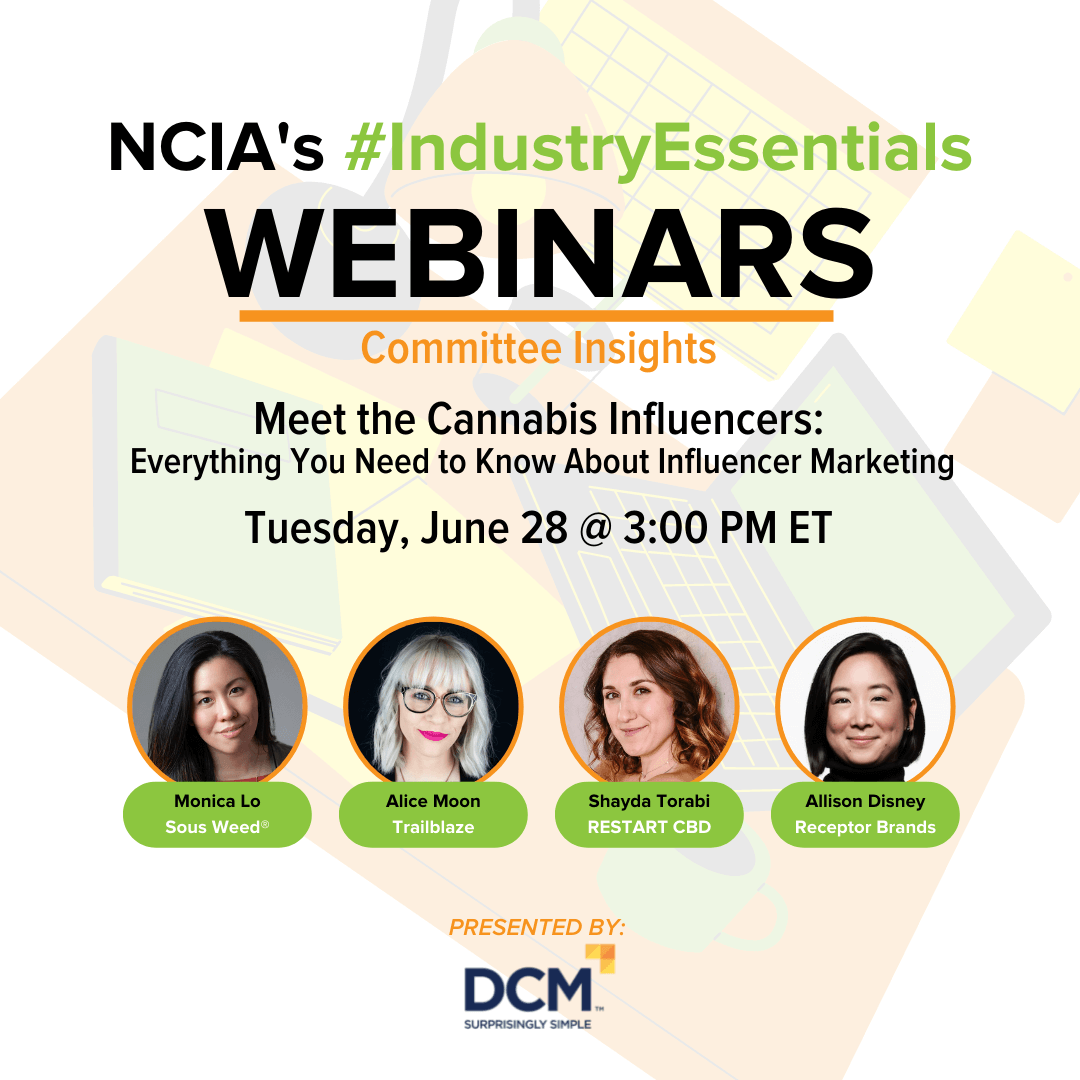
Committee Insights | 6.28.22 | Meet the Cannabis Influencers: Everything You Need to Know About Influencer Marketing
NCIA’s #IndustryEssentials webinar series is our premier digital educational series featuring a variety of interactive programs allowing us to provide you timely, engaging and essential education when you need it most.
Got questions about how influencer marketing can help your cannabis brand? Interested in working with a cannabis influencer but don’t know how?
You’ll get all your questions answered in this edition of our NCIA Committee Insights series originally aired on Tuesday, June 28, 2022 in which members of NCIA’s Marketing & Advertising Committee convened an all-star panel of innovative influencers who’ve worked with the cannabis industry’s leading brands.
Tune in to the conversation featuring moderator Allison Disney as she speaks with the amazing Alice Moon, Shayda Torabi, and Monica Lo to discuss how to reach and engage cannabis users with original branded content.
What You’ll Learn:
WHY influencer marketing should be in your marketing mix
WHO is most influential in cannabis conversations online
WHAT a successful influencer marketing partnership looks like
HOW to engage the right influencer partner(s) for your brand
Committee Blog: Do’s and Don’ts of Cannabis Influencer Marketing on Social Media
By NCIA’s Marketing and Advertising Committee, Helen Mac Murray, Mac Murray & Shuster LLP, and Dan Serard, Cannabis Creative Group
The requirements and restrictions surrounding paid advertising on social media are hardly a secret. Cannabis businesses have to tread carefully to avoid getting shut down or banned completely from online platforms.
However, there is one popular way to leverage the power of social media without risking your account: Influencer Marketing.
An influencer is any public figure, celebrity, creator, or individual that has the power to affect the purchasing decisions of others because of their authority, knowledge, position, or relationship with the audience. Influencers are typically content creators that actively engage in a select niche online, such as Lifestyle, Fashion, and even Cannabis.
Influencer marketing is a fantastic way for cannabis brands and dispensaries to leverage the power of social media without getting tangled up in the mess of rules and regulations. However, that doesn’t mean there are no rules and regulations for influencer marketing.
Here are some do’s and don’ts of cannabis influencer marketing on social media:
DO select your influencer partners carefully.
Marketers and business owners can be quick to forget that influencers are not just marketing tools, but rather, people as well. In that regard, influencers are their own brand. Their entire digital presence is curated carefully to align with their unique values and interests.
This means that when cannabis brands are interested in working with influencers, they have to be extremely careful who they choose. Not only does their character reflect on your brand, but also because it’s going to cost you a pretty penny.
Therefore, focus on building meaningful relationships with influencers and popular creators. Add value to their community and don’t view them as a tool in the toolkit. When you manage these relationships the right way, you turn one-time influencers into long-time brand ambassadors.
If you are partnering with someone who will be making claims about your brand or promoting your product in any way, be sure to:
Examine their credentials
Make sure they actually use and love your product
Evaluate whether their values align with your brand’s values
Check that their engaged audience is your target audience
One of the biggest benefits of influencer marketing across industries is that it is a relatable way to sell products. If your influencer partners or brand ambassadors do not actually use and love your product, the partnership will lose its value. Both your brand and the influencer will lose credibility.
When selecting influencers to partner with on campaigns, take time to do your research. Observe their regular social media activity as a follower, be patient during the agreement phase, and understand that this is a long-term partnership.
DON’T run or re-run any paid influencer ads without consent.
After the Borat debacle in Massachusetts, cannabis brands have (rightfully) become paranoid about using influencers or celebrities in their marketing campaigns.
While memes on social media are perfectly fair game, a disclaimer or two never hurt anybody if you want to cover your tracks. However, paid ads are a completely different ball game.
For those who are wondering what you can and can’t do when it comes to using a celebrity or cannabis influencer’s image or likeness, here’s a general rule to keep in mind: Do not run or re-run any paid advertising with a public figure without express legal consent.
When it comes to influencers, this means you need to be very specific on the terms of your engagement. For instance, if you are simply looking for a one-time product endorsement on their own channels, you can share these assets from their account to yours. However, you are not allowed to take those assets and use them in future campaigns, especially paid ones, unless you have explicit permission from the influencer.
In other words, if you want to be able to run any cannabis advertising campaigns with partner content, be sure to let the influencer know during the agreement phase, and prepare your budget accordingly.
DO make sure your influencer partners disclose your relationship with their audience.
Disclaimers are extremely important on social media and other marketing platforms when working with influencers. They provide your audience with transparency and protect all parties from any legal backlash.
If you have any relationship with a cannabis influencer of any kind (celebrities, bloggers, etc.), make sure they disclose that to their own audience when engaging in formal partner campaigns with your brand.
Using a descriptor in the caption or image, like #ad
Disclosing any paid travel, stay, or product exchanges
Add disclaimers in both the text and the media
Disclosing material connections with a brand is an important requirement for influencers, but brands are also liable for influencer posts that violate the law. You never want your cannabis brand to be associated with anyone that might find themselves in hot water, so be sure to make these terms clear when partnering with influencers.
DON’T run ads without proving your product claims.
This may go without saying, but when it comes to paid advertising in cannabis, throwing spaghetti at the wall and seeing what sticks isn’t really a good idea. When you’re running ads – whether it is on a traditional medium, like a billboard, or a digital medium, such as pay-per-click ads – it is important to do your due diligence.
Don’t wait to prove your product claims until after the ads have run. Not only will this get you in trouble with the FTC, but you will appear deceitful to your customers and quickly lose their trust.
Instead, ensure you have third-party lab testing, credible experts (like cannabis doctors or budtenders) able to speak to your specific product, and/or the receipts to back up your claims if challenged.
DO be cautious when using consumer testimonials about your product.
Existing customers are the best marketers for your brand. Using reviews to show social proof of your product is a great idea. In fact, any cannabis marketing professional will tell you that it is encouraged to show off testimonials on social media, websites, email lists, and more.
Only use the words of your customers if you have express permission to use them on other channels, or if they are already posted in public forums, such as Google Reviews.
It is also highly recommended that you only use testimonials if they reflect the results of most of your customers. You can’t use consumer testimonials if you do not have substantiation that the endorser’s experience is representative of what consumers will generally achieve unless the advertisement clearly and conspicuously discloses the generally expected performance in the depicted circumstances, and the advertiser must possess and rely on adequate substantiation for that representation.
While it’s always helpful to highlight benefits that real people have experienced, disclaimers should always be made if anything sounds too close to a health claim. For instance, if a customer comments on an Instagram post that your product has made their anxiety disappear, you’ll want to gain express permission from them to use their words as a testimonial, and you should add a note when posting that such claims one customer’s unique experience and can’t be interpreted as medical advice.
DON’T bring on a marketing company only for damage control.
Cannabis marketing agencies are a powerful tool for a brand or dispensary. From social media and email marketing to search engine optimization, branding, website design and development, and more, these companies are experts at crafting a digital presence for your business.
However, good marketing only goes so far. Even the best cannabis marketing professional or influencer can’t cover up for false information, a bad product, poor customer service, or just bad business overall.
Additionally, even when marketing companies have industry-specific expertise, they are not lawyers. As a brand, you can’t rely on your agency to know the exact letter of the law.
Instead of using social media or your marketing efforts as damage control, be intentional about building a high-value brand and bringing on a marketing agency that can make you stand out from the crowd in good conscience.
That means, start from the ground up, provide accurate information, and protect yourself and your brand from any liability by being cautious of any cannabis advertising and marketing rules and regulations.
Using cannabis influencers for your social media marketing campaigns
Developing a strong presence on social media isn’t just impressive, it’s important for your audience and potential customers to buy into your brand. Whether it’s paid or organic, influencer marketing is a great workaround to some of the more harsh realities of social media rules and regulations for cannabis brands and dispensaries.
When you harness the power of these public figures and their engaged communities online, you can take your brand to new heights.
Committee Blog: Five Best Practices to Future-Proof Your Cannabis Brand on Social Media
By Jake Setlak, Receptor Brands on behalf of NCIA’s Marketing & Advertising Committee
Social media platforms can be perilous for cannabis businesses. Every brand feels the need to have a presence on social media. Their typical approach is to accumulate followers by posting what you think those followers want to see. Then one day, without notice, those followers — and the platform algorithm’s understanding of why your brand was relevant to them — vanishes. Cannabis brands on social media are surrounded by so much gray area, it’s hard to know what makes your presence vulnerable to risks of suspension or worse. To help brands avoid those gray areas, here are five practices to help cannabis marketers future-proof their brands on social media.
1. Embrace standards.
Brands are held to higher standards on social media than users are. This is especially true for brands in regulated categories like cannabis. Why? Standards help protect against fraud and deception. These protections serve both consumer (users) and commercial (brands, businesses) interests across a wide variety of media channels. Think: truth in advertising and consumer protection laws. Get familiar with the federal, state, and municipal or regional laws that apply to all commercial interests where your cannabis brand operates (or find someone to do this on your behalf).
2. Think about your reputation.
How you behave on social media says a lot about your brand. There’s more than content to consider — bad behavior can permanently discolor your brand’s reputation. Why? Everyone can see what you’re doing. Openly engaging in deceptive practices shows consumers, partners, and regulators that your brand isn’t trustworthy. Those duplicate and back-up Instagram profiles? They signal to the rest of us that you know you’re taking risks. That could be all it takes to inspire someone to flag or report you. Social platforms notoriously rely on users to police the community — if users like you don’t report violations, the platforms tend not to know about them.
3. Safeguard your brand’s presence.
This is worth repeating, regardless of being in cannabis or another category: avoid getting banned. Why? No back-up profile can magically restore lost followers and engagement. When social media platforms decide to allow cannabis brands to use paid advertising, you’ll be locked out. This is why it’s important to set clear goals and objectives for maintaining your brand’s social presence.
Establish a compliance strategy for your social media efforts with three must-haves:
Social Media Policy for Employees
Community Management Guidelines & Protocols
Legal Counsel (professional advice regarding cannabis category regulations, truth-in-advertising standards and consumer protection laws, and social media platform policies)
4. Know what you can say and how you can say it.
Be careful not to misinterpret another brand’s social media activity as setting a precedent for yours. Why? Seeing someone else break the rules is not license or permission for us to break those same rules. Plus, let’s face it — legitimate cannabis brands are already working uphill against prohibition-era prejudices. Know a bad example when you see one, and more importantly know what you can say and how you can say it on social media platforms.
What you can say:
DO stick to “social” objectives. Take the higher ground. Speak from your brand values, not necessarily what the “insta” know-it-alls might insist. Be a valuable presence in the community, not just more clutter in their feed.
DON’T antagonize the community. Remember, you’re a commercial interest and held to higher standards than users. It looks bad when brands argue with competitors, followers, or other brands. The Internet is full of trolls who prey and depend on your impulsive responses — even if it isn’t your aim to deceive or misinform, you may already be a target because of the stigma that still comes with cannabis.
How you can say it:
DO communicate generally. Make observations. Be insightful. Grow your audience. Engage the community.
DON’T advertise or promote. Explicit calls-to-action (CTAs) like “get”, “find”, “try”, or “buy” aren’t allowed for cannabis, especially on platforms where you can’t guarantee your audience is of a compliant age. This is the same reason you want to avoid depicting or promoting over-consumption.
5. Set the bar higher.
Aim to be the most upstanding citizen in the cannabis community. Why? No one knows when federal legalization will happen or how quickly a platform’s policies will change. This means no one can say it’s too soon to start preparing for such an eventuality!
There are four ways you can start raising the bar right now:
Make content that makes a difference.
Content creation for startups and small businesses doesn’t have to be overwhelming. Start with measurable objectives that justify your content creation process and budget. Scale your efforts toward more effectiveness, not merely more frequent posts. Set aside time to regularly evaluate and optimize your efforts. This is where well-placed focus will go a long way for you. It might take more effort to get beyond the “recommended” or popular approaches, but you will discover that you move faster and spend less when you go with what you know: the meaning and value your brand offers the cannabis community.
Apply paid advertising standard to organic content.
These apply to paid advertising but may in some cases also apply to organic content posted by commercial interests (brands). Platforms change frequently and without warning, so it’s wise to stay current on the policies and guidelines of the platforms you use.
Here are helpful resources for the five social platforms where many brands — regardless of category — typically start on social media. Enforcement may still be a mystery in many cases, but these policies help us understand when a post or profile might venture into gray areas and risk a suspension or worse.
Jake Setlak is a founding member and head of Creative Strategy / Brand Experience at Receptor Brands, an agency custom-made for cannabis that transforms relationships between cannabis brands and their customers. Prior to his work in cannabis, Jake spent 20 years guiding the digital transformation of some of the world’s biggest brands and their advertising agencies. He’s worked in social media channels since before they were called “social media” and invented the Facebook Comment Ad format (now known as the boosted or promoted post). Jake is a member of NCIA’s Education Committee but produced this content while a member of the Marketing & Advertising Committee and serving on its Next-Generation Advertising subcommittee.
Committee Blog: Everything You Need to Know About ADA Compliance for Your Cannabis Website
When the legal cannabis industry began making waves in the late ’90s, there was still a major stigma against cannabis users. Although the federal status of the plant has yet to change, a Pew Research survey shows that around nine-in-ten Americans favor legalization for adult-use or medical purposes.
As more consumers enter regulated cannabis markets, the industry continues to evolve and be held to higher standards. Given its diverse history, the cannabis industry does not only aim to be an inclusive space – it is expected.
From social equity programs to ADA compliance, cannabis businesses and markets are increasingly standing out from the crowd with their efforts to be more broadly accessible.
What is ADA Compliance?
The ADA, or Americans with Disabilities Act, is a law that prohibits discrimination against people with disabilities in all public spaces. ADA website compliance expands upon this and refers to meeting the standards set by the Americans with Disabilities Act Standards for Accessible Design. This act describes the accessibility of information technology, such as the Internet and its websites (as opposed to physical locations).
In other words, your cannabis website’s ADA compliance characterizes whether or not the site is deemed accessible to people with disabilities as outlined in the ADA’s guidelines.
Why does my cannabis website need to be ADA compliant?
Nearly every registered and operating business needs to follow ADA. It is required that any business, regardless of size, make all reasonable efforts to accommodate customers with disabilities.
More importantly, as a business owner, you want to provide everyone, online or offline, with the same positive experience and level of accessibility. As we continue to become a more technology-based society, website accessibility will become more important to your business as well as consumers.
Now that you understand why your cannabis website needs to be ADA compliant, it’s important to learn how.
Before you touch your website, we recommend reviewing the Website Content Accessibility Guidelines. These guidelines explain how to make web content more accessible to people with disabilities, from the text, images, and sounds on your website to the code or markup that defines structure, presentation, etc.
Once you have a complete overview of what makes website content accessible to all users, you can begin to go through your site and evaluate it for needed changes. Here is a checklist of features you should have to make sure your website is following best practices:
Keyboard navigation is supported.
Your website can be easily navigated without a mouse.
Fonts are easy to read.
Screen readers can accurately interpret and read your site content.
Text can be scaled without distorting the page.
The contrast between the text and the background is sufficient for easy legibility.
Website design is consistent and intuitive.
Calls to Action are clear and concise.
Alt tags, closed captions, and descriptions are provided for all image and video assets.
With all the existing rules and regulations surrounding the cannabis industry, especially when it comes to cannabis marketing, it can be overwhelming to think about more to add to the pile. However, ADA compliance will not only show your customers that you are committed to creating inclusive spaces both in-store and online, but it will also protect your business.
Is ADA compliance mandatory?
In short, yes.
Although there are no clear ADA regulations that define what makes a website compliant, courts have overwhelmingly ruled that websites are considered places of public accommodation. Therefore, under Title III of the ADA, accessibility is mandatory for websites that affect interstate commerce and fit under 12 listed categories.
These 12 categories include sales establishments, like retailers and dispensaries, as well as service establishments, such as any cannabis ancillary business.
Additionally, if your website fails to meet ADA standards, you risk lawsuits and large fines. First-time violations typically receive a $55,000 – $75,000 fine, while repeat violations come with a $150,000 fine. In fact, federally funded organizations that are not compliant can lose funding.
Can I be sued if my cannabis website is not ADA compliant?
Absolutely. The more commercial in nature your website is, the more you become vulnerable to lawsuits. This is especially true if your website is connected to a physical location. However, even if your website is only web-based, you can absolutely still be sued.
In fact, online-only businesses with no physical presence are increasingly being swept up in ADA compliance litigation. So whether you’re a dispensary, a CBD brand, or a B2B cannabis business, you should be testing and mediating your cannabis website for ADA compliance.
How do I test ADA compliance?
There are a number of ways to test whether or not your cannabis website meets the Web Content Accessibility Guidelines (WCAG) standards.
Another way to test your cannabis site’s ADA compliance is by conducting a manual audit. Completing a website audit by yourself means evaluating every page of your site for accessibility using the WCAG standards and checklists like the one above. It can also include testing your website using assistive technology, such as a screen reader, to be sure all barriers have been remedied.
The bottom line is that your cannabis website should be ADA compliant – and not just because of the legal requirements. To take meaningful steps towards a more equitable and inclusive industry, we must all be proactive in making all touchpoints of our businesses more accessible.
Committee Blog: Trust In Cannabis – Why It Matters More Now Than Ever
As a country, the U.S. is experiencing what can best be described as the “age of distrust.” While public distrust in institutions has been escalating for at least a decade, according to the annual Edelman Trust Barometer which has tracked trust in media, governments, businesses, and nonprofits since 2000. Social unrest and a global pandemic have escalated this distrust. Never has the public eyed institutions or businesses with such suspicion.
Meanwhile, in our industry, the vaping crisis of summer 2019 hit our industry below the belt, aided by some bad actors knowingly flooding the illicit market with products that couldn’t meet stringent state testing. That crisis created a crisis of confidence in the overall cannabis industry-leading it into a bleak period which was only partially buoyed by the declaration that dispensaries were considered “essential businesses” during the COVID-19 pandemic, pro-cannabis outcomes in both voting booths and Congress, many thanks to NCIA’s national and local efforts. By supporting NCIA, you’re signaling industry commitment and that you value growing trust within the industry.
Now, against the national backdrop of distrust and a COVID-19 vaccine that offers a glimmer of hope, it’s time to evaluate ourselves and our industry’s actions. Never has it been more crucial for all brands, but particularly our industry, to lean into actions and communications which consistently and powerfully earn the trust of investors and consumers. As an industry, we’re on an important precipice, what we do next will either ensure our credibility or tarnish it for years to come.
Consumers (and therefore investors) are looking at brands in a more holistic manner. Trust will be the single most valuable brand attribute.
Trust is defined on two spectrums: competence and ethics.
For CEOs, CMO’s, and experts in our industry, the time is now to act and communicate from a place of authentically aligned communications. This alignment will require hyper levels of empathy and a constant pulse on the state of affairs affecting your customers. Consumer behavior is in flux now.
The COVID-19 pandemic has changed consumers and now is the time for brands to align. According to the Edelman Barometer special report, Brands Amidst Crisis:
The role of brands in reflecting the consumer’s desire to be viewed as a tastemaker or trendsetter has decreased 9%
Up 38% is spending time with family
86% of consumers expect brands to solve both societal and personal problems, including proper treatment of employees and making product in a domestic market
The only values more important than trust to consumers are price and quality
Because consumer behavior is in flux, it’s never been more important to ensure internal and external values and communications align. Ironically, ensuring alignment supports the flexibility needed to respond quickly to changing behaviors or unexpected upheaval.
Aligned communications means we act internally and externally in a consistent and emotionally intelligent manner that earns trust. It’s not just good for our industry, trust in brands has very real bottom-line implications including increased sales, increased investor opportunities, and reduced customer acquisition costs. In fact, according to Edelman Trust Barometer, high trust consumers have 75% more brand loyalty.
Outstanding packaging and even quality products are the minimum expectations for today’s brands. But even those choices come under scrutiny from consumers if they don’t mirror consumer expectations and lifestyle. Therefore, earning trust starts at the very beginning. The earliest choices are powerful signals to consumers about brand values.
It isn’t enough to simply sponsor a campaign or align with a social movement. While those choices can be powerful quivers in your trust arsenal, it feels and sounds hollow when the brand is suddenly thrusting itself into a conversation without looking at itself first. Consumers are increasingly aware of “trust washing.”
92% of employees expect their employer’s CEO to speak up for issues ranging from income inequality to diversity and training for future jobs. An aligned trust-based strategy starts on the inside. Take a solid look at the ethos and ethics within your own company.
What are your company’s values?
What do you stand for?
How do you signal trust internally and how do you reward it?
Does your internal communication stand for your values?
The reason this internal step is critical is no matter what, your brand ethos is distilled into consumer interactions and communication, whether those communications are with dispensary workers or directly to the consumer, the experience will always stay with the brand. Imagine a dispensary worker making recommendations to a new-to-cannabis buyer, naturally, the dispensary worker has a huge amount of influence on the consumer’s impression of a new brand. And new-to-cannabis buyers are most likely to be loyal to their first brand, assuming the product meets expectations.
Personal experience is the number one way to build trust with consumers. 59% of customers say personal experience matters the most.
What consumer interactions signal trust?
How do you manage poor reviews?
How do you handle customer inquiries?
How does your owned media reflect not only your brand values but those of your customers?
Personal experience is absolutely about product experience and brand interactions. Brand interactions at events will take on more importance in cannabis. Consumers will want to engage in an experiential way with cannabis brands and it won’t be at cannabis events exclusively, consumers will expect to see cannabis brands in all the same places they see alcohol brands, even if sales and sampling aren’t available, which means experiences will need to be multi-sensory and strongly personal. Choose your experiences carefully based on your brand audience and ethos.
Earned media is second only to personal experience incredible trust-building. During the COVID-19 pandemic, trust in publications increased by 7%. Brands should look for opportunities in earned media that reflect their values. Branded content is another area where brands can use the credibility of publications.
Experts are still considered credible sources (52%) and they far surpass celebrities (35%) and influencers (36%). As you consider brand strategies in 2021, take a careful look at who you’re leveraging and what role they play. Choose your experts carefully and ensure they are fully vetted. NCIA’s Marketing and Advertising Committee is developing an “experts directory” of carefully vetted industry professionals, this will be a key resource not only to event organizers, but CEOs and CMOs looking for credible, authentic experts.
Our industry has so much to offer consumers, we provide very real opportunities for consumers to enhance their lives. We have been active on numerous social justice fronts from the very beginning. We may come from a historical place of rebellion, but often, even that rebellion came from a place of empathy and not just income. Consumers today are responding to companies who double down on trust and an aligned brand value system. There’s every reason to think the cannabis industry can do this better than anyone. Together, let’s lean into our values and seed trust not just in our companies, but in our industry.
*All statistics come from Edelman Trust Barometer 2020, unless otherwise noted.
Tara Coomans is the CEO of Avaans Media (formerly known as Primo PR), which has been working with hemp and THC brands and services since 2015 from startup through IPO. Founded in 2008, Avaans Media brings a digitally forward and purpose-driven perspective to public relations. Avaans Media is based in Los Angeles with clients and team members distributed around the country including Washington D.C., New York and Denver.
Coomans is on NCIA’s Marketing & Advertising (MAC) committee and leads the MAC Experts Directory subcommittee for 2021. Coomans is a frequent writer and speaker on public relations, marketing, and social media topics.


 Tara Coomans is the CEO of
Follow NCIA
Newsletter
Facebook
Twitter
LinkedIn
Instagram
News & Resource Topics
–
This Just In
How THCa Vapes Are Changing Consumer
Announcing NCIA’s 2026-2028 Board of Directors