Midterm Election Wins, Losses, and the Lame Duck Session
Photo By CannabisCamera.com
by Michelle Rutter Friberg, NCIA’s Deputy Director of Government Relations
Last week, the long-anticipated 2022 midterm elections (finally) took place. In addition to the usual House and Senate elections, five states voted on cannabis ballot initiatives: Arkansas, Maryland, Missouri, North Dakota, and South Dakota – with only two of those passing successfully. Let’s take a look at what transpired and what it means for the lame duck session and possibly the 118th Congress:
Ballot Initiatives
Voters in Arkansas, Maryland, Missouri, North Dakota, and South Dakota were all faced with a similar question on election day: whether or not to legalize cannabis for adult use. Unfortunately, three of the five initiatives did not gather enough support to pass: Arkansas, North Dakota, and South Dakota.
The results for Maryland’s referendum came in early on election night with a decisive victory: more than 65% of voters cast their ballots in support. They were asked “Do you favor the legalization of the use of cannabis by an individual who is at least 21 years of age on or after July 1st, 2023, in the state of Maryland?” Now that the measure has been approved by voters, it will require the legislature to put forth a bill that will set basic regulations for the adult-use cannabis program.
Missouri voters also approved Amendment 3, which would legalize cannabis for adults 21 and over, as well as impose a six percent tax on recreational cannabis sales and use the revenue to facilitate automatic expungements for people with certain non-violent marijuana offenses on their records. The amendment garnered 53% of the vote.
This gives advocates an increase in the number of representatives and four more Senators from legal states, most notably those from Missouri, who are both avid conservatives and have not supported cannabis reform broadly in the past.
House of Representatives
Although Republicans are still projected to win the House, the margins are shaping up to be narrower than initially predicted. It takes 218 seats to win a majority in the chamber, and as of publication, Republicans hold 212 with a number of districts still yet to be called.
The change in party control means a change in leadership and shake-ups at the committee level. Minority Leader McCarthy is expected to run for Speaker of the House, while Minority Whip Steve Scalise has thrown his hat in the ring for Majority Leader – but there’s much uncertainty and infighting within the caucus.
Senate
Control of the Senate will remain in the hands of Democrats. Over the weekend, Nevada’s Senate race was called for incumbent Catherine Cortez Masto – making Georgia’s runoff election slightly less contentious.
A closely watched Senate race in Pennsylvania flipped in favor of Democrats: legalization advocate John Fetterman (D) defeated TV-personality and New Jersey resident Dr. Oz (R). We continue to closely monitor the races in Alaska and Arizona and what their outcomes may mean for cannabis reform.
Lame Duck Session
The likelihood of a split Congress means that the lame duck session happening between now and January will be jam-packed. In addition to must-pass legislation like the National Defense Authorization Act (NDAA) and a budget/omnibus bill of some type, Democrats will also be focused on other topics like judicial nominations, the debt ceiling, and hopefully the SAFE Banking Act.
Midterm Elections Looking Green
By Madeline Grant, NCIA’s Government Relations Manager
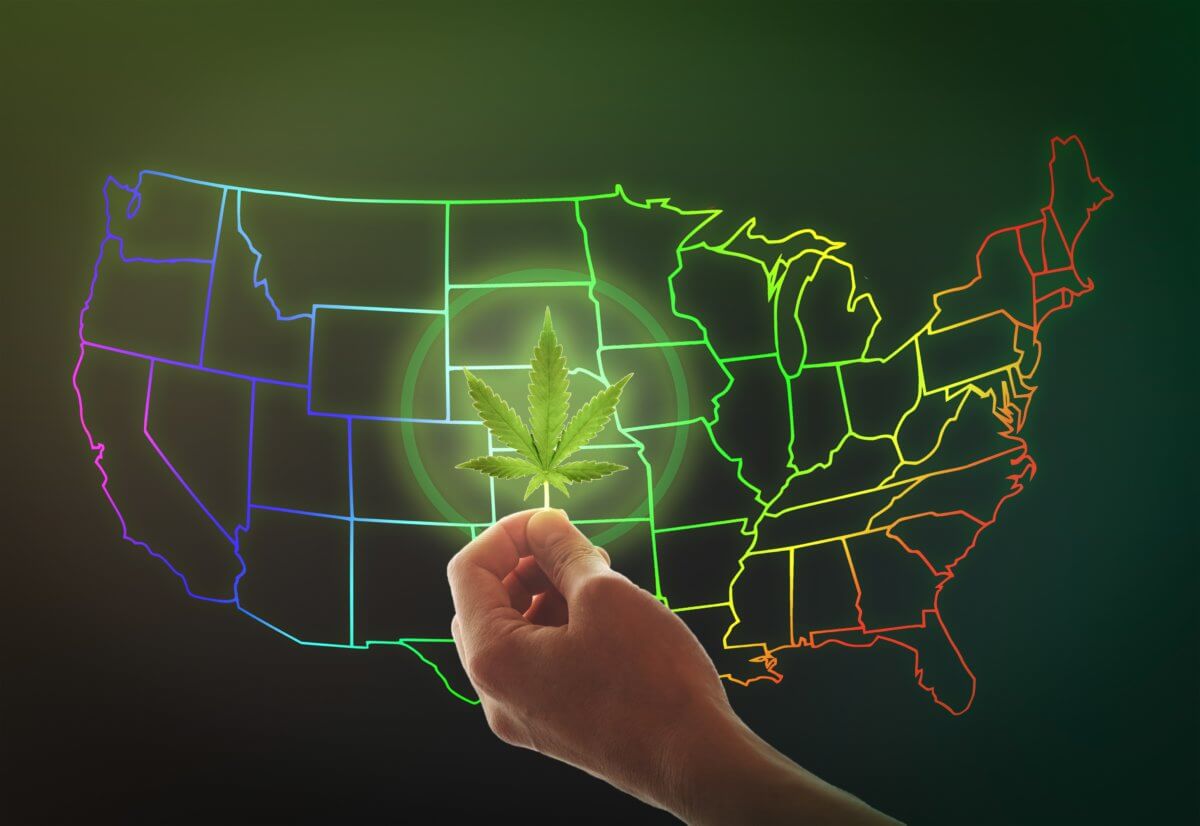
The midterm elections are quickly approaching with less than three weeks away. Not only will the elections determine the balance of power in Congress, but local elections and ballot measures are set to make a big impact across the country. As the midterm elections approach, another 20 million Americans could soon be living in a state where anyone at least 21 years old can legally possess marijuana. There are six states with recreational cannabis legalization initiatives or referendums on the ballot this November: Arkansas, Maryland, Missouri, North Dakota, Oklahoma, and South Dakota. Let’s take a closer look at each state:
Arkansas
Although the Arkansas Board of Election Commissioners rejected the ballot question in August, the state Supreme Court cleared the way for the question to make it to the poll. The Responsible Growth Arkansas campaign submitted about 193,000 signatures- more than double what’s required to qualify the constitutional amendment- in July. If the initiative, Issue 4/ the Marijuana Legalization Initiative, is approved by voters, it would allow adults 21 years and older to legally possess up to an ounce of cannabis. It would implement a 10 percent tax on sales and require the state’s Alcoholic Beverage Control Division to develop rules for businesses, according to Ballotpedia. The initiative does not allow for home cultivation, and it has no provisions to expunge cannabis-related criminal records. For more specifics on what the initiative would accomplish read HERE.
Maryland
When Marylanders head to the polls in November, they will be asked to approve or reject legislation that allows adults 21 and over to possess, use, or grow small amounts of cannabis. If passed, the referendum would open the door to creating a taxed and regulated recreational cannabis industry in the State. State lawmakers have been paving the way for future cannabis legalization when they passed two separate bills in April of this year. House bill 837, which is set to go into effect in July 2023, would allow anyone over the age of 21 to possess up to 1.5 ounces of cannabis, with anything between 1.5 and 2.5 ounces subject to a civil fine of $250 and anything above 2.5 ounces subject to a charge of possession and intent to distribute. The second bill, House Bill 1, established that the question of legalization would be put to voters via a referendum on the November ballot. It’s important to note that this bill does not establish the regulatory framework for the recreational market, and state lawmakers will need to return next session to build out a framework for the cannabis industry if the referendum passes in November. A recent Goucher poll found that 62 percent of residents- including about half of Republicans- support legalizing recreational cannabis, with just 34 percent opposed.
Missouri
After a long battle between the Legal Missouri 2022 and prohibitionists, an initiative to legalize cannabis in Missouri officially cleared for ballot placement this September. Joy Sweeny, who is affiliated with the Community Anti-Drug Coalitions of America (CADCA), filed a lawsuit, alleging that the legalization initiative violated the single-subject rule for ballot measures under the state Constitution and that the signatures were improperly certified, according to Marijuana Moment. Two lower courts dismissed the challenge, so Sweeney sought to bring it directly to Missouri’s Supreme Court, where they would not take the case. Missouri Amendment 3, Marijuana Legalization Initiative (2022) would legalize the purchase, possession, consumption, use, delivery, manufacturing, personal use for adults over the age of 21; allow individuals convicted of nonviolent cannabis-related offenses to petition to be released from incarceration and/or expungement; and exact a 6 percent tax on the sale of cannabis.
North Dakota
The campaign New Approach ND delivered 25,762 signatures to the secretary of state’s office in July 2022. A month later, Secretary of State Al Jaegar’s (R) office approved the measure, certifying that the campaign had submitted enough valid petitions to put the measure before voters, according to Marijuana Moment. The initiative would allow adults 21 and older to purchase and possess up to one ounce of cannabis and grow up to three plants for personal use. The legalization proposal will now be designated as “Measure 1” on the ballot this November.
Oklahoma
Oklahoma’s cannabis reform measure will not be on the November ballot but Governor Kevin Stitt (R-OK) issued an executive order on October 18 setting a special election to determine if legal sales of cannabis should be extended to anyone at least 21 years old or older. Oklahomans for Sensible Marijuana collected far more than 95,000 signatures required to make the November ballot. However, because the contractor hired by the Oklahoma Secretary of State’s office took 48 days to certify the signatures, there wasn’t time for the initiative to be placed on the November ballot. The group unsuccessfully sued the state in hopes of forcing the question. The court said, despite sufficient signatures to qualify for the ballot, the measure was held up by bureaucratic requirements, protest deadlines and a new signature-counting software. Nevertheless, Governor Stitt issued the executive order and Oklahomans for Sensible Marijuana Laws will have less than five months to make their case to voters for why legalization should be extended to anyone at least 21 years old. It’s important to note that when Oklahoma voters legalized medical cannabis in 2018 there was evident opposition from practically every elected official, health care group, law enforcement official, and business organization in the state.
South Dakota
Similar to North Dakota, in May 2022 the secretary of state’s office confirmed that South Dakotans for Better Marijuana Laws (SDBML) turned in a sufficient number of signatures to qualify a cannabis legalization measure for the November ballot.In the 2020 election SDBML’s success at the ballot was overruled by the state Supreme Court as a result of a legal challenge funded by Governor Kristi Noem’s (R) administration. The court ruled that the measure violated a single-subject rule for ballot initiatives. Ironically, Governor Noem made comments pledging to implement cannabis legalization if voters approve the ballot initiative at an event this past August. Some advocates believe she has no choice but to pivot her support now that she is up for reelection. With SDBML’s success this year, South Dakotans will vote on the ballot measure in November.
There is no denying that 2022 is a big year for cannabis policy reform. Although state campaigns have met challenges through the courts, state officials, governors, prohibitionists, law enforcement, and more; it is evident that there is no stopping the voice of the people. As the country gears up for the midterm elections, all of these states will continue to educate and campaign for the recreational passage of cannabis. The 2022 midterm elections come on the heels of President Biden’s announcement to pardon thousands of people convicted of marijuana possession under federal law and review whether marijuana should be in the same legal category as drugs like heroin and LSD. The timing of President Biden’s announcement illustrates an important fundamental change in America’s response to cannabis and the National Cannabis Industry Association is hard at work on Capitol Hill to continue educating Congress.
Committee Insights | 9.28.22 | Cannabis Ballot Initiatives in the November 2022 Election
In this edition of our NCIA Committee Insights series originally aired on Wednesday, September 28, 2022 members of NCIA’s State Regulations Committee convened a panel of government affairs, business development and licensing experts for an in-depth discussion focusing on cannabis ballot initiatives up for a vote this coming November.
They provided a detailed overview on the status of each campaign so that you’ll learn how best to position yourself for success and what you can do to help push these efforts across the finish line. If you’re considering business Arkansas, Maryland, Missouri either of the Dakotas then this session is specifically geared for you.
At the conclusion of the discussion they hosted a moderated Q&A session to provide NCIA members an opportunity to interact with leading minds from the cannabis regulatory and licensing space, join today to contribute to future conversations!
Learning Objectives:
• Provide practical information to NCIA members about the cannabis ballot initiatives and potential new business opportunities.
Sumer Thomas
Director of Regulatory Operations
Canna Advisor
Nicola Batten
CEO & Founder
koLaB Consulting
Larry Luksha
Government Relations & Business Development
Veritec Solutions
Joseph Smith
Senior Managing Associate
Thompson Hine LLP
Midterm Election Voters Will Likely Determine Cannabis Legalization Amid Several States
By Sadaf Naushad, NCIA Intern
With midterm elections just four months away, cannabis activists are paving the path for major reformations to take place nationwide.
In order for voters to see cannabis legalization on their state’s midterm ballot, cannabis advocates are scrambling to collect the number of signatures necessary. Fortunately, residents within various states are in support of cannabis legalization, as demonstrated through the high volumes of submitted signatures.
The rapidly emerging cannabis industry has led to spiked encouragement of cannabis legalization across the U.S., emphasizing the demand for lawmakers to implement safe and secure cannabis policies.
Let’s take a closer look at some of the state-level progress:
Arkansas
Cannabis activists are highly optimistic after their recent efforts to push for legalization on Arkansas’ midterm ballot. Last week, advocates turned in more than twice as many signatures to the Secretary of State’s office as required to appear on the ballot. According to Responsible Growth Arkansas, 89,151 signatures are needed to qualify for the measure. Advocates stunned the Secretary of State when they delivered just over 190,000 signatures.
Provisions on the measure would permit anyone at least 21 years of age to possess up to one ounce of cannabis. Additionally, Arkansas would grant its current medical shops permission to add adult-use sales on March 8, 2023. A lottery would also distribute 40 additional licenses for adult-use dispensaries, and municipalities would need to hold a referendum if they prefer to prohibit adult-use businesses. On the other hand, the measure does not include expungements of prior marijuana convictions.
While many view the signatures as enhanced legalization support, Arkansas True Grass and Arkansans for Marijuana Reform have raised concerns about the potential provisions. Both organizations state that the measure would favor large businesses in the present medical cannabis industry. But Steve Lancaster, Responsible Growth Arkansas’ spokesperson, believes that the “constitutional amendment provides a sound infrastructure for reform that prioritizes regulations.” If voters approve legalization, Lancaster intends to advance further reforms in the legislature.
At the moment, however, two weeks remain for Arkansas to verify the submitted signatures.
North Dakota
Cannabis consumers find themselves one step closer to legalization in North Dakota. Just three months ago, lawmakers approved the cannabis legalization ballot language, clearing the procedural obstacle to begin gathering signatures.
On Friday, cannabis activists collected numerous signatures, exceeding North Dakota’s 15,582 minimum requirement. The New Approach North Dakota campaign claimed they obtained 21,400 valid signatures and anticipate that number to increase before today’s deadline.
The measure’s initiative would allow those 21 years of age and older to purchase and possess a maximum of one ounce of cannabis, along with permitting adults to cultivate a maximum of three plants for personal use. Furthermore, the Department of Health and Human Services would be responsible for conducting regulations and overseeing licensing for cannabis businesses. The department’s regulators would have until October 1, 2023 to incorporate rules regarding security, advertising, labeling, packaging and testing standards. To mitigate the possibility of a monopolized market, North Dakota’s initiative specifies that any individual or organization can only own up to four retail locations or one cultivation facility.
Nebraska
Tremendous momentum builds across Nebraska, as activists exceed the amount of signatures to qualify medical cannabis legalization initiatives for the midterm ballot.
Nebraska requires each proposal to have 87,000 valid signatures from registered voters to qualify for November’s ballot. On Wednesday, however, advocates encountered a legal hurdle when a federal court overturned a lower federal court’s ruling that had momentarily eased ballot prerequisites. The ruling states that signatures “must come from a minimum of five percent of voters in at least 38 counties across the state.” The Nebraskans for Medical Marijuana Campaign, in addition to many activists, deem this ruling as unconstitutional, stating that it generates a detrimental burden that gives oversized influence to small, rural communities that are more challenging to reach.
Nevertheless, these barriers have not fazed activists assembling cannabis legalization support. In May, the campaign collected 20,000 signatures on each petition, and now that number has increased to over 90,000. To guarantee sufficient valid signatures, the Nebraskans for Medical Marijuana campaign aim to gather several thousand more signatures before Thursday’s turn-in deadline.
Minnesota
With Minnesota’s recent legalization of edibles and drinks infused with low amounts of THC, consumers remain excited for what’s to come.
But for lawmakers, this means acknowledging Minnesota’s current absence of statewide cannabis regulations. For now, local governments are responsible for enacting market rules within their jurisdictions. According to U.S. Representative Heather Edelson (DFL), “the ability for municipalities to offer important guidance and clarity on day-to-day operations and compliance within a city is vital.”
That being said, Representative Edelson has conducted meetings with mayors, city council members, city managers and the League of Minnesota Cities to inform them about how the new law could shape their areas and how they can execute parameters within local markets.
Oklahoma
Oklahoma is yet another state pushing for cannabis legalization to surface on the November ballot. Last Tuesday, The Oklahomans for Sensible Marijuana Laws campaign submitted over 164,000 signatures to the Secretary of State’s office, surpassing the minimum number of 94,911 signatures necessary to qualify for the ballot.
If passed, the measure would permit adults 21 and older to possess and purchase up to one ounce of cannabis. Adults would also be able to grow a maximum of six mature plants and six seedings for personal use. The Oklahoma Medical Marijuana Authority Department is in charge of regulating the market, as well as issuing cannabis business licenses. The department would impose a 15% tax on adult-use cannabis products, in which its revenue would go towards the “Oklahoma Marijuana Revenue Trust Fund.” These funds would initially cover the costs of managing the program, while the rest of the funds would be allocated between municipalities where the sales followed, the State Judicial Revolving Fund, the general fund, public education grants and grants for organizations involved in substance abuse treatment and prevention.
Finally, for those serving time due to prior cannabis convictions, the measure allows inmates to “file a petition for resentencing, reversal of conviction and dismissal of case, or modification of judgment and sentence.” Those who previously served a sentence for past cannabis convictions can petition for expungement.
Altogether, the cannabis industry is witnessing a growing number of legalization support nationwide. From Minnesota to Oklahoma, cannabis consumers are eager to have their voices heard and addressed on November’s midterm ballot. The recent legalization efforts across states shine a light on the mounting acceptance of the industry’s movement, setting the stage for crucial cannabis reformations to follow.
Stay tuned for more updates on cannabis policy reforms. If you are interested in learning more about NCIA’s government relations work and how to get involved, please reach out to Madeline@thecannabisindustry.org.
NCIA’s 2018 Post-Election Webinar
Watch this webinar recorded on Thursday, November 8, for NCIA’s recap of the midterm elections and what they mean for cannabis policy reform nationally.
Hear from representatives of the statewide cannabis campaigns in Michigan, Missouri, North Dakota, and Utah to find out what went right, what went wrong, and what happens next for regulators, businesses, and consumers. NCIA and the Marijuana Policy Project discussed the next states to watch and key federal legislation to follow in 2019.
From The Ballot Box: Post-Midterm Election Analysis
by Michelle Rutter, NCIA Government Relations Manager
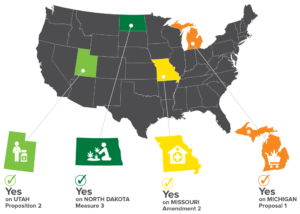
Last night, Americans all over the country let their voices be heard at the ballot box. Voters in Michigan cast their votes for the legalization of adult-use cannabis, increasing momentum of our movement. At the same time, voters in Missouri and Utah were successful in legalizing medical cannabis, becoming the 32nd and 33rd states to do so, and despite significant hurdles.
MICHIGAN
Appearing on the ballot as Proposal 1, this initiative passed by a whopping 55% and made Michigan the first state in the Midwest to legalize adult-use cannabis for those over the age of 21. The proposal outlined an excise sales tax of 10%, which will be levied on sales at retailers and micro-businesses, and then be allocated to local governments, K-12 education, and road and bridge maintenance. In the future, municipalities will be given the authority to to ban or limit cannabis businesses and establishments within their boundaries. Michigan’s prominent Midwest location, as well as the size of the projected adult-use market, make it a game-changing initiative to watch for cannabis reform. Michigan is the only adult-use state that also gave it’s electoral votes to President Trump in the 2016 election.
NORTH DAKOTA
In North Dakota, Measure 3, or the Marijuana Legalization and Automatic Expungement Initiative, appeared on the ballot and failed by only receiving 40% of the vote. This measure would have made cannabis legal in the state of North Dakota for people 21 years of age or older and, unlike other initiatives, also created an automatic expungement process for individuals with convictions for a controlled substance that has been legalized. Advocates and policy organizations were initially stunned when the campaign submitted enough signatures to appear on the ballot, and immediately recognized the importance of a staunchly, dependably conservative state choosing to legalize the adult-use of cannabis. Both of the candidates who ran for Senate in the state, Rep. Kevin Cramer (R) and Sen. Heidi Heitkamp (D) stated that they opposed the measure.
UTAH
In Utah, the Medical Marijuana Initiative (Proposition 2) appeared on the 2018 ballot and passed with 53% of the vote. This initiative legalized the medical use of marijuana for individuals with qualifying medical illnesses such as epilepsy, HIV, and and multiple sclerosis, among others. In October, the proponents and opponents of the measure, Mormon church leaders, and elected officials met to discuss the possibility of passing a medical cannabis law through the state legislature– regardless of the result for Proposition 2, which it was determined, would remain on the ballot. State lawmakers plan to hold a special session to work out details for how to make Utah the next medical cannabis state. Utah is a perfect example of a traditionally conservative state choosing to reform their cannabis laws to be more compassionate — Utah has given its electoral votes to Republican presidents in every election since 1968.
MISSOURI
In Missouri, three separate medical cannabis initiatives appeared on the ballot last night– including two proposed constitutional amendments and one statutory measure– with Amendment 2 triumphing with 65% of the vote. The other two medical cannabis initiatives failed. The winning Amendment 2, backed by New Approach Missouri, was favored by national advocacy groups such as NCIA, MPP, and NORML. The initiative legalized cannabis for medical purposes, creates a licensing system for cultivation, testing, and dispensing of medical cannabis and sets up a 4% tax on cannabis sales. State tax revenue garnered will be spent on healthcare services for veterans. Voters in Missouri also elected Josh Hawley (R) to replace sitting Sen. Claire McCaskill (D). Interestingly, Amendment 2 received over 300,000 more votes than Senator-elect Hawley — proving that cannabis is a winning issue across partisan lines.
OUTLOOK: 2019 AND THE 116TH CONGRESS
These stunning victories have implications in Washington, D.C. and set the stage for federal reform in the 116th Congress. In addition to the ballot initiatives that were passed last night, Democrats took control of the House of Representatives, while Republicans maintained their control of the Senate. While this development surely means that cannabis policy will progress further than ever in the House, it also means that anything passed through that chamber will face significant hurdles in the more conservative Senate.
HOUSE
This year’s midterm election was one of the most highly anticipated in modern American history.
Last night, the House of Representatives switched from a Republican majority to a Democratic majority: as of Wednesday morning, Democrats held 220 seats, while Republicans held 194.
Republican leadership in the House of Representatives over the last two years has blocked even popular reforms such as banking access from receiving hearings or votes. With a Democratic majority in the House of Representatives, cannabis legislation will likely move at an unprecedented rate. Because Democrats have traditionally been more friendly to cannabis reforms, there is the possibility that hearings will be held, bills will move through committees, and even possibly be voted on and passed on to the Senate.
Most, if not all, of last night’s House races will have implications for cannabis policy in the 116th Congress. Notable cannabis opponent and chairman of the powerful Rules Committee Pete Sessions was defeated in a stunning victory by Colin Allred, who has stated his clear support for medical cannabis. At the same time, cannabis advocates saw the loss of longtime cannabis champion Rep. Dana Rohrabacher (R-CA), marking the end of an era. While the loss of Rep. Rohrabacher will be felt by many, his challenger Harley Rouda has stated his unequivocal support for adult-use cannabis.
SENATE
As polls indicated prior to Election Day, Republicans maintained their control of the Senate, and in fact strengthened their majority. As of Wednesday morning, Republicans had gained two members in the Senate, holding a total of 51 seats, with three races still in play. While the Democrat-controlled House of Representatives may be able to move pro-cannabis amendments and legislation through that chamber, anything that moves on to the more conservative Senate will face significant hurdles.
One of the most closely watched Senate races in the country was in Nevada, where sitting Sen. Dean Heller (R) faced Rep. Jacky Rosen (D). While Sen. Heller has signaled his support for cannabis reform in the past, he currently does not co-sponsor any pro-cannabis legislation in the Senate. Rep. Rosen, however, is a co-sponsor of multiple bills in the House, including the SAFE Banking Act (H.R. 2215), the Small Business Tax Equity Act (H.R. 1810), and the STATES Act (H.R. 6043), among others. In addition, Rep. Rosen replied to an NCIA candidate survey and stated, “I was proud to support Nevada’s marijuana ballot initiative in 2016 and our state has already seen the positive impacts of this industry, including thousands of jobs and millions of dollars in tax revenue.”
With more on the line than ever before, political donations and investments in our industry are vital. NCIA’s political action committee (NCIA-PAC) is proud to have donated to 41 of the winning candidates on election night.
The 116th Congress will arrive in Washington, D.C. in January. With the change in leadership in the House of Representatives, cannabis policy and reforms will be able to advance in a way never seen before. At the same time, any pro-cannabis bills or amendments sent to the Senate will still face challenges, but as recent elections have proved, anything is possible.
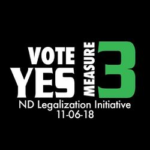
What Measure 3 does is rather simple. It removes marijuana from the list of Schedule 1 Substances, and as a result, legalizes it for personal consumption, use, distribution, and possession for all North Dakotans over the age of 21. Additionally, it seals previous records so long as they were of age, did not distribute to minors, and were non-violent. Lastly, it legalizes hemp for full-scale agricultural production, a crop which per bushel is worth 9 to 11 times that of wheat depending on the commodity prices, while taxing both marijuana and hemp at an effective rate of between 8-14% (depending on your local city sales tax).
So, what does this really mean for the average North Dakotan and their community?
1. Starting December 6, adults will no longer be torn away from their families for simple possession, breaking apart families and creating dependents on the state rather than contributors. College students will no longer risk losing their student loans or the ability to ever find employment for daring to go to a party with friends.
2. Starting December 6, thousands, if not tens of thousands suffering from PTSD, depression, anxiety, and other conditions not covered by our medical marijuana law will be able to get proven life-saving medicine. As it stands, North Dakota politicians have in altering the medical bill denied veterans the best medicine for their condition indefinitely.
3. Starting December 6, tax revenue will increase as many new entrepreneurs will open up businesses and serve their communities. The illegal market for marijuana will cease to exist as shady drug dealers are replaced by reputable members of your community, and they will all pay taxes according to the fiscal impacts report released by the state of North Dakota.
4. Starting December 6t, farmers will be able to actually plan to grow hemp in North Dakota, and for 2019 will have access to a cash crop which outperforms wheat 10:1, if they choose to grow marijuana itself, the benefits are potentially even greater. Based on Colorado wholesale prices, 1 acre of marijuana could provide a farmer with more revenue than 400 acres of corn.
5. Starting January 6, records of non-violent marijuana offenders who did not deal to children will be sealed. This means we can start to reintegrate people into a society that has legalized marijuana, and allow them greater opportunities to find employment, procure student loans, or even find basic housing. As it sits, 170,000+ records need to be sealed, which means for every 4 people in ND there is roughly 1 record for marijuana hurting someone in your community.
What this doesn’t mean:
1. DUI’s will not be legal. Attorneys Alicia Dearn (multi-time award winner licensed to practice federal law in all 50 states), Nicholas Sarwark (Former Deputy Public Defender of Colorado), and Jordan Parker agree: a fair reading of Measure 3 does not legalize DUI.
2. Smoking in schools or in public will not be legal. When vaping and e-cigarettes were made legal, public smoking bans were ruled to apply to them. Similarly, marijuana smoking in public will have the existing bans applied.
3.) Crime will not rise. In states that have legalized, crime has stayed consistently lower than pre-legalization, and in many cases has dropped slightly.
Last, but not least, we would like to dispute the fact that this is “the most liberal marijuana law.” Measure 3 has received support from some of the strongest conservative voices in the state including:
1.) Tony Gehrig (Fargo City Commissioner and staunch conservative)
2.) Rick Becker (District 7 State Legislator which is in Bismarck, Republican)
3.) The North Dakota Liberty PAC (which has endorsed multiple republican candidates)
4.) And countless everyday North Dakota Republicans
Thank you for voting YES on Measure 3 in North Dakota this November 6!
Your 2016 Cannabis Ballot Initiative Rundown
Michelle Rutter, NCIA
by Michelle Rutter, NCIA’s Government Relations Coordinator
In November, five states will vote on legalizing adult-use cannabis for individuals over 21 – Arizona, California, Maine, Massachusetts, and Nevada – while an additional four states will vote on medicinal cannabis reform – Arkansas, Florida, Montana, and North Dakota. All nine initiatives differ slightly from one another and each has its own unique language.
Below are NCIA’s quick summaries of each of the initiatives. Read up, then visit the campaign sites for more information and how you can help make 2016 another success in the fight to end marijuana prohibition.
ADULT-USE
ARIZONA
The Campaign to Regulate Marijuana Like Alcohol (Proposition 205) legalizes the possession and consumption of marijuana by persons who are over 21 and levies a 15% tax on the sale of cannabis, which would then be allocated to education and healthcare in the state. This would create an estimated $113 million in new tax revenue.
– Allows local governments to regulate and limit cannabis businesses
– If passed, Arizona’s cannabis market is projected to surpass $1 billion within three years
The Adult-Use of Marijuana Act (AUMA) (Proposition 64) legalizes the possession and consumption of marijuana by persons who are over 21 and enacts a 15% sales tax, as well as a cultivation tax of $9.25 per ounce of flowers and $2.75 per ounce for leaves.
– Estimated $1.4 billion in revenues within the first year of a fully operational market
– Written to prevent licenses for corporate or large-scale cannabis businesses for five years, which is in order to deter “unreasonable restraints on competition by creation or maintenance of unlawful monopoly power”
California has the largest state cannabis market (medical or adult-use) in the country, estimated at $2.7 billion in 2016.
The Campaign to Regulate Marijuana Like Alcohol (Question 1) legalizes the possession and consumption of marijuana by persons who are over 21 and enacts a 10% sales tax in addition to the state’s 5.5% sales tax. The first $30 million in tax revenue from cannabis sales would be used for school construction, with any additional revenue allocated to the General Fund.
– Medical cannabis will not be subjected to the 10% sales tax
– Caps the number of cannabis stores and cultivators until 2019 and 2022, respectively
The Campaign to Regulate Marijuana Like Alcohol (Question 4) legalizes the possession and consumption of marijuana by persons who are over 21 and creates a Cannabis Control Commission of three members appointed by the state Treasurer, which would generally administer the law governing cannabis use and distribution, promulgate regulations, and be responsible for the licensing of commercial cannabis establishments. It also creates a Cannabis Advisory Board of 15 members appointed by the Governor.
– Enacts an excise tax of 3.75%, in addition to the state sales tax
– A city or town could impose a separate tax of up to 2%
The Campaign to Regulate Marijuana Like Alcohol (Question 2) legalizes the possession and consumption of marijuana by persons who are over 21 and designates the Nevada Department of Taxation to issue licenses to cannabis retailers, suppliers, testing facilities, and distributors.
– Gives local governments control over cannabis business locations, and forbids businesses to operate near schools, childcare facilities, houses of worship, and certain community facilities.
– Enacts a 15% excise tax on wholesale sales of cannabis, in addition to the existing sales tax which would apply to the retail sale of cannabis
– Revenue generated from these taxes would be used to support K-12 education
There are two competing initiatives on the 2016 ballot: the Arkansas Medical Cannabis Act (AMCA) and Arkansas Medical Marijuana Amendment of 2016 (AMMA), known as Issue 7 and Issue 6, respectively. The main differences lie in patient card fee limits, the organizations that would implement the program, the distribution of sales tax revenue, and whether certain patients could cultivate their own medicine. As of October 2016, Issue 7, the Arkansas Medical Cannabis Act (AMCA) was struck from the ballot. The initiative will still appear on the ballot, but the results will not be counted.
Arkansas Medical Cannabis Act (AMCA):
– Sets a cap on the fees required to get dispensary and cultivation licenses and the fees required for patient cards
– Assigns the Arkansas Department of Health to set rules for patient cards, medical conditions that qualify a patient for medical marijuana use, and operating rules for dispensaries and cultivators
– Requires that all sales tax revenue goes back into the medical marijuana program
– Permits qualified cardholders to purchase medical cannabis from non-profit compassion centers
– Allows patients and their caregivers to cultivate up to 10 cannabis plants at home provided they take steps to ensure it is secure
Arkansas Medical Marijuana Amendment (AMMA):
– Sets a cap on the fee required to acquire a dispensary or cultivation license, but no limit on the cost for patient card fees;
– Assigns the Arkansas Department of Health to set rules for patient cards and medical conditions that qualify a patient for medical marijuana use, and the Arkansas Alcoholic Beverage Control to establish operating rules for dispensaries and cultivators;
– Divides sales tax revenue, assigning 10% to the medical marijuana program, 10% to the Skills Development Fund, 30% to the state’s General Fund, and 50% to the state’s Vocational and Technical Training Special Revenue Fund
The Florida Right to Medical Marijuana Initiative (Amendment 2) allows medical use of cannabis for individuals with debilitating medical conditions as determined by a licensed Florida physician and allows caregivers to assist patients’ use of medical cannabis.
– Mandates that the Department of Health shall register and regulate centers that produce and distribute cannabis for medical purposes shall issue identification cards to patients and caregivers.
– Constitutional amendments on the ballot in Florida must garner at least 60% in order to pass. This is why the medical cannabis amendment on the ballot in 2014 failed, despite receiving 58% of the vote.
Montana is voting to amend their dysfunctional medical cannabis program that has basically been regulated out of existence. The initiative amends the Montana Marijuana Act of 2011 and renames it the “Montana Medical Marijuana Act” (I-182).
– Allows providers to hire employees to cultivate, dispense, and transport medical cannabis, and repeals the limit of three patients for each licensed provider.
– Repeals the requirement that physicians who provide certifications for 25 or more patients annually be referred to the Board of Medical Examiners.
– Removes the authority of law enforcement to conduct unannounced inspections of medical marijuana facilities and requires annual inspections by the State
The North Dakota Medical Marijuana Initiative will be Initiated Statutory Measure 5 on the ballot and is also known as the North Dakota Compassionate Care Act, which creates a state-regulated medical marijuana program for patients with specified debilitating conditions and written certifications from their doctors. Registered patients could obtain medical cannabis from a licensed non-profit compassion center, and if the patient lives 40+ miles away, they are permitted to cultivate a limited amount of cannabis for their medical use.
This year it’s more important than ever to make sure you’re registered to vote and get to the ballot box on November 8th. If you live in one of the nine states with a ballot initiative, cast your vote for ending prohibition or allowing patients access to medicine. Otherwise, don’t forget to cast your ballot for candidates at the local, state, and federal level who support cannabis reform to ensure that 2017 is the industry’s biggest year yet!


 By Madeline Grant, NCIA’s Government Relations Manager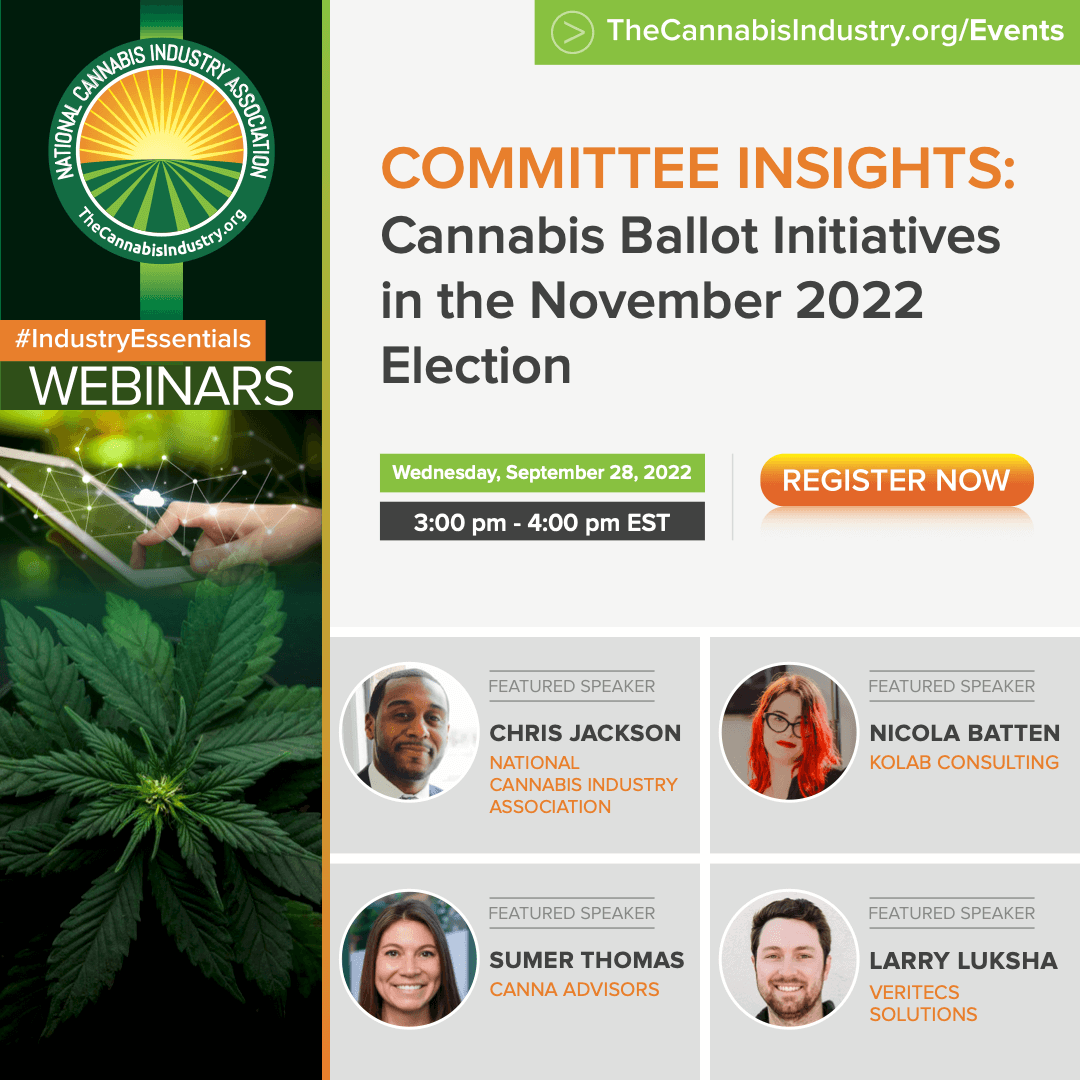
 By Sadaf Naushad, NCIA Intern
 MICHIGAN
 These stunning victories

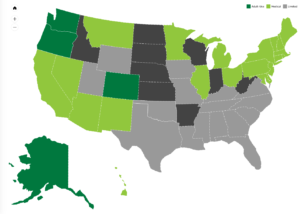 MEDICAL
Follow NCIA
Newsletter
Facebook
Twitter
LinkedIn
Instagram
News & Resource Topics
–
This Just In
How THCa Vapes Are Changing Consumer
Announcing NCIA’s 2026-2028 Board of Directors