Taking the Long View – Strategic Facility Design Considerations for the Schedule III Era
In the dynamic landscape of the cannabis industry, regulatory changes can significantly impact how businesses operate and plan for growth. The recent proposal to reschedule cannabis from Schedule I to Schedule III has sparked discussions across the industry, particularly regarding facility design and operational strategies. This blog dives into key insights from the National Cannabis Industry Association’s webinar on “Taking the Long View – Strategic Facility Design Considerations for the Schedule III Era,” highlighting expert advice and practical recommendations for stakeholders navigating these changes.
The webinar, hosted by Brian Gilbert of the NCIA, served as a crucial platform for industry professionals to explore the implications of cannabis rescheduling on facility design and operations. The session focused on four main pillars: understanding tax changes, enhancing operational efficiency, promoting sustainable growth, and implementing practical strategies to navigate regulatory shifts.
Key Takeaways
1. Policy and Tax Implications
The discussion, led by Shawn Cooney of Cloud Farming, Chair of NCIA’s Facilities Design Committee, underscored the potential financial benefits for businesses following cannabis rescheduling (00:03:41). A highlight was the exploration of Section 280E, which could offer substantial tax savings once regulatory changes are implemented. Jeremy Schlicher of Urban Green Design expanded on these insights, offering strategic financial planning advice aimed at leveraging tax incentives to reinvest in facility improvements (00:07:21).
2. Operational Efficiency and Sustainability
Efficiency in energy management emerged as a critical theme throughout the webinar. Experts emphasized the importance of conducting energy audits and adopting efficient lighting and HVAC systems (00:10:18). These measures not only reduce operational costs but also align with sustainability goals crucial for long-term viability in the industry. Practical recommendations tailored to cultivation, manufacturing, and retail sectors were discussed to optimize workflow efficiencies and regulatory compliance (00:15:10).
3. Cultivation Methods and Environmental Considerations
Kim Kannapel of Modern Thermal Design provided invaluable insights into cultivation methods and environmental sustainability. The webinar highlighted the viability of various methods—indoor, greenhouse, and outdoor—each catering to different market segments and regulatory landscapes. The discussion underscored the role of climate and local regulations in shaping cultivation decisions (00:37:28), emphasizing the need for adaptable strategies that prioritize energy efficiency and environmental stewardship.
As Chair of NCIA’s Facility Design Committee, Shawn Cooney brought deep regulatory expertise to the discussion. He emphasized the importance of holistic sustainability practices and compliance with evolving regulatory frameworks. His insights into tax implications and strategic planning resonated with participants seeking clarity on financial strategies post-rescheduling (00:25:32).
Kim Kannapel’s contributions focused on environmental sustainability within cannabis cultivation. Her expertise in optimizing cultivation methods highlighted the interconnectedness of environmental stewardship and operational efficiency. By advocating for adaptive strategies, Kim encouraged businesses to consider long-term environmental impacts when designing and expanding their facilities (00:37:28).
A staunch advocate for the innovative triple bottom line approach, Jeremy Schlicher brings a wealth of knowledge to the discussion on strategic facility design in the cannabis industry. He emphasizes the integration of economic prosperity, environmental stewardship, and social responsibility in every aspect of facility planning and operations. Jeremy’s insights into maximizing operational efficiency through sustainable practices, such as energy audits and efficient HVAC systems, underscore his commitment to reducing environmental impact while enhancing business profitability.
Importance of Participating in the Public Comment Period
Participating in the public comment period is crucial for shaping the future regulatory landscape of the cannabis industry. The Department of Justice’s proposal to reschedule cannabis presents a unique opportunity for stakeholders to voice their perspectives and influence policy decisions. NCIA has launched a dedicated tool to streamline this process, making it easier for industry professionals to submit informed comments.Submit your comment here.
Recap of Episode I & II
Episode I: Understanding Section 280E and its Impact on Cannabis Businesses
In Episode I, the focus was on the financial and tax implications of rescheduling cannabis. Section 280E was a major topic, with discussions centered on how the rescheduling could lead to significant tax savings and the importance of strategic financial planning for businesses to maximize these benefits.
Episode II: Cannabis Rescheduling’s Impact on Research and Safety
Episode II delved into the implications of cannabis rescheduling on research and safety protocols. This session emphasized the potential for increased research opportunities and the necessity for businesses to stay ahead of regulatory changes to maintain compliance and ensure product safety.
Looking Ahead: Preview of Episodes 4 & 5
Episode IV: Navigating Insurance and Risk Management in the Schedule III Era
Join us for the fourth episode of NCIA’s multi-part #IndustryEssentials webinar series, “Navigating Insurance and Risk Management in the Schedule III Era,” led by our Risk Management & Insurance Committee. This session delves into the evolving landscape of cannabis insurance and risk management, highlighting the opportunities and challenges presented by the rescheduling of cannabis to Schedule III.
Date: Tuesday, July 9th, 2024 Time: 3:00 PM EST – 4:00 PM ET
Episode V: Cannabis Manufacturing in the Schedule III Era
Building on the insights from our first four episodes, join us for the fifth installment of NCIA’s #IndustryEssentials multi-part webinar series. This session, led by our expert Cannabis Manufacturing Committee, will focus on the profound impacts and implications of rescheduling cannabis on the manufacturing sector. As we navigate these unprecedented changes, our panel of industry leaders will provide critical insights and practical guidance to help your business adapt and thrive in this new landscape.
Advancing the Industry Together: NCIA’s Mission in Action
The overarching theme of this series is to equip cannabis industry stakeholders with the knowledge and strategies needed to navigate the complex landscape of regulatory changes. By understanding the financial, operational, and research implications of cannabis rescheduling, businesses can better position themselves for sustainable growth and success. Each episode builds on the previous one, creating a comprehensive resource for industry professionals to stay informed and proactive in their planning and operations.
The webinar “Taking the Long View – Strategic Facility Design Considerations for the Schedule III Era,” offered a comprehensive roadmap for stakeholders navigating regulatory changes in the cannabis industry. By addressing tax implications, promoting operational efficiency, and advocating for sustainable growth practices, the session equipped participants with actionable strategies to thrive amidst evolving regulatory landscapes.
Call to Action
As the industry continues to evolve, staying informed and proactive is crucial for cannabis businesses. Explore NCIA’s resources, including upcoming webinars and educational materials, to deepen your understanding of regulatory changes and strategic facility design considerations. Engage with industry peers and experts to share insights and best practices that drive sustainable growth and operational excellence.
For those not yet members, consider joining the National Cannabis Industry Association (NCIA) to unlock unmatched benefits, resources, and access. Membership provides exclusive opportunities to influence industry standards, gain regulatory insights, and network with industry leaders. Join NCIA today to leverage these benefits and stay ahead in the competitive cannabis market.
Member Blog: Cultivating Safety – Advanced Workers’ Compensation Solutions for Cannabis Businesses
The cannabis industry is experiencing rapid growth, bringing with it unique risks and regulatory challenges, especially in protecting employees. Recognizing the complexities of this industry is crucial for developing comprehensive insurance solutions, particularly in workers’ compensation. This blog explores strategies and insights tailored to navigate the intricacies of cannabis-related businesses.
The Unique Occupational Risks in Cannabis
Occupational hazards in the cannabis industry vary significantly across its different verticals—from cultivation and harvesting to manufacturing, distribution, and retail. Each step of the way introduces specific risks:
Cultivation: Employees may face exposure to pesticides, ergonomic challenges, and the potential for injuries related to manual labor or the operation of agricultural machinery and electrical exposures
Manufacturing: The extraction process involves handling volatile substances, which can pose chemical exposure risks, while the use of heavy machinery introduces the potential for industrial accidents.
Retail and Distribution: Employees in these sectors might encounter security concerns, the risk of theft, and repetitive motion injuries, alongside the unique challenges of delivering products safely.
Recognizing and addressing these varied risks is the cornerstone of an effective workers’ compensation strategy, ensuring that businesses are prepared to support their employees in the event of an occupational injury or illness.
Why Workers’ Compensation Is Essential
Workers’ compensation is not just a legal formality; it’s a cornerstone of your business’s resilience. A well-conceived policy ensures that employees are protected in the event of workplace injuries, which in turn safeguards your business from potentially crippling financial liabilities.
Generic workers’ compensation policies often fall short of meeting the specific needs of the cannabis industry. A focused approach on the unique challenges of cannabis operations, is not only beneficial, but necessary for comprehensive protection. This strategy involves:
Risk Identification and Analysis: Understanding the specific hazards associated with different cannabis industry roles is the first step in crafting effective workers’ compensation policies.
Rapid Claim Resolution: Efficient processing and resolution of claims are vital in controlling costs and supporting injured employees’ return to work. Speedy claim closure not only benefits the employee, but also helps manage the financial impact on the business.
Mitigation and Cost Control: A Proactive Approach
Effective claim resolution and risk mitigation are key for cannabis businesses to control workers’ compensation costs effectively. Leveraging advanced data analytics helps identify claim sources and implement prevention measures, closing claims swiftly and reducing overall insurance costs.
Implementing Robust Risk Management Practices
Significant impacts on the frequency and severity of claims can be achieved with:
Safety Training and Education: Regular programs can help employees avoid injuries and safely navigate potential hazards.
Ergonomic Assessments: Identifying modifications in roles involving manual labor or repetitive tasks can reduce strain and prevent injuries.
Security Measures: Enhancing security can mitigate risks associated with theft, especially important in retail and distribution.
A Case in Point: Swift Resolution for a Cannabis Delivery Company
Consider the case of a cannabis delivery company that faced a workers’ compensation claim when a delivery driver sustained an injury on the job. By employing a focused approach to claim management, including prompt medical evaluation and clear communication channels, Liberty’s intervention led to the claim being settled and closed in under four weeks—a testament to our commitment to fast and effective resolution. This not only minimized the cost to the company, but also allowed the employee to return to work sooner, maintaining productivity and morale.
Beyond Claims: Comprehensive Risk Management
A holistic risk management approach covers all potential risks, from delivery driver incidents to cultivation and retail hazards, ensuring comprehensive coverage.
Choosing a Strategic Partner
Partnering with an insurance provider that understands the cannabis industry’s complexities is critical. Customized strategies in insurance and workers’ compensation can offer unparalleled protection and peace of mind, supporting your business’s growth and resilience.
The Path Forward for Cannabis Businesses
As the cannabis industry evolves, strategic foresight in managing workers’ compensation is essential. Focusing on specific sector needs and prioritizing efficient solutions can create a safer work environment and a more resilient future. With the right strategies and a commitment to safety and efficiency, businesses can navigate these challenges successfully, ensuring protection for employers and their valued employees.
For more information, please reach out toValerie Taylor, Vice President (National Cannabis Practice Leader), Liberty Company Insurance Brokers and Kirk Aguilera, Managing Partner (National Workers’ Compensation Practice Leader).
Webinar Release: Positioning for Prosperity – Insurance Essentials for Social Equity Awardees
In our ongoing commitment to providing timely and essential education to the cannabis industry, the National Cannabis Industry Association (NCIA) recently hosted a thought-provoking webinar titled “Positioning for Prosperity: Insurance Essentials for Social Equity Awardees.” In collaboration with NCIA’s Risk Management & Insurance Committee (RMIC), this webinar delved into the critical considerations surrounding insurance needs within the cannabis industry.
Led by a panel of esteemed experts, the discussion navigated the intricate landscape of insurance coverage, specifically tailored to address the needs of social equity awardees. From exploring the advantages and disadvantages of social equity programs to addressing challenges such as information inaccessibility and skyrocketing premiums, the webinar provided valuable insights for businesses seeking to navigate the insurance landscape.
Key topics included:
Defining social equity awardees and discussing their advantages and disadvantages in the industry and market.
Exploring the unique coverage needs for social equity awardees.
Examining real-life examples of what has and hasn’t worked in the cannabis industry regarding insurance coverage.
Understanding the differences between state requirements and optimal coverage for cannabis businesses.
Exploring other financial requirements that help social equity awardees establish sustainable companies.
Throughout the webinar, participants gained insights into how to position their businesses for success in the evolving cannabis landscape while gaining a deeper understanding of the vital role organizations like CANNRA play in progressive policy improvement.
Missed the webinar? Don’t worry! You can watch the full recording on our YouTube channel below.
At NCIA, we remain committed to providing valuable resources, education, and insights to empower businesses and individuals within the cannabis industry. Stay tuned for more updates, webinars, and events designed to support your journey in the cannabis space.
Thank you to our panelists, attendees, and the RMIC for their contributions to making this webinar a success.
Member Blog: Cannabis Industry Predictions for 2024
Presented by the Cannabis Team with BGM, a Seedling Member of NCIA
As we usher in the transformative year of 2024, the cannabis industry stands at the threshold of unprecedented growth and evolution. The Cannabis Team at BGM, a dedicated Seedling Member of the National Cannabis Industry Association (NCIA), invites you to explore the latest insights and predictions for the cannabis sector in their comprehensive blog post. This overview provides a glimpse into the changing landscape, legislative shifts, emerging market dynamics, and the multitude of opportunities and challenges that lie ahead.
Let’s look at the latest insights and 2024 predictions for the cannabis industry. This blog addresses the changing landscape, including regulatory shifts and market opportunities. Continue reading to explore the future of the cannabis industry and learn how your cannabis business can stay ahead in the coming year.
Growth and Expansion
In 2024, the global cannabis market is expected to experience substantial growth, fueled by emerging legal markets, innovative product offerings, and technological advancements. This growth presents opportunities and challenges, especially in navigating complex legal and regulatory landscapes.
Market Dynamics
Projected Market Growth: The U.S. cannabis market is projected to grow significantly. Retail cannabis sales could reach $53.5 billion by 2027, with adult-use sales growing more rapidly. States like New York are working on finalizing details to launch approved programs, contributing to this growth.
Technological Advancements: Blockchain and AI will likely revolutionize supply chain management and compliance tracking.
Product Innovation: The trend toward personalized cannabis products is expected to gain traction as consumers become more educated and discerning. Cannabis companies will likely continue tailoring their products to meet a wide range of individual needs and preferences. However, pre-rolls are projected to continue to be a top product sale item in 2024. As people progress in their exploration and knowledge of cannabis, we believe they will gravitate towards craft cannabis products, and artisanal flower, despite the enduring demand for low-cost and convenient options.
Legislative Predictions
Legalization: We foresee several additional states legalizing recreational cannabis in 2024. Federal legalization of medical or recreational cannabis appears to be a long way off, as demonstrated by the inability of the SAFE Banking Act to pass in Congress.
SAFE Banking Act: This continues to be a pivotal issue, with potential movement expected in 2024.
Federal Rescheduling: Anticipated action by President Biden could reshape the industry’s regulatory framework, impacting financial reporting and taxation.
State-Level Changes: States like Maryland, possibly followed by Pennsylvania and Ohio, may influence regional market dynamics and tax structures.
Industry Trends
Ancillary Services: As the industry grows, so does the demand for financial and ancillary services, highlighting the need for specialized accounting solutions and advisory services.
Canadian Market Resurgence: Canadian cannabis stocks may witness a revival, affecting cross-border financial transactions and investment strategies.
Global Influence: Germany’s role as a market catalyst emphasizes the importance of understanding international financial regulations in the cannabis sector.
State Trends
Maryland and Neighboring States: Maryland’s recent move to full legalization is expected to influence neighboring states. Analysts predict that Pennsylvania might follow Maryland’s lead. There’s also pressure on Virginia to get its program operational in 2024.
Vermont and Mississippi: Farmers in states such as Vermont and Mississippi, which have legalized cannabis, face challenges with federal regulations around hemp cultivation. The U.S. Department of Agriculture (USDA) has rescinded hemp licenses for some farmers who grow marijuana, reflecting the ongoing conflict between federal and state laws regarding cannabis.
New York: The New York Cannabis Control Board anticipates approving additional licenses in early 2024. We will wait to see the progress.
Continued Legalization Trends: More states are likely to embrace broader cannabis legalization, including CBD and Delta 8 THC, enhancing consumer accessibility across the U.S. This trend is driven by legal advancements, ongoing research, and shifting societal views.
To continue reading the full article and explore the remaining sections on Financial Implications, Technology and Data Management, Ethical and Social Considerations, Global Market Integration, and Risk Management, click here to visit BGM’s website. Your journey into the future of cannabis begins now.
Join the Cannabis Movement: Become an NCIA Member Today
As we delve into the transformative year of 2024 in the cannabis industry, it’s crucial to be part of a community that champions growth, innovation, and advocacy. The National Cannabis Industry Association (NCIA) stands at the forefront, shaping the future of the cannabis sector.
Why Join NCIA?
Network with Industry Leaders: Connect with like-minded professionals, industry leaders, and visionaries who are driving the cannabis industry forward. NCIA offers a platform for networking and collaboration that is unparalleled.
Stay Informed: Stay ahead of the curve with the latest insights, trends, and legislative updates. NCIA provides valuable resources and information, ensuring that you are well-informed about the dynamic landscape of the cannabis market.
Advocacy and Influence:Be part of a collective voice that advocates for sensible cannabis policies at the national level. As a member of NCIA, you contribute to shaping the regulatory environment and fostering a thriving, responsible cannabis industry.
Who Should Join?
If you are a cannabis business owner, entrepreneur, investor, or industry enthusiast, NCIA is your gateway to a community that understands the unique challenges and opportunities within the cannabis sector. Whether you’re navigating legislative changes, seeking business connections, or staying informed about market dynamics, NCIA is the ultimate resource.
How to Join:
Becoming an NCIA member is simple. Visit our membership page to explore the benefits and choose the membership level that aligns with your goals. Join the community that is actively shaping the future of the cannabis industry.
Beyond the Doorstep: Mastering Risk Management in the Cannabis Delivery Revolution
In the fast-paced world of cannabis retail delivery, where popularity and convenience of home delivery mingles with the complexities of compliance, risk management takes center stage. As experts in the field of cannabis insurance, we recognize that the journey from shelf to doorstep is not just a logistical dance but a tightrope walk of potential hazards. In this blog post, we navigate through the labyrinth of risks in cannabis delivery, honing in on the often-underestimated challenges faced by the delivery workforce.
The Green Route: Cannabis Delivery Takes Center Stage
With the rising demand for cannabis products and the evolving legal landscape, cannabis delivery services have remained the heartbeat of the industry. The convenience of having products delivered directly to the doorstep is undoubtedly a game-changer. Furthermore, in the post-pandemic era, the surge in home delivery services has not only reshaped consumer behavior but has also provided a gateway for a previously untapped market segment—individuals who may feel hesitant to step into a physical cannabis retail store.
Dangers Unseen: The Employee-Side Risks
When it comes to cannabis delivery, the focus often centers on product safety and compliance with intricate regulations. Yet, the risks faced by delivery personnel are equally significant and deserve careful consideration. One of the most common and often unexpected risks is the peril of dog bites. As a seasoned insurance professional, I’ve seen cases where a routine delivery turned into a harrowing experience due to an unforeseen encounter with an aggressive pet.
Dog bites may seem minor, but they can lead to serious injuries, legal complications, and financial ramifications for both the employee and the business. It’s crucial for cannabis delivery businesses to incorporate comprehensive insurance coverage that accounts for these unpredictable scenarios.
On the Road: Navigating the Risks of Car Accidents
Another aspect of risk management in cannabis delivery centers on the transportation process. The potential for car accidents poses a substantial threat to delivery personnel, particularly when navigating through unpredictable traffic conditions. Thus, ensuring the safety and protection of the delivery team is paramount.
As experts in cannabis insurance, we advocate for a holistic approach to risk management that encompasses employee training, vehicle safety measures, and robust insurance coverage. Businesses must be proactive in implementing safety protocols and providing ongoing training to mitigate the risks associated with accidents on the road.
Insurance Solutions: Safeguarding Your Assets
In the world of cannabis delivery, insurance is not merely a legal requirement; it is a strategic investment in the longevity of your business. Tailoring insurance coverage to address employee-side risks is a pivotal step in fortifying your enterprise against unforeseen challenges.
A comprehensive risk management strategy hinges on an all-encompassing liability coverage that explicitly includes incidents like dog bites. It’s crucial to underscore that occurrences such as dog bites are integral components of a robust workers’ compensation policy, underscoring their inclusion within the same framework. This interconnected approach forms the backbone of a well-rounded risk management strategy. Additionally, ensuring that your delivery vehicles are adequately insured acts as a critical safeguard, shielding your business from the financial ramifications of accidents.
Nurturing Growth Through Proactive Risk Management
Overall, the cannabis industry continues to evolve, so too must our approach to risk management. The journey from seed to sale is fraught with uncertainties, and it’s our responsibility as insurance professionals to provide a safety net that extends beyond insurance that meets the minimum legal requirements. By prioritizing employee-side risks in cannabis delivery, businesses not only protect their most valuable assets—their workforce—but also fortify their position in this dynamic market. In the ever-changing landscape of cannabis, let proactive risk management be the compass guiding your business towards a sustainable and secure future.
Elevate Your Cannabis Business with NCIA Membership
Embark on a journey of growth, knowledge, and industry collaboration by becoming a member of the National Cannabis Industry Association (NCIA). As the leading voice of the cannabis industry, NCIA provides unparalleled resources, advocacy, and networking opportunities to businesses navigating the dynamic landscape of cannabis.
Why Join NCIA?
Industry Advocacy: Gain a powerful ally in shaping cannabis policies and regulations at the national level. NCIA actively engages with policymakers to ensure a favorable environment for cannabis businesses.
Educational Resources: Stay ahead in the ever-evolving cannabis space with access to exclusive industry reports, webinars, and educational events. NCIA keeps you informed about the latest trends and best practices.
NCIA Events: Connect with fellow industry professionals, entrepreneurs, and thought leaders at NCIA’s signature events – including the 2024 Stakeholder Summit Series and 12th annual Cannabis Industry Lobby Days. Forge valuable partnerships and stay connected with the pulse of the cannabis community.
How NCIA Membership Enhances Your Risk Management Strategy
In collaboration with industry leaders, NCIA offers insights and resources to strengthen your risk management approach. As a member, you’ll have access to specialized content, webinars, and expert advice tailored to the unique challenges faced by cannabis businesses in the delivery sector.
Join NCIA Today
Elevate your cannabis delivery business with NCIA membership and take a proactive step towards a secure and thriving future. To explore the benefits of membership and join the growing community of cannabis professionals, visit National Cannabis Industry Association. For personalized assistance and insights, feel free to reach out to our dedicated membership team at membership@cannabisindustry.org.
Unlock the full potential of your cannabis business with NCIA – Your Partner in Progress.
Welcome to the National Cannabis Industry Association’s (NCIA) insightful webinar recording, “Committee Insights: Where Risk Assessment Integrity Meets Policy.” Hosted by NCIA’s Cannabis Manufacturing Committee and originally broadcast on Tuesday, October 24th, 2023, this session provided a deep dive into the complex but critical intersection of cannabis industry risk assessment and policy development. This blog post will highlight key discussions and insights from the panel, offering a condensed overview of the critical issues explored during the webinar, continue reading and view the full recording below.
Comprehensive Risk Assessment for Vape Product Manufacturers
The panelists underscored the importance of thorough risk assessments for vape product manufacturers, especially in the highly regulated cannabis and hemp sectors. The conversation centered on essential areas of concern, including the potential for fraud, liability, and the significance of ingredient selection, particularly terpenes. Material of construction and employee safety were also key factors that were addressed.
Hardware Risks and Due Diligence
The webinar uncovered the risks associated with hardware components and vendors. It shed light on the due diligence required when introducing new vape products, which includes vetting hardware suppliers and partners. Addressing concerns related to shrinkage and theft was another significant aspect of risk management. Additionally, the panel stressed the importance of setting safety guidelines based on industry standards such as ASTM.
Safety Standards and Ingredient Considerations
The discussion dived into the implications of safety standards, especially ASTM, and their role in determining acceptable safety levels within the industry. The panel emphasized the importance of ingredient considerations, particularly in preventing E-cigarette or Vaping Product Use-Associated Lung Injury (EVALI). Risk assessment for ingredients was a major focus, as it plays a critical role in product safety and integrity.
Implications of Fraud and Counterfeit Products
A crucial point discussed was the far-reaching implications of fraud, counterfeit products, and negligence within the cannabis and hemp industry. The panelists delved into the legal considerations when unknowingly selling dangerous products. They also highlighted the industry’s ongoing struggle with counterfeiting and the need for robust prevention measures to protect consumers.
Regulatory Challenges and Industry Growth
The webinar touched upon the challenges of navigating regulatory environments for both regulators and operators. The panelists emphasized the need for striking a balance between regulation and innovation to ensure the industry’s growth while maintaining product safety. The conversation also addressed the evolving landscape of marketing and advertising regulations, emphasizing the need for clear guidance in these areas.
Essential Insights from Industry Experts
Learn more about our distinguished panel of NCIA member experts including hardware & product manufacturers, toxicologists, legal professionals and regulators each of which brought their unique perspective and insights to our comprehensive exploration.
This is the third of five in a multi-part series of #IndustryEssentials webinars. You can watch Parts I & II plus register Part IV & V at the links below.
Episode I – Committee Insights: Mapping the Vape Landscape: Where are We and Where Do We Go from Here?” – [Watch Here]
Episode II – Committee Insights: Cannabis Vaping – Avoid Being an Easy Target – [Watch Here]
Episode IV: Committee Insights: Cannabis Vaping – Beyond the Pen – [Date & Time TBD]
Episode V: Committee Insights: Dabinar Special Edition – Dabbing 101 – [Date & Time TBD]
For access to our full webinar recording archive, featuring 100+ episodes from five separate recurring series, head here.
Join NCIA and Be Part of Future Speaking Opportunities
If you’re eager to share your expertise and insights with our dynamic cannabis community, we encourage you to consider becoming a member of the National Cannabis Industry Association (NCIA). Our member-led committees, such as the Cannabis Manufacturing Committee, offer numerous opportunities to participate in our webinars and events as a speaker. By joining NCIA, you’ll be well-positioned to become a part of our expert panelists in the future. Don’t miss the chance to contribute to meaningful discussions that help shape the cannabis industry.
Learn more about NCIA membership and the benefits it offers here.
Explore Sponsorship Opportunities
For those interested in sponsoring future webinars and events to reach a broad and engaged audience within the cannabis industry, we invite you to fill out our sponsorship inquiry form. Our team will be happy to provide you with more details on how you can collaborate with NCIA to promote your brand and engage with our community.
Your involvement with NCIA opens doors to a wealth of opportunities in the ever-evolving cannabis industry. We look forward to having you as part of our vibrant community!
A Valuable Resource for Industry Professionals
NCIA’s “Committee Insights” series serves as a comprehensive resource for cannabis and hemp industry professionals and this episode offers valuable insights into the critical role of risk assessment and policy development in shaping the future of cannabis operations. By exploring our full recording, you’ll gain invaluable insights and stay informed about the latest developments in the ever-evolving cannabis industry.
Stay Connected with NCIA
Thank you for being a part of our dynamic cannabis community. NCIA’s #IndustryEssentials webinar series is our premier digital educational platform, offering timely and essential insights precisely when you need them. This session is part of our Committee Insights series, produced in collaboration with our member-led committees. Sign up today to receive more industry insights and updates to stay ahead in the evolving cannabis and hemp sectors.
Cannabis Vaping – Avoid Being an Easy Target | 10.12.23 | NCIA #IndustryEssentials Webinar
In the ever-evolving cannabis industry, staying informed and educated is paramount. The National Cannabis Industry Association (NCIA) understands this need and presents its premier digital educational series, the #IndustryEssentials webinar series. The latest installment, “Committee Insights: Cannabis Vaping – Avoid Being an Easy Target” is a deep dive into the world of cannabis manufacturing risk management.
A Changing Landscape: The 2019 EVALI Outbreak
The year 2019 brought a significant shift in the cannabis vaping landscape with the EVALI outbreak. This crisis stirred up the cannabis vape industry, causing some businesses to become easy targets in the court of public opinion. The incident prompted a critical need for companies to design safer products and expand their due diligence testing during the product development phase. With vaping remaining a popular form of consumption, particularly among GenZ users, the industry found itself at a crossroads.
A Journey into Risk Management
NCIA’s second vaping webinar of 2023 addressed these challenges head-on, gathering industry experts to discuss what their companies are doing to avoid being easy targets, prevent another EVALI-like crisis, and navigate an industry in the absence of regulations. The session focused on key learning objectives, including risk assessment and due diligence protocols, best practices and manufacturing standards during product development, youth prevention strategies, and insights gained from emissions testing of vape products.
A Source of Valuable Insights
This webinar was a source of invaluable insights, covering risk management strategies that are crucial for manufacturers in the cannabis industry. It highlighted the significance of risk assessment and due diligence protocols, enabling businesses to determine consumer exposure limits. The presentation of best practices and manufacturing standards helps set industry benchmarks, ensuring product quality and safety. Addressing youth prevention strategies is essential for responsible cannabis consumption. Finally, the discussion on emissions testing of vape products provides information for creating a safer industry.
Becoming Part of the NCIA Community
If you found this webinar valuable and wish to access more educational content and networking opportunities, consider becoming a member of the National Cannabis Industry Association (NCIA). Membership opens doors to a wealth of resources and opportunities in the cannabis industry.
Sponsorship Opportunities
For businesses looking to gain visibility in educational programs and webinars like this one, NCIA offers sponsorship opportunities. Partnering with NCIA can help companies establish a presence in the industry and connect with professionals and enthusiasts.
In conclusion, NCIA’s commitment to providing timely, engaging, and essential education is evident in its #IndustryEssentials webinar series. The “Committee Insights: Cannabis Vaping – Avoid Being an Easy Target” webinar brings us closer to understanding the risks and challenges faced by manufacturers in the cannabis industry. As the industry continues to evolve, staying informed and educated is key to success.
Future Editions of this Series
This is the second of five in a multi-part series of #IndustryEssentials webinars. You can watch Parts I & III plus register Part IV & V at the links below.
Episode I – Committee Insights: Mapping the Vape Landscape: Where are We and Where Do We Go from Here?” – [Watch Here]
Episode III – Committee Insights: Where Risk Assessment Integrity Meets Policy –[Watch Here]
Episode IV: Committee Insights: Cannabis Vaping – Beyond the Pen – [Date & Time TBD]
Episode V: Committee Insights: Dabinar Special Edition – Dabbing 101 – [Date & Time TBD]
Stay tuned as more details surrounding Parts IV & V will be announced soon!
Thank you for reading, and stay tuned for more updates from NCIA, your trusted source for cannabis industry insights and knowledge.
Mapping the Vape Landscape | 10.2.23 | Committee Insights
Welcome to the recorded session of our webinar, “Mapping the Vape Landscape: Where are We and Where Do We Go from Here?” In this engaging discussion, hosted by NCIA’s Cannabis Manufacturing Committee, we dive into the dynamic world of vaping in the cannabis industry.
NCIA’s #IndustryEssentials webinar series is our premier digital educational platform, offering timely and essential insights when you need them most. This session is part of our Committee Insights series, produced in collaboration with our member-led committees.
Vaping is often hailed as the future of our industry, providing potent doses at a lower cost. However, it’s also a topic of controversy. This webinar features a distinguished panel that covers all aspects of the vaping vertical, from industry leaders to experts in hardware and safety standards. Whether you’re a retailer, brand representative, manufacturer, or a newcomer, this discussion addresses misconceptions, spotlights current trends, and prepares you for the future of vaping.
Learning Objectives:
• Explore the current categories of devices, products, and formulations.
• Discover strategies to optimize the user experience in a rapidly evolving market.
• Gain insights into the regulations shaping the vaping industry.
• Peer into the future: standards, trends, and potential game-changers.
Panelists:
Tucker Holland
Co-founder, CFO and Processing Director Entourage Cannabis
Darwin Millard
Chief Scientific Officer Final Bell
Join us in this exploration of the vape landscape and gain valuable insights from industry experts. Watch the recording to enhance your understanding of the cannabis industry’s most polarizing yet transformative segment.
—
This is the first of five in a multi-part series of #IndustryEssentials webinars. You can watch Parts II & III plus register Part IV & V at the links below.
Episode II – Committee Insights: Cannabis Vaping – Avoid Being an Easy Target – [Watch Here]
Episode III – Committee Insights: Where Risk Assessment Integrity Meets Policy –[Watch Here]
Episode IV: Committee Insights: Cannabis Vaping – Beyond the Pen – [Date & Time TBD]
Episode V: Committee Insights: Dabinar Special Edition – Dabbing 101 – [Date & Time TBD]
Stay tuned as more details surrounding Parts IV & V will be announced soon!
Cracking the Code – Unraveling the Challenge of Coverage for Novel Cannabinoids | 8.8.23 | Committee Insights
NCIA’s #IndustryEssentials webinar series is our premier digital educational platform featuring a variety of interactive programs allowing us to provide you timely, engaging and essential education when you need it most.
In this edition of our Committee Insights series, originally aired on August 8, NCIA’s Risk Management & Insurance Committee explored why insurance for novel cannabinoids can be such a challenging code to crack. Our discussion will help you navigate through liability and legislative loopholes, offering a clearer understanding of your exposure, while considering the patchwork of federal and state requirements.
In case you missed it, in conjunction with this session they’ve also released the third edition of their “Risk Management and Insurance Manual” specifically exploring this subject, which is available for download on NCIA’s website here: https://bit.ly/3OvGtag
You’ll leave with a better understanding of how unravel the complexities of insuring novel cannabinoids and equipped with the knowledge needed to make informed decisions regarding your insurance coverage. Whether you’re a cannabis business owner, a risk manager, an insurance professional, or anyone with an interest in this topic, this webinar will provide you with practical takeaways to safeguard your products, operations, and workforce.
Tune in as we crack the code to safeguard your products, operations and workforce!
Member Blog: Securing Your Cannabis Venture – Mastering Inspections with Comprehensive Cannabis Insurance
The cannabis industry continues to blaze a trail of growth and innovation, opening numerous opportunities for entrepreneurs and investors. However, this thriving landscape also exposes businesses to unique risks that demand proactive risk management solutions. Insurance plays a pivotal role in safeguarding cannabis ventures from potential losses, making it an essential aspect of responsible business operations. In this blog post, I will explore the critical role of inspections, the challenges they present, and how partnering with a reliable cannabis insurance broker can protect your business interests while mastering the art of inspections.
Understanding the Need for Inspections
The cannabis industry operates under stringent regulations, and inspections are an indispensable component of ensuring compliance. These routine evaluations, carried out by regulatory bodies or insurance carriers, are designed to assess product quality, safety standards, and adherence to legal requirements. While inspections are vital for maintaining high standards within the industry, they also expose businesses to potential vulnerabilities, particularly theft.
The Perils of Theft: Unraveling Insider Threats
As the cannabis industry expands, so does the risk of theft. A concerning issue arises from potential “inside jobs,” where employees or third-party trusted individuals gather sensitive information on-site, posing a significant threat to the operation’s stability. This situation often leads to confusion and concern for clients regarding third-party insurance inspectors who sometimes come on site without communication or vetting.
Clients frequently encounter uncertainty when dealing with these inspectors. They tend to reach out to operators to schedule appointments without confirming the inspector’s affiliation with the insurance carrier or broker. This results in delayed responses, as these calls are often mistaken for telemarketing and disregarded. Unfortunately, this miscommunication can lead to compliance issues with the insurance carrier.
To address this problem, transparent communication between the insurance broker, inspection company, and operator is essential. For example, many clients now ask me to verify the identity of those contacting them before scheduling appointments. I highly recommend this practice to protect clients’ sensitive information.
In this evolving landscape, ensuring security and effective communication is paramount. By taking proactive steps, we can enhance the industry’s growth while safeguarding its integrity.
Transparent Expectations: Building a Solid Foundation
Open and direct communication, coupled with well-defined expectations, serve as the cornerstone for effective inspections within the cannabis industry. My commitment lies in bridging the gap between clients and inspectors, enabling them to familiarize themselves with one another and streamline the scheduling process. A comprehensive comprehension of the inspection procedure, its aims, and the specific areas subject to scrutiny is imperative for businesses. Simultaneously, transparency on the part of insurance carriers regarding inspection protocols and their protective role is crucial for your business’s security.
Embracing a collaborative approach to inspections fosters a strong alliance between businesses and insurers. This synergy guarantees a seamless process that ultimately benefits all stakeholders involved.
Guarding Behind-the-Scenes Details: Protecting Business Operations
In the fiercely competitive cannabis landscape, certain aspects of business operations must be protected with utmost confidentiality. These behind-the-scenes details include proprietary cultivation techniques, security measures, and intricate supply chain arrangements. Recognizing the sensitivity of this information, leading cannabis insurance brokers take extraordinary measures to safeguard such details.
The integrity of inspection processes begins before any inspector sets foot on your cannabis business premises. Reputable cannabis insurance carriers undertake rigorous vetting of third-party inspection companies to verify their credentials and expertise. This stringent evaluation ensures that inspectors adhere to the highest standards and are committed to protecting your business. In cases where an inspector contacts you directly, it is essential to politely reschedule the inspection and promptly inform your insurance broker.
Aligning Real-Time Risks with Comprehensive Insurance Coverage
Beyond regulatory compliance, inspections serve another vital purpose: assessing real-time risks and aligning them with the insurance coverage outlined in your policy. This strategic alignment ensures that your cannabis business is adequately protected against potential losses. Collaborating with your insurance broker to comprehend the risks inspectors evaluate and their significance empowers you to optimize your risk management strategies. By proactively addressing any coverage gaps, your cannabis insurance policy becomes a reliable safety net, allowing you to navigate the dynamic cannabis industry with confidence.
Addressing Unique Industry Challenges: Tailored Cannabis Insurance Solutions
The cannabis industry operates in a state of constant flux, with evolving regulations and market dynamics presenting ever-changing challenges. These unique complexities demand specialized insurance solutions that cater to the specific needs of cannabis businesses. Leading cannabis insurance providers possess an in-depth understanding of industry intricacies, enabling them to craft policies that safeguard against cannabis-specific risks. From crop damage and product recalls to theft issues, these tailored insurance solutions provide comprehensive coverage, assuring businesses of their resilience in the face of adversity.
Overall, inspections and comprehensive cannabis insurance play instrumental roles in securing your cannabis venture against potential risks and losses. Transparent communication and clear expectations before, during and after inspections build trust and foster collaboration between all stakeholders.
Guarding behind-the-scenes details is of utmost importance, and trusted cannabis brokers go the extra mile to protect your business operations from potential breaches. Vetting inspectors diligently ensures the security of the inspection process, preventing unauthorized access to sensitive information.
By aligning real-time risks with comprehensive insurance coverage, cannabis entrepreneurs gain invaluable peace of mind and the ability to navigate the industry confidently. As you embark on your journey in the dynamic cannabis sector, choose a reputable cannabis insurance broker who understands the intricacies of the industry and can offer tailored solutions to safeguard your business interests.
Remember, mastering inspections and harnessing the power of comprehensive cannabis insurance will be your business’s most potent shield in an ever-changing and promising landscape. Embrace the future of the cannabis industry with confidence, knowing that your venture is secured and protected every step of the way.
Committee Blog: Navigating the 2023 Cannabis Harvest Season – Balancing Labor Costs, Worker Safety, and Automation
As we enter the Fall cannabis harvest season of 2023, several dynamics impacting human resources in the cannabis industry have shifted considerably. Between escalating labor costs and the imperatives of ensuring safer working conditions, the landscape for cannabis industry employers isn’t what it used to be.
Here are three recommendations to help you navigate workflows this harvest season:
1. Proactive Planning Amidst Rising Labor Costs:
Labor costs in the cannabis industry have seen a sharp surge in recent months. Where we saw hourly rates for harvest workers in years past at $12-$20/hour, this range is now closer to $14-$25/hour, depending on the market. This uptick isn’t just a reflection of rising expectations among industry employers, but also a clearer sense of the safety risks involved, what experienced cannabis harvest workers are willing to work for, and the number of such workers who have left the industry entirely in recent months. For cannabis companies, this necessitates early planning. Human resources departments need to remain agile to adapt to these changes in the labor market.
To address this, a multi-pronged strategy is best. If you’re still finalizing your harvest approach, consider a blend of hiring seasonal talent while also investing in some automation. By leveraging the unique strengths of both seasonal and full-time workers, along with automation, you can tap into hands-on expertise, while enjoying the benefits of flexibility and cost-effectiveness.
2. Prioritizing Worker Safety:
The increasing global temperatures, a distressing trend for many cultivators, has implications for outdoor and greenhouse workers. HR professionals need to be proactive in revising Safety protocols to protect workers from the adverse effects of heat. Regular breaks, shaded areas, hydration stations, and training on recognizing heat-related illnesses are no longer optional. In certain areas, you may want to consider having your crew come in earlier than usual, before the weather heats up, as long as you have adequate lighting in place so the team can work safely.
If you operate in remote locations or places farther from urban centers, it becomes even more crucial to ensure nearby amenities and facilities are optimized for the warmer climate. This includes considering air-conditioned accommodations, cool showers, or providing cooling stations on-site. Keep a list of essential nearby services, and ensure they cater to the needs of workers battling higher temperatures.
In light of respiratory concerns, especially in indoor processing settings, invest in premium Personal Protective Equipment (PPE) for tasks like handling kief, resin, and pre-rolls. This PPE can also be used by workers outdoors when there are some air quality concerns due to fire season. It is not safe for workers to be out when air quality is poor. Check with your Worker’s Compensation provider to see what the threshold is for your policy.
If you’re looking for Work Site Safety or OSHA guidance, please reach out to NCIA’s HR Committee for recommendations.
3. Integrating Automation with the Human Touch:
2023 is undeniably a pivotal year for integrating automation in the harvest process. Advancements in technology offer tools that can help streamline multiple stages of the harvest. While there are certain upfront costs involved, there are also long-term benefits to be had in terms of overall profitability and efficiency. While much of the available machinery has a way to go before being as accurate as an experienced Harvesting Tech or Trimmer, especially for growers in remote areas, where there isn’t a large pool of talent, leaning more on automation could make the difference between harvesting your cannabis at its peak, or not.
You can also look to our related NCIA blog post from 2021 for additional suggestions to help you prepare for the Fall harvest. Navigating the harvest this season will require forward-thinking, investment in a combination of seasonal workers and technology, along with a renewed commitment to worker well-being. As challenges continue to mount in our industry, the companies that adapt and prioritize both efficiency and worker safety will undoubtedly reap the greatest rewards.
Member Blog: 5 Types of Business Insurance You Should Consider
As the cannabis industry continues to rapidly expand and evolve, entrepreneurs need to be proactive in safeguarding their businesses from potential risks. Insurance is crucial for any business, and the cannabis sector is no exception. In this article, we will explore five important types of business insurance specifically tailored to the needs of cannabis entrepreneurs. By understanding these essential policies, cannabis industry professionals can make informed decisions to protect their investments and future-proof their ventures.
General Liability Insurance
General liability insurance covers the cost of any injury or damage caused by your business. This includes injuries on your premises and injuries to someone while using your products or services. It also covers you if someone is injured while on your property, even if they’re not part of an organized event or program (like a birthday party). General liability insurance will also cover the cost of any lawsuits filed against you for negligence or breach of contract arising out of the above scenarios.
Professional Liability Insurance (Also Known As Errors And Omissions)
Professional liability insurance, also known as errors and omissions insurance, protects you from lawsuits if a client feels you have made an error in your work. This can be anything from a client claiming that you didn’t perform according to the contract terms or did not fulfill their expectations.
This coverage differs from general liability protection in that it only covers claims against professional services like accounting or legal services. If you own a business where your products or services could physically injure customers, you also need general liability coverage (more on this later).
The good news is that most businesses need both types of policies: professional liability for the expertise required for running their business and general liability for protecting themselves against bodily injury incurred by customers using their products/services.
Business Interruption Insurance
A business interruption policy provides coverage for losses that result from the sudden, unforeseen loss of use or operation of your business. For example, if you’re forced to close your doors because a fire destroyed your building, this policy will pay back some of the revenue you lost during that period. Business interruption insurance can be purchased as part of a multi-line or a stand-alone policy.
Workers’ Compensation
The next type of insurance to consider is workers’ compensation insurance. This form of insurance covers the cost of medical expenses and lost wages for an employee who has been injured on the job. In all states, workers’ compensation policies are required by law, but you may want to add additional coverage for your business if there is a high risk of injury among your employees. Your premiums will be higher if you have a larger number of workers or more dangerous jobs than others in your area, so it makes sense to review this kind of coverage before purchasing it.
Employment Practices Liability (EPL) Insurance
Employment Practices Liability (EPL) insurance can be a lifesaver for small businesses, especially when there are multiple employees.
EPL insurance protects your business from sexual harassment, discrimination, and wrongful termination claims. It also provides coverage for defending these types of claims against you.
If you’re doing business in certain industries, EPL policies are often required by law or rely on government contracts to run your business. A few examples include healthcare providers, educational institutions, restaurants, and hotels—though it varies by state, so check with your insurance agent before purchasing a policy.
Conclusion
The bottom line is that you should consider your business insurance needs carefully and ensure adequate coverage. If you’re unsure about what type of insurance to get or how much coverage is enough for your business, please speak with an agent or broker who can help guide you through these decisions.
With recreational marijuana legalized in 23 states, Washington D.C. and Guam, the public continues to broadly favor legalization for medical and recreational purposes. Why then, is it still a challenge for the cannabis industry to access financial services? The short answer: cannabis banking is risky for financial institutions (FIs), and bankers are committed to avoiding unnecessary risk. Historically, FIs have worked to keep funds associated with illegal activity out of their banks and credit unions, so FIs are sensitive to conflicting state and federal cannabis laws. For example, many FIs are regulated by federal agencies, but marijuana is a Schedule I controlled substance.
Navigating the Challenges
However, there are many banks and credit unions that have taken this risk for a variety of reasons, including creating new sources of income, a desire to serve the unbanked in their communities, and supporting the social equity initiatives in the cannabis industry. These FIs are usually discreet about their cannabis banking programs, and it’s often hard to identify them through your typical approach: prowling websites, Google searches or even trade shows (although this has improved over the past 12 to 18 months).
Fortunately, the best approach is also a well-trusted option: word of mouth. Contact lawyers, accountants and bookkeepers in your area. If they represent or work with other local marijuana related businesses (MRBs), they may know who they are banking with or know someone who does. You should also consider contacting the FIs directly, even if you don’t know if they are working with MRBs. You might be surprised to find that they do, and if they don’t, they might redirect you to another FI in the area. Finally, organizations like the PBC Conference team, provide resources to aid your search, including a Cannabis Banking Directory published annually.
Focus your search on credit unions, community banks, and regional banks. We are entering a new phase of cannabis banking with some FIs offering more than just a place to park your cash. A growing number now offer loans, payroll services, business insurance, etc., so take time to see what’s available, compare multiple FIs’ programs, and find the best match for your cannabis-related business’ (CRB) needs.
Be Prepared
Every action taken by an FI, regardless of their location or asset size, is closely scrutinized by state and federal banking regulators, and law enforcement agencies. They want to make sure that banks and credit unions are only working with legitimate and legal state CRBs. Therefore, you can expect an FI to require a combination of the following:
Driver’s license or other acceptable state-issued identification for all account holders
Information on all beneficial owners of the company, not just those who own a percentage of the company above a certain percentage threshold (such as 20%)
Tax returns for the previous year for both the company and the beneficial owners
Financial information such as profit and loss accounts and capitalization tables
A copy of any required state licenses
Operational data such as projected annual sales and number of patients/customers
Corporate formation documents such as articles of incorporation and business plans
Sales transaction data (store reports or invoices) for the past thirty days
Behind the scenes of cannabis banking, FIs must do a lot to ensure that they are onboarding only legitimate CRBs; from collecting and analyzing market transactions to conducting reporting. This means that FIs often have additional staff to fulfill their compliance duties and they invest in software to automate some of their monitoring. FIs invest heavily in banking cannabis and account fees help offset those expenses. This means you can expect to pay account setup fees and monthly account maintenance fees to help cover these costs. Prices have come down in recent years. The days of paying $5,000 per month for an easy deposit account are long gone, but the fees will remain high as long as a lot of oversight and reporting falls on FIs.
Embrace the Journey
FIs are far savvier about detecting MRB activity among their existing customer/member accounts. At this point, it’s not a question of “if” your FI will find out you’re an MRB, but when. Few things are more disruptive to a business than getting a letter from your FI informing you that your account will be closed in thirty days. Don’t put yourself in that position. Additionally, you may be missing out on vital financial and business services by staying “under the radar” and not having a transparent relationship with a bank or credit union. Start looking for a cannabis-friendly bank or credit union today!
Member Blog: Safeguarding Cannabis Businesses – Managing Product Liability and Ensuring Consumer Safety
The rapidly expanding cannabis industry presents unique challenges when it comes to managing product liability. As the sector continues to grow, businesses must prioritize quality control, labeling requirements, and consumer safety to protect their reputation and financial well-being. In this article, I will explore the various risks associated with product liability in the cannabis industry and discuss risk transfer strategies to safeguard businesses from claims related to cannabis products. One of the largest misconceptions I hear is that if a client is not making the product, they do not need product liability. Unfortunately, the reality in the industry is that in a product allegation, everyone through the entire supply chain could be named in a suit.
Quality Control and Labeling Requirements:
One of the key challenges in the cannabis industry is maintaining consistent product quality and ensuring accurate labeling. Product liability claims can arise if a consumer experiences adverse effects due to contaminated or mislabeled products. To mitigate these risks, cannabis businesses must implement robust quality control measures specific to what part of the supply chain.
From cultivation to manufacturing and distribution, every stakeholder should prioritize quality assurance practices. This includes regular testing for potency, contaminants, and pesticides. By adhering to rigorous standards, businesses can minimize the chances of their products causing harm to consumers and reduce the likelihood of product liability claims.
Accurate and compliant labeling plays a critical role in managing product liability risks. It’s vital for cannabis businesses to stay informed about the specific labeling requirements in their market, as laws and regulations vary across jurisdictions. Take California, for instance, where non-manufactured products have their own set of requirements, distinct from those for manufactured products. Whether it’s raw flower or gummies, each product category has its own labeling specifications.
Sadly, there have been instances where products were packaged to attract children or imitate popular snack brands. These cases highlight the deceptive packaging that misleads consumers and targets underage individuals. By ensuring proper labeling, businesses can offer transparency to consumers, building trust in their brand. Furthermore, accurate labeling of THC content is crucial to avoid potential product liability and advertising claims. By providing clear and precise information about THC levels, businesses can protect themselves while also meeting consumer expectations.
Consumer Safety and Education:
Cannabis businesses must prioritize consumer safety by providing clear instructions for product usage and appropriate warnings, especially for edibles and other products with specific dosage instructions. Consumers should be informed about potential risks, possible side effects, and any known allergens present in the product. Accessible information to consumers can help reduce the likelihood of product misuse and associated liability claims.
Insurance Strategies for Product Liability:
Product liability insurance is a critical component of risk management for cannabis businesses. The cost of insurance premiums is typically based on gross sales, meaning that the more products a company sells, the higher the associated risk. However, it is important to note that not all insurance policies cover product liability in the cannabis industry. Therefore, businesses should work with specialized brokers who understand the unique risks and challenges in this sector.
In addition to product liability insurance, implementing further risk transfer processes can play a significant role in reducing the likelihood of being involved in a lawsuit. Businesses should establish clear contracts and agreements between cultivators, manufacturers, and distributors, outlining each party’s responsibilities and liabilities. These agreements help allocate risks appropriately and provide a legal framework for dispute resolution.
Overall, managing product liability in the cannabis industry requires a proactive and comprehensive approach. By prioritizing quality control, adhering to labeling requirements, and ensuring consumer safety, businesses can minimize the risks associated with all aspects of the supply chain when it comes to product liability. Additionally, securing appropriate insurance coverage and implementing additional risk transfer processes can provide further protection and peace of mind. As the industry evolves, staying informed and proactive in risk management will be key to long-term success and sustainability in the cannabis market.
For more information, please reach out toValerie Taylor, Vice President, Liberty Company Insurance Brokers.
Committee Insights | 7.26.23 | Concepts for Regulatory Consideration – Shifting the Conversation from “Cannabis vs. Hemp” to “The Cannabinoids”
NCIA’s #IndustryEssentials webinar series is our premier digital educational platform featuring a variety of interactive programs allowing us to provide you timely, engaging and essential education when you need it most.
In this edition of our NCIA Committee Insights series, originally aired on July 26, we were joined by leading cannabinoid product manufacturers and Cannabis Regulators Association (representing cannabis and hemp regulators across more than 40 states and U.S. territories) to examine different approaches to regulating consumer products containing cannabinoids across the US and discuss the potential for harmonized regulations in the future.
Regulating the cannabinoids is difficult enough, but throw in the challenges associated with cannabinoids derived from marijuana or hemp and the challenges can get even more complicated. Not to mention the debate between intoxicating and non-intoxicating cannabinoids and how to address the risks to public health and safety from these different types of cannabinoids. Then you have the proverbial “cherry on top” with how to address cannabinoids, both naturally occurring and novel, being produced by genetically modified organisms and scientists in the lab. There has got to be a logical way to solve this problem.
One potential solution is shifting the conversation away from cannabis vs. hemp and toward the constituents of concern, the cannabinoids. By regulating the cannabinoids, we can focus the debate on what matters, how to regulate cannabinoid ingredients in a way that is proportional to the level of risk to public health and safety. This ensures we have both a functional and vibrant cannabinoid products market and the means to protect consumers.
Learning Objectives:
• Learn about the similarities and differences between marijuana and hemp regulations for consumer products containing cannabinoids
• Find out what a consumer product containing cannabinoids is and how this concept can be used to promote more common sense regulations
• Listen to new perspectives on the challenges facing the cannabinoid-containing consumer products space and how to more efficiently regulate this marketplace
Curious about the complex world of cannabinoid regulation? Sit back and settle in for an insightful webinar where we delve into the challenges (and solutions!) surrounding cannabinoids derived from marijuana and hemp.
Safeguarding Consumers in the Cannabinoid Product Landscape (Part III):
Know Your Hazards – Occupational Health and Safety Considerations in Cannabinoid Ingredient Manufacturing (Part IV): https://bit.ly/3rEUeKP
Committee Insights | 7.13.23 | Know Your Hazards – Occupational Health and Safety Considerations in Cannabinoid Ingredient Manufacturing
NCIA’s #IndustryEssentials webinar series is our premier digital educational platform featuring a variety of interactive programs allowing us to provide you timely, engaging and essential education when you need it most.
In this edition of our NCIA Committee Insights series, originally aired on July 13, we were joined by members of NCIA’s Cannabis Manufacturing, Scientific Advisory and Hemp Committees for an in-depth discussion highlighting the occupational health and safety considerations to make during the manufacture of cannabinoids and provide recommendations for mitigating risk.
There is no mistaking that manufacturing cannabinoids is here to stay. It is more and more prevalent to see historically plant/naturally derived bulk ingredients being manufactured in a controlled environment in the lab or through innovative processes like precision fermentation. It is likely that bulk ingredient manufacturing of cannabinoids will go this route too.
For cannabinoids like HHC, that do not exist naturally in the plant or in high enough quantities to be commercially viable for extraction, it is most certainly the case that manufacture of these compounds will occur in the lab. To produce these compounds safely, we can luckily look toward existing regulations and occupational health and safety guidelines for producing novel ingredients for use in foods and non-foods.
Learning Objectives:
• Recognizing common occupational safety hazards associated with manufacturing cannabinoids and recommendation to mitigate these hazards
• Learning the different occupational safety considerations between isolation and purification of naturally occurring cannabinoids and the manufacture (synthesis) of cannabinoids in the lab
• Understanding the special safety considerations that processes like hydrogenation and others have and why these are critical to mitigating liability for your business
Safeguarding Consumers in the Cannabinoid Product Landscape (Part III):
Know Your Hazards – Occupational Health and Safety Considerations in Cannabinoid Ingredient Manufacturing (Part IV): https://bit.ly/3rEUeKP
Concepts for Regulatory Consideration – Shifting the Conversation from “Cannabis vs. Hemp” to “The Cannabinoids” (Part V): https://bit.ly/3P3r5AW
Committee Insights | Safeguarding Consumers in the Cannabinoid Product Landscape
NCIA’s #IndustryEssentials webinar series is our premier digital educational platform featuring a variety of interactive programs allowing us to provide you timely, engaging and essential education when you need it most.
In this edition of our NCIA Committee Insights series, originally aired on June 13, we were joined by members of NCIA’s Cannabis Manufacturing, Scientific Advisory and Hemp Committees for an in-depth discussion of the current cannabinoid testing & labeling landscape alongside complications compounding consumer safety and product manufacturing concerns.
Consumer products that contain cannabinoids are a popular new consumer product category sweeping the United States. Whether these consumer products are manufactured using cannabinoids derived from cannabis or hemp, consumers deserve to know what they are consuming.
Truth in labeling is critical to providing cannabinoid content information to a consumer so they can make an informed purchase decision and in ensuring consumer safety. However, with so many different label content requirements from state to state for consumer products containing cannabinoids, this lack of consistency can lead to potential risks to the end consumer.
This is especially true when the majority of cannabinoid product manufacturers are dependent on third-party data during product manufacturing and compliance testing. This interdependence between testing laboratories and product manufacturers makes it all the more important that label content requirements are both achievable from a manufacturing standpoint without being overly burdensome for regulators to verify and do not endanger public health and safety.
In this webinar, our panelists explored about the current state of America’s somewhat-monitored cannabinoid-product marketplace, and examined several of the issues related to cannabinoid quantification, cannabinoid content declarations, and label claim verification and how these relate to consumer safety.
Learning Objectives:
• Learn about the potential risks associated with untested, unlabeled products both for the business owner and as a consumer
• Review the current landscape of cannabinoid testing requirements, how they vary state to state and the role 3rd party labs play in the picture
• Understand the nuances with label content compliance and implications on label claims
• Explore data integrity issues preventing consumers from making informed decisions
• Share best practices for what the the industry should do, what consumers can do and what regulators need to do
Panelists:
Paul Coble
Technology Attorney
Harris Bricken Sliwoski LLP
Matthew Johnson
Vice President, Risk Services
QuadScore Insurance Services
NCIA’s #IndustryEssentials webinar series is our premier digital educational series featuring a variety of interactive programs allowing us to provide you timely, engaging and essential education when you need it most.
In this edition of our NCIA Committee Insights series, originally aired on December 14 and produced in collaboration by NCIA’s Cannabis Manufacturing Committee, Scientific Advisory Committee and Hemp Committee we introduced and framed the myriad regulatory, scientific, linguistic, and ethical issues that come with the rise of minor, novel, and synthetic cannabinoids.
Learning Objectives:
• Understand the role of minor, novel, and synthetic cannabinoids in the cannabis industry and the unique issues relating to their current status.
At the conclusion of the discussion our panel hosted a lengthy moderated Q&A session so our network could get all their burning questions answered by these leading manufacturing, biochemical, and legal professionals from the hemp and cannabis industries.
Panelists:
Scott Seeley
Biochemist and Patent/TM Attorney @Eastgate IP
Cassin Coleman
Founder
Cassin Consulting
Keith Butler
CEO
OP Innovates / Hemp Mellow
Paul Coble
Intellectual Property Attorney
Harris Bricken Sliwoski LLP
There is more to cannabis than THC and CBD. As our understanding (and commercialization) of cannabis evolves, new compounds like CBG, delta-8-THC, THCv, and others are coming onto the scene. These various “minor” cannabinoids, however, bring with them a host of new issues.
Over the next few months this collaboration will continue to explore these issues with various subjects ranging from basic and advanced overviews of these molecules, regulatory recommendations, risk management and compliance concerns all the way to consumer and manufacturer safety. Stay up to date and be the first to know when additional follow-up sessions are scheduled by signing up via the form below.
From Lab to Label: Safeguarding Consumers in the Cannabinoid Product Landscape (Part III): https://bit.ly/3Xc9Lx6
Know Your Hazards – Occupational Health and Safety Considerations in Cannabinoid Ingredient Manufacturing (Part IV): https://bit.ly/3rEUeKP
Concepts for Regulatory Consideration – Shifting the Conversation from “Cannabis vs. Hemp” to “The Cannabinoids” (Part V): https://bit.ly/3P3r5AW
Committee Insights | Setting the Stage: Minor, Novel, and Synthetic Cannabinoids
There is more to cannabis than THC and CBD. As our understanding (and commercialization) of cannabis evolves, new compounds like CBG, delta-8-THC, THCv, and others are coming onto the scene. These various “minor” cannabinoids, however, bring with them a host of new issues.
NCIA’s Cannabis Manufacturing Committee, Scientific Advisory Committee and Hemp Committee are all collaborating on a series of #IndustryEssentials webinars over the next few months which will explore these issues with various subjects ranging from basic and advanced overviews of these molecules, regulatory recommendations, risk management and compliance concerns all the way to consumer and manufacturer safety.
To kick off this series we’re showcasing an initial session taking place on Wednesday, December, 14th at 3PM ET / 12PM PT introducing and framing the myriad regulatory, scientific, linguistic, and ethical issues that come with the rise of minor, novel, and synthetic cannabinoids.
But before we get started … Acquire the foundational knowledge needed to dive deep into this session by watching this introductory video on Minor, Novel and Synthetic Cannabinoids.
During this brief 15-minute presentation our panelists Scott Seeley of Eastgate IP and James Granger of Clear Cannabis Inc, both members of NCIA’s Cannabis Manufacturing Committee, will walk you through the categories of compounds, outside of the commonly known big two – THC and CBD, and explain what is known about these compounds along with what the industry can do to move forward to provide safe products to consumers.
Committee Insights | 8.16.22 | Cannabis Consumption Lounges & the Next Wave of Hospitality Disruption
In this edition of our NCIA Committee Insights series originally aired on Tuesday, August 23, 2022 members of Risk Management & Insurance Committee convened a panel of cannabis regulators and legal experts alongside leading event and hospitality operators to provide cannabusiness professionals the inside scoop on new regulations being adopted to manage/establish cannabis consumption establishments.
Dive deep into the ins & outs of Michigan’s cutting edge regulatory structure and learn from those operating in the space across the country with our panel of experts.
Learning Objectives
• Review of leading edge regulatory framework providing a model for MI consumption lounges
• Highlight the license structure for temporary events – how do consumption, sales and/or both formats function within this framework?
• How have these regulations evolved since first adoption?
• Review dram shop liability and offer an educationally lensed analysis
• Discuss how that may or may not be a good framework to apply to cannabis?
Catalyst Conversations | 9.28.21 | Risk, Security, and Insurance Mean Something Completely Different in Regulated Cannabis
NCIA’s Catalyst Conversations series is an advanced webinar series curated to give enrollees in our Social Equity Scholarship program the opportunity to network and gain access to valuable knowledge that will help them excel in the cannabis industry.
In this edition of our Catalyst Conversations series originally aired on Tuesday, September 28, NCIA’s Risk Management and Insurance Committee teamed up with the Diversity, Equity, and Inclusion Committee to create a powerful discussion every Social Equity operator should join in on.
Legacy and Social Equity operators face many hurdles. One of the biggest hurdles is creating a risk management strategy and gameplan in the regulated industry, which can prove to be very different from the risk management strategies that may have gotten them here in the first place. In the regulated industry, the greatest risks to survival aren’t always so obvious, and the ways to mitigate those risks can often seem too expensive, or even worse, the service providers may be difficult to trust. The still-existent impact of the War on Drugs cannot be underestimated in the role it plays in this dynamic.
During this webinar, we host a lively discussion about the very real threats to the survival of small cannabusinesses, and the ways to mitigate those risks.
Attendees will walk away with these key insights:
• Understand the current state of Security and Insurance in the regulated industry
• Get pragmatic information on what to look for when vetting Security and Insurance firms and coverage
• Learn how to incorporate simple tactics into your current business strategy.
• Understand how the impact of the War on Drugs and making the transition from Legacy markets may affect your outlook on Security and Insurance in a unique way, and what you can do about it
• Recognize the importance of assessing and mitigating financial risk in the regulated industry
A special thank you to the benefactors of NCIA’s Diversity, Equity and Inclusion Program which are listed below!
Suppliers provide a product or service to a business and have an essential role in the entire product cycle – from sourcing materials to production. Cannabis businesses rely on and work closely with them to deliver the best product or service in the market.
With a newly regulated product like cannabis, there is even more scrutiny and cost that operators will have to deal with when it could be a supplier that fails or makes a mistake. Your entire operation could be compromised. To prevent this, it’s important for businesses to conduct supplier auditing.
What is Supply Auditing and Why Do You Need It?
A supplier audit evaluates the vendor’s competency to deliver the best quality raw materials or services. It’s the best solution to determine whether a particular supplier is contributing to the growth of your business. With a good system in place, it should streamline business operations and maximize productivity.
A company with a good supplier can deliver high-quality products and services. However, as the company grows, the risk does too. Whether it is for nutrients, soil, or other raw materials a regular audit may be needed to ensure that the supplier continues to deliver products that are of high quality or with up-to-date certification in order to be used for production or manufacturing.
You may perform an audit at least once a year or when a supplier needs to be monitored or evaluated. If your final product or service is not of the best quality, it could be because of the raw materials from the suppliers. In this case, it’s a must to perform a supplier audit. Otherwise, it could negatively impact your business. Keep in mind that it’s not only about your monthly or yearly sales targets. As a company, it’s your responsibility to take care of your brand. If you consistently deliver low-quality products, it could also affect your business as a whole.
Regular Auditing Ensures Suppliers Meet Your Standards
How do you know suppliers comply with your standards or contributes to the company’s main objectives? By regularly auditing them. All of your department’s operations must align with the company’s sales goals and that includes your suppliers. Keep in mind that they help you deliver the best products to your clients so it’s only right to make sure that they also deliver what was promised to you – and that is by providing you only with the highest quality raw materials for all of your products or services.
Regular Auditing is Cost-Effective
When a supplier fails to fully deliver, that could lead to a loss of a company’s revenue. A regular audit can help businesses prevent this costly problem. Supplier auditing can help them track whether the suppliers comply with level agreements. You can also identify potential problems and be able to remedy them before they could become costly business problems. Through supplier auditing, businesses can create contingency plans. By preventing a major problem, businesses won’t have to suffer a loss of revenue.
Regular Auditing Contributes to Quality Improvement
One of the most effective ways to find out if your company is consistent in delivering high-quality products is to audit your suppliers. As much as possible, make it a comprehensive audit to ensure that you have checked everything. Having a supplier quality checklist can surely help.
The supplier checklist will not be the same for all businesses. It can vary, depending on what industry you are in. Your checklist could include human resources, purchasing, delivery, production process, inspections, health & safety, risk management, quality control, regulatory compliance, supply chain management, food safety, control of materials, handling and storage, and KPIs. The checklist will serve as a guide for inspectors to evaluate all the important areas.
How Beneficial is Improving Supplier Quality?
Having a good supplier relationship can help businesses collaborate better with the suppliers. It provides complete transparency to both the company and the supplier. Regular auditing makes sure that the manufacturer or the supplier continues to meet business objectives. Other benefits include:
Customer Satisfaction
A business can grow or thrive in the cannabis industry if they know how to create awareness for their brand, reach out to their target audience and achieve their sales targets. And this takes more than just marketing, your production or manufacturing team also plays a role. When a business consistently provides the best and innovative products and services, rest assured that it will satisfy the customers. Customer satisfaction can help your brand. You will get repeat customers. With regular auditing, you are able to detect areas that may affect customer satisfaction. Before the problem turns into something serious or damaging, you would be able to alleviate it.
More Profits
Your end goal isn’t only to make your products or service known but to make your business more profitable. By being able to manage risks and quality through supply auditing, your company can maximize productivity and continue to deliver high-quality products to customers.
Investing in Compliance Automation Streamlines Business Operations
Digitalization can help your business effectively manage supplier compliance through automation. A cloud-based quality management software can help your entire staff become more efficient and effective by allowing teams to collaborate and raise actions against suppliers. Easily notify suppliers to submit certificates as they become due while conducting audits regularly and ensuring documentation is up to date.
Maria is the Director of Marketing & Communications at Isolocity. She first joined Isolocity at its inception as a marketing coordinator and has played a pivotal role in expanding the companies brand awareness across multiple industries. In her current role, Maria has aided in the development of strategic relationships and communications for the company. With Isolocity, she has been able to help cannabis companies streamline their quality compliance processes through digitization. Prior to joining Isolocity, she has also worked independently as a marketing consultant and in the consumer electronics industry. Outside of work, she enjoys spending her time with her watercolors or settling down with her partner to watch comic book films.
Isolocity’s quality compliance software holistically integrates over a decade of experience using quality principles from internationally recognized standards such as ISO 9001:2015, GMP, and more. It harnesses the power of automation to reduce work and resources needed by up to 50%. Its secure cloud technology allows users to implement and comply with complex quality control measures – from anywhere.
Committee Insights | 8.24.21 | Advanced Risk Mitigation for Cannabis: Best Practices and Policies
In this edition of our NCIA Committee Insights series originally aired on Tuesday, August 24, 2021 we were joined by members of our Risk Management & Insurance Committee for a discussion on how to reduce the overall risk facing cannabis businesses through the implementation of proactive risk management practices.
Join our panel of experts as they walk through a number of hot-button issues specific to the cannabis industry, including cybersecurity, product liability, marketing risks, and the protection of high-value assets.
Our team of cannabis professionals will guide you through real-life scenarios to help you learn from the mistakes of others. Although cannabis is still an emerging industry, there is a broad array of tools that business owners can use to protect their bottom line and maintain their business’s operations through an emergency.
Some of the various risk-reduction tools that will be discussed in this webinar include specialized insurance policies, contractual risk transfer, common-sense business practices, appropriate investment review, and cutting-edge technology that helps protect large quantities of cash and cannabis. These insights will help members prepare for the unexpected and ensure business continuity through the coming years.
Panelists:
Matthew Johnson
Vice President, Risk Services
QuadScore Insurance Services
Danny Bozzuto
Co-Founder
Cannabis Connect Insurance
Kevin Mullins
VP, Emerging Market Sales
3SI
Chris Payne
Treasurer/Board Member
CLIC Risk Retention Group, Inc.
Cimone Casson
Cannas Capital
Insurance Agent
New Risk Management and Insurance Committee Manual: Introduction to Cannabis Insurance
The cannabis industry is one of the fastest-growing industries in the U.S., maturing at more than 25% annually. As the cannabis industry continues to emerge and flourish from state to state, there remains uncertainty as to the immediate future of federal legislation to remove cannabis from the schedule of controlled substances.
The cannabis industry will continue to experience the convergence between state and federal government regulations until a uniform regulatory and compliance framework can be established. Fundamental services such as banking, financing, and insurance, along with IRS 280E tax regulations, will continue to burden state-regulated cannabis businesses. And, with the industry still in its relative infancy, emerging and shifting regulatory backdrops create risks to these businesses.
Cannabis businesses can manage these risks in a variety of ways. Perhaps the foremost among them are the procurement of appropriate insurance coverage. While just a few years ago, insurance coverage options for cannabis operators were incredibly limited, today there are dozens of insurance carriers serving the industry.
Cannabis operators have to be proactive in developing a risk management program that conforms to local and state compliance and security requirements. As the industry continues to evolve, we will need to be more diligent in controlling and managing risk.
To assist with this process, NCIA’s Risk Management & Insurance Committee (RMIC) is pleased to provide the first in a series of Insurance Manuals that will help guide you through the various coverages and definitions used in the cannabis insurance industry. This first edition of the RMIC Insurance Manual will outline the basic and entry level knowledge base for the cannabis insurance industry, and explore the various insurable risks attributed to the cannabis supply chain. Future additions will dive deeper into more specific insurance topics.
NCIA’s Risk Management & Insurance Committee is a multidisciplinary group of risk management professionals convened to draw on expertise and experiences of professionals dedicated to the cannabis community. Primary contributors for the first installment of the Insurance Manual include:
Committee Blog: Cannabis Auto Insurance – Best Practices, Claims Processes, and More!
by Jesse Parenti, Programs Director of Nine Points Strategies, Stephanie Bozzuto of Cannabis Connect Insurance Services, Matthew Johnson, Vice President of QuadScore Risk Services, and Helkin Berg, CEO of Strimo Members of NCIA’s Risk Management and Insurance Committee
If your company has an “auto exposure” such as delivery, distribution, or employees simply running company errands, your company needs a robust risk management program.
Managing a fleet is essential to ensure drivers are given the necessary tools to be safe and responsible while on the open road. Implementing a vehicle maintenance program is also a necessary component of fleet management.
Proper automotive risk management starts with driver guidelines on how you hire your drivers and what is required to qualify to be employed by your organization. Best practices on age, driving experience, motor vehicle reports, and training make for a great start. Even though your employees may think they are only delivering or transporting cannabis, they are commercial drivers, and they need to take that duty very seriously. Morbid as it may sound, death is not the worst thing that can happen…
Here are some best practices:
Drivers should ideally be at least 25 years old with five years of driving experience. For the best insurance pricing and experience, you should hire drivers that are between 35-55 years old. Note that commercial drivers over a certain age will face increased pricing from insurance companies much like their youthful counterparts. Keep that 22-year-old with four speeding tickets off your policy, even if they are the business owner’s relative!
Only hire drivers with squeaky clean driving records. Experienced drivers with a clean record are more likely to continue to drive this way when working for your organization. If you hire drivers with violations or points on their records, expect this level of driving to continue when working for you. Drivers don’t often change driving habits just because of their employment status. Note that age and driving records directly affect commercial auto rates.
Set up an Employee Pull Notice Program or Motor Vehicle Reportpull program through the DMV. A “pull program” ensures that you are aware of your drivers’ violations in real-time, whether the violations happen during or outside of work. Suppose a driver is out of compliance based on your insurance carrier guidelines. In that case, your insurer can deny a claim based on your driver’s record or violations that happened while employed by your organization, even if the violation occurred outside of work. If you are not monitoring your drivers, you would never be aware of these concerns or problems. Secured motor vehicle records (MVR) storage is also crucial to protect your employee’s personal information. Make sure you backup all your records in the cloud or a protected server network. Identity theft can happen quickly, and unprotected data will create cyber liability exposures if not protected correctly.
Take cell phone, texting, or distracted driving violations very seriously. Distracted driving is the #1 cause of death and accidents since 2012 and is increasing yearly as time goes on. The NHTSA reports that an estimated 1.6 million accidents in 2020 were caused by distracted drivers too busy eating, texting, smoking, etc., to keep their eyes on the road. Suppose one of your drivers has a distracted driving violation. In that case, you can rectify it by having them take a distracted driver class to understand the gravity of such infractions. Then put that driver on probation with consistent monitoring of their MVR for 18-24 months to ensure they don’t continue to have these violations.
Onboarding driver training must include how to drive defensively, what to do if you are held up for a robbery, and what to do if you are pulled over by the police. This training makes a world of difference when or if any of these take place. In addition to robust onboarding training, training needs to continue over time as safety never stops, and good practices always need to be reinforced.
Here are some examples of claims to give you an idea of what could happen to you:
A large distribution company hires a driver and has them complete some training in a large, empty box truck. This training helps the driver understand how to drive and brake with a(n empty) truck. The next day the driver goes out with a full load of cannabis flower and concentrates in their truck. The driver notices that the truck is handling differently than when it was empty. A wind picks up just as the truck is taking a turn. The truck rolls onto its side and totals the box on the truck, damaging the product inside. The company could have avoided this accident had they trained their driver in real-life experiences, with actual loads.
A driver is delivering cannabis to a customer’s home. While en route, the driver accidentally hits a pedestrian crossing a sidewalk on a poorly lit street. The driver did nothing wrong, but the accident still caused permanent disability to the man who was the head of the household, and the insurance company paid out over $7M. If the insured didn’t have the $10M in auto liability, they would have had to close their doors.
You and your employees can do everything right, but accidents can and will still happen. That is why culture, safety, and accountability are essential when working in the transportation and delivery space. If you don’t take this seriously, your company will pay the price. To avoid these costly mistakes, work with your legal team, insurance providers, and software vendors to ensure ideal policies, training requirements, and data storage.
——————————————————————————————–
Nine Point Strategies is a national risk management firm specializing in all forms of commercial auto for the cannabis industry. We can help you with anything you need concerning hiring, training and maintaining all your required driver compliance you need to be a safe and profitable organization. Contact us to discuss how we can better protect your cannabis auto exposures.
QuadScore Insurance Services is the nation’s leading insurance provider for marijuana businesses. QuadScore offers comprehensive property & casualty solutions as well as a full suite of risk management services for large cannabis companies around the United States.
The Strimo™ team is comprised of industry veterans. We are both practitioners in cannabis and long-time experts in software. We have supported companies in rapid growth and deeply understand that your software needs to grow with you. Strimo is the leading enterprise cannabis SaaS platform.
Cannabis Connect Insurance is a specialty division of Bozzuto Insurance, an insurance firm serving businesses since 1978 and part of Acrisure, LLC the 4th largest insurance brokerage in the United States. We specialize in connecting cannabis business owners with custom built insurance programs.Cannabis Connect was founded on basic principles of honesty, integrity, and trust. We are actively involved in the cannabis industry on both a local and state level. We are involved in multiple cannabis associations and continue to remain informed on policy forms and legislative changes to ensure our clients best interests come first.
Committee Insights | 7.14.21 | How to develop a Risk Assessment for your Canna-Business
In this edition of our NCIA Committee Insights series originally aired on Wednesday, July 14, 2021 we were joined by members of our Risk Management and Insurance Committee for a discussion on how to evaluate and rank risks to your cannabusiness.
Our experts discussed the potential impact of risk to cannabusiness operations and how to effectively identify and rank them. The discussion included risks posed by product sales, partnership agreements and corporate culture. The expert panelists also shared insights gained from their respective areas of specialty which include; Legal, Financial, Manufacturing, Technology and Insurance. Their insights will arm YOU with the tools needed to fortify yout operational practices and minimize or avoid costly losses.
How a Hardening Market is Limiting Coverage and How to Be Prepared.
2020 was one heck of a year. The insurance industry has experienced more claims this year than in the history of insurance with over a billion dollars in intentional property destruction alone. With the catastrophic claims from COVID-19, record-setting wildfires, civil unrest, and theft, expect property insurance rates to spike this year — and even more so if you’ve experienced a property claim.
Should an insured party that does not have a loss on their record expect an increase in their premium upon renewal? Simple answer, YES.
What is “commercial property”?
In the insurance world, commercial property is a lot more than just physical property — like cultivation equipment or a brick building. Commercial property coverage also includes (but is not limited to): loss of income, equipment breakdown, business property or equipment, inventory of others and finished stock that has been processed, packaged and ready for sale.
Commercial property insurance is not required but is highly recommended — your business could close due to a fire, theft, natural disaster, or other catastrophic loss. If your brand-new cultivation facility burns to the ground, you don’t want to be the one paying to build a new one out of your own pocket.
Property insurance is still an essential component of your insurance portfolio. There are many forms of property insurance that need to be considered. Property coverages include but are not limited to:
loss of income (sometimes known as business interruption),
tenant improvements,
real property such as the building,
business personal property,
manufacturing equipment,
cannabis inventory,
signage,
and property of others (in this case, any cannabis stock or equipment you may hold for another licensed operator).
Also, it’s important to understand the different forms of coverage available in property insurance. You can learn and understand the forms by looking at the property declaration page. There is basic, broad and special. Here is a breakdown of what each form generally covers:
Broad: Covers basic perils and more – fire, lightning, explosion, smoke, windstorm, hail, riot, civil commotion, aircraft, vehicles, vandalism, sprinkler leakage, sinkhole collapse, volcanic action), plus the following additional perils: falling objects; weight of snow, ice, or sleet; water damage (in the form of leakage from appliances); and collapse from specified causes.
Special: This is considered all risks coverage: coverage for loss from any cause except those that are specifically excluded. This is the BEST form of property insurance.
What people often don’t realize is that when you buy property coverages, these differences between Basic, Broad, and Special determine if you have coverage or not for your loss based on the peril that caused the loss.
Example: In a brush or fire area, getting Special coverage is almost impossible which is exactly what an operator in that environment needs. But when an insured asks for coverage, they usually are required by a lender or lease to have property coverage. They are usually not requiring a special form, just property coverage per the specific limits per the contract. At this time, the insureds are not concerned about Basic coverage, but that is all that they can get due to brush zones caused by recent fire areas throughout the U.S. Fire is covered, but not much else.
Any defense you can provide your property when located in these high brush areas is essential to surviving in these harsh environments. Clearance of 100 feet minimum from all structures is always recommended where possible. Water storage and proper access throughout the property is also recommended. This will help with personal defense and help support the efforts of your fire department in case a fire comes your way.
Wind and Hail coverage is another example that you need to address concerning property in the Midwest and East coast. Make sure this is addressed in your property policy if you live in these areas. These policies will have either a flat deductible or a % deductible based on the policy that is written. A flat deductible could be $5K-100K and the deductible will range from 1-5% of property coverage based on the geographics and coverage written for the policy.
Knowing it’s a hard market with higher pricing shouldn’t steer you away from purchasing this coverage — but that knowledge should make you more aware of the initial costs to properly safeguard your property.
The reason why property insurance is getting pricier isn’t that the insurance companies are out to get you… it’s that they’re busy paying for your neighbor down the road whose dispensary was targeted by criminals or whose building burnt up in a wildfire. With that in mind, savvy insurance customers are taking steps to reduce their risk profile (and their corresponding insurance premiums). If you haven’t already, take some time to check out your property and do what you can to protect yourself from fire, theft, hail, or other local worries.
Content provided by Jesse Parenti of PCF Insurance Services- Nine Point Strategies, Stephanie Bozzuto of Cannabis Connect Insurance Services, Helkin Berg of Strimo, Michael DeNault of Charles River Insurance, Summer Jenkins of Cannasure Insurance Services, and Matthew Johnson of QuadScore Insurance Services on behalf of NCIA’s Risk Management & Insurance Committee.
Member Blog: While You Are At Home (Part 2) – Time To Prepare For Achieving GMP Certification
In our last article, we discussed the benefits of Good Manufacturing Practices as a means to increase productivity, efficiency, and to drive accountability within an organization. With cannabis and hemp businesses negatively impacted by the ongoing COVID-19 pandemic, tight budgets are even tighter and existing room for errors are tighter than ever. As we begin to carefully rise out of the pandemic, failing to address recurring errors and inefficiencies will be catastrophic. In this follow up article, we dive into a few key systems that make up a GMP facility that you can get started on regardless of whether you are at home or on-site.
Internal (Self) Auditing
Even the most thorough and diligent people make mistakes or forget something from time to time. When you have a business that requires multiple people to make it run, the chances of a mistake increase exponentially. Left unchecked, this can result in catastrophic issues such as inventory reconciliation issues, customer dissatisfaction, product nonconformities, recalls, and even lawsuits. An internal audit program utilizes checklists to periodically conduct independent reviews of all operational areas at predefined intervals. Non-conformances are identified, and corrective action plans are implemented. This best practice is not only a GMP requirement but drives continuous improvement within your organization, ensuring:
List out all functional areas
Generate a matrix to establish the frequency of auditing for each functional area (we recommend every functional area be audited at least once per year – you can spread the auditing workload out over a calendar year rather than doing a full business audit once a year).
Conduct reviews of relevant procedures, documents, and records within those areas
Document the findings (including non-conformities)
Develop corrective action plans with the functional area manager to reconcile these non-conformities
Establish a timeline for closeout
Verify the effectiveness of the corrective action by conducting a spot audit 30-days later
Supplier Management
Did you encounter new challenges with the ability of your existing suppliers to provide you with the quality and timeliness of your raw materials, parts, or ingredients for your operation? Supplier management is a key component of a GMP program and ensures that you are able to deliver on your promises to the final client, be it the customer/patient, or another business in the supply chain. Items to include in a supplier management program include:
A Vendor Qualification Form
Quality Agreements
Right to Audit
Terms and conditions regarding product quality (specifications), and % of on-time performance
Documentation – upon delivery and retained over time
Review your existing contracts and supplier program. Don’t have a formal program in place? Get one started now based on existing relationships and their frameworks, and enjoy the benefits of this program as the economy slowly reopens.
Document Control
Do you have a list of all procedures, forms, and record books? Are they all stored in one binder in the Compliance office or do personnel have access via an electronic Document Management System. How do you ensure when a revision to a document is made that the old one is removed from circulation and not accidentally used by an employee? Document control is a pesky activity that many see as an administrative burden. However, discovering that a new formulation recipe was not being followed by a few employees because they were still using an outdated copy of the procedure for the last 3 months will justify any administrative burden and then some. Fortunately, being the year 2020, affordable electronic systems exist to streamline the process of effectively documenting and communicating all changes to relevant personnel, keeping your business compliant and operating efficiently.
Cleaning and Sanitation Validation
It is likely you increased your cleaning and sanitation regiment in light of COVID-19. How will you know when it is appropriate to scale back to pre-COVID regimens? Do you have any evidence that your prior cleaning and sanitation procedure was effective? Many companies are surprised to hear that their procedures are grossly ineffective. In one example, a company required personnel to wear Crocs in the ‘clean’ production areas. They also wore copious amounts of PPE (fresh lab gown and pants, hair nets, face shields) any time they went into a cultivation room. However, they suffered from significant pest outbreaks that seemed to spread from room-to-room with ease. They even had sticky mats outside of every room. The problem? The Crocs! A simple ATP test revealed bioburden levels that would make a college football port-o-potty seem clean. They were able to reduce their PPE levels by reorganizing workflows and periodically disinfecting the crocs, and their pest outbreaks disappeared within 4 weeks!
The cost – a few hundred dollars in testing for pathogens every week as part of their cleaning and sanitation program. By validating their results (running multiple tests and coming up with the same non-detect result) they were confident that their processes were effective (or as we call it in the GMP world – Validated).
Risk Management and Business Continuity
This final one is not an explicit GMP requirement, but, when built into your overall Quality System can provide you with quantifiable benefits. One of the other business disruptions that became evident in the COVID-19 era was how many companies did not have an effective Workplace Crisis Management Plan in place. Along with the GMP audit process it is recommended to review and update business continuity plans. What was learned during COVID-19? Where are gaps in the chain of communication, processes, and policies? How can we improve our training programs? Taking time to improve and adapt operating procedures will continue to build trust and effectiveness in your business.
Merril Gilbert, Co-Founder and CEO of Trace Trustand A True Dose™ and hGMP™ the first universal independent certification programs for dose accuracy in legal Cannabis and Hemp derived ingestible products. Always at the forefront of emerging trends on the future of food, technology, health and wellness, she leverages 25 years of experience of creative development, operations and investment for everything food and beverage. Current Chair of the NCIA Education Committee.
David Vaillencourt, CEO of The GMP Collective. David and his team at The GMP Collective bring decades of pharmaceutical and food industry best practices to cannabis and hemp. He holds a Master’s Degree, is a Certified Food Systems Auditor and brings a decade of experience in various governmental scientific work. David supports the industry in many ways, including serving as an Officer on ASTM International’s D37 Cannabis Standards Development Committee, participation in NCIA’s Facility Design Committee, and has also developed cannabis training content for college courses.
Committee Blog: Practical Tips for Cannabis Businesses Impacted by Theft and Property Damage
As the country continues to grapple with the murder of George Floyd and its aftermath, we have seen reports that numerous cannabis dispensaries in California, Illinois, Oregon, and elsewhere have been the victims of theft and property damage. A number of shops have been hit multiple times in successive days, with many reports indicating that businesses are being targeted by organized groups not involved in protests.
The owners of these dispensaries, like many of the other business owners around them, are likely asking themselves: Is my insurance going to cover this? The good news is that, for many of them, it is likely that they will have coverage for at least some of the losses that they have suffered. What losses are ultimately reimbursed can depend on a number of factors, including what an impacted business owner does in the immediate aftermath of an incident. Thus, we provide below an outline of the steps that businesses should follow in the unfortunate event that your shop has been damaged:
File a police report.
Immediately report the loss to the relevant cannabis regulatory authority (check both state and local regulations to ensure full compliance).
Get in contact with your insurance provider and file a claim immediately. Once filed, you will receive a claim number and an assigned claims adjuster who you will work with from the very beginning to the end of the claim.
Ensure your place of business is well protected (even after the loss). Do your very best to continue to protect what you can after a loss.
Document everything. Take photos, save and review your video surveillance. Your insurance company will ask for this when you file a claim
Begin taking inventory of everything that has been damaged, destroyed, and stolen. Your insurance company will need this as well.
Review your insurance policy again and speak with your insurance professional.
Does your insurance policy cover civil unrest, theft, or vandalism coverage? Is it excluded? Is it not listed at all? Many cannabis businesses operate under property insurance policies that will cover losses for property damage and theft that occurs during a public disturbance.
Some insurance policies, however, contain “protective safeguard” endorsements creating certain requirements that the cannabis business owner must follow or a claim can be denied. Many of the requirements include a central burglar alarm, cameras, an approved vault or safe room, and other similar risk mitigation measures. Pay special attention to these protective safeguard requirements, and ensure that all are met. This can be particularly important for businesses that have already been the victims of crime. If the safety systems in question have been damaged or are otherwise inoperable as a result, make sure to put your insurer on notice of this fact and, ideally, get them to approve a temporary accommodation relieving your business of the relevant protective safeguard.
Policies may also be “sublimited” for certain types of property coverage, meaning that limits for particular types of loss are lower than the overall policy limits. Impacted businesses should look for a page entitled “Property Optional Extension Endorsement.” The types of coverage that might be sublimited include:
Employee Dishonesty;
Money and Securities;
Outdoor Property (Fences, Radio/TV Antennas/Satellite Dishes and Signs Outdoor Property (Trees, Shrubs or Plants);
Personal Effects and Property of Others (relevant if a dispensary has not taken title to product): and
Valuable Papers and Records (Other Than Electronic Data).
In addition to taking these actions, dispensary owners in cities where civil unrest is ongoing should give consideration to reducing their store hours or even closing entirely until conditions change in order to keep their staff safe. For those concerned about leaving product in their stores and having it stolen, some states, including California, allow for licensed cannabis dispensaries to remove product from a licensed facility in the face of a public disturbance or emergency. Nonetheless, businesses should always consult their state and local regulations and/or consult with an attorney before removing cannabis products from their facilities in any way that would normally be impermissible under applicable laws.
In sum, while cannabis dispensaries unfortunately appear to be attractive targets for opportunistic criminals, there are a number of steps these businesses can and should take right now to help them begin to pick up the pieces.
Webinar Recording: NCIA Committee Insights – Managing Novel Risks During the COVID-19 Crisis
In case you missed it, watch the recording of this webinar from April 27, 2020. NCIA’s Risk Management and Insurance Committee presents a conversation regarding how cannabis operators can mitigate the risks that the coronavirus presents to their customers, their employees, and their businesses. Get actionable advice and expert insights regarding how to manage your risk and avoid potential liability while keeping your essential business open.
Topics addressed include:
Identifying all novel risks presented by COVID-19
Addressing the availability for insurance coverage for COVID-related losses
Creating SOPs around employee and customer safety
Increased delivery exposure and SOPs around fleet management, driver safety/protection
Managing increased cyber security risks through insurance and strong SOPs
What coronavirus teaches us about the import of proactive risk management
Speakers include:
Jason Horst, Principal
Horst Legal Counsel
Stephanie Bozzuto, Co-Founder & President
Marketing Cannabis Connect Insurance Services
Summer Jenkins, CLCS, Senior Product Development Manager
Cannasure Insurance Services
Eric Rahn, Managing Partner
S2S Insurance Specialists
Wes Gilbreath, CFO
Continental Heritage Insurance Company
Eduardo Provencio, General Council
Mary’s Medicinals





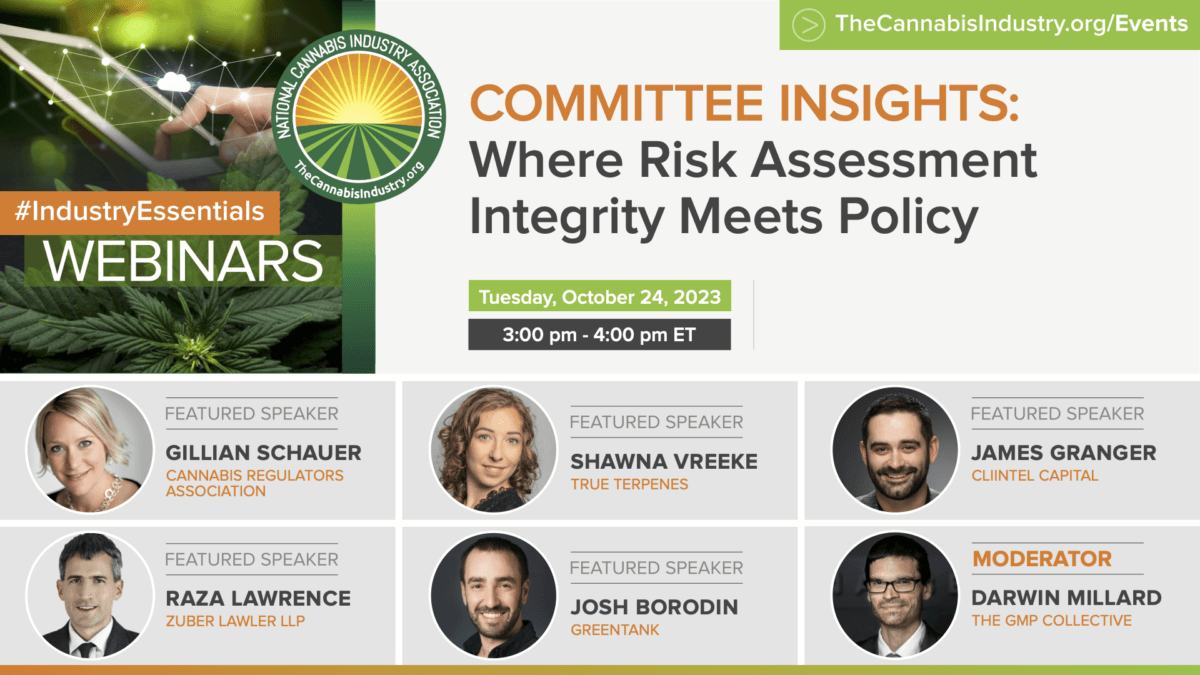
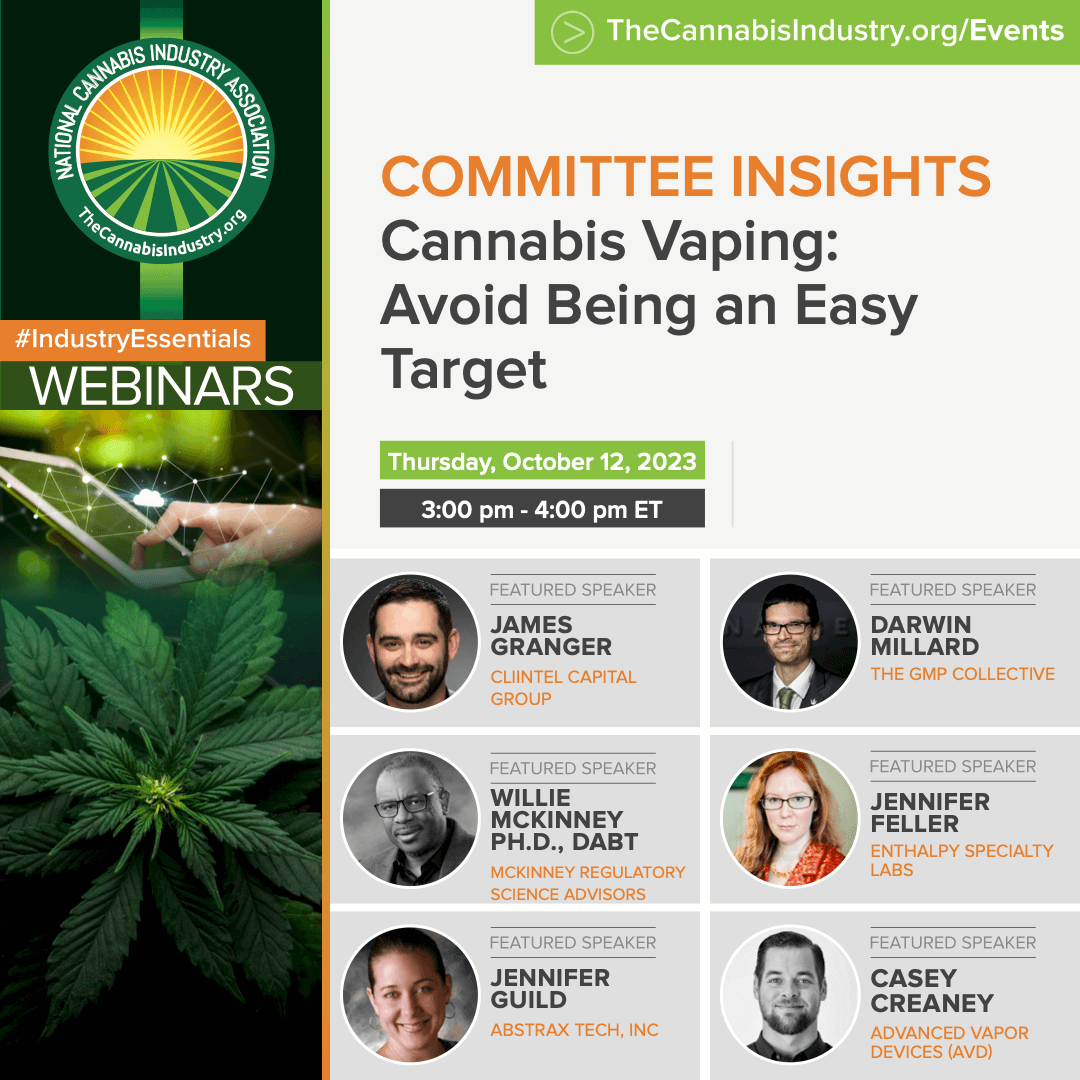

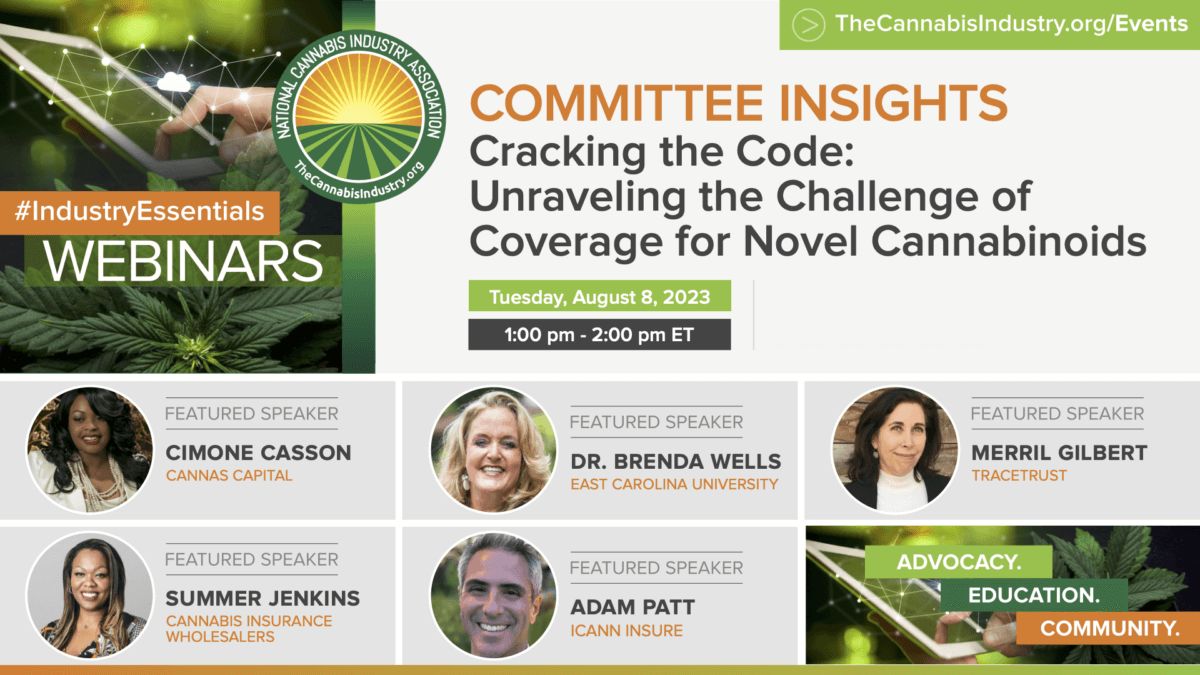






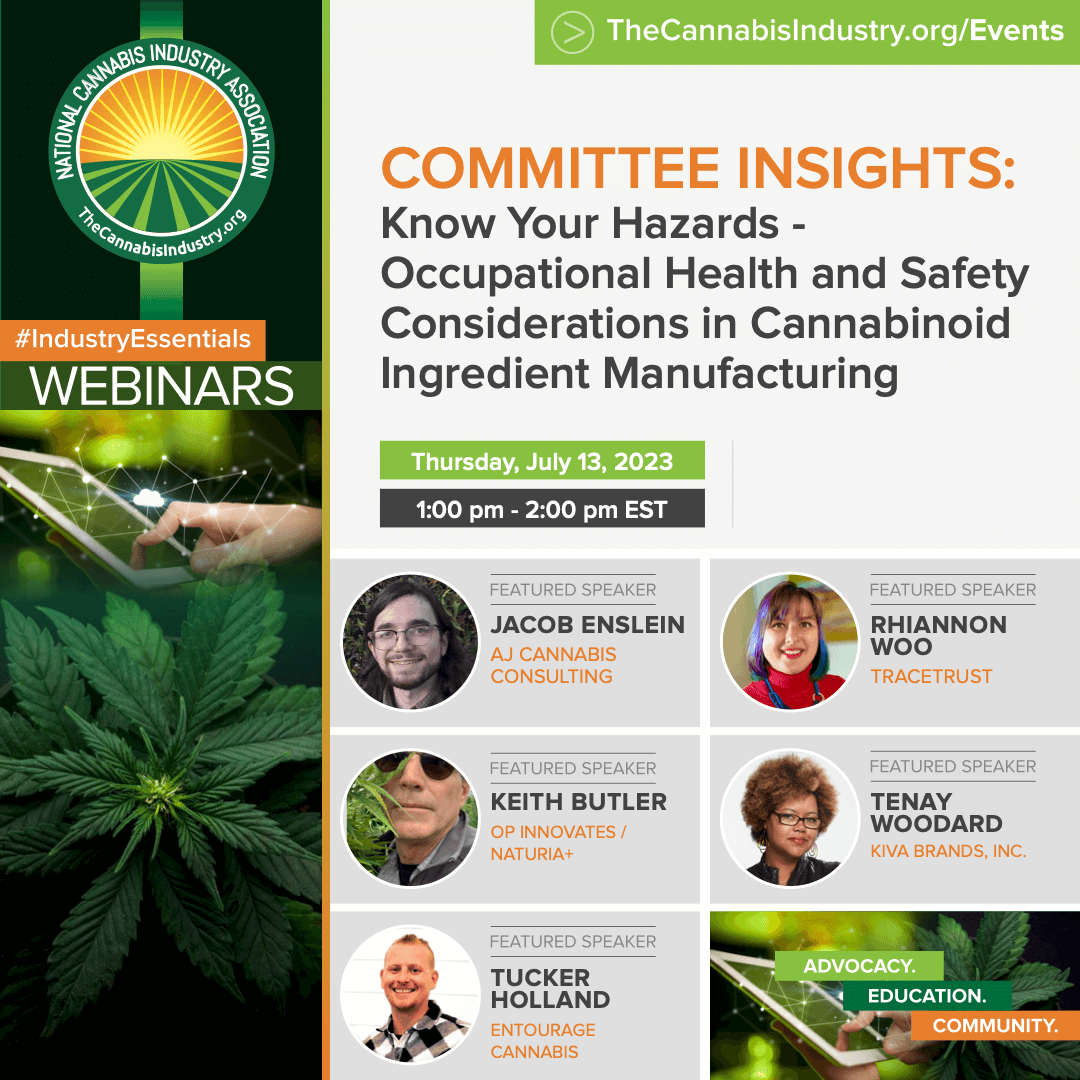


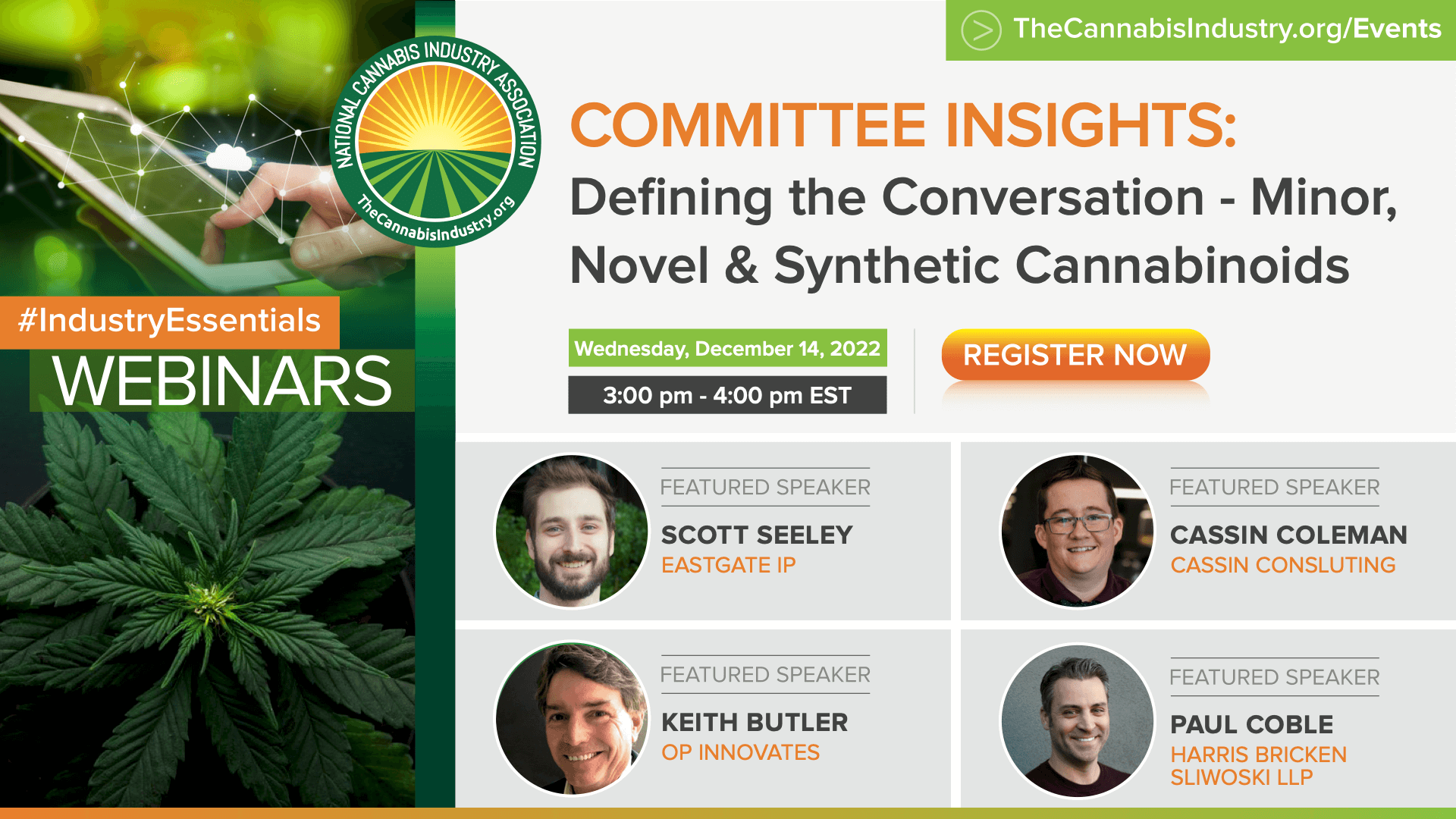


 Maria is the Director of Marketing & Communications at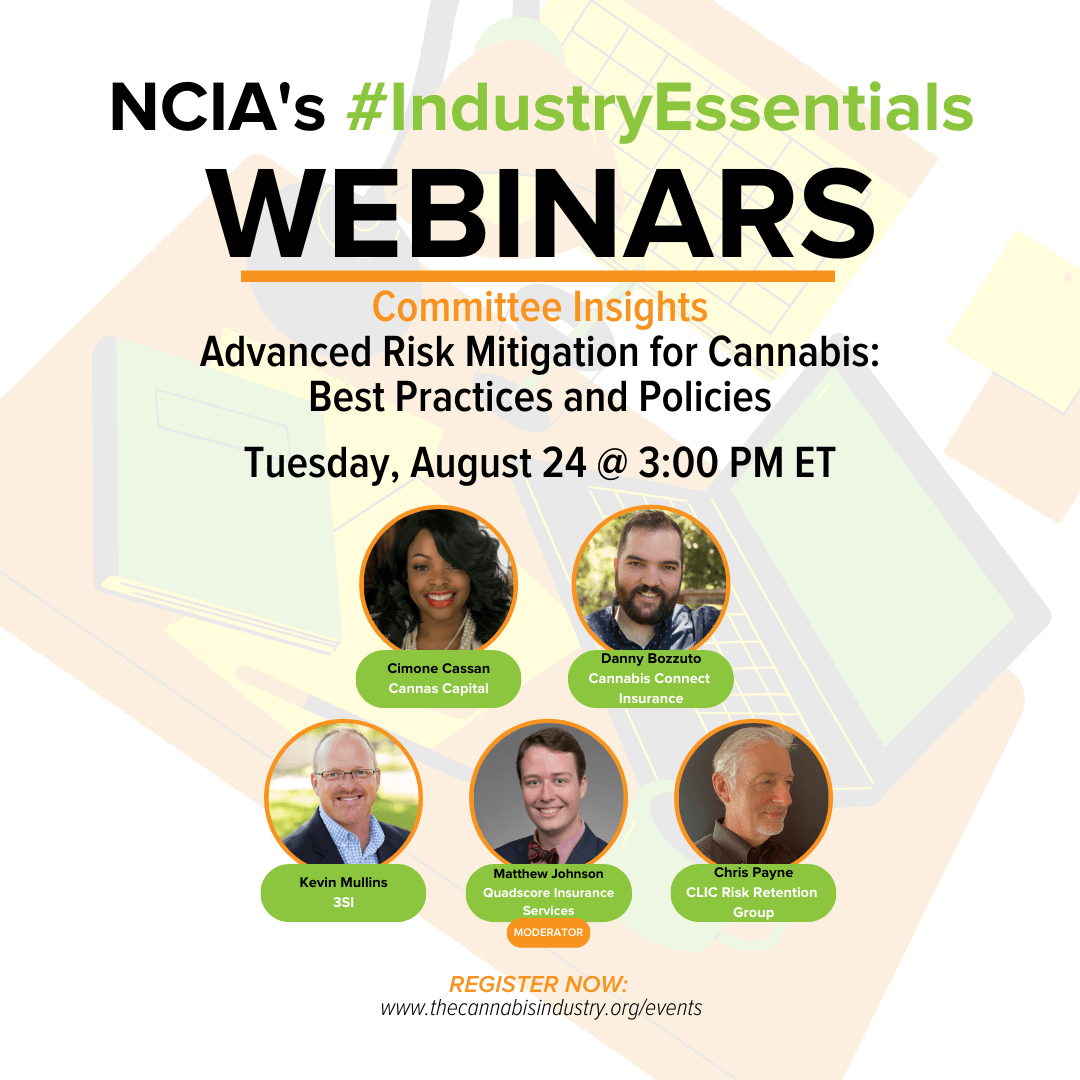

 The cannabis industry is one of the fastest-growing industries in the U.S., maturing at more than 25% annually. As the cannabis industry continues to emerge and flourish from state to state, there remains uncertainty as to the immediate future of federal legislation to
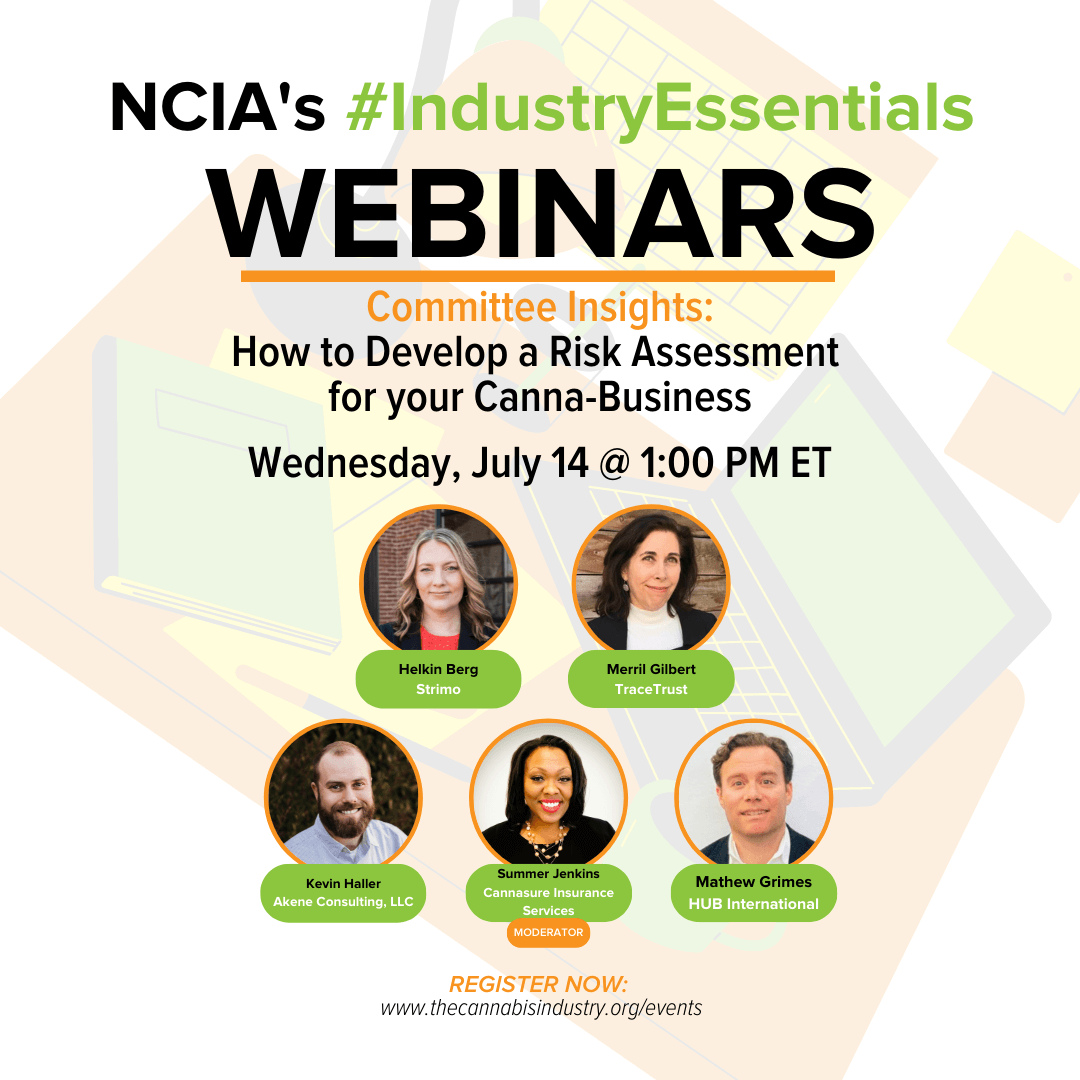


 Merril Gilbert, Co-Founder and CEO of
  David Vaillencourt, CEO of
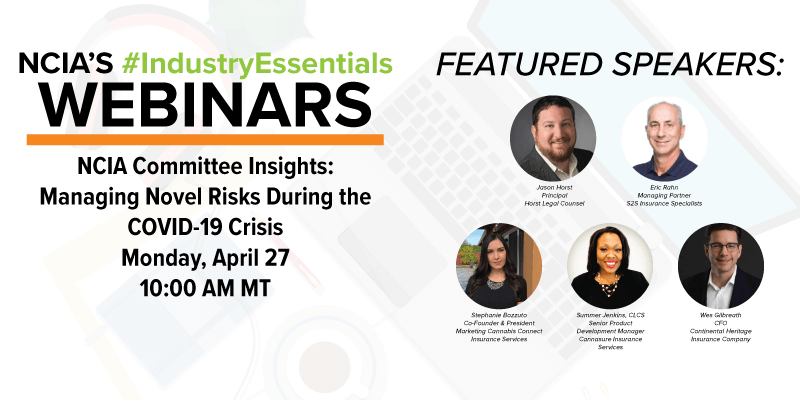
Follow NCIA
Newsletter
Facebook
Twitter
LinkedIn
Instagram
News & Resource Topics
–
This Just In
DOJ Reschedules Medical Cannabis to Schedule III & Announces June 2026 Hearing on Broader Rescheduling
National Cannabis Industry Association (NCIA) to Convene Industry Leaders in Washington for Annual Lobby Days, Bringing Together a Unified Voice for Federal Cannabis Reform