by Michelle Rutter Friberg, NCIA’s Deputy Director of Government Relations
Since I last provided an update from Washington, D.C., not much has changed in terms of cannabis reform. That being said, there are still a few short developments that we’ve been keeping an eye on that we want to bring to your attention! Keep reading to learn the latest:
SAFE Banking
SAFE Banking passed the House for the sixth time in February as part of the America COMPETES Act. More recently, a stakeholder meeting was held with lead champion Congressman Perlmutter that NCIA was proud to have participated in.
During this stakeholder meeting, Rep. Perlmutter reviewed where the bill is at, the hurdles it must clear in order to pass, and reiterated his commitment to passing the bill before this session is over. Congressman Perlmutter also talked extensively about a recent hearing that the House Financial Services Subcommittee on Consumer Protection and Financial Institutions held titled “Small Businesses, Big Impact: Ensuring Small and Minority-Owned Businesses Share in the Economic Recovery.” Chaired by Rep. Perlmutter himself, the subcommittee heard testimony from the Minority Cannabis Business Association’s (MCBA) Executive Director, Amber Litteljohn, on the economic barriers federal policy has created within the burgeoning cannabis market.
Hemp
A few weeks ago, the United States Department of Agriculture’s (USDA) National Agricultural Statistics Service (NASS) released the results of the 2021 Hemp Acreage and Production Survey in its National Hemp Report. This is a massive, first-ever survey of its kind to be done at the national level, and is set to provide a “benchmark” analysis of the economic impact of the burgeoning newly legal market.
The survey collected data for hemp grown in the open and hemp under protection. Planted area for industrial hemp grown in the open for all utilizations in the United States totaled 54,152 acres. Area harvested for all utilizations totaled 33,480 acres. The value of U.S. hemp production in the open totaled $712 million. The value of production for hemp that was grown under protection in the United States totaled $112 million. Area under protection totaled 15.6 million square feet.
SCOTUS
The Supreme Court has officially asked the highest lawyer in the land, the solicitor general, to weigh in on cannabis.
Justices were asked whether or not employees seeking workers’ compensation for medical cannabis after being hurt on the job should receive the assistance, but before they do, they want the broader government to comment. They have requested that the solicitor general submit a brief on the topic. For more details, check out this great piece our friends at Marijuana Moment published.
While this week’s update was another “hodge-podge”, NCIA’s government relations team continues to work hard at passing reform this Congress. We continue to meet with offices to elevate the need for SAFE Banking – primarily for small and minority-owned businesses, discuss the decimation that 280E is wreaking, and highlight opportunities for restorative justice. Interested in becoming more involved with lobbying and our government relations efforts? Contact Stefan at stefan@thecannabisindustry.org to talk about becoming an Evergreen Member today!
Video: NCIA Today – July 2, 2021
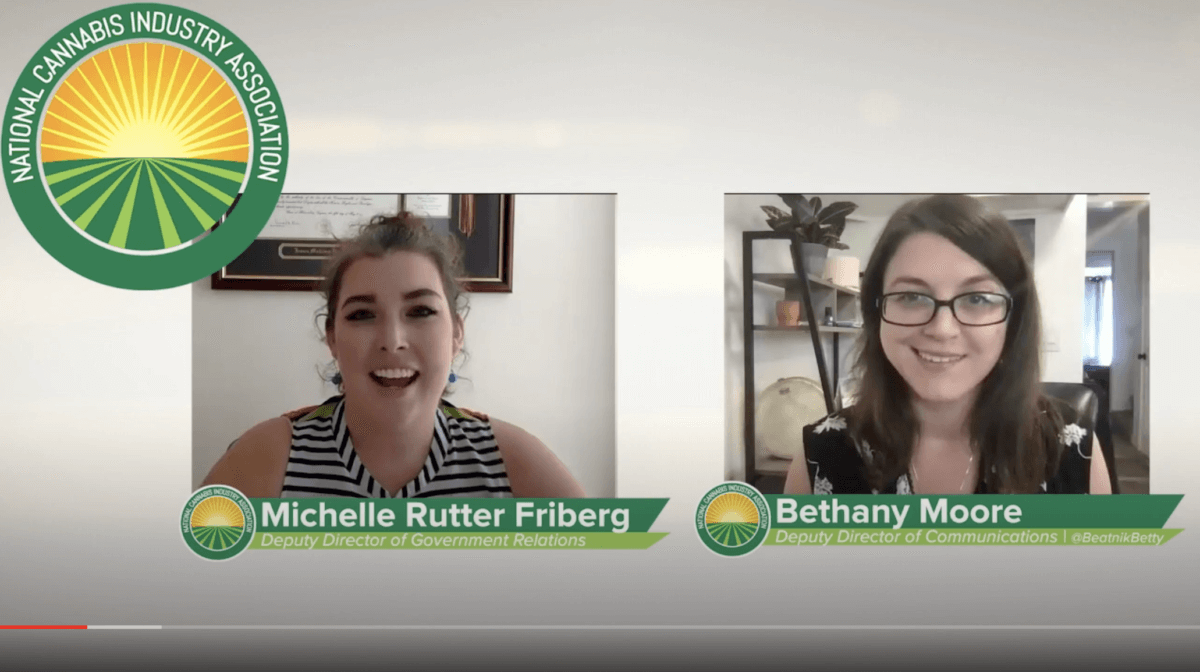
NCIA Deputy Director of Communications Bethany Moore checks in with what’s going on across the country with the National Cannabis Industry Association’s membership, board, allies, and staff. Join us every Friday here on Facebook for NCIA Today Live.
Registration to our Midwest Cannabis Business Conference in Detroit is now open with special limited-time super early bird pricing on tickets available.
By Michelle Rutter Friberg, NCIA’s Deputy Director of Government Relations
While it’s become commonplace to hear cannabis come up in the halls of Congress, and increasingly so in the White House, there’s one branch of government that has been quieter on the topic: the Supreme Court (SCOTUS). However, this week, conservative Justice Clarence Thomas changed that when the court actually declined to weigh in on a 280E case.
Towards the end of 2020, a Colorado medical cannabis dispensary decided to ask the U.S. Supreme Court to review a lower-court decision that allowed the IRS to obtain business records in order to apply the 280E provision of the tax code. (Fun fact: NCIA member Jim Thorburn, of the Thorburn Law Group, was actually the counsel on record for this appeal!) According to the filings, the IRS overstepped its authority and also violated the company’s Fourth Amendment privacy rights. Some of the questions the company took to the highest court in the land:
Does the Fourth Amendment protect taxpayers from having confidential information released to the IRS and federal law enforcement authorities?
Does the application of Section 280E to state-legal marijuana businesses violate the federal constitution?
Again, while SCOTUS declined to consider this appeal, Justice Thomas took issue with the underlying state/federal discrepancy in the country’s cannabis laws and issued a searing statement. He specifically discussed a 2005 ruling by SCOTUS in a case called Gonzales v. Raich. In this ruling, the court narrowly determined that the federal government could enforce prohibition against cannabis cultivation that took place wholly within California based on its authority to regulate interstate commerce. Check out a few excerpts from Justice Thomas’ statement below:
“Whatever the merits of Raich when it was decided, federal policies of the past 16 years have greatly undermined its reasoning. Once comprehensive, the Federal Government’s current approach is a half-in, half-out regime that simultaneously tolerates and forbids local use of marijuana. This contradictory and unstable state of affairs strains basic principles of federalism and conceals traps for the unwary.”
“Given all these developments, one can certainly understand why an ordinary person might think that the Federal Government has retreated from its once-absolute ban on marijuana. See, e.g., Halper, Congress Quietly Ends Federal Government’s Ban on Medical Marijuana, L. A. Times, Dec. 16, 2014. One can also perhaps understand why business owners in Colorado, like petitioners, may think that their intrastate marijuana operations will be treated like any other enterprise that is legal under state law.”
“As things currently stand, the Internal Revenue Service is investigating whether petitioners deducted business expenses in violation of §280E, and petitioners are trying to prevent disclosure of relevant records held by the State. In other words, petitioners have found that the Government’s willingness to often look the other way on marijuana is more episodic than coherent.”
“This disjuncture between the Government’s recent laissez-faire policies on marijuana and the actual operation of specific laws is not limited to the tax context. Many marijuana-related businesses operate entirely in cash because federal law prohibits certain financial institutions from knowingly accepting deposits from or providing other bank services to businesses that violate federal law. Black & Galeazzi, Cannabis Banking: Proceed With Caution, American Bar Assn., Feb. 6, 2020. Cash-based operations are understandably enticing to burglars and robbers. But, if marijuana-related businesses, in recognition of this, hire armed guards for protection, the owners and the guards might run afoul of a federal law that imposes harsh penalties for using a firearm in furtherance of a ‘drug trafficking crime.’”
“Suffice it to say, the Federal Government’s current approach to marijuana bears little resemblance to the watertight nationwide prohibition that a closely divided Court found necessary to justify the Government’s blanket prohibition in Raich. If the Government is now content to allow States to act “as laboratories” “‘and try novel social and economic experiments,’” Raich, 545 U.S., at 42 (O’Connor, J., dissenting), then it might no longer have authority to intrude on “[t]he States’ core police powers . . . to define criminal law and to protect the health, safety, and welfare of their citizens.””
Just to be clear, these statements don’t change the law of the land, nor do they indicate formal policy developments. They do, however, show that the constantly shifting public perception of cannabis is affecting the way we as a society think about marijuana, which will, at some point, translate into policy. It’s no small feat that one of the most conservative justices on the Supreme Court has weighed in so substantially on this topic. Continue the momentum and join the movement with NCIA!

Follow NCIA
Newsletter
Facebook
Twitter
LinkedIn
Instagram
News & Resource Topics
–
This Just In
DOJ Reschedules Medical Cannabis to Schedule III & Announces June 2026 Hearing on Broader Rescheduling
National Cannabis Industry Association (NCIA) to Convene Industry Leaders in Washington for Annual Lobby Days, Bringing Together a Unified Voice for Federal Cannabis Reform