CAOA Delays, House Negotiations, and a Cannabis Festival
Photo By CannabisCamera.com
By Michelle Rutter Friberg, NCIA’s Deputy Director of Government Relations
Hopefully you’ve had a chance to recover after 4/20, but here in Washington, D.C. the work never ends!
Over the last few weeks, there have been developments on the timeline for the Cannabis Administration and Opportunity Act (CAOA), updates on the path forward for SAFE Banking, and a slew of pro-legalization events took place in the D.C. Keep reading for the latest:
More Delays for the Cannabis Administration and Opportunity Act (CAOA)
In February 2021, Senate Majority Leader Chuck Schumer (D-NY) along with Sen. Finance Committee Chairman Ron Wyden (D-OR) and Sen. Cory Booker (D-NJ) announced that they would be introducing a comprehensive cannabis bill to deschedule cannabis, enact a regulatory framework for this new industry, and seek to repair some of the harms that the war on drugs has created. In July of that year, the trio released the long-awaited, detailed discussion draft of the Cannabis Administration and Opportunity Act (CAOA) and asked for comments and feedback from stakeholders (you can read NCIA’s here) to be submitted by September 1, 2021. Since then, the Senators have been diligently reviewing and working on the legislation.
The sponsoring offices had hoped to introduce the CAOA in the beginning part of the year, and more specifically April 2022, however, they recently announced that they are continuing their diligent work and will introduce the bill before August recess.
While this announcement can be frustrating at face value, I’m happy that the Senators are being thoughtful, careful, and considerate about crafting this legislation. Precedent matters a lot on Capitol Hill, so getting it right on the first try (or attempting to!) matters.
SAFE Banking & the America COMPETES Act
The House of Representatives has passed the SAFE Banking Act three times this Congress; first in April 2021 as a standalone bill by vote of 321-101 and most recently as an amendment to the House’s version of the America COMPETES Act, which is now being negotiated by a bicameral, bipartisan conference committee.
While many in D.C. had hoped that negotiations would conclude by Memorial Day, lead sponsor Sen. Todd Young (R-IN) recently said that a more realistic timeline for the bill would be the end of summer. This week, the Senate will vote on 28 motions to instruct- these are procedural, non-binding resolutions that guide the conference committee through the negotiation process. After that, the conference committee can begin meeting
National Cannabis Festival and more!
Founded in 2016, the National Cannabis Festival is an annual event held in Washington, D.C. with a focus on cannabis and music, advocacy, education, and activism. Now boasting well over 20,000 attendees, NCIA is proud to have been involved with the event since its inaugural year, and I even sit as an advocacy committee chair!
This year, the festival was back and better than ever with an entire week of events celebrating cannabis advocacy in the nation’s capital, including an incredible Policy Summit featuring members of Congress, advocates, journalists, and more.
Like I said – the work never ends in D.C., and the NCIA team is gearing up for another busy month filled with Evergreen virtual lobby days, Hill meetings, coalition building, and more! Want to get involved? Consider becoming a member today!
Crazy for Cannabis Administration and Opportunity Act (CAOA)
Photo By CannabisCamera.com
By Michelle Rutter Friberg, NCIA’s Deputy Director of Government Relations
Last week was undoubtedly one of the most exciting weeks in federal cannabis policy ever! On July 14, Senate Majority Leader Chuck Schumer (D-NY), along with Sen. Cory Booker (D-NJ) and Senate Finance Committee Chair Ron Wyden (D-OR), unveiled long-awaited draft legislation that would remove cannabis from the schedule of controlled substances while allowing states to determine their own cannabis policies. Let’s take a look at what we know:
What is it?
You’ll recall that back in February, the trio of Senators announced that they were working on a comprehensive cannabis bill. Since then, NCIA and other advocates have (im)patiently been waiting to see what shape that would take – I was calling it the best-kept secret in Washington! However, at long last, the discussion draft of the Cannabis Administration and Opportunity Act (CAOA) was released.
A discussion draft is exactly what it sounds like – prior to introducing this language as formal legislation, the Senators have shared it in this form, allowing stakeholders, the public, and others the opportunity to weigh in and provide their expertise and feedback.
What’s in it?
As I mentioned above, the CAOA removes cannabis from the list of controlled substances, effectively legalizing it at the federal level while still allowing states to set their own policies. According to the bill’s detailed summary, it has a few goals:
“… [it will] Ensure that Americans – especially Black and Brown Americans – no longer have to fear arrest or be barred from public housing or federal financial aid for higher education for using cannabis in states where it’s legal. State-compliant cannabis businesses will finally be treated like other businesses and allowed access to essential financial services, like bank accounts and loans. Medical research will no longer be stifled.”
The bill also includes:
Restorative measures for people and communities who were unfairly targeted in the war on drugs.
Automatic expungements for federal non-violent marijuana crimes and allows an individual currently serving time in federal prison for nonviolent marijuana crimes to petition a court for resentencing.
An “Opportunity Trust Fund” funded by federal cannabis tax revenue to reinvest in the communities most impacted by the failed war on drugs, as well as helping to level the playing field for entrepreneurs of color who continue to face barriers of access to the industry.
An end to discrimination in federal public benefits for medical marijuana patients and adult-use consumers.
Respect for state cannabis laws and a path for responsible federal regulation of the cannabis industry. Like with federal regulations on alcohol, under CAOA, states can determine their own cannabis laws, but federal prohibition will no longer be an obstacle. Regulatory responsibility will be moved from the U.S. Drug Enforcement Agency (DEA) to the Alcohol and Tobacco Tax and Trade Bureau (TTB), the Bureau of Alcohol Tobacco Firearms and Explosives (ATF), as well as the Food and Drug Administration (FDA) to protect public health.
A federal tax structure – CAOA would impose an excise tax on cannabis products in a manner similar to the tax imposed on alcohol and tobacco. The general rate of tax would be 10 percent for the year of enactment and the first full calendar year after enactment. The tax rate would increase annually to 15 percent, 20 percent, and 25 percent in the following years.
What’s next?
The discussion draft comment and feedback process will be ongoing until September 1. Until then, NCIA will be working with our board, Policy Council, committees, and our members (particularly our Evergreen members!) to solicit their expert input on some of the areas the Senators have expressed interest in. After that deadline, the Senators will take their time to review submissions and subsequently formally introduce the revised language later this year. Stay tuned via our newsletter, blog, and upcoming events to learn the latest on this and how you can actually submit your thoughts to us!
A Closer Look at the “Flurry” of Cannabis Legislation in Congress
by Michael Correia, NCIA Director of Government Relations
Last week, we saw Congress introduce a flurry of marijuana related legislation, with many aspects directly affecting the cannabis industry.
Taking the lead on bill introductions were cannabis champions Rep. Earl Blumenauer and Sen. Ron Wyden of Oregon, who introduced a series of bi-cameral, bi-partisan bills that they referred to collectively as the ‘Path to Marijuana Reform’. In addition, the cannabis industry gained a new Republican champion – Rep. Carlos Curbelo of Florida. Rep. Curbelo is a member of the Ways and Means committee and is an original co-sponsor of the new legislation that aims to fix 280E. Their goal was to pave the way for regulation of cannabis at the federal level, and provide certainty in the 50 states. In addition, Colorado Congressman Jared Polis introduced his own stand-alone regulation bill.
This legislation would repeal the tax penalty that singles out state-legal marijuana businesses and bars them from claiming deductions and tax credits. Because marijuana is classified as a Schedule I drug, cannabis dispensaries operating legally under state law are prohibited from deducting normal business expenses from their net income on federal tax returns. In fact, many dispensaries have been forced to pay between 50 and 70 percent of their net income to the federal government. The lead sponsor is Republican Congressman Carlos Curbelo from Florida, who sits on the House Ways and Means Committee, the Committee of jurisdiction on tax bills. NCIA has been lobbying on this bill for years and is happy to have the Congressman help us navigate this bill through Congress.
H.R. 1824/S. 780, the Responsibly Addressing the Marijuana Policy Gap Act of 2017:
Congressional advocates say this bill reduces the conflict between state and federal law, without legalizing cannabis at the federal level. An all-encompassing bill, this legislation contains numerous sections addressing cannabis reform. Section 101 amends the Controlled Substances Act to exempt any person acting in compliance with state laws law from criminal penalties. Sections 201-207 address the 280E provision; makes exemptions for marijuana advertisements; allows access to banking services; allows access to bankruptcy relief; and allows tribal entities to pursue cannabis reform with fear of federal penalties. Sections 301-306 allow expungement of criminal records for certain marijuana-related offenses; limits marijuana drug testing for federal employment; excludes marijuana misdemeanors offenses from federal financial aid; limits federal civil forfeiture of state compliant marijuana businesses; limits immigrant deportation for marijuana related activity; and excludes marijuana related activity for federally assisted housing. Sections 401-403 lowers barriers to federal medical research of marijuana; authorizes Veterans Affairs doctors to allow recommendations for medical marijuana; and allows Indian Health Services to allow recommendations for medical marijuana.
This legislation would effectively legalize marijuana at the federal level by de-scheduling, taxing, and regulating marijuana. If passed, the Attorney General would have 60 days to remove marijuana from the Controlled Substances Act, but would still prohibit the transport of marijuana into any state in which it was still illegal under state law. Because of marijuana’s removal from the Controlled Substances Act, 280E would no longer apply to state-legal cannabis operators. In addition, this legislation would allow for a federal excise tax on marijuana. An excise tax of 10 percent would be in effect for the first two years after enactment. The rate would increase to 15 percent in the third year, 20 percent in the fourth year, and 25 percent thereafter. In addition, a $1000 per year occupational tax would be levied on each marijuana production facility.
H.R. 1841, the Regulate Marijuana Like Alcohol Act:
This bill, introduced by Colorado Congressman Jared Polis, would eliminate the federal ban on marijuana and establish a regulatory system that enables that choose to allow the use of marijuana without interference from the federal government. 60 days after enactment, marijuana would be removed from the Controlled Substances Act, but does not apply to interstate commerce. It would remove oversight from the DEA and move it to the Bureau of Alcohol, Tobacco, Firearms and Explosives; and would regulate marijuana like alcohol. It would establish a permitting system stemming from an annual licensing fee on marijuana producers. Finally, it would establish standards for advertising marijuana and its products.
—
With uncertainty still remaining related to potential Department of Justice enforcement, more and more advocates in Congress are coming out in support of our efforts. NCIA will continue pushing for reforms at the federal level and our friends on Capitol Hill won’t stop until your cannabis businesses are able to operate freely, like all other businesses.
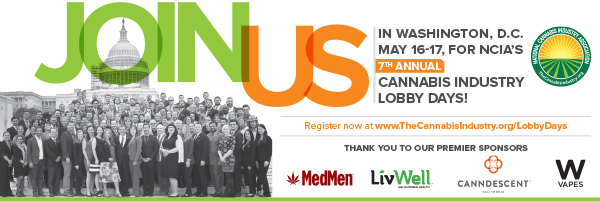
NCIA member looking to help advance our issues on Capitol Hill should register for our 7th Annual Cannabis Industry Lobby Days coming up May 16 and 17 in Washington, D.C.
The 5 Critical Pieces of Cannabis Legislation You Need to Know About
by Michelle Rutter, Government Relations Coordinator
As the cannabis industry has continued to thrive and expand, the number of bills in Congress dealing with the issue has done the same. Between the House of Representatives and the Senate, there are well over a dozen bills that address the conflicts between state and federal cannabis policy. NCIA’s lobbying efforts focus primarily on banking access and the unfair taxation caused by Section 280E, but we also advocate for other bills that are crucial for the industry. Below are my choices for “The 5 Critical Pieces of Cannabis Legislation You Need to Know About”:
BANKING H.R.2076: Marijuana Businesses Access to Banking Act of 2015 Introduced by: Rep. Ed Perlmutter (D-CO, 7th District) Last Action: Referred to House Subcommittee on Crime, Terrorism, Homeland Security, and Investigations on June 1, 2015. Summary: This bill would provide a safe harbor for depository institutions providing financial services to a cannabis-related business insofar as it prohibits a federal banking regulator from: (1) terminating or limiting the deposit or share insurance of a depository institution solely because it provides financial services to a marijuana-related legitimate business; or (2) prohibiting, penalizing, or otherwise discouraging a depository institution from offering such services.
S.1726: Marijuana Businesses Access to Banking Act of 2015 Introduced by: Sen. Jeff Merkley (D-OR) Last Action: Read twice and referred to the Committee on Banking, Housing, and Urban Affairs on July 9, 2015. Summary: Although the House and Senate cannabis banking bills are companions, the bill introduced by Sen. Merkley is slightly more detailed in its language.
The Senate bill would prevent federal banking regulators from: prohibiting, penalizing or discouraging a bank from providing financial services to a legitimate state-sanctioned and regulated marijuana business; terminating or limiting a bank’s federal deposit insurance solely because the bank is providing services to a state-sanctioned marijuana business; recommending or incentivizing a bank to halt or downgrade providing any kind of banking services to these businesses; or taking any action on a loan to an owner or operator of a marijuana-related business.
The bill also creates a safe harbor from criminal prosecution and liability and asset forfeiture for banks and their officers and employees who provide financial services to legitimate, state-sanctioned marijuana businesses, while maintaining banks’ right to choose not to offer those services. It would also require banks to comply with current Financial Crimes Enforcement Network (FinCEN) guidance, while at the same time allowing FinCEN guidance to be streamlined over time as states and the federal government adapt to legalized medicinal and recreational marijuana policies.
280E H.R.1855: Small Business Tax Equity Act of 2015 Introduced by: Rep. Earl Blumenauer (D-OR, 3rd District) Last Action: Referred to House Committee on Ways and Means on April 16, 2015. Summary: Amends the Internal Revenue Code by adding language at the end of Section 280E that would exempt a trade or business that conducts marijuana sales in compliance with state law from the prohibition against allowing business-related tax credits or deductions for expenditures in connection with trafficking in controlled substances.
S.987: Small Business Tax Equity Act of 2015 Introduced by: Sen. Ron Wyden (D-OR) Last Action: Referred to Senate Committee on Finance on April 16, 2015. Summary: This Senate bill is the companion to the H.R. 1855 described above. As such, the summary is the same.
STATES’ RIGHTS AND RESPONSIBILITIES H.R.1940: Respect State Marijuana Laws Act of 2015 Introduced by: Rep. Dana Rohrabacher (R-CA, 48th District) Last Action: Referred to the House Subcommittee on Crime, Terrorism, Homeland Security, and Investigations on May 15, 2015. Summary: Amends the Controlled Substances Act to provide that the provisions of the Act related to cannabis shall not apply to any person acting in compliance with state laws relating to the production, possession, distribution, dispensation, administration, or delivery of marijuana
CIVIL ASSET FORFEITURE H.R.3518: Stop Civil Asset Forfeiture Funding for Marijuana Suppression Act of 2015 Introduced by: Rep. Ted Lieu (D-CA, 33rd District) Last Action: Referred to the House Subcommittee on Crime, Terrorism, Homeland Security, and Investigations on October 5, 2015. Summary: This bill would prevent the Drug Enforcement Administration (DEA) from using federal forfeiture funds to pay for its Domestic Cannabis Eradication/Suppression Program. Additionally, the bill would ban transferring property to federal, state or local agencies if that property “is used for any purpose pertaining to” the DEA’s marijuana eradication program.
MEDICAL CANNABIS S.683: Compassionate Access, Research Expansion, and Respect States (CARERS) Act of 2015 Introduced by: Sen. Cory Booker (D-NJ) Last Action: Referred to Senate Committee on the Judiciary on March 10, 2015. Summary: Amends the Controlled Substances Act (CSA) to provide that control and enforcement provisions of such Act relating to marijuana shall not apply to any person acting in compliance with state law relating to the production, possession, distribution, dispensation, administration, laboratory testing, or delivery of medical marijuana.
Transfers marijuana from schedule I to schedule II of the CSA.
Excludes “cannabidiol” from the definition of “marijuana” and defines it separately as the substance cannabidiol, as derived from marijuana or the synthetic formulation, that contains not greater than 0.3% delta-9-tetrahydrocannabinol on a dry weight basis.
Prohibits a federal banking regulator from: (1) terminating or limiting the deposit insurance of a depository institution solely because it provides or has provided financial services to a marijuana-related legitimate business; or (2) prohibiting, penalizing, or otherwise discouraging a depository institution from providing financial services to a marijuana-related legitimate business.
Provides depository institutions that provide financial services to a marijuana-related legitimate business protection under federal law from federal criminal prosecution or investigation, criminal penalties, and forfeiture of legal interest in collateral solely for providing financial services to such a business.
Directs The Department of Health and Human Services to terminate the Public Health Service interdisciplinary review process described in the guidance entitled “Guidance on Procedures for the Provision of marijuana for Medical Research” (issued on May 21, 1999), and also demands the Drug Enforcement Administration to issue at least three licenses under CSA registration requirements to manufacture marijuana and marijuana-derivatives for research approved by the Food and Drug Administration. Also directs the Department of Veterans Affairs (VA) to authorize VA health care providers to provide veterans with recommendations and opinions regarding participation in state marijuana programs.
H.R.1538: Compassionate Access, Research Expansion, and Respect States (CARERS) Act of 2015 Introduced by: Rep. Steve Cohen (D, TN-9) Last Action: Referred to the House Subcommittee on Crime, Terrorism, Homeland Security, and Investigations on April 21, 2015. Summary: This House bill is the companion to S. 683 described above. As such, the summary is the same.
In addition to these crucial pieces of legislation, there are other bills relating to cannabis that have been introduced to Congress on issues like CBD, a federal excise tax on cannabis, veterans’ access, and hemp. Cannabis advocates and NCIA members should continue to participate in NCIA’s events and lobbying efforts in addition to contacting their elected officials in order to see cannabis continue to progress in Washington, D.C. and on Capitol Hill.

Follow NCIA
Newsletter
Facebook
Twitter
LinkedIn
Instagram
News & Resource Topics
–
This Just In
DOJ Reschedules Medical Cannabis to Schedule III & Announces June 2026 Hearing on Broader Rescheduling
National Cannabis Industry Association (NCIA) to Convene Industry Leaders in Washington for Annual Lobby Days, Bringing Together a Unified Voice for Federal Cannabis Reform