NCIA (and myself personally!) have been talking about the SAFE Banking Act for years.
After the Senate Banking Committee’s hearing on the topic of financial services and the cannabis industry in May, it became clear that in order for the bill to continue on in the legislative process and receive a markup that changes to a few sections needed to be made.
As a result, a slightly new (and improved?) version of the bill was introduced as the SAFER (S. 2860: Secure and Fair Enforcement Regulation) Banking Act last month. Most of the changes in the bill pertained to Section 10, which bars federal banking regulators from taking discriminatory enforcement action against any industry (not just cannabis).
Once SAFER was formally introduced, the Senate Banking Committee announced that a markup was scheduled for September 27. It’s important to note that this was the firsttime ever that a Senate committee held a markup on a pro-cannabis bill.
During the markup session, multiple amendments were offered. The first, offered by Chairman Brown (D-OH) was what’s known as a “manager’s amendment” and primarily made technical changes to the bill. That amendment also made changes so that the Treasury secretary would be given one year (instead of 180 days) to issue updated guidance to financial institutions that work with cannabis businesses that was first released during the Obama administration in 2014. It also stipulated that federal home loan banks are now included under a list of financial institutions that would be protected from being penalized by federal regulators simply for working with state-legal cannabis businesses.
Another amendment, from Sen. Warnock (D-GA) would have created a 5-year sunset for the legislation unless a report from the Treasury Department certified that it had decreased the racial wealth gap and ameliorated other negative economic impacts of the war on drugs. This amendment ultimately failed.
Additionally, amendments from Senators Hagerty (R-TN), Rounds (R-SD), Crapo (R-ID) were also offered but were ruled out of order, withdrawn, and failed, respectively.
Republican members of the committee voiced concern that the bill allowed for financial institutes to utilize reputational risk to de-bank certain accounts they do not align with ideologically and argued that no financial regulator should be able to pressure any financial entity to refuse to provide service to a lawful entity.
Some Democrat members, particularly Sen. Warnock (D-GA), voiced concern that the bill does not adequately address the disproportionate impacts of marijuana criminalization and its exacerbation of the racial wealth gap in the United States. Other members of the committee encouraged amendments and future legislation intended to improve the quality of life for those most negatively impacted by marijuana criminalization in addition to creating safer conditions for banks and other financial institutions. Sen. Warnock was the lone Democrat who voted “No” on the bill during the markup.
Ultimately, the bill passed out of the committee markup by a bipartisan vote of 14-9. This sets the stage for a full Senate floor vote, which Majority Leader Schumer (D-NY) has committed to scheduling as soon as possible, with the possibility of adding the HOPE and GRAM Acts to the bill before passage.
I don’t know about you, but I’m not done making history yet! Stay tuned for the latest on the SAFER Banking Act and how you can help get the bill passed!
Summer Recess & Cannabis Progress: Cannabis News from the Capitol and Expectations for the August Break
by Michelle Rutter Friberg, NCIA’s Director of Government Relations
After NCIA’s 11th Annual Cannabis Industry Lobby Days concluded in May, cannabis news from Washington, D.C. has been relatively slow. Curious about what’s next before August recess begins? Keep reading to see what may happen ahead of the break and for a recap on where we’re at now.
SAFE Banking
Last month, just before NCIA’s Lobby Days, the Senate Banking, Housing, and Urban Affairs Committee held a hearing titled “Examining Cannabis Banking Challenges of Small Businesses and Workers”. Witnesses included the bill’s lead sponsors, Senators Jeff Merkley (D-OR) and Steve Daines (R-MT), as well as Ademola Oyefes (International Vice President and Director of Legislative and Political Action Department, United Food and Commercial Workers International Union [UFCW]), Michelle Sullivan (Chief Risk & Compliance Officer, Dama Financial), Dr. Kevin Sabet (President/CEO, Smart Approaches to Marijuana [Project SAM]); and Cat Packer (Vice Chair, Cannabis Regulators of Color Coalition).
My takeaways from the hearing: no new talking points from Project SAM, surprised by DAMA’s comments (they’ve since walked their testimony [which many saw as opposition to the bill] back), and most importantly of all: the real need for SAFE so that we can stop talking about access to financial services and start talking about legalizing and regulation cannabis in a smart and equitable way.
As for what’s next? Banking Committee Chairman Sen. Sherrod Brown (D-OH) recently shared that SAFE Banking would be scheduled for a markup after a few other bills received theirs. The good news? That process has begun. The bad news? Still no formal news on when SAFE’s markup will be. I’m expecting it to be after the Fourth of July break but before members leave D.C. for their annual, month-long August recess.
Appropriations
For years, advocates have looked to the appropriations process as a way in which to enact cannabis reform at the federal level.
In 2014, a provision that protected medical cannabis patients, programs, and businesses from federal interference (known as the “Rohrabacher-Farr” amendment) was included in the federal budget and became law. Since then, the provision has been included in appropriations bills and remains the law of the land.
NCIA has (and continues to) lobby on behalf of expanding this provision to include adult-use businesses and to also use the appropriations process to enact other reforms like allowing Washington, D.C. to commercialize adult-use cannabis sales.
House GOP negotiators heightened the stakes earlier this week when they announced they would mark up their FY2024 spending plans to levels lower than the budget caps set as part of a deal struck between President Biden and Speaker Kevin McCarthy (R-CA). This will undoubtedly make the already contentious budget-process even more volatile.
Maryland
On July 1, adult-use cannabis sales will begin in Maryland. Cannabis became legal for those over 21 in Virginia in 2021, while D.C. legalized cannabis for adults via Initiative 71 in 2014 (but have been unable to begin sales due to congressional interference). Legal sales in the District’s neighboring states means that members of Congress will surely be more exposed to the benefits of regulation.
So, while it’s been relatively quiet in D.C. in June, stay tuned in July for a possible first-ever Senate markup of SAFE Banking! As always, NCIA will continue to advocate on behalf of your business and keep you updated on the latest.
Bills in Congress, SAFE Banking, and House and Senate Committees
by Michelle Rutter Friberg, NCIA’s Deputy Director of Government Relations
While it got off to a slow start, the 118th Congress is finally in full swing. Let’s take a look at some of the latest cannabis and government relations news coming out of Washington, D.C.:
Bills are being introduced
When a new Congress begins, all legislation from the last session must be re-introduced and start from scratch again in the legislative process. Over the last few weeks, a couple of cannabis bills have been reintroduced: two from Congressman Greg Steube (R-FL) and one from Congressman Alex Mooney (R-WV).
Rep. Mooney was the first to introduce a cannabis bill for the 118th Congress when he released his Second Amendment Protection Act. Last Congress, a similar bill was filed by the late Rep. Don Young (R-AK) known as the Gun Rights And Marijuana (GRAM) Act. The full text of the new measure is not yet available so it’s unclear what exactly the bill contains, but advocates expect the bill to be similar to the version Mooney introduced in the 116th Congress. Interestingly, although federal law explicitly prohibits all Americans who consume or possess marijuana from purchasing or possessing a firearm, a judge in Oklahoma late last week declared that ban unconstitutional.
Congressman Steube’s two bills were the Veterans Cannabis Use for Safe Healing Act and the Marijuana 1-to-3 Act. The former prohibits the Department of Veterans Affairs (VA) from denying a veteran any VA benefit due to participation in a state-approved marijuana program. For veterans participating in these approved programs, the VA must ensure its healthcare providers both discuss marijuana use with such veterans and adjust treatment plans accordingly and record such use in the veterans’ medical records. The latter bill, the Marijuana 1 to 3 Act, has been introduced by Rep. Steube in past sessions and seeks to do exactly what the title says: reschedule cannabis to Schedule 3 – a reform that would not resolve the federal conflict with the vast majority of state laws with some form of legal cannabis
A SAFE Bet?
The cannabis industry may have been devastated when Congress failed to pass the SAFE Banking Act last Congress, but we’re not giving up yet! Congressional champions have every intention of reintroducing SAFE in both chambers, but don’t expect the bill to look identical to last session.
Last week, Senate Majority Leader Schumer held a closed-door meeting with a number of other Democratic Senators to discuss what’s next for the bill. Reportedly, the Senators discussed changing the text of the bill to reflect some of the “SAFE +” language that was negotiated at the end of 2022, including the HOPE Act. It’s currently unclear if the House’s version will be identical.
Committees Finally Seated
It took Congress longer than usual to seat committees this session – particularly in the House – but we now know which members will have jurisdiction over which issue areas. Our friends at Politico put together an extensive list, but some committees I’ll be keeping my eye on include the House Judiciary Committee, the Senate Banking Committee, and the Appropriations Committees in both chambers.
Call For Signatures: Move The SAFE Banking Act Through Senate Committee
The National Cannabis Industry Association, in collaboration with other cannabis-related organizations, drafted a letter to Senate Banking Committee Chairman Mike Crapo (R-ID), urging him to move the House version of the SAFE Banking Act through committee and to the Senate floor for a vote.
The letter also addressed serious concerns the industry finds with one of Sen. Crapo’s suggested amendments to limit the provisions of the SAFE Banking Act to products containing less than 2% THC. Now we need the help of businesses in the cannabis industry to join us in letting Chairman Crapo know how important it is to move the SAFE Banking Act through Committee this session of Congress. Please follow the link below to add your name to the growing list of industry voices calling for fair and safe banking access.
Senate Banking Committee Chairman Gives Cannabis Industry Coal for Christmas
by Michael Correia, NCIA’s Director of Government Relations
NCIA’s Director of Government Relations, Michael Correia
As you may have heard by now, Senate Banking Committee Chairman Mike Crapo (R-ID) issued a very disappointing press releaseabout his opposition to the SAFE Banking Act yesterday. If you recall, the SAFE Banking Act passed the House of Representatives in September with an overwhelming bipartisan majority (321-103) and is waiting for a legislative markup in the more conservative Senate.
In the release, Chairman Crapo said, “I remain firmly opposed to efforts to legalize marijuana on the federal level, and I am opposed to legalization in the State of Idaho. I also do not support the SAFE Banking Act that passed in the House of Representatives. Significant concerns remain that the SAFE Banking Act does not address the high-level potency of marijuana, marketing tactics to children, lack of research on marijuana’s effects, and the need to prevent bad actors and cartels from using the banks to disguise ill-gotten cash to launder money into the financial system.” Perhaps the most alarming change Chairman Crapo suggested was a 2% THC potency cap on products in order for a business to have access to the banking system. This provision alone is unworkable and unacceptable.
Chairman Crapo continued by outlining numerous areas that he believes need to be addressed:
Add public health and safety solutions as a requirement for banks to do business with legally-operating state cannabis companies. Options to consider include THC potency; clear and conspicuous disclosures on products; marketing; effects on minors, unborn children and pregnant women; and age restrictions, among other considerations.
Prevent bad actors and cartels from using legacy cash and the financial system to disguise ill-gotten cash or launder money.
Update 2014 FinCEN rulemaking and guidance regarding marijuana-related businesses, and ensure FinCEN has all of the necessary tools it needs to prosecute money launderers and promulgate rulemakings.
Respect state rights in interstate commerce and banking for institutions who operate in multiple states with different state rules.
Eliminate “Operation Choke Point” and preventing future “Operation Choke Point” initiatives. Under fear of retribution, many banks have stopped providing financial services to members of lawful industries for no reason other than political pressure, which takes the guise of regulatory and enforcement scrutiny.
Unfortunately, Chairman Crapo’s views are out of step with the majority of Americans, and every day that he delays a markup on this legislation is another day that puts public safety at risk. While the Chairman may oppose broader cannabis policy reform, he clearly recognizes the problems created by lack of access to financial services. The SAFE Banking Act already addresses many of the chairman’s concerns, particularly public safety, clarity, and transparency. We’re happy to discuss these items with the Senate Banking Committee in a markup. However, efforts to slow this legislation’s momentum will not fix the underlying problems and will continue to put people at risk.
NCIA will continue to work with industry stakeholders, advocates, the financial services industry, and other coalition partners to address Chairman Crapo’s concerns and reach a conclusion that aids public safety, is good policy, and delivers a positive outcome for the burgeoning cannabis industry. That being said, here is how you can help.
Chairman Crapo is requesting public feedback on the SAFE Banking Act and the concerns that he outlined. Interested? You can submit proposals to Banking Committee staff at submissions@banking.senate.gov. Here are a few important tips to remember:
Be polite. While the Chairman’s opinions may not align with your own, remember that he is the sole person deciding whether or not the SAFE Banking Act will continue on in the legislative process.
NCIA, the American Bankers Association, and many other stakeholders have already provided the committee with relevant information on several of the issues identified by the Chairman including legacy cash, interstate commerce and ‘Operation Chokepoint.’
The SAFE Banking Act is a narrow financial services bill that will increase transparency, accountability, and public safety in communities around the country. It does not legalize marijuana.
The SAFE Banking Act is supported by a wide range of national organizations and state officials, including: National Association of Attorneys General (NAAG), United Food and Commercial Workers (UFCW), Credit Union National Association (CUNA), Independent Community Bankers Association (ICBA), American Bankers Association (ABA), Mid-size Bank Coalition of America (MBCA), National Bankers Association (NBA), Electronic Transaction Association (ETA), Law Enforcement Action Partnership (LEAP), The Real Estate Roundtable (RER), National Association of REALTORS, Safe and Responsible Banking Alliance (SARBA), American Land Title Association (ALTA), American Property Casualty Insurance Association (APCIA), The Council of Insurance Agents and Brokers (CIAB), Reinsurance Association of America (RAA), Independent Insurance Agents and Brokers of America (Big “I”), Wholesale Specialty Insurance Association (WSIA), National Association of Mutual Insurance Companies (NAMIC), Rural County Representatives of California (RCRC), Brinks, Inc., International Council of Shopping Centers (ICSC), National Association of Professional Employer Associations (NAPEA), National Cannabis Industry Association (NCIA), Minority Cannabis Business Association (MCBA), National Cannabis Roundtable (NCR) and the Cannabis Trade Federation (CTF). Additionally, the Mayors Coalition to Push for Marijuana Reform, 38 State Attorneys General, 20 Governors, and 18 State Banking Supervisors have endorsed the legislation.
If your business is not yet a member of NCIA, the best way you can help this effort is by joining today so that our team in D.C. can start the year off stronger than ever in our efforts to move sensible banking reform through the Senate and to the president’s desk. Although this news is not what we wanted for Christmas, NCIA has been and will continue to work tirelessly to pass the SAFE Banking Act. We will continue to advocate for a responsible, safe, legal industry in 2020 and beyond. Happy holidays from NCIA’s D.C. team to you and yours!
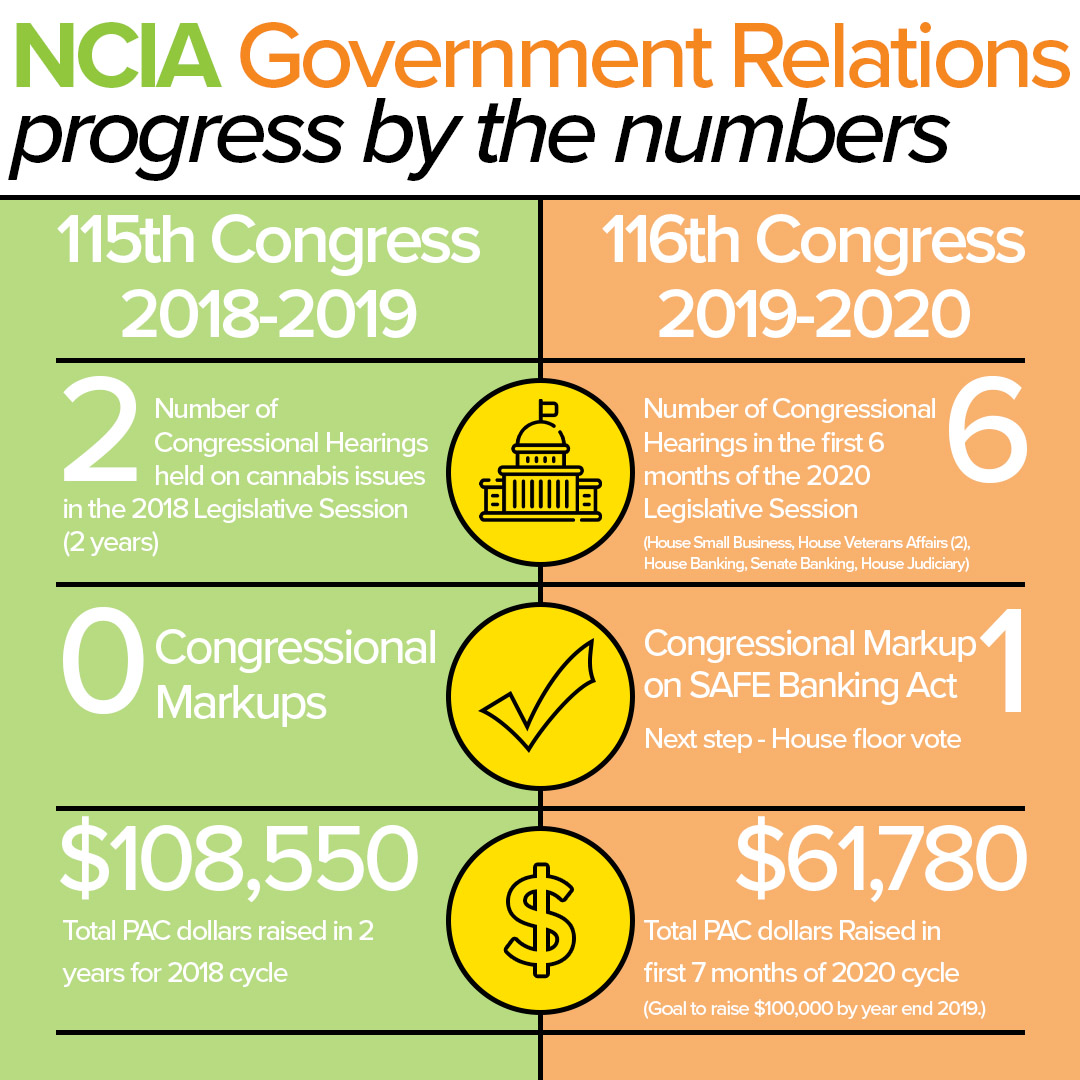
2019 By The Numbers (So Far!)
August recess is winding down, and soon, Members of Congress will return to D.C. for the remainder of the year. This year, however, was a benchmark year for cannabis policy, and we still have four months left to go! Let’s take a look back on how 2018 compared to 2019 (so far!).
2:
Number of Congressional hearings held on cannabis issues in the 115th Congress (2017-2018)
6:
The number of Congressional hearings as of August 2019 in the following committees:
House Small Business Committee House Veterans Affairs Committee (2) House Financial Services Committee Senate Banking Committee House Judiciary Committee
95:
The number of cosponsors the House version of the SAFE Banking Act garnered during the entire 115th Congress.
206:
The number of cosponsors on H.R. 1595, the SAFE Banking Act, just in the first seven months of 2019.
0:
The number of Congressional markups held on a cannabis bill in the 115th Congress.
1:
The number of Congressional markups held on a cannabis bill in the 116th Congress. In March 2018, the House Financial Services Committee marked up H.R. 1595: the SAFE Banking Act. It passed out of Committee by a vote of 45-15.
$108,550:
Total NCIA-PAC dollars raised for the 115th Congress (2017-2018)
$61,780:
Total NCIA-PAC dollars raised in the first 7 months of 2019. Our goal to raise $100,000 by the end of the year, so make sure you learn more about the NCIA-PAC here!
We have been busy this year advocating for pro-cannabis policy reform and will continue pounding the pavement on Capitol Hill. We look forward to all of the successes yet to come in 2019 and beyond!
Progress on the SAFE Banking Act in the House and Senate
Less than two months ago, H.R. 1595: the Secure and Fair Enforcement (SAFE) Banking Act was marked up by the House Financial Services Committee, where it passed out of committee by a margin of 45-15. While the bill must still come to the House floor for a vote by the full chamber and then be taken up by the Senate, let’s take a look at where the bill currently stands.
As a refresher, the SAFE Banking Act would prevent federal banking regulators from punishing banks for working with cannabis related businesses that are obeying state laws or halting their services, taking action on loans made to those businesses, or limiting a depository institution’s access to the Deposit Insurance Fund. The bill would also protect ancillary businesses that work with the cannabis industry from being charged with money laundering and other financial crimes, and requires the Financial Institution Examination Council to develop guidance to help credit unions and banks understand how to lawfully serve cannabis businesses. In the House, the legislation was introduced by Reps.Ed Perlmutter (D-CO) and Denny Heck (D-WA), while the Senate bill was introduced by Sens.Jeff Merkley (D-OR) and Cory Gardner (R-CO).
When the House version of the SAFE Banking Act was introduced in March, you’ll remember it had a historic 108 original cosponsors. As of the beginning of May, the legislation currently has a whopping 172 cosponsors, with 17 members getting on the bill in April alone.
The Senate version of the SAFE Banking Act (S. 1200) was introduced in April with 21 original cosponsors. Currently, the bill is up to 25 cosponsors – that’s a quarter of the entire Senate! Notably, there are six Senators who are running for President in 2020 that have signed onto the legislation.
In addition to gaining more cosponsors in both houses of Congress, other government officials have also thrown their support behind the bill. In April, 27 state banking supervisors signed a letter addressed to congressional leadership that stated, “We urge Congress to consider legislation that creates a safe harbor for financial institutions to serve a state-compliant business or entrusts sovereign states with the full oversight and jurisdiction of marijuana-related activity.”
Even with all this progress and positive signs for the future, we still have some roadblocks in our path to ensuring this legislation crosses the finish line during the current session.
In the House, Republican support is still lagging despite bipartisan original sponsorship. With Republicans making up only 11% of the current cosponsors, we still have much work to do convincing the GOP members of the House to support this sensible legislation.
In the Senate, we will need all the support we can get in Congress to overcome the objections of a key committee head, Sen. Mike Crapo (R-ID), who is the chairman of the Senate Banking Committee. Sen. Crapo will determine whether the SAFE Banking Act can get its first hearing in the Senate, and his recent statements at a conference hosted by the Independent Community Bankers of America (ICBA) that this issue should be left to the Department of Justice highlight the need for us to keep building consensus and momentum to convince him otherwise.
Essentially, we’ve come farther than many thought we would, but there is still much work to do, and we want you to join us!
In just two short weeks, hundreds of cannabis industry professionals from all over the country will descend on Capitol Hill this month for the 9th year in a row for NCIA’s Annual Lobby Days. It’s more important than ever before to make your voice heard and advocate for the federal reforms our industry needs to truly thrive. Whether it’s access to banking for your business, much-needed federal tax reforms, or some of the many other struggles faced by our industry that could be remedied by congressional action, we need you to tell your stories on Capitol Hill with us on May 21-23. See you there!


Follow NCIA
Newsletter
Facebook
Twitter
LinkedIn
Instagram
News & Resource Topics
–
This Just In
Member Blog: The Evolving Cannabis Legal & Regulatory Landscape in 2026
How THCa Vapes Are Changing Consumer