
Member Blog: Merchandising in Your Retail Dispensary – How to Make the Most of Your Space and Increase Profits
by Melinda Yoo, Sungrown Studios
How to make the most of your space and increase profits and move inventory when sales stall
Merchandising a dispensary can be a daunting task. There are many components to consider; different brands, product types, customer needs, compliance, promo’s, and security are just a few. Product placement in a dispensary often determines the traffic low of the space. We know that certain products that require a longer “browse time” may also create traffic flow bottlenecks in the floor plan if not carefully planned and executed. But often in the design process, merchandising comes after the general front of house layout. Then, merchandising and product placement sometimes becomes a task left for the last minute, or worse, someone on the staff who has no experience.
Another tricky merchandising caveat is that it needs to lend itself to the vision of the brand and the overall customer experience. There are so many nuances to how merchandising effects the customer journey, that without vast knowledge in customer trends, store layout conventions, general marketing and design, hiring a professional is the only way to check all of those boxes.
There are some general guidelines that will help you and your team navigate merchandising your dispensary and getting a professional, cohesive feel to your cannabis dispensary.
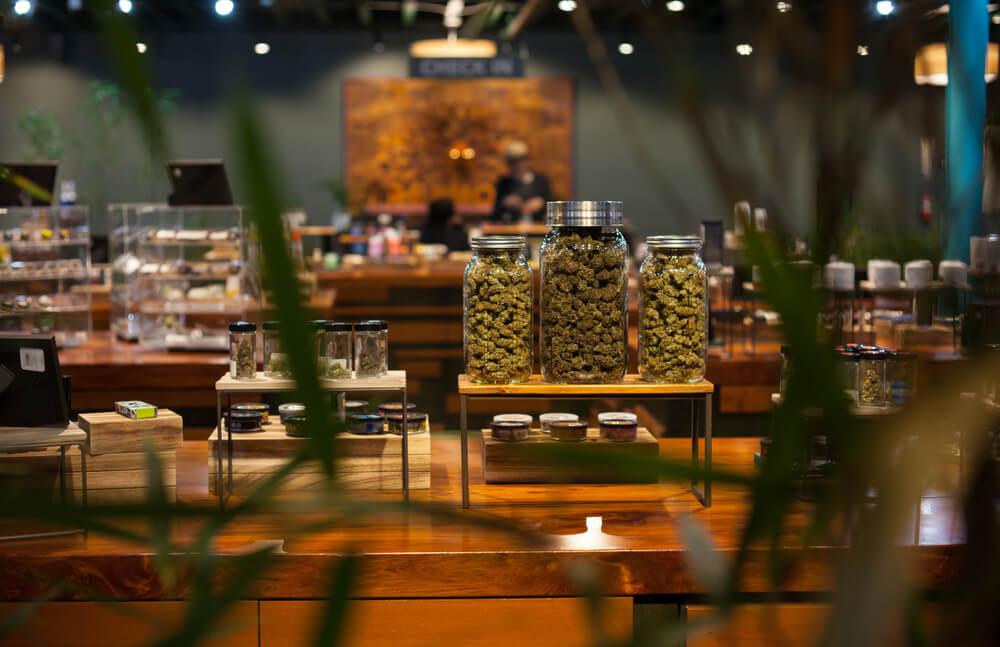
‘Less is more’ applies here in a big way. Overloading your fixtures with multiples of each product creates visual clutter and removes the “specialness” of each package. I highly recommend no more than three of each SKU on a single display. If the packaging is large or tall you may want to reduce the quantity. Products should have ample space around each package to give visual breaks from product to product.
The ‘less is more’ strategy also applies to signage and info cards too. Font overload or forcing your customers to read or scan QR codes constantly detracts from the product, detracts from the implied budtenders connection to the customer and ultimately their unique expertise. This is why most digital menu boards are unsuccessful. Control what your rented shelf space looks like with your vendors. Make sure guidelines are put into contract that outline very clearly what their topper or display will look like. You don’t want to give them free reign of your carefully planned dispensary. Visual clutter and font overload is a common merchandising mistake.
Review your human scale. The heights and depths of fixtures are sometimes calculated to simply put as much product inside as possible, not how comfortably someone can view or reach something. This is very common with the vision type merchandise tables built for display and cash wrap vision cases. You usually have to move around a bit, stretch to see the middle or back up and lean over to look inside. Would your staff have to constantly bend or reach to access products? Or turn their backs on the customer? If the scale is correct, the customer will not have to be uncomfortable while looking at your products. This also goes for furniture. The scale of your seating, tables, reception desks are all crucial to the comfort level of your space.
Checking your profit margins by SKU’s is a great way to begin laying out your cases or shelves. A complete inventory list with markup percentages, top sellers and unique products will be needed to identify which products deserve the hottest locations in the cannabis dispensary. You may actually be surprised at what you find. Every individual fixture will also have a hot zone, or an area where customers gravitate to and typically select products from. You want to take full advantage of those top-selling sections.
Identify the ‘hot zones’ in your space. Interior store merchandisers will have a complete system in place for identifying these areas. But you can get a great snapshot for yourself if you look closely at your store on a busy Saturday. Watch how the customers enter. Did they go left or right? Where do they look and walk first? When they look at a wall display or into a vision case, which side are they looking at? What level? How long did they stand there? Make some notes and see if all of the customers entering are shopping in nearly the same convention. Are there areas of your dispensary that customers seem to be avoiding? Take notes on those too. What products are in those areas? Are they just not trending products? Ugly or awkward packaging? Or are the fixtures not well lit? Too much signage? Now compare that to what you see on a slower day and time. Are the results consistent?
This is commonly called journey tracking and will give you great insights into how well your fixtures and store floor plan is working (or not working) for you. Customer shopping habits are both fascinating and trackable, and very likely give you the info you’ll need to make any adjustments to your current shelf conventions or floor plan.
Make them meander. Often, dispensaries have a long and narrow footprint. The tendency is to put all the cases on the side walls and the checkout counter running across the back of the store, leaving your middle of the store empty. Runway-style floor plans can be extremely successful if you take deliberate steps to stop the customer at various points and encourage a meandering path of travel. If your customers are going straight to the back counter and straight back out the door, you are definitely not capturing sales you could be, and you’re wasting your real estate. Without cluttering the middle space, i do like to add staggered fixtures (table height as to not create a security sight blind) that display various products, impulse items and even merch when applicable. These meandering tables encourage the guest to move through the space in a zig zag pattern and more often than not they will walk in a zipper pattern. Which also means, the items that are on the outside walls where the meandering tables terminate will be hot zones. Use that to your full merchandising potential. Use LED light strips or spots to highlight these areas and products.
Finally, stop overcomplicating things. Every single product does not need museum- like merchandising, staging, lighting, or signage. Lay off the repetitive info and QR codes, neon, digital, and clutter. A great hint is to go to your favorite store. It doesn’t have to be a dispensary either, just a great shop or boutique that you enjoy shopping in. Do your own self-customer journey while you’re there. Revisit how you entered, where you walked and paused, and where specifically you purchased from. Think about how the product was presented to you, and ask yourself if the layout and merchandising encouraged you to buy more?
Thinking critically about your personal shopping experience and making some simple changes will help you shape the customer experience in your own dispensary. It’s also helpful to bring in a fresh perspective from time to time.
Setting a standard for merchandising practices across all of your locations is a great way to make sure that you’re implementing tried and true techniques to increase sales, food traffic and put your best image forward as an organized, beautiful and profitable dispensary.
 Melinda Yoo designs innovative, profitable and award-winning cannabis retail dispensaries across North America. Her work is inspiring, her clients are notable and her vision for the cannabis industry is unparalleled. She leads her team thoughtfully through the creative and technical processes of creating unique retail experiences that are both jaw dropping and profitable.
After over a decade at a traditional, residential interior design firm in Chicago, Melinda followed her curiosity to retail interior design and merchandising. She quickly fell in love with dispensary design and all the quirks and challenges that go with it.
Since then, she has grown and led Sungrown Studio, received press recognition with her magazine-worthy retail environments and thought leadership. Sungrown Studio was named Dispensary Design Master 2022 by mg Magazine. Melinda continues to design amazing retail stores that reflect her clients values and brand.
When she’s not leading her kickass team, you can find her spending time on the hiking trails with her dog or raising her three little humans.

 Andy Poticha is principal at
Follow NCIA
Newsletter
Facebook
Twitter
LinkedIn
Instagram
News & Resource Topics
–
This Just In
NCIA Applauds Reintroduction of SAFE Banking Following Lobby Days
Beyond Rescheduling: Inside NCIA’s 14th Annual National Cannabis Industry Lobby Days