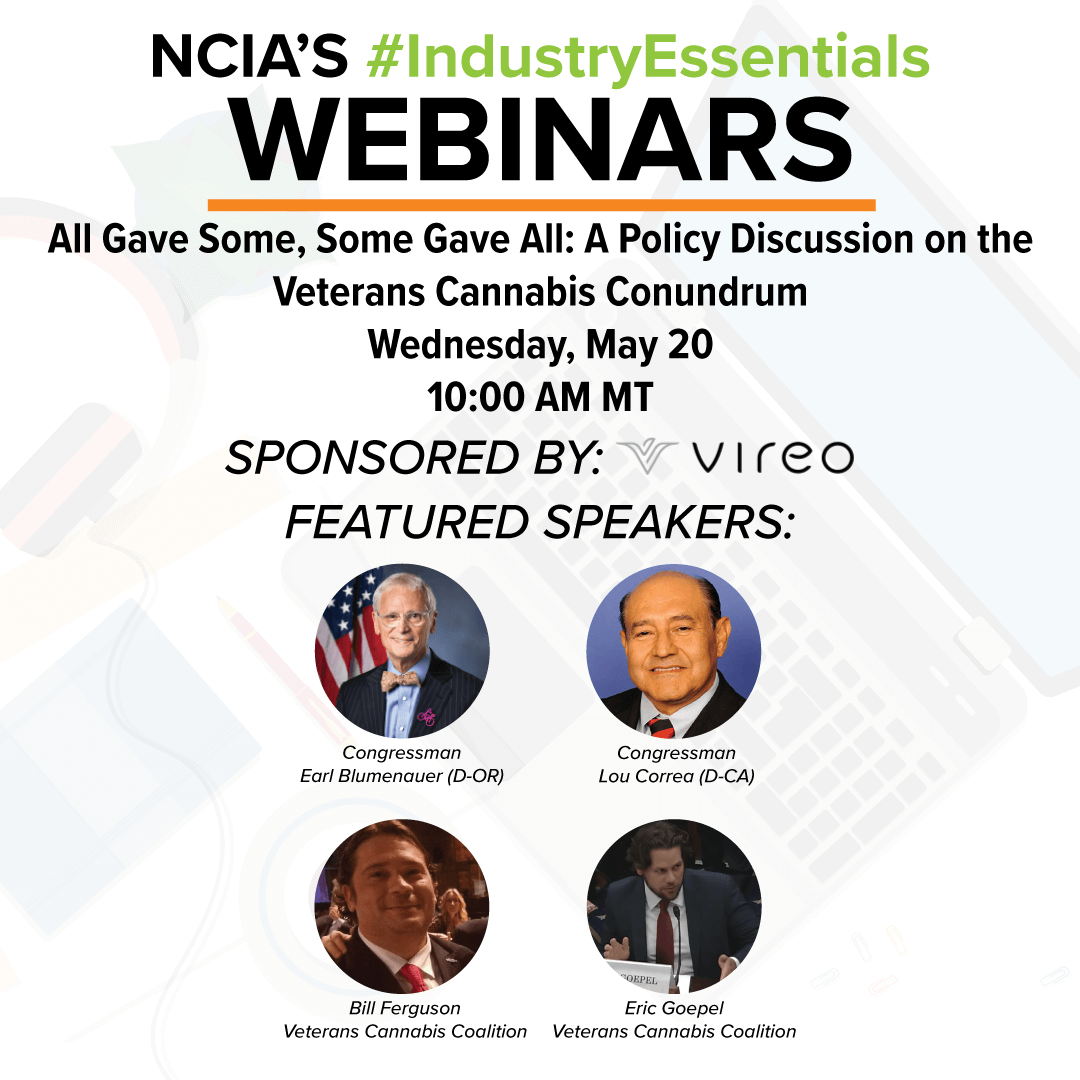
Webinar Recording: All Gave Some, Some Gave All – A Policy Discussion on the Veterans Cannabis Conundrum
In case you missed this webinar on Memorial Day, watch this recording.
Especially around Memorial Day, it’s important to remember the reason for the holiday: our veterans. Unfortunately, though all gave some and some gave all, the vast majority of our veterans are still unable to access safe, regulated cannabis. Many individuals in the veteran community struggle under unique health burdens stemming from their honorable service, and have experienced little success in managing their conditions with available pharmaceuticals. Through cannabis, veterans of all generations and with various conditions have experienced improvements in their quality of life by using cannabis.
In Congress, two bills aimed at tackling this issue have already passed out of the House Veterans Affairs Committee — H.R. 712: the VA Medicinal Cannabis Research Act of 2019, sponsored by Congressman Lou Correa (D-CA) and H.R. 1647: the Veterans Equal Access Act, sponsored by Congressman Earl Blumenauer (D-OR). In March, the Congressional Budget Office scored H.R. 1647 and found that passing the bill into law would cost the federal government exactly $0.
Enjoy this webinar focused on cannabis, health, and our armed services members. NCIA’s Government Relations team is joined by none other than the lead sponsors of the VA Medicinal Cannabis Research Act of 2019 and H.R. 1647: the Veterans Equal Access Act, Congressmen Lou Correa and Earl Blumenauer, respectively. Our panel also includes the cofounders of the Veterans Cannabis Coalition, Eric Goepel and Bill Ferguson. This unique opportunity will allow you to hear from the lead sponsors of legislation designed to give our veterans the best quality of life possible, interact with member(s) of Congress, and learn more about the prospects of these bills passing into law.
Top Ten Reasons NCIA Supports De-Scheduling Cannabis
Today, the House Judiciary Committee (Subcommittee on Crime, Terrorism and Homeland Security) is holding a hearing on marijuana policy reform proposals and related social equity provisions. While NCIA supports the STATES Act and other incremental approaches to reform, we strongly prefer a longer-term approach that includes de-scheduling cannabis and the inclusion of robust social equity provisions. Let’s get this right the first time around.
Below are the top ten reasons to support de-scheduling:
1. De-scheduling is good public policy because cannabis should not be classified alongside dangerous drugs like heroin and methamphetamines, and cannabis has proven medicinal properties and is safer for adults than alcohol and many over-the-counter medicines.
2. De-scheduling automatically solves the banking problems plaguing the cannabis industry and automatically cures issues related to the unfair tax provisions imposed by 280E.
3. De-scheduling removes many of the roadblocks in the way of creating an industry that prioritizes and promotes social equity and inclusion.
4. De-Scheduling would allow for cannabis to be transported across state lines in accordance with interstate trade compacts, opening opportunities for licensed growers to get their product into more markets and to stabilize supply and demand issues currently facing some state markets.
5. De-scheduling takes regulatory authority away from the DEA and creates opportunities for the federal government to regulate marijuana through FDA and Treasury with regimes that are more appropriate, given the relative harm of cannabis compared to other adult products.
6. De-scheduling immediately makes federal research and grants possible.
7. De-scheduling immediately changes current immigration policy that prohibits people with “bad moral character” from applying for citizenship because of their work in the cannabis industry.
8. De-scheduling allows for the provision of bankruptcy protection for cannabis-related businesses.
9. De-scheduling would allow veterans access to plant-based medicine and retention of VA benefits if they choose to use medicinal marijuana.
10. De-scheduling still allows for state autonomy while simultaneously providing for federal continuity.

Follow NCIA
Newsletter
Facebook
Twitter
LinkedIn
Instagram
News & Resource Topics
–
This Just In
DOJ Reschedules Medical Cannabis to Schedule III & Announces June 2026 Hearing on Broader Rescheduling
National Cannabis Industry Association (NCIA) to Convene Industry Leaders in Washington for Annual Lobby Days, Bringing Together a Unified Voice for Federal Cannabis Reform