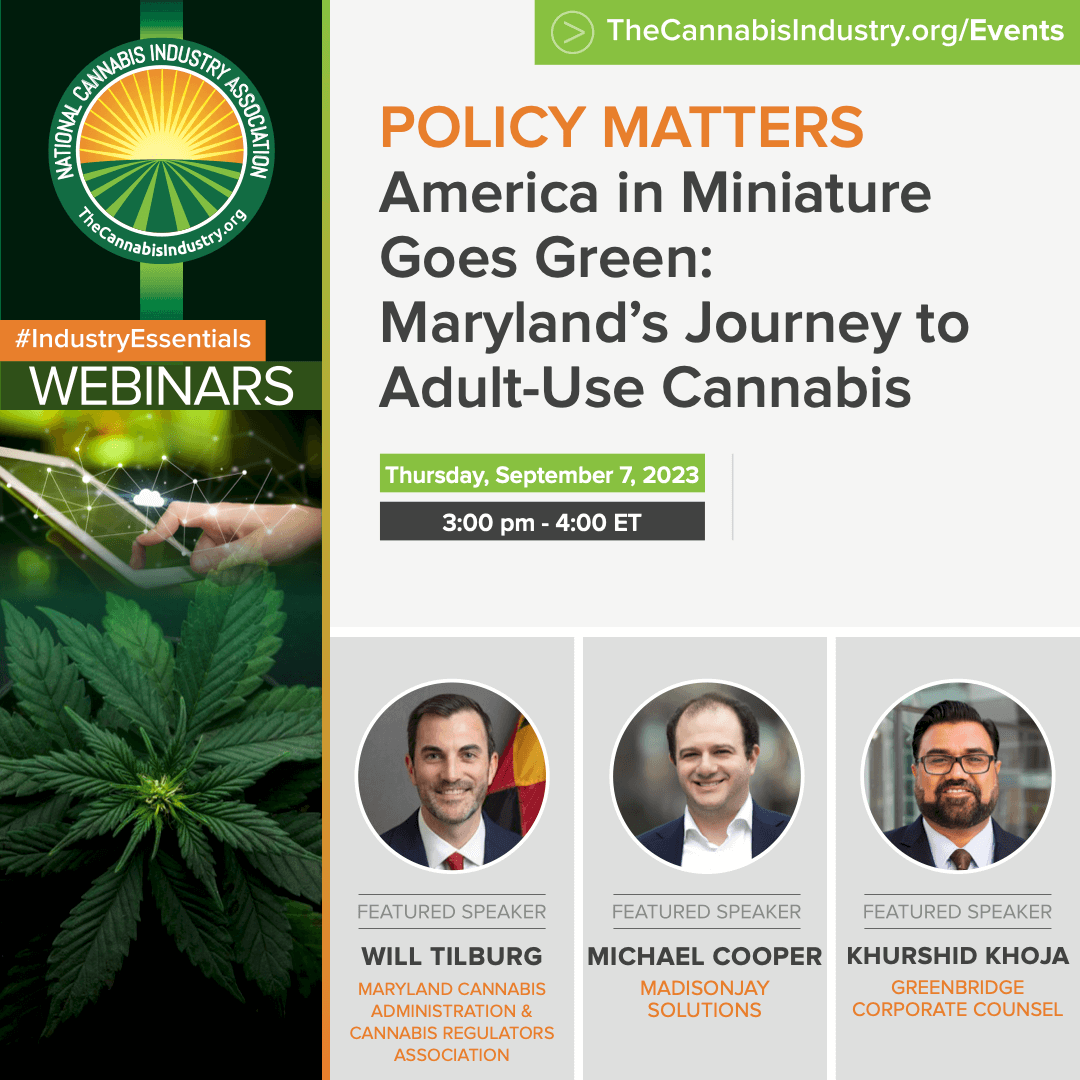
America in Miniature Goes Green: Maryland’s Journey to Adult-Use Cannabis | 9.7.23 | Policy Matters
Introducing “Policy Matters” – an insightful new #IndustryEssentials webinar series dedicated to unraveling the intricate world of regulatory and policy dynamics within the cannabis industry. As the cannabis landscape continues to evolve, staying informed about the latest regulations and policies impacting Main Street cannabis operators is crucial for success. Join us for a series of engaging discussions where regional regulators, industry leaders, legal experts, and policy influencers come together with NCIA leadership to shed light on the most pressing issues facing cannabis professionals.
Are you curious about the intricacies of launching an adult-use cannabis market in record time? In the debut episode of our new Policy Matters webinar series we delved into the strategic aspects of designing a thriving cannabis market while meeting regulatory standards. In this exclusive session, NCIA Policy Co-Chairs Khurshid Khoja and Michael Cooper were joined by Will Tilburg, Director of the Maryland Cannabis Administration and President of the Cannabis Regulators Association, to explore invaluable insights into the objectives that drive cannabis regulators and the pitfalls they strive to avoid. Discover the pressing enforcement challenges that are top of mind for cannabis regulators in 2023 and gain a clear understanding of the evolving landscape.
Don’t miss this opportunity to gain an understanding of how policy matters in the fast-paced cannabis sector. Stay informed, stay ahead, and be part of the conversation that’s shaping the future of cannabis policy. Tune in today and empower yourself with the knowledge to thrive in this dynamic industry.
03:40 – Launching an Adult Use Market in 2023 | Were there lessons from the existing medical market and others around the nation that you identified as important, both success stories and pitfalls to avoid?
07:23 – Launching an Adult Use Market in 2023 | What allowed you to move so efficiently and what lessons would you highlight for industry and regulators in new markets rolling-out in the future?
12:48 – Launching an Adult Use Market in 2023 | What are some priorities you have for the months ahead?
16:55 – Launching an Adult Use Market in 2023 | What advice would you give to future regulators on building relationships within the executive branch to prioritize these issues?
22:20 – Social Equity | Can you talk about reserving the first round of adult-use cannabis licenses exclusively for social equity applicants and other recent milestones or developments working with the Office of Social Equity?
28:56 – Social Equity | How has Maryland worked to make its medical cannabis industry more equitable and ensure these goals aren’t undercut as they have been with similar licensing preferences in other states?
34:04 – Enforcement | How did the state set up its enforcement plan? How do you strike a balance in a new market between a complete absence of enforcement and protecting public health?
37:34 – Enforcement | What are some key enforcement priorities for you looking ahead?
41:40 – CANNRA | Can you talk about the Cannabis Regulators Association (CANNRA) purpose, membership, and goals?
44:39 – CANNRA | What are the priorities or goals for your tenure as CANNRA president?
47:20 – Federal Reform & Regulation | What is Maryland doing to address the hemp-derived cannabinoids issue as it relates to protecting public health and unfair competition with adult-use cannabis licensees?
52:10 – Federal Reform & Regulation | As a state regulator, how did you receive the recent HHS recommendation for rescheduling of cannabis to Schedule III?
56:34 – Federal Reform & Regulation | What is the optimal division of labor between state and federal government if cannabis is completely descheduled in the future?
Member Blog: Adult-Use Cannabis Now Legal in Maryland – A Look at the New Law
In the heart of the East Coast, Maryland stands as a state rich in history and diversity. But now, it’s making headlines for quite a different reason.
In a significant move, the state has crossed one of the biggest milestones of its legislative journey- adult-use cannabis is now officially legal.
Of course, the decision comes after much debate, consideration, and reflection on the impact this will have on society. However, this law is sure to change the way cannabis is viewed, controlled, and used within the state.
The following article explores the details of this landmark law, what it means for Maryland’s future, and how customers can get their hands on adult-use cannabis.
Let’s cut to the chase!
The New Cannabis Law In Maryland: Explained
The journey of legalizing cannabis for adult-use began in the 2022 General Election. During these elections, voters gave a nod in favor of allowing adults aged 21 and older to use cannabis. This came into effect on July 1, 2023.
But what did this mean for the state?
Well, during the 2023 legislative session, lawmakers got to work. They passed a law called House Bill 556/Senate 516, describing the rules for legal sales of cannabis, including how to license sellers and how to tax them.
This change was sealed when the Cannabis Reform Act got the Governor’s signature on May 3, 2023. This Act was like a green signal for licensed shops to sell both medical and adult-use sales. So, by July 1, there was an official marketplace for adult-use cannabis.
But that’s not all! The Act gave more powers to the Maryland Cannabis Administration. They were tasked with issuing more licenses to those growing, processing, and selling cannabis. There was also something new – the incubator licenses. All these licenses were set to be released in two phases.
Highlights of The New Law:
Adults aged 21 and over can legally possess, consume, and grow marijuana for personal use.
The legal limit to possess cannabis is:
Up to 1.5 ounces of flower
Up to 12 grams of concentrated cannabis
The product contains up to 750 milligrams of delta-9-THC.
Public consumption remains illegal.
Driving under the influence of marijuana is still a criminal offense.
Expungement of certain marijuana-related convictions, giving thousands of individuals a fresh start.
Under federal law, cannabis is still prohibited; that’s why transporting or carrying it across state borders is not allowed.
How Can Someone Buy Cannabis Products For Adult-Use?
Purchasing cannabis products for “non-medical” use is pretty easy now. If you or someone you know wish to get their hands on these products, follow this simple guide:
You need to be 21 years old or older. That’s the legal age for buying cannabis products for adult-use in Maryland. Remember to carry a valid photo ID to confirm your age when visiting a dispensary.
Dispensaries or stores have a variety of options to choose from. So, whether you’re interested in edibles, flowers, tinctures, or topicals, it’s essential to check them out to find the product that suits your preferences. You can even ask questions to make a well-informed decision.
Though you don’t require a medical card to buy cannabis, you do have to keep the maximum limit of possession in mind and follow all the state regulations. It will help avoid potential penalties or legal troubles at the federal level.
That’s all! Now, you can enjoy the benefits of this popular herb from the comfort of your home.
What Would Be The Implications Of This Law in Maryland?
Well, just like any law amendment and law regulation, this milestone has also brought along a few implications that include:
Economic Implication
The legalization of adult-use cannabis in Maryland is set to have significant economic implications. Tax revenues from cannabis sales are estimated to bolster state funds, allowing for investment in various public services like education, healthcare, and infrastructure.
The growth of the cannabis industry will likely create new jobs, supporting the local economy and providing opportunities for entrepreneurs and workers alike. Proper regulation can further ensure that the economic benefits are widespread and sustainable.
Social Implications
The state has taken a significant step, and this is because people’s feelings and opinions about cannabis are changing. This is reducing the age-old stigma related to its consumption and other uses.
In addition to this, the new law allows for expungement of prior convictions related to its possession and use. This is a step for righting past wrongs, positively impacting countless lives, and offering them a second chance to build their lives.
Educational Initiatives
Education is one of the key components of Maryland’s approach to cannabis legalization. Basically, the plan is to implement public education campaigns aimed at informing residents about responsible use, potential health risks, and legal boundaries.
These educational initiatives are vital for ensuring that people, especially young ones, understand the new law’s nuances and potential health implications. Such awareness is crucial in preventing misuse and fostering a responsible approach to adult-use cannabis.
Moreover, this will make regulation of the law much easier, transparent, and responsible. In fact, law enforcement agencies have also provided clear guidelines on the legal use of cannabis, emphasizing the continued illegality of driving under the influence, underage possession, and other related offenses.
Key Takeaways: A Historical Moment for Maryland
The decision to legalize adult-use cannabis in Maryland isn’t a minor tweak in legislation. It’s a significant moment, marking the state’s progressive stance in acknowledging changing societal views and personal freedoms.
In fact, it’s about dollars and cents too. With regulated sales and businesses springing up, the state stands to gain from additional tax revenue and job creation. The state has shown foresight. The legalization comes with robust educational initiatives and strict safety regulations.
From ensuring quality control of products to launching public education campaigns, the state is determined to prevent misuse and ensure responsible consumption. Ultimately, it’s a multifaceted approach shaped by careful deliberation, public interest, and a vision for a better future.
Member Blog: Dollars and Sense – 2022 Michigan Cannabis CFO Outlook
The cannabis industry is one of the fastest-growing sectors in Michigan. It’s also an ever-changing industry, leading to myriad challenges for businesses operating within this space. One issue licensees face is a significant gap in vital business intelligence that’s needed to remain relevant in an extremely competitive market.
To help fill this gap, Rehmann partnered with A&K Research, Inc. of Northville, Mich. to survey cannabis operations within the state and to create the 2022 Michigan Cannabis CFO Outlook. As one of the leading professional advisory firms serving the cannabis industry in Michigan, Rehmann spearheaded this project to help cannabis licensees make empowered business decisions based on peer feedback.
The 2022 Michigan Cannabis CFO Outlook shares findings from the survey, including top challenges the cannabis industry faces in Michigan. Top-of-mind concerns: managing the financial side of the business; deciding whether it’s time to sell the business and how best to go about it; staying on top of compliance requirements; navigating federal legislation and resulting tax burdens; and understanding potential changes in lending laws that impact relationships between banking institutions and legitimate cannabis-related businesses.
In addition, this report features industry spotlights highlighting current cannabis businesses facing these issues in real-time. They share how they’re navigating this ever-evolving industry and economic landscape.
Michigan Marijuana Sales
Just how quickly is this industry growing? Michigan saw $21 million in medical cannabis sales and $188 million adult-use marijuana purchases in July 2022 – a total that is about $15 million greater than the previous monthly record set in April 2022. Most of the marijuana sales for both medical and recreational use were for flower products, followed by vape cartridges. Data also shows a continuation of a sales trend in Michigan’s marijuana market, with medical cannabis purchases decreasing and adult-use sales increasing.
Report Takeaways
Here’s a snapshot of report insights and some of our takeaways. You can download the full 2022 Michigan Cannabis CFO Outlook here.
Tax and M&A Activity
39% of companies are considering or are in the process of selling their business. This could be due to the current challenges of operating within the Michigan cannabis market or for a variety of other reasons. Many licensees are entrepreneurs who enjoyed starting and growing the business from the ground up and are ready to move on.
Half of the companies are paying an effective tax rate between 20% and 30%. One in five currently show a loss from operations. This was surprisingly much lower than we expected. It’s not uncommon to see tax rates of over 50% within the industry depending on where the business falls in the vertical chain and how aggressive you can be with your structure or costing model.
Cannabis Business Operations
Just over one-quarter (28%) of businesses have been subject to some level of federal, state, or reporting audits. The industry is still young, and as we continue to look at this data year over year, we expect this number to drastically increase. It’s important to have your finances in order to be prepared for that time to come.
Almost two-thirds (65%) use QuickBooks for their accounting system, with the remainder being dispersed between Sage, SAP, Dynamics, and Xero. Accounting for the cannabis industry can be extremely complex. Many cannabis businesses started with QuickBooks and are now outgrowing that system and ready for more powerful systems to meet their unique needs.
Perceptions of the Current Michigan Cannabis Industry
The majority (56%) expect retail pricing needing another 1-3 years to stabilize. One of the biggest concerns within the industry is pricing of cannabis. We’ve seen a significant drop in retail pricing over the past several years and there is concern that it may drop even more.
Nearly half (42%) think that between 26% and 50% of wholesalers are losing money at current retail prices. Given the struggles with pricing, growers who are selling wholesale are facing a lot of challenges at this point. As more and more operations start up within Michigan (a state without a license cap), the market continues to move toward oversaturation.
What some of the survey respondents had to say about the state of the industry:
“As a small-sized grower focusing on high-end quality, we are impacted greatly by falling retail prices. The rampant increase in licenses/grows caused a glut in the market that has yet to subside. We are focusing all our efforts on lowering costs to keep up with falling prices.” [Grower]
“The industry is currently in a very fragile state. The testing numbers are overinflated for potency, customers are going back to the black market and the current pricing is not sustainable. In addition, new businesses for all areas are opening and believe there is enough capacity for everyone to make money.” [Testing Facility]
“If 280E would go away, things would be much better. Limited licensing for cultivation and processing would also help.” [Grower, Processor & Provisioning Center / Retailer]
To download your digital copy of the full report today, click here.
Chris Rosmarin manages the commercial audit practice in Grand Rapids and also leads the Firm’s cannabis practice. He provides audit and other assurance services, due diligence services and accounting advisory services to various companies both large and small.
Chris understands that clients expect and deserve a partner that is responsive, invested in the relationship and dedicated to helping them respond to their challenges. He strives to deliver on those expectations by meeting deadlines and being available and present throughout the relationship.
Rehmann is a professional advisory firm that provides accounting and assurance, business solutions and outsourcing, specialized consulting, and wealth management services. For over 80 years, Rehmann has provided forward-thinking solutions to our clients. With nearly 900 associates in Michigan, Ohio, and Florida, we are the momentum behind what’s possible. We focus on the business of business — allowing companies and individuals to focus on what makes them extraordinary. We help you look to the future with confidence, thanks to our unrivaled expertise and integrity. Through our partnerships with our clients and communities, we drive impact that empowers our world. Find us online at rehmann.com.
Member Blog: Nevada and Las Vegas Cannabis Market Analysis
The state of Nevada has always been a unique place to do business. Not only is its economy fueled almost entirely by tourism, but its population is located almost exclusively within a few key urban centers. These factors influence nearly every type of business opportunity in Nevada – including cannabis.
While Nevada’s economic and geographic constraints are unique in themselves, the type of tourist industry found here is one of a kind. Las Vegas is famously known as “Sin City.” It is a place where people flock from around the globe to indulge their vices, such as gambling and clubbing.
As a microcosm of Nevada itself, the Nevada cannabis industry has its own set of challenges and opportunities.
Overview of the Nevada Cannabis Industry
Nevada boasts both medical and adult-use cannabis markets. The state voted to legalize medical cannabis back in 2000, although their first medical dispensary did not open until 2015. While the medical cannabis space in Nevada began with a crawl, the adult-use industry has been quite different.
Nevada voted to legalize adult-use cannabis in late 2016, with the first adult-use dispensary opening mid-2017. Nevada has both medical and recreational dispensaries, although certain stores service both customer bases.
One of the more exciting facets of the Nevada cannabis market has to do with home cultivation. Its unique program allows people 21+ years old to grow at home if they live more than 25 miles from a dispensary. Nevada put these rules in place to accommodate citizens living in rural areas who cannot access dispensaries.
Since Nevada’s legalization, cannabis has become a big business. Here are some statistics for the 2019-2020 fiscal year in the Nevada cannabis industry:
Total Sales: $684,959,149.00
Cannabis Taxes: $105,180,947.00
Licensing & Application Fees: $5,212,557
Nevada sales are ahead of other new adult-use recreational markets such as Illinois and Massachusetts to put these numbers in perspective. Nevada falls short compared to more established industries such as Colorado and Washington, but it holds promise for massive growth.
What is Unique About the Las Vegas Cannabis Market?
The tourism industry in Las Vegas makes for a unique market. Adult-use market regulations coupled with the global renown of the city lead to an environment where out-of-state visitors greatly influence cannabis sales.
The structure of a cannabis market directly influences business opportunities. In medical cannabis, qualifying conditions and patient counts dictate potential market growth. Conversely, adult-use markets are only limited by people’s age.
The interesting thing about the Las Vegas market is that anyone over 21-years can legally purchase cannabis – this includes out-of-state visitors. According to the Las Vegas Conventions and Visitors Authority website, the city saw 42,523,700 visitors in 2019 alone. These people spent over $10 billion in Las Vegas that year. Within these billions of dollars in tourist money lies an excellent opportunity for adult-use operators in Nevada.
Another fact worth noting is that people flock to “Sin City” to partake in activities inaccessible in other U.S. states. Cannabis fits nicely into this package of taboo activities that can only be done in Las Vegas, NV.
Is it Hard to Open a Cannabis Business in Las Vegas?
While the tourist money in Las Vegas makes for a very intriguing adult-use market, it is not easy to acquire a cannabis business license. Unfortunately, Nevada has put a cap on the number of licenses available in the state, making it much more difficult to enter than other adult-use states like Colorado.
There are five types of business licenses in the Nevada cannabis industry:
Cultivation Facility
Distributor
Product Manufacturing Facility
Testing Facility/Laboratory
Retail Store
It’s worth noting that both the medical and adult-use markets offer these same business licenses. Similarly, the licensing cap in the state includes both verticals.
As of early 2021, the state of Nevada awarded 132 dispensary licenses. However, these licenses did not go to 132 different operators. Certain businesses acquired multiple licenses, with some able to open as many as seven retail stores. While Nevada has issued 132 retail licenses, there are only 80 dispensaries operational at this point.
The licensing situation in Nevada is frustrating for local investors and outside interests alike. Namely, because studies show that the Nevada economy could support as many as 1,283 more dispensaries than it has issued licenses for. Aggravation mounts with a lack of expansion opportunities in the area.
The state of Nevada only accepts additional cannabis business license requests during “application periods.” These short windows are scheduled by the Nevada Cannabis Compliance Board and stay open for just ten days. However, there has not been an application opportunity since 2018, and it doesn’t appear there will be one anytime soon. As such, it appears that plant-touching opportunities in Nevada are limited to current license holders.
Where is the Most Opportunity in Nevada Cannabis?
While many believe there is ample room for new players in the Nevada cannabis market, the state does not agree at this point. As a result, if you are looking to get involved in the Nevada industry, you are well-advised to look into ancillary business models instead of plant-touching businesses.
With such promise in the Nevada market, you can rest assured that those cannabis companies that have won licenses will be extremely busy. Ancillary operators can take advantage of this climate by developing models that operate in the business-to-business (B2B) vertical. To help plant-touching companies in Nevada, both product-based and service-based ancillary businesses could prove profitable. Examples of product-based companies include business management software and cultivation technology, while service-based businesses work in marketing, staffing, and consulting.
Opening an ancillary cannabis company in Nevada gives you the ability to enter the market by circumventing the licensing process. Even more, you don’t have to worry about application fees, compliance mandates, and other stressors faced by plant-touching companies. You also have the option to operate across state and national borders if you so desire.
Summary
There is no doubt that the Nevada cannabis industry is one-of-a-kind. While there is a good deal of excitement surrounding the market, many feel it hasn’t even come close to reaching its potential. To this end, the adult-use market in Nevada was only 1.5 years old when the COVID-19 pandemic struck. The financial blow of the pandemic was cataclysmic in Las Vegas, as the tourism industry dropped to 50% below average in 2020.
With the pandemic on the downswing in 2021, there is an unmistakable air of excitement across the globe. Some economists feel that we are about to enter a new “roaring 20’s” period, where people celebrate by spending travel money that was unusable during COVID-19. With this celebratory outlook on the near feature, there is no doubt Sin City will see its share of visitors. With the casinos and hotels full again, maybe we will finally see what the Nevada cannabis market can really do.
Dr. Monaco is the Director of Laboratory Operations for CLS Holdings’ newly opened approximately $4 million laboratory, and is responsible for all day-to-day operations inside the North Las Vegas facility. Dr. Monaco brings over 8 years of licensed & regulated cannabis experience, starting back in 2012 when medical marijuana first opened in Arizona, he has held numerous positions, with escalating responsibilities year over year. He graduated from the University of Arizona College of Pharmacy, in Tucson, Arizona, with a Doctor of Pharmacy in 2010.
Member Blog: Four States Legalized Cannabis in November – Here’s What That Means for the Industry
Voters in New Jersey, Arizona, South Dakota, and Montana legalized adult-use cannabis sales during November’s election. So, what comes next?
Last month, Americans in four states voted to legalize adult-use cannabis.
If you’re an adult over 21 in Arizona, New Jersey, South Dakota, or Montana, theoretically, you’ll be able to consume and purchase cannabis legally in 2021.
To many Americans, the end of cannabis prohibition in these states looks like a sudden act of voter mobilization. But industry insiders know it took years of work by activists, business people, and lawmakers to make legalization possible.
Before adults can legally purchase and consume cannabis, lawmakers in each state must outline rules and regulations, and dispensaries must go through intense licensing processes before opening their doors to the public.
The process won’t happen overnight.
In some newly legal states, it could take close to a year to iron out the details. And in the past, it’s taken even longer.
Take Massachusetts, for example. Voters cast their ballots in favor of legalization in 2016, but the first dispensary didn’t open until 2018.
Maine’s citizens also voted in support of legal weed in 2016, but it took four years for the first dispensary to open. The first two retailers – SeaWeed and Theory Wellness – opened on October 8 of this year.
“It has taken four years to move from referendum to retail sales since Mainers narrowly approved the legalization of recreational cannabis at the ballot box in 2016. Legislative rewrites, gubernatorial vetoes, a change in state administration, and then the impact of COVID-19 pandemic have combined to make Maine’s rollout the slowest in U.S. history.” – Portland Press Herald
Lawmakers in New Jersey are trying to speed things up. Democratic Senator Nick Scutari wants to move quickly to pass legislation modeled off a 2019 legal cannabis bill he sponsored. Still, legislators are fighting over the details. New Jersey’s Medical Marijuana licensing policies force applicants to pay large sums to compete for a limited number of licenses, allowing big businesses with deep pockets and holdings in other legal states to make millions.
Some New Jersey lawmakers are trying to keep the same from happening when adult-use dispensaries open their doors by prioritizing local businesses.
Arizona lawmakers anticipate legal cannabis sales to begin as early as March. The state plans to prioritize licenses for owners “from communities disproportionately impacted by the enforcement of previous marijuana laws.” Arizona’s 123 medical marijuana dispensaries will have the first opportunities to apply for adult-use licenses in January after the Arizona Department of Health Services writes the rules.
Entrepreneurs in South Dakota and Montana are ready to apply for dispensary licenses, but they, too, will have to wait.
In South Dakota, lawmakers say dispensaries will be open and selling legal adult-use cannabis by July 1. In Montana, people should be able to legally purchase cannabis on October 1, barring any bumps in the road.
Have we reached a tipping point?
The public’s view of cannabis is changing. One in three Americans now live in a state with legal weed, and, according to a recent Gallup poll, 68% of Americans support federal cannabis legalization. So, have we reached a tipping point?
That’s hard to say.
Thirty-six states now have a legal medical cannabis system. When sales begin in Arizona, New Jersey, South Dakota, and Montana, more than twenty states will have fully legalized cannabis. And while federal cannabis reform might be a defining aspect of the incoming administration’s legacy, legalization is mostly dependent on congress, and it’s still unclear which party will control the Senate next year.
Democratic leaders have pledged to end federal cannabis prohibition. If the Democratic party wins Senate control, full legalization is almost a certainty. But if Republicans maintain their Senate majority, the Republican party’s past approach to cannabis doesn’t indicate their leaders are ready to support far-reaching reform. Still, federal cannabis legalization isn’t outside the realm of possibility, even with a Republican-controlled Senate.
Only time will tell.
And again, regardless of what happens politically, it’s obvious America’s opinion of cannabis isn’t what it once was.
Oprah asked former President Obama if he and Michelle indulged in “pizza, pot, or alcohol” on election night in a recent televised interview. When a television icon casually asks a former President if he smoked weed with the former first lady, you know attitudes are changing.
Could federal cannabis legalization be the key to healing our COVID-ravaged economy?
This year, COVID-19 slowed the progress of cannabis legalization for individual states, but the pandemic could help push federal legalization forward next year. Here’s why.
A federally legal cannabis industry would accelerate America’s economic recovery.
The pandemic has had a catastrophic impact on many industries, and while a lot of employees will return to work, many jobs will be forever lost. The longer it takes for people to find employment, the longer it will take for the economy to recover.
The end of federal cannabis prohibition would create thousands of new jobs and reverse the pandemic’s adverse economic impact.
Here’s a point to consider: according to estimates from New Frontier Data, America’s legal cannabis market could be worth nearly $30 billion by 2025 – and that’s without federal legalization. If government officials choose to end federal prohibition next year, the estimates will increase dramatically.
For cannabis dispensaries, cultivators, cannabis-adjacent businesses (like cannabis marketing agencies), and American citizens, a nationwide end to prohibition would be life-changing.
But again, what the immediate future holds is anyone’s guess.
Aaron Rosenbluth is Hybrid Marketing Co‘s Content Director, and he loves to write blogs. He’s written so many blogs that he’s lost count. And beyond his skills as a copywriter and storyteller, he’s an obsessive reader and researcher. Aaron writes on subjects ranging from cannabis to collaboration, social equity to HR software, interior design to cybersecurity. His words attract, engage, educate, and convert. Btw, Aaron hates the phrase “content is king” (even though content is king – and queen).
Hybrid Marketing Co is a Denver-based branding and marketing agency that specializes in building custom strategies that supercharge growth and drive revenue. Working with brands and businesses across the U.S. and Canada, Hybrid’s partners run the full-spectrum of the cannabis world including dispensaries, manufacturers, cultivators, and ancillary businesses. Visit hybridmarketingco.com to learn more about the Hybrid approach.
Election Night 2020: Victories For Sensible Cannabis Policies
by Morgan Fox, NCIA’s Director of Media Relations
While the country waits for the outcomes of national elections that could very well impact the future of cannabis policy reform advocacy, we do have a LOT to be happy about today!
Last night, adult-use and medical ballot initiatives SWEPT the elections, passing in every state in which they were considered!
Voters in Arizona, Montana, New Jersey, and South Dakota all passed measures making cannabis legal and regulated for adults. South Dakota also approved a medical cannabis initiative by an even greater margin, and was joined by Mississippi where an overwhelming majority of voters not only supported medical cannabis but chose the much more comprehensive of two competing options.
You can learn more about these initiatives here and how they fared in the elections here.
There are a lot of important milestones and lessons to observe from these historic results.
First, let’s talk about New Jersey. Roughly two thirds of voters in the state approved this ballot measure, which was referred to them after lawmakers were unable to pass similar legislation last year. This is a big jump in ballot approval margins; before now, the most popular legalization referendum was in California, which approved Proposition 64 in 2016 with 57% of the vote. That’s a 10% margin increase in just four short years! The large population and huge market potential (more than $1.5B by 2025) are sure to have a major impact on the industry. Regionally, passage of this initiative is certain to add urgency to adult-use cannabis regulation efforts in states like New York, Pennsylvania, Connecticut, Delaware, and Rhode Island.
South Dakota also set a record by becoming the first state to approve an adult use law before having an established medical cannabis system, and in a very conservative state no less! Voters supported both medical and cannabis initiatives despite strong opposition from the governor and other officials.
In Arizona, after voters narrowly defeated a legalization initiative in 2016, a significant swing brought a 10% increase in support resulting in passage. This long-overdue change is especially important because Arizona is the only state where simple possession is a felony and nearly 15,000 people are arrested every year.
So what does this mean for future reform efforts?
First and foremost, the passage of the adult use initiatives means nearly 34% of Americans now live in states with laws making cannabis legal and regulated for adults. These four states account for roughly 60,000 marijuana arrests every year, mostly for simple possession. Congressional representation of states where cannabis is legal for adults will increase by 29 representatives and eight senators. This doesn’t guarantee their support for cannabis legislation, but it certainly increases the chances.
Second, passage of cannabis policy reform initiatives in conservative states like Mississippi, Montana, and South Dakota should send a signal to Republican lawmakers in Congress that this is an issue that they can support, and one which they will face political consequences for impeding. The fact that all three of these states had multiple cannabis-related issues on the ballot and voters were not swayed or confused is a testament to the will for change in these areas and a growing understanding of the issue.
Long story short: more and more states will continue to enact sensible, modern cannabis policies in the coming years, and every state that does so will help add to the chorus of voices from the public and in Congress calling for an end to outdated federal prohibition policies.
WEBINAR: Michigan Voted to Legalize Adult-Use Cannabis – What You Need To Know Now
On Election Day, Michigan voters resoundingly approved Prop 1 to legalize and regulate adult-use marijuana under state law. It’s an exciting time with great possibilities, but what does this mean for the future state of Michigan’s legal cannabis landscape?
Watch this recording of the webinar from NCIA’s State Regulations Committee, presenting its first-ever interactive webinar designed to help you answer the pressing questions about Michigan’s new adult-use market.
Join NCIA’s State Regulations Committee members, including Chair Maureen McNamaraof Cannabis Trainers, Committee Vice Chair Michael Cooperof MadisonJay Solutions, and Barton Morris of Cannabis Legal Group, as they help us fill in the blanks for adult-use regulations in the state of Michigan. The webinar helps answer what we currently know about the laws, any key open questions that remain, and what potential market entrants should be doing now to get ready.
Watch the webinar “Michigan Voted to Legalize Adult-Use Cannabis: What You Need To Know Now” hosted by members of NCIA’s State Regulations Committee.
The End of Prohibition in California: An Interview with Berkeley Patients Group
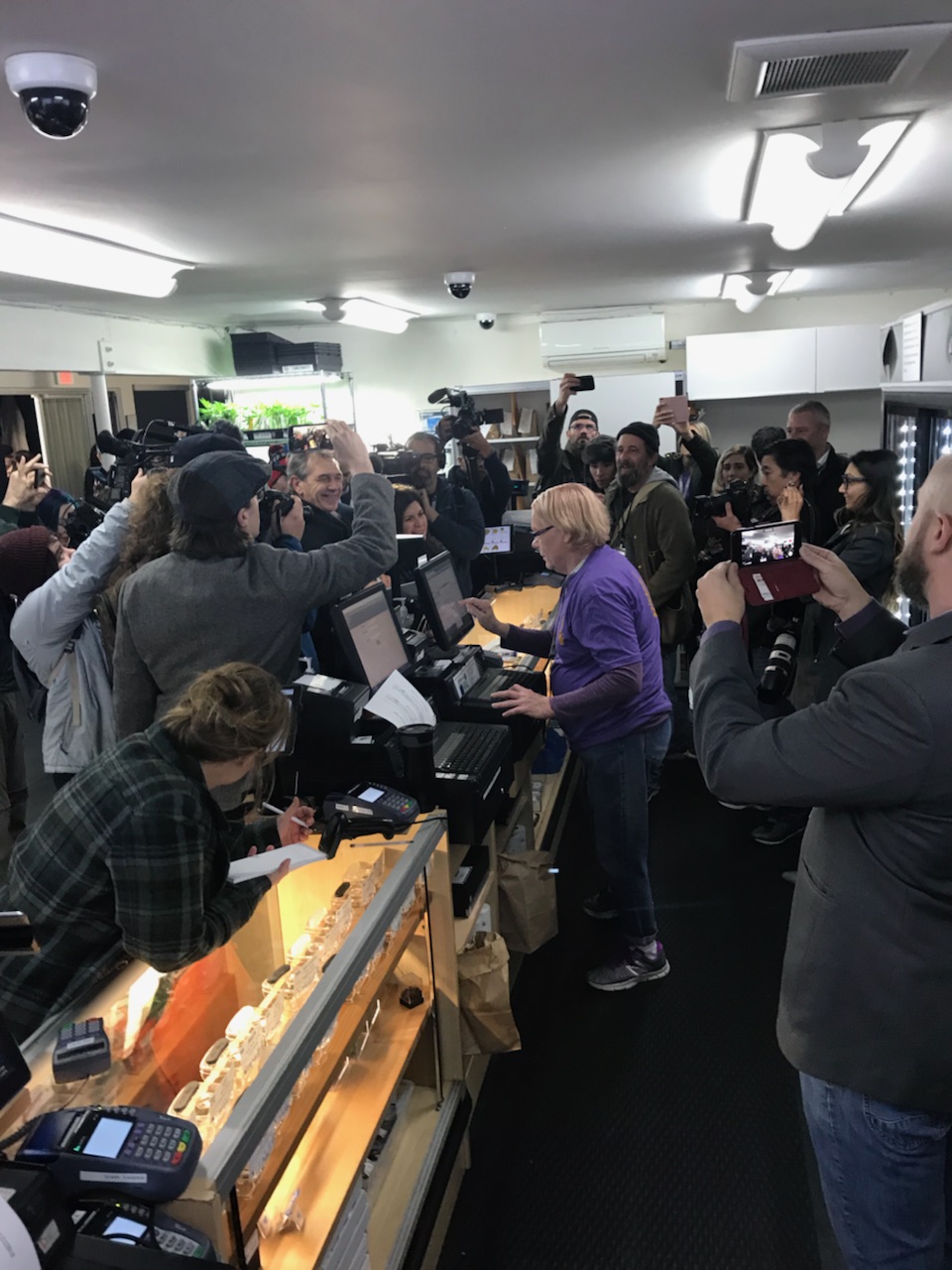
At the conclusion of the first week of adult-use cannabis sales in California, we spoke to Sabrina Fendrick, Director of Government Affairs of Berkeley Patients Group, to get a picture of their recent launch into the adult-use cannabis market. Berkeley Patients Group has been serving patients in the Greater East Bay Area of Northern California since 1999 and is a founding member of NCIA.
Sabrina, what was the process like for Berkeley Patients Group to apply for an adult-use cannabis license in California?
What we got was actually a temporary license, so the process for that is not as onerous or complicated as the annual process. We submitted our local authorization, site plan, and landlord approval. We did this three times, one for adult-use sales, one for medical sales, and one for distribution.
We had to work very closely with the city of Berkeley to make sure we had all of our ducks in a row, which was a little bit complicated because Berkeley had a ban on adult-use commercial cannabis activity. We engaged with the mayor and city council to get a “carve out” for us since we are a Berkeley institution as the nation’s oldest medical cannabis dispensary. We were intensely involved in conversations with regulators like the Berkeley Cannabis Inspector Mark Sproat throughout the whole process. We had it a little easy actually since we’ve been around for many years, as we were established in 1999.
When did you learn you had been awarded the license and how did your team react?
We learned on December 15th that we had received all of our licenses at about 4pm on a Friday, and the whole team was elated. There was perhaps even a little anxiety in wanting to make sure we had everything ready to roll out on January 1 to start offering cannabis to adults in California.
The first few days have been generally pretty smooth. There are a few questions surrounding process and operations to figure out as we go, but the whole roll out process has been smooth. Not a whole lot has changed except we’re getting longer lines, and we’re making sure that our systems are in place to be fully compliant with state law and all of the staff training required to go with that.
What is your reaction to the recent news of AG Jeff Sessions announcing on January 4th to rescind the Cole Memo?
We fully intend to keep serving the Berkeley community and the surrounding area as a state-licensed locally-operated compliant business. Further action on behalf of the Attorney General and the Department of Justice remains to be seen, but we do have support from local politicians and regulators.
We’re confident that public opinion and federal protections will continue to support the will of the voters and states’ rights. The DOJ should be using law enforcement resources to go after real criminals committing real crimes, and not enforcing an outdated, archaic policy that has almost no support from the general public.
As is traditional on the first day of adult-use sales, did Berkeley Patients Group make its first sale of cannabis to anyone noteworthy?
Yes, longtime California cannabis activists Mikki Norris and Chris Conrad were sold the first cannabis purchase in our dispensary. They were both spokespeople for Proposition 64 all the way back to Proposition 215, so it was an honor to make the first sale to people who were actively involved in reforming these laws in California.
2018 NATIONAL CANNABIS INDUSTRY FORECAST
Michelle Rutter, NCIA
by Michelle Rutter, NCIA Government Relations Manager
With the beginning of 2018, we start another election year. Multiple states in the midwest are running medical cannabis ballot initiatives, while Vermont is set to become the first state to legalize adult-use cannabis through the state legislature. In Washington, D.C., policy moves at a slower pace, but with Attorney General Jeff Sessions in office, it’s important to remain vigilant. Let’s take a look at what may happen in cannabis policy across the country:
MEDICAL CANNABIS POLICY
UTAH
The Utah Patients Coalition (UPC) is leading a 2018 ballot campaign to establish a medical cannabis program. The initiative seeks to protect terminally and seriously ill patients with specific debilitating medical conditions, including HIV/AIDS, PTSD, and chronic pain, among others. In addition, the initiative allows for caretakers to administer medical cannabis and would issue four types of licenses if passed: cultivation facilities, processing facilities, independent testing laboratories, and dispensaries.
The Chairman of the Senate Finance Committee, Orrin Hatch (R-UT) has introduced a medical cannabis research bill, and has even said on the Senate floor that medical cannabis can be an alternative to opioids. Passing the 2018 ballot initiative in his home state of Utah will be critical to furthering advocates’ work at the federal level.
A recent poll done by the Salt Lake Tribune found that 3 in 4 Utahns support legalizing medical cannabis. The campaign must collect 113,143 signatures from registered voters in order to qualify for the ballot. As of October 2017, the coalition had already garnered 20,000 signatures.
MISSOURI
A group called New Approach Missouri has formed and is in the process of collecting signatures for a proposed constitutional amendment to their state constitution that would legalize medical cannabis. The initiative would create a statewide system for production and sale of medical cannabis and provides for limited and regulated patient cultivation. Interestingly, the initiative levies a four percent retail tax, but all revenue in excess of the cost of regulating the medical cannabis program will go towards Missouri’s veterans.
New Approach Missouri must to collect 160,199 valid signatures from registered voters in order to be placed on the ballot. As of December 2017, the campaign had collected roughly 100,000 signatures. A poll done in 2015 showed that 85% of Missourians support implementing a medical cannabis program.
OKLAHOMA
Oklahomans for Health is the proponent of the upcoming state question SQ788, which would create a medical cannabis program. Obtaining a state-issued medical marijuana card would require a board-certified physician’s signature, though there are no specific qualifying conditions. The measure would enact a seven percent tax on marijuana sales, with revenue financing regulatory costs. Any surplus would be distributed: 75% to the General Fund to be used for education, and 25% to the Oklahoma State Department of Health to be used for drug and alcohol rehabilitation.
The initiative has already qualified, and will appear on the ballot in November 2018. Polling data is scarce, however, a 2013 poll showed that 71% of Oklahomans supported legalizing medical cannabis.
SOUTH DAKOTA
A group known as New Approach South Dakota is behind an effort to legalize medical cannabis in 2018. The group was also hoping to submit signatures to legalize adult-use cannabis, but was unsuccessful. The measure would set an excise tax on marijuana that would include a $50 per ounce tax on cannabis flower for buyers, and would have other taxes apply to buying immature plants and other parts of the cannabis plant.
In November 2017, New Approach South Dakota submitted roughly 15,000 signatures to qualify for the ballot- that’s just 1,000 more than required. The state hopes to review submitted ballot initiatives in the coming months.
ADULT-USE CANNABIS POLICY
MICHIGAN
The Coalition to Regulate Marijuana Like Alcohol has officially submitted ballot language to the State of Michigan that would legalize consumption and possession of marijuana for adults 21 and over in Michigan. The proposal enacts an excise tax on marijuana at the retail level in addition to the standard state sales tax and provides for state regulators to grant business licenses for cultivators, processors, testing facilities, secure transporters, retail stores and microbusinesses.
In November 2017, the Coalition to Regulate Marijuana Like Alcohol turned in more than 360,000 signatures to qualify for the ballot– that’s 100,000 signatures beyond the 252,000 required by the state. Polling done in early 2017 showed that 57% of Michiganders would support legalizing cannabis.
VERMONT
Vermont is poised to make history and become the first state to legalize adult-use cannabis through the state legislature in early 2018. In December 2017, Vermont House Speaker Mitzi Johnson (D) said, “It will be up for a vote in early January. I expect that it likely will pass in early January.”
The state came incredibly close to passing language that would have legalized adult-use cannabis back in 2017, however, the legislature was unable to make changes Governor Phil Scott (R) requested before the session ended. The Governor has since stated that he is “comfortable” with signing legalization legislation.
OHIO
The group that unsuccessfully ran a ballot initiative in 2015 to legalize cannabis in Ohio is making a comeback in 2018. In December 2017, a team announced that they will work to place a cannabis legalization measure on the ballot in 2018. Known as the Regulate Marijuana Like Alcohol Amendment, the measure would allow people over the age of 21 to purchase and use cannabis legally. The amendment would also create a taxed and regulated cultivation, processing, and sales system.
Valid signatures from 305,592 registered voters are required before July 4, 2018, in order to qualify the measure for the ballot.
NEW JERSEY
Unlike New Jersey’s Governor Chris Christie (R) , Governor-Elect Phil Murphy (D) is setting a positive tone on cannabis in the state. Murphy has advocated for legalization multiple times, and even made one of his campaign promises to legalize adult-use cannabis in his first 100 days in office.
Democrats in the state legislature have already introduced multiple bills to tax and regulate adult-use cannabis, predicted to be worth more than $1 billion in the state. The full legalization bill currently being considered is S3195, sponsored by state Senator Nicholas Scutari (D). Sen. Stephen Sweeney (D), the state senate’s president, has already promised to pass the bill within the first three months of Murphy’s administration.
Recent polling shows that over 60% of New Jersey residents support legalizing cannabis.
CANNABIS DECRIMINALIZATION
VIRGINIA
In November 2017, voters in Virginia elected Ralph Northam (D) as their next Governor. Northam made cannabis decriminalization a centerpiece of his gubernatorial campaign, and has even spoken about the hemp cultivation and the medical benefits of cannabis.
Virginia lawmakers considered but did not act on decriminalization legislation during the 2017 session. However, with the State Crime Commission conducting a study on the effects of decriminalization in the state at the request of the Republican Senate majority leader, advocates remain hopeful in 2018.
FEDERAL CANNABIS POLICY
While 2018 is shaping up to be a busy year for cannabis policy at the state level, things will likely move slowly in Washington, D.C. NCIA will be working to ensure language protecting medical cannabis patients (the Rohrabacher-Blumenauer amendment, formerly known as the Rohrabacher-Farr amendment) remains in federal law. NCIA will also be lobbying to expand that language to apply to adult use states (McClintock-Polis amendment) and to include a banking amendment that would allow cannabis businesses access to financial services (Heck amendment).
As leadership in both houses of Congress continue to negotiate the final version of the tax reform bill, there will be opportunities next year for Congress to make additions and changes on future individual tax legislation. NCIA will be looking at any possible avenues to have 280E legislation be included in future bills if the opportunity arises. Action on the cannabis banking bill is unlikely in 2018, however, NCIA will continue to advocate for a committee hearing, gather more cosponsors on HR 2215: The SAFE (Secure and Fair Enforcement) Banking Act, and work to identify a Republican lead sponsor for the bill in 2019.
NCIA will also be working to ensure that the Cole Memo remains in place. Attorney General Jeff Sessions has recently said that the Department of Justice will be reviewing current memos, and that “Guidance documents can be used to explain existing law… but they should not be used to change the law or to impose new standards to determine compliance with the law… This Department of Justice will not use guidance documents to circumvent the rule-making process, and we will proactively work to rescind existing guidance documents that go too far.” While Attorney General Sessions is very clearly personally opposed to cannabis, it’s important to note that personal feelings are not official Justice Department policy.
In addition, NCIA is working behind the scenes to educate the Trump Administration on cannabis policy, maintain the Cole Memo, protect cannabis patients and consumers, and make positive remarks regarding medical cannabis in 2018.
Your 2016 Cannabis Ballot Initiative Rundown
Michelle Rutter, NCIA
by Michelle Rutter, NCIA’s Government Relations Coordinator
In November, five states will vote on legalizing adult-use cannabis for individuals over 21 – Arizona, California, Maine, Massachusetts, and Nevada – while an additional four states will vote on medicinal cannabis reform – Arkansas, Florida, Montana, and North Dakota. All nine initiatives differ slightly from one another and each has its own unique language.
Below are NCIA’s quick summaries of each of the initiatives. Read up, then visit the campaign sites for more information and how you can help make 2016 another success in the fight to end marijuana prohibition.
ADULT-USE
ARIZONA
The Campaign to Regulate Marijuana Like Alcohol (Proposition 205) legalizes the possession and consumption of marijuana by persons who are over 21 and levies a 15% tax on the sale of cannabis, which would then be allocated to education and healthcare in the state. This would create an estimated $113 million in new tax revenue.
– Allows local governments to regulate and limit cannabis businesses
– If passed, Arizona’s cannabis market is projected to surpass $1 billion within three years
The Adult-Use of Marijuana Act (AUMA) (Proposition 64) legalizes the possession and consumption of marijuana by persons who are over 21 and enacts a 15% sales tax, as well as a cultivation tax of $9.25 per ounce of flowers and $2.75 per ounce for leaves.
– Estimated $1.4 billion in revenues within the first year of a fully operational market
– Written to prevent licenses for corporate or large-scale cannabis businesses for five years, which is in order to deter “unreasonable restraints on competition by creation or maintenance of unlawful monopoly power”
California has the largest state cannabis market (medical or adult-use) in the country, estimated at $2.7 billion in 2016.
The Campaign to Regulate Marijuana Like Alcohol (Question 1) legalizes the possession and consumption of marijuana by persons who are over 21 and enacts a 10% sales tax in addition to the state’s 5.5% sales tax. The first $30 million in tax revenue from cannabis sales would be used for school construction, with any additional revenue allocated to the General Fund.
– Medical cannabis will not be subjected to the 10% sales tax
– Caps the number of cannabis stores and cultivators until 2019 and 2022, respectively
The Campaign to Regulate Marijuana Like Alcohol (Question 4) legalizes the possession and consumption of marijuana by persons who are over 21 and creates a Cannabis Control Commission of three members appointed by the state Treasurer, which would generally administer the law governing cannabis use and distribution, promulgate regulations, and be responsible for the licensing of commercial cannabis establishments. It also creates a Cannabis Advisory Board of 15 members appointed by the Governor.
– Enacts an excise tax of 3.75%, in addition to the state sales tax
– A city or town could impose a separate tax of up to 2%
The Campaign to Regulate Marijuana Like Alcohol (Question 2) legalizes the possession and consumption of marijuana by persons who are over 21 and designates the Nevada Department of Taxation to issue licenses to cannabis retailers, suppliers, testing facilities, and distributors.
– Gives local governments control over cannabis business locations, and forbids businesses to operate near schools, childcare facilities, houses of worship, and certain community facilities.
– Enacts a 15% excise tax on wholesale sales of cannabis, in addition to the existing sales tax which would apply to the retail sale of cannabis
– Revenue generated from these taxes would be used to support K-12 education
There are two competing initiatives on the 2016 ballot: the Arkansas Medical Cannabis Act (AMCA) and Arkansas Medical Marijuana Amendment of 2016 (AMMA), known as Issue 7 and Issue 6, respectively. The main differences lie in patient card fee limits, the organizations that would implement the program, the distribution of sales tax revenue, and whether certain patients could cultivate their own medicine. As of October 2016, Issue 7, the Arkansas Medical Cannabis Act (AMCA) was struck from the ballot. The initiative will still appear on the ballot, but the results will not be counted.
Arkansas Medical Cannabis Act (AMCA):
– Sets a cap on the fees required to get dispensary and cultivation licenses and the fees required for patient cards
– Assigns the Arkansas Department of Health to set rules for patient cards, medical conditions that qualify a patient for medical marijuana use, and operating rules for dispensaries and cultivators
– Requires that all sales tax revenue goes back into the medical marijuana program
– Permits qualified cardholders to purchase medical cannabis from non-profit compassion centers
– Allows patients and their caregivers to cultivate up to 10 cannabis plants at home provided they take steps to ensure it is secure
Arkansas Medical Marijuana Amendment (AMMA):
– Sets a cap on the fee required to acquire a dispensary or cultivation license, but no limit on the cost for patient card fees;
– Assigns the Arkansas Department of Health to set rules for patient cards and medical conditions that qualify a patient for medical marijuana use, and the Arkansas Alcoholic Beverage Control to establish operating rules for dispensaries and cultivators;
– Divides sales tax revenue, assigning 10% to the medical marijuana program, 10% to the Skills Development Fund, 30% to the state’s General Fund, and 50% to the state’s Vocational and Technical Training Special Revenue Fund
The Florida Right to Medical Marijuana Initiative (Amendment 2) allows medical use of cannabis for individuals with debilitating medical conditions as determined by a licensed Florida physician and allows caregivers to assist patients’ use of medical cannabis.
– Mandates that the Department of Health shall register and regulate centers that produce and distribute cannabis for medical purposes shall issue identification cards to patients and caregivers.
– Constitutional amendments on the ballot in Florida must garner at least 60% in order to pass. This is why the medical cannabis amendment on the ballot in 2014 failed, despite receiving 58% of the vote.
Montana is voting to amend their dysfunctional medical cannabis program that has basically been regulated out of existence. The initiative amends the Montana Marijuana Act of 2011 and renames it the “Montana Medical Marijuana Act” (I-182).
– Allows providers to hire employees to cultivate, dispense, and transport medical cannabis, and repeals the limit of three patients for each licensed provider.
– Repeals the requirement that physicians who provide certifications for 25 or more patients annually be referred to the Board of Medical Examiners.
– Removes the authority of law enforcement to conduct unannounced inspections of medical marijuana facilities and requires annual inspections by the State
The North Dakota Medical Marijuana Initiative will be Initiated Statutory Measure 5 on the ballot and is also known as the North Dakota Compassionate Care Act, which creates a state-regulated medical marijuana program for patients with specified debilitating conditions and written certifications from their doctors. Registered patients could obtain medical cannabis from a licensed non-profit compassion center, and if the patient lives 40+ miles away, they are permitted to cultivate a limited amount of cannabis for their medical use.
This year it’s more important than ever to make sure you’re registered to vote and get to the ballot box on November 8th. If you live in one of the nine states with a ballot initiative, cast your vote for ending prohibition or allowing patients access to medicine. Otherwise, don’t forget to cast your ballot for candidates at the local, state, and federal level who support cannabis reform to ensure that 2017 is the industry’s biggest year yet!


 Chris Rosmarin manages the commercial audit practice in Grand Rapids and also leads the Firm’s cannabis practice. He provides audit and other assurance services, due diligence services and accounting advisory services to various companies both large and small.
 Dr. Monaco is the Director of Laboratory Operations for
 Aaron Rosenbluth is


 MEDICAL
Follow NCIA
Newsletter
Facebook
Twitter
LinkedIn
Instagram
News & Resource Topics
–
This Just In
Beyond Rescheduling: Inside NCIA’s 14th Annual National Cannabis Industry Lobby Days
DOJ Reschedules Medical Cannabis to Schedule III & Announces June 2026 Hearing on Broader Rescheduling