A (Mostly) Non-COVID-19 Legislative Update

by Michelle Rutter Friberg, NCIA’s Deputy Director of Government Relations
I don’t know about you, but it seems no matter where I look, everything is about COVID-19. And with good reason — many of us are still working from home, helping their families with distance learning, and overall dealing with the effects of the virus. That being said, this week I wanted to take a look at two pieces of cannabis legislation — non-COVID related — and update you on where things stand, since we’re already nearly halfway through 2020!
The SAFE Banking Act
Last September, the SAFE Banking Act became the first piece of cannabis reform legislation to ever pass out of the United States House of Representatives by an astounding bipartisan vote of 321-103. The first iteration of the bill, named the Marijuana Businesses Access to Banking Act, was introduced to the 113th Congress back in 2013 and has made a long journey to get to this point in the legislative process.
Now that the SAFE Banking Act has passed the House, its journey has continued in the more conservative, Republican-controlled Senate. However, just before Christmas, Senate Banking Committee Chairman Mike Crapo (R-ID) issued a press release detailing his opposition to cannabis policy reform — including the SAFE Banking Act as it’s currently written. In the release, Chairman Crapo said,
“I remain firmly opposed to efforts to legalize marijuana on the federal level, and I am opposed to legalization in the State of Idaho. I also do not support the SAFE Banking Act that passed in the House of Representatives. Significant concerns remain that the SAFE Banking Act does not address the high-level potency of marijuana, marketing tactics to children, lack of research on marijuana’s effects, and the need to prevent bad actors and cartels from using the banks to disguise ill-gotten cash to launder money into the financial system.”
Even now with COVID-19, NCIA is virtually lobbying for the SAFE Banking Act, or some of its provisions, to be included in the next coronavirus relief package. Before COVID-19, the all-cash situation cannabis businesses face created an unnecessary public safety risk and undue safety burden on state and local tax and licensing authorities who must receive and process large cash payments. Now, as recent reports show that viruses can live on cash for up to 17 days, the public safety concerns of this cash-only system compound. The lack of access to financial institutions places industry workers, government employees, and the public-at-large at risk as banknotes circulate from consumers and patients to businesses to government.
NCIA is continually working with Sen. Crapo, congressional and committee staff, coalition partners, and the bill’s cosponsors to ensure that all parties have the materials and information that they need in order to solve this pressing public safety– and now, public health– issue and pass the SAFE Banking Act into law!
The MORE Act
In November, by a vote of 24-10, the House Judiciary Committee approved the Marijuana Opportunity Reinvestment and Expungement (MORE) Act of 2019, or H.R. 3884. This bill was introduced by House Judiciary Committee Chairman Jerrold Nadler (D-NY) and currently has 73 cosponsors. This was the first time that a congressional committee held a vote on – let alone approved – a comprehensive bill that would make cannabis legal. Perhaps even more significantly, this bill recognizes and works to address the disproportionate impact prohibition has had on marginalized communities and people of color while helping to increase access and opportunity in the legal cannabis industry.
The bill still has a long way to go, though. While the House Judiciary Committee has passed the legislation, there are still six more congressional committees with jurisdiction over the bill, including the Energy and Commerce, Agriculture, Education and Labor, Ways and Means, Natural Resources, and Oversight and Reform committees. In January, the House Small Business Committee waived its jurisdiction over the MORE Act.
While the MORE Act does not contain an explicit regulatory structure for cannabis after it is descheduled, Chairman Nadler said in a press conference the day before the markup vote that it was possible amendments could be added to the bill as it moves through the House.
All that being said, it’s unclear what Congress’ schedule will look like for the rest of the year. The Senate returned to Washington yesterday, however, the House remains out of session as concerns about legislating in the age of COVID-19 remain. On top of that, 2020 is an election year, which complicates matters (and scheduling) even more. Regardless, I hope you can rest assured knowing that NCIA’s government relations team is working around the clock to advocate for the cannabis industry — whether that be banking reform, ending cannabis criminalization, or allowing for SBA relief. From D.C. to wherever you are, stay healthy!
COVID-19 Cannabis Coalition In Action: Securing Financial Relief

By Michelle Rutter Friberg, NCIA’s Deputy Director of Government Relations
In the age of COVID19, advocacy, activism, and lobbying have had to adapt and mobilize quickly, as have all professions during this difficult time. Last week, NCIA along with a group of coalition members teamed up to write and send nearly 100 letters to governors, state treasurers, and cannabis industry regulators letters asking them to help secure financial relief that cannabis businesses are being denied by the federal government amid the coronavirus outbreak.
Our coalition sent two letters: the first was delivered to state treasurers and governors and asked that they speak to their congressional delegations about including a provision in the next COVID-19 legislative relief package that would make state-legal cannabis businesses eligible for Small Business Administration (SBA) assistance. As state officials, they know that these businesses are a legitimate part of the local economy and community, creating good-paying jobs and providing what have widely been deemed essential services to citizens.
The letter also asked that these officials consider creating a state-based lending or loan guarantee program for cannabis businesses; specifically, the creation of a program to fill the gap created by cannabis business ineligibility for the SBA’s Paycheck Protection Program and Economic Injury Disaster Loans. Those programs provide short-term liquidity to businesses and workers to assist with operating expenses, healthcare costs, paid sick leave, other benefits required under federal relief packages, and to help out with ensuring business continuity in the event of an economic disaster. That letter was signed by NCIA, Cannabis Trade Federation, Global Alliance for Cannabis Commerce, Marijuana Policy Project, Minority Cannabis Business Association, and National Cannabis Roundtable.
The second letter was sent to state regulators of medical cannabis programs in eleven different states. Our coalition asked that these states:
- Deem medical cannabis businesses essential
- Allow home delivery with online and phone ordering
- Allow curbside pickup from existing dispensaries, with online ordering
- Allow doctors to issue recommendations and renewals via telemedicine
- Temporarily eliminate or reduce caregiver application fees
- Honor medical cannabis documentation within 90 days of expiration
- Temporarily amend existing regulations to ensure adequate staffing
NCIA was proud to work with the same coalition aforementioned, as well as Americans for Safe Access and NORML to send those letters.
It appears that our efforts are not going unnoticed, either– we have received word from at least one state treasurer’s office that they will draft and send a letter on the subject to their congressional delegation. Other states are attempting to set up Small Business COVID-19 Relief funds. The Massachusetts Cannabis Control Commission also voted unanimously last week to send a letter to the state’s congressional delegation asking them to include the cannabis industry in future federal coronavirus aid packages. Massachusetts is notably the only state with a legal adult-use market — which reached $420 million in sales last year — to disallow those dispensaries from operating during this time. A number of dispensaries have since sued Gov. Charlie Baker (R-MA) to reopen the adult-use market.
In Colorado, Governor Jared Polis (D) wrote a letter to Congressman Jared Crow (D-CO), who sits on the House Small Business Committee. He urged the Congressman to do everything in his power to help this industry, writing, “In an ideal world, Congress would include a provision in an upcoming bill guaranteeing that all state-legal cannabis businesses, direct and indirect, will be eligible for these loans. In the alternative, I hope that you can at least work with your colleagues to ensure that Indirect Marijuana Businesses will be eligible for the loans.” Governor Polis also noted that this ineligibility “could have a devastating effect on our business community and tens of thousands of employees.” If you are a Colorado resident, we encourage you to reach out to the Governor’s office and thank them for their support.
That’s not all NCIA is working on, though — we are virtually lobbying congressional offices day and night to ensure that the next COVID-19 package includes relief for businesses involved in the cannabis industry. We are receiving positive feedback and will continue to explore any and every avenue to help our member businesses during this time. Wherever you are reading this from, I hope you, your family, and your business associates are all safe and healthy. We are still fighting for you in Washington, D.C.!
2019 By The Numbers (So Far!)
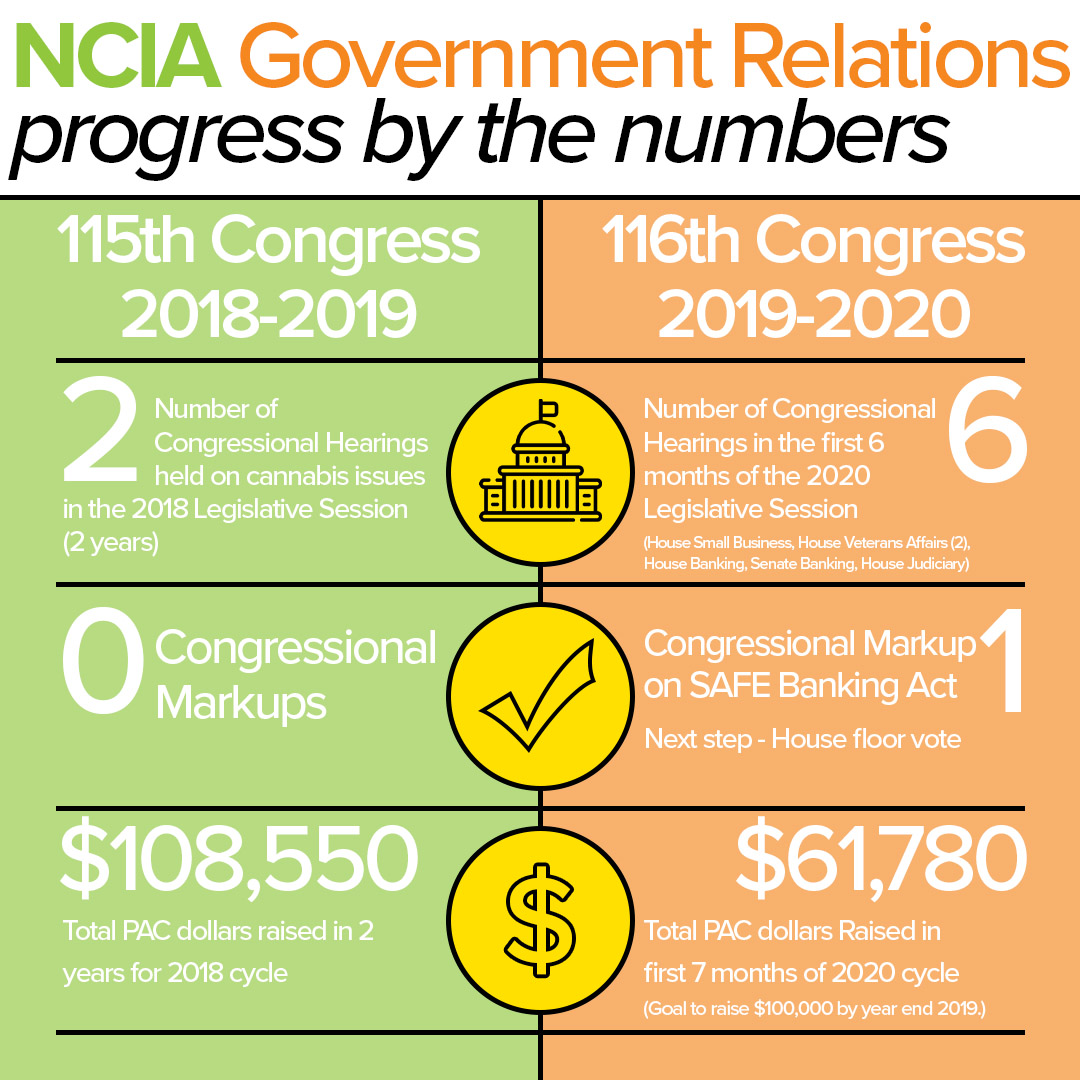
August recess is winding down, and soon, Members of Congress will return to D.C. for the remainder of the year. This year, however, was a benchmark year for cannabis policy, and we still have four months left to go! Let’s take a look back on how 2018 compared to 2019 (so far!).
2:
Number of Congressional hearings held on cannabis issues in the 115th Congress (2017-2018)
6:
The number of Congressional hearings as of August 2019 in the following committees:
House Small Business Committee
House Veterans Affairs Committee (2)
House Financial Services Committee
Senate Banking Committee
House Judiciary Committee
95:
The number of cosponsors the House version of the SAFE Banking Act garnered during the entire 115th Congress.
206:
The number of cosponsors on H.R. 1595, the SAFE Banking Act, just in the first seven months of 2019.
0:
The number of Congressional markups held on a cannabis bill in the 115th Congress.
1:
The number of Congressional markups held on a cannabis bill in the 116th Congress. In March 2018, the House Financial Services Committee marked up H.R. 1595: the SAFE Banking Act. It passed out of Committee by a vote of 45-15.
$108,550:
Total NCIA-PAC dollars raised for the 115th Congress (2017-2018)
$61,780:
Total NCIA-PAC dollars raised in the first 7 months of 2019. Our goal to raise $100,000 by the end of the year, so make sure you learn more about the NCIA-PAC here!
We have been busy this year advocating for pro-cannabis policy reform and will continue pounding the pavement on Capitol Hill. We look forward to all of the successes yet to come in 2019 and beyond!
Follow NCIA
Newsletter
Facebook
Twitter
LinkedIn
Instagram
News & Resource Topics
–
This Just In
Member Blog: Guaranteeing the First Loan
NCIA Applauds Reintroduction of SAFE Banking Following Lobby Days