Member Blog: The Hidden Gem of Licensing and Endorsement Deals in Cannabis
By Dan Shapiro, Greenlane Holdings
Sitting here on July 14, 2021, the Senate Majority Leader of the United States Chuck Schumer just introduced legislation to (among other things) federally legalize cannabis. Yet, despite the Senate’s official entrance into the path to legalization, many states, businesses, and importantly here, athletes and celebrities, or “talent,” continue to behave as if legalization has already occurred. Side note – it has in many states!
Talent throughout the country have engaged in a variety of licensing and endorsement deals within the cannabis industry, ranging from Martha Stewart, Keith Haring, Bob Marley, Seth Rogan, Berner, Travis Scott, Rick Ross, “Sugar” Sean O’Malley, Jonathan Adler, to Gary Payton. A common theme among talent newly entering the space seems to be a default to the plant itself, i.e., partnering with cannabis producers to either endorse or license intellectual property (“IP”) to create cannabis strains and products. Here, I would like to first describe what licensing and endorsement deals are and then discuss a hidden gem of the cannabis licensing and endorsement space. That is, talent partnering with cannabis ancillary businesses, meaning, businesses that sell cannabis accessories and products but do NOT ‘touch the plant.’
Before I dive into a discussion of cannabis accessories, it is important to quickly outline “licensing and endorsement deals.” At a high level, a licensing deal is the process of an individual granting another party the right to use his or her name, image, and likeness, for a particular purpose, in exchange for certain consideration (payment). For example, publicly-traded cannabis accessory distributor Greenlane (NASDAQ: GNLN), where I serve as the Associate General Counsel, has remitted consideration to the owner of the artist Keith Haring’s IP, to use images of his artwork on a line of smoking accessories. A licensing deal allows an owner of IP to capitalize on its value by finding the right partner who can harness the IP in a way to create a profitable outcome. It allows an IP owner to find a partner with the production and distribution capacity and operational know-how that an IP owner likely does not possess. In a licensing deal, the end consumer is often under the impression that the end product is coming directly from the IP owner, which can add huge value to the talent’s brand; whether the talent is alive or deceased. This perception for the end consumer can be different with endorsement deals where there is usually a clear delineation between the talent and brand.
An endorsement deal is where talent is used to create awareness for a particular product or service; this can be seen in commercials, Instagram or Twitter posts, and public appearances. Unlike a pure licensing deal, an endorsement deal will commonly make it clear that the product being endorsed is not coming from the talent directly, but that he or she is merely promoting the underlying product in exchange for consideration. Nevertheless, despite the distinction, licensing deals and endorsement deals often merge into one and the same. For instance, Greenlane’s cannabis accessory house brand and retail arm Higher Standards did a licensing and endorsement deal with UFC MMA fighter “Sugar” Sean O’Malley. In this deal, Higher Standards secured a license to use Sugar Sean’s IP to create a limited-edition water pipe and promote this water pipe using his IP on all of its promotional mediums. As part of the deal, Greenlane also caused Sugar Sean to promote the Higher Standards brand on his social media platforms through a select number of posts and mentions. This is a prime example where talent and brands will often dip their toes into a deal that incorporates both a licensing and endorsement component.
So, now that I have established what a licensing and endorsement deal looks like, I want to shift to a discussion of the benefits of working with cannabis accessories. For clarity, cannabis accessories can include rolling trays, roach clips, rolling papers, vaporizers, water pipes, jars, grinders, lighters, packaging, and in certain cases, clothing. So, why should talent focus on licensing and endorsement deals with cannabis accessories?
Cannabis accessories can allow for a unique form of creative control for talent. Talent can create a product from scratch, like an ashtray, jar, or water pipe, and have a direct impact on the structural design. Additionally, accessories can be sold in a plethora of different locations. Unlike cannabis products, accessories can be found in department stores, headshops, smoke shops, convenience stores, clothing stores, and upscale interior design boutiques. In addition to the broad array of available doors, accessories can also allow certain talent to enter the cannabis space in a way that more closely aligns with their primary non-cannabis-focused brand. A great example of this is Greenlane’s licensing deal with iconic designer Jonathan Adler. It would be impossible for Jonathan Adler to partner with a plant-touching product and still be able to sell those products in his stores throughout the world. By partnering with Greenlane, Jonathan Adler is able to enter the cannabis space while maintaining his traditional brand and his ability to sell these products in his interior design boutiques.
An additional appeal of the cannabis accessory space is timing, flexibility, and speed. While talent could quickly endorse an already developed and cultivated cannabis strain or other plant-touching product, the process could be timely. In contrast, to go back to the Sugar Sean example, Greenlane and Sugar Sean were able to move swiftly and nimbly to promote a line of water pipes for a launch in direct correlation to an upcoming fight. The deal moved quickly and highlighted the maneuverability and flexibility of working with accessories. Often, a template or mold for a product is already developed, with the talent’s unique branding and direction the last piece of the puzzle. For plant-touching products, talent may want to be a part of the cultivation process; focused on taste and effect on consumers. This process will usually take a bit more time and can present far more variables and regulatory concerns and limitations.
Ultimately, there are fascinating and innovative deals to be made for both plant-touching and non-plant-touching products, but moving forward, I believe the hidden gem of cannabis endorsement and licensing deals is with the non-plant-touching cannabis accessories.
 Dan Shapiro is the Associate General Counsel at Greenlane Holdings, Inc. (NASDAQ: GNLN), one of the largest global sellers of premium cannabis accessories and CBD products. Prior to joining Greenlane, Dan worked at CAA in the Sports Business & Legal Affairs division. Dan is the Founder and Inaugural Chair of the Cannabis Division of the American Bar Association Forum on Entertainment and Sports Industries and a member of the National Cannabis Industry Association’s States Regulations Committee. Dan is a member of the New York Bar and Authorized House Counsel in Florida, and holds a JD from Cardozo Law School where he served as the President of the Cardozo Sports Law Society, and a BA from The George Washington University.
Member Blog: Four States Legalized Cannabis in November – Here’s What That Means for the Industry

By Aaron Rosenbluth, Director of Content at Hybrid Marketing Co.
Voters in New Jersey, Arizona, South Dakota, and Montana legalized adult-use cannabis sales during November’s election. So, what comes next?
Last month, Americans in four states voted to legalize adult-use cannabis.
If you’re an adult over 21 in Arizona, New Jersey, South Dakota, or Montana, theoretically, you’ll be able to consume and purchase cannabis legally in 2021.
To many Americans, the end of cannabis prohibition in these states looks like a sudden act of voter mobilization. But industry insiders know it took years of work by activists, business people, and lawmakers to make legalization possible.
Before adults can legally purchase and consume cannabis, lawmakers in each state must outline rules and regulations, and dispensaries must go through intense licensing processes before opening their doors to the public.
The process won’t happen overnight.
In some newly legal states, it could take close to a year to iron out the details. And in the past, it’s taken even longer.
Take Massachusetts, for example. Voters cast their ballots in favor of legalization in 2016, but the first dispensary didn’t open until 2018.
Maine’s citizens also voted in support of legal weed in 2016, but it took four years for the first dispensary to open. The first two retailers – SeaWeed and Theory Wellness – opened on October 8 of this year.
“It has taken four years to move from referendum to retail sales since Mainers narrowly approved the legalization of recreational cannabis at the ballot box in 2016. Legislative rewrites, gubernatorial vetoes, a change in state administration, and then the impact of COVID-19 pandemic have combined to make Maine’s rollout the slowest in U.S. history.” – Portland Press Herald
Lawmakers in New Jersey are trying to speed things up. Democratic Senator Nick Scutari wants to move quickly to pass legislation modeled off a 2019 legal cannabis bill he sponsored. Still, legislators are fighting over the details. New Jersey’s Medical Marijuana licensing policies force applicants to pay large sums to compete for a limited number of licenses, allowing big businesses with deep pockets and holdings in other legal states to make millions.
Some New Jersey lawmakers are trying to keep the same from happening when adult-use dispensaries open their doors by prioritizing local businesses.
Arizona lawmakers anticipate legal cannabis sales to begin as early as March. The state plans to prioritize licenses for owners “from communities disproportionately impacted by the enforcement of previous marijuana laws.” Arizona’s 123 medical marijuana dispensaries will have the first opportunities to apply for adult-use licenses in January after the Arizona Department of Health Services writes the rules.
Entrepreneurs in South Dakota and Montana are ready to apply for dispensary licenses, but they, too, will have to wait.
In South Dakota, lawmakers say dispensaries will be open and selling legal adult-use cannabis by July 1. In Montana, people should be able to legally purchase cannabis on October 1, barring any bumps in the road.
Have we reached a tipping point?
The public’s view of cannabis is changing. One in three Americans now live in a state with legal weed, and, according to a recent Gallup poll, 68% of Americans support federal cannabis legalization. So, have we reached a tipping point?
That’s hard to say.
Thirty-six states now have a legal medical cannabis system. When sales begin in Arizona, New Jersey, South Dakota, and Montana, more than twenty states will have fully legalized cannabis. And while federal cannabis reform might be a defining aspect of the incoming administration’s legacy, legalization is mostly dependent on congress, and it’s still unclear which party will control the Senate next year.
Democratic leaders have pledged to end federal cannabis prohibition. If the Democratic party wins Senate control, full legalization is almost a certainty. But if Republicans maintain their Senate majority, the Republican party’s past approach to cannabis doesn’t indicate their leaders are ready to support far-reaching reform. Still, federal cannabis legalization isn’t outside the realm of possibility, even with a Republican-controlled Senate.
Only time will tell.
And again, regardless of what happens politically, it’s obvious America’s opinion of cannabis isn’t what it once was.
Oprah asked former President Obama if he and Michelle indulged in “pizza, pot, or alcohol” on election night in a recent televised interview. When a television icon casually asks a former President if he smoked weed with the former first lady, you know attitudes are changing.
Could federal cannabis legalization be the key to healing our COVID-ravaged economy?
This year, COVID-19 slowed the progress of cannabis legalization for individual states, but the pandemic could help push federal legalization forward next year. Here’s why.
A federally legal cannabis industry would accelerate America’s economic recovery.
The pandemic has had a catastrophic impact on many industries, and while a lot of employees will return to work, many jobs will be forever lost. The longer it takes for people to find employment, the longer it will take for the economy to recover.
The end of federal cannabis prohibition would create thousands of new jobs and reverse the pandemic’s adverse economic impact.
Here’s a point to consider: according to estimates from New Frontier Data, America’s legal cannabis market could be worth nearly $30 billion by 2025 – and that’s without federal legalization. If government officials choose to end federal prohibition next year, the estimates will increase dramatically.
For cannabis dispensaries, cultivators, cannabis-adjacent businesses (like cannabis marketing agencies), and American citizens, a nationwide end to prohibition would be life-changing.
But again, what the immediate future holds is anyone’s guess.
 Aaron Rosenbluth is Hybrid Marketing Co‘s Content Director, and he loves to write blogs. He’s written so many blogs that he’s lost count. And beyond his skills as a copywriter and storyteller, he’s an obsessive reader and researcher. Aaron writes on subjects ranging from cannabis to collaboration, social equity to HR software, interior design to cybersecurity. His words attract, engage, educate, and convert. Btw, Aaron hates the phrase “content is king” (even though content is king – and queen).
Hybrid Marketing Co is a Denver-based branding and marketing agency that specializes in building custom strategies that supercharge growth and drive revenue. Working with brands and businesses across the U.S. and Canada, Hybrid’s partners run the full-spectrum of the cannabis world including dispensaries, manufacturers, cultivators, and ancillary businesses. Visit hybridmarketingco.com to learn more about the Hybrid approach.
Member Blog: 7 Steps To Opening A Cannabis Dispensary

by Gary Cohen, Cova Software
As cannabis reform barrels ahead like a freight train, entrepreneurs everywhere are eyeing ways to get in on the green rush. And for those without the background or interest in cultivation or manufacturing, cannabis retail can be a very alluring — and lucrative — prospect.
Of course, that’s not to say there won’t be work involved. Just like any other business, opening a cannabis dispensary requires a lot of planning, paperwork, and, of course, capital. It also requires a lot of additional compliance hurdles not often encountered in other industries.
Today, we’re looking at the seven essential steps you’ll need to address as you seek to launch your own cannabis retail venture.
Seven Essential Steps to Opening a Cannabis Dispensary
Find a suitable location.
While it might seem counterintuitive to talk about location before licensing, the fact is that in most jurisdictions, you’ll be required to have a prospective retail location identified before you can even begin filling out the licensing paperwork.
Naturally, your dispensary location will have to align with all applicable regulations, including local zoning ordinances and state-level mandates. Researching your state’s guidelines shouldn’t be too difficult, as most maintain a checklist on their official government websites.
Obtain a cannabis retail license.
This step is easier said than done — but in the end, no license means no dispensary. Each state has their own cannabis retail licensing and application structure, so once you’ve locked down a potential location, you’ll want to begin researching the requirements and getting all the paperwork in order.
Obtaining a license may take up to a few months, so you’ll be able to work on the other components of your dispensary as you work through the licensing process. But you definitely want to know exactly what you’re up against as early as possible.
Estimate your costs.
The total cost of opening a cannabis dispensary varies greatly by state and local jurisdiction. Application and licensing fees alone can range between a couple thousand dollars up to $20k. Again, you’ll need to research your state and local permitting guides to find out exactly what you’re looking at in terms of licensing fees.
Other major cost considerations will include:
- Physical location (real estate rental/purchase as well as renovation, furnishing, and finishing costs)
- Professional fees (insurance, legal, financial, etc.)
- Payroll
- Capital investments (security/surveillance system, dispensary technology, etc.)
Write your business plan.
No serious investor is going to consider bankrolling your operation without seeing a solid cannabis retail business plan. Financiers want to know that you’ve covered all your bases, and your plan should address the following key areas:
- Finances
- Compliance
- Dispensary staff
- Sales and marketing
- Logistics/operations
- Security
Of course, detailed information about your planned location will need to be addressed as well.
Secure your capital.
As quickly as the industry is progressing, federal cannabis banking reform could be here sooner than later. But until then, cannabis-friendly financial services are still very hard to come by. That means your primary source of funding will likely be private investors, friends, family, or yourself. There are also some well-established cannabis-specific investment groups out there that are worth looking into.
Consider your dispensary technology needs.
As a cannabis dispensary owner, you’re going to need a technology solution that not only keeps up with the typical retail performance burdens but also satisfies your state’s compliance requirements — in other words, seed-to-sale reporting.
When it comes to a cannabis retail point-of-sale system, you’ll want to consider the following:
- Compliance reporting (a platform that can tie in directly to the state’s system and automatically report all necessary data can save you untold time and labor costs)
- Reliability
- Ease of use
Determine your product sourcing procedures.
Finally, you’ll need to determine how you’ll source your products. This is another area that you’ll need to reference your particular state’s rules and regulations on; some states prohibit dispensaries from being involved in cultivation, and others highly encourage it. Either way, you’ll likely have to obtain a separate license if you want to get into cultivation.
Start by identifying and interviewing local cannabis producers. This is also a good opportunity to determine the types of products you’ll want to offer and ways you can incorporate them into your marketing.
Want to Learn More about Opening Your Dispensary?
Get a more in-depth look at everything involved with launching your own cannabis dispensary by downloading our How To Open A Cannabis Dispensary e-book — it’s absolutely free.
Grab your copy today!
 Gary leads Cova’s charge into the legal cannabis space by guiding the vision, strategic development, ‘go to market’ plans and culture.
Before joining Cova, Gary was a principal in over a dozen tech start-ups in the mobile communications industry ranging from small VC funded companies to Fortune 100 firms, including Onavo, which was later acquired by Facebook. In those companies he led sales, marketing, business analytics and market expansions. He has also held a multitude of leadership roles with Verizon and AT&T.
Gary holds a degree in finance with a master’s in marketing from the University of Colorado.
Member Blog: The Explosive Growth of California Cannabis Licenses and What Comes Next
by Ed Keating, Co-founder of Cannabiz Media
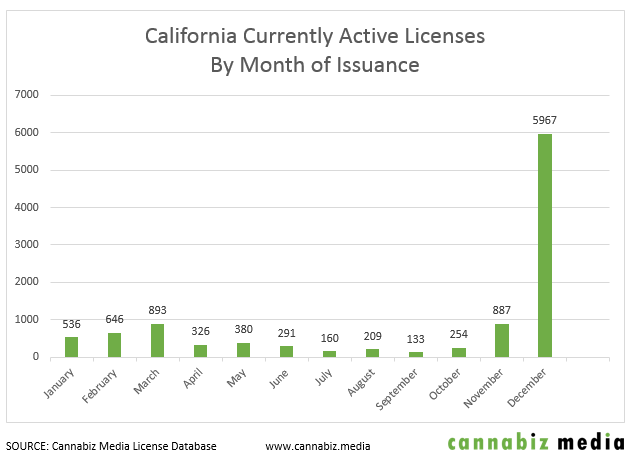
We’re more than one year into California’s legal cannabis industry and license growth continued on a fast-rising upward trajectory through the end of 2018. In fact, between November 1, 2018 and December 31, 2018, California issued a total of 6,855 new cannabis licenses according to the Cannabiz Media License Database as people worked extended hours to process the remaining temporary license applications.
To put that number into perspective, California had 4,085 active licenses as of October 31, 2018. During the next 61 days, the state more than doubled that number to 10,940 active licenses on December 31st. You can see the data visually in the chart below.
Majority of Licenses Granted Went to Cultivators
Of the 6,855 licenses granted in California during November and December 2018, 65% were issued to cultivators by the California Department of Agriculture.
Distributor licenses accounted for 14% of the licenses granted during that two month period, followed by manufacturer licenses at 12%, retailers/dispensaries at 3%, microbusinesses at 3%, delivery businesses at 3%, and testing labs at less than 1%.
Cultivators Continue Stacking Licenses
During the final two months of 2018, 45 license holders gained double digit licenses, which accounted for 24% (1,665) of the 6,855 new licenses issued. One reason for this is because cultivator licenses are skyrocketing as more growers secure multiple small licenses to create large cultivation facilities.
Between November and December 2018, five companies received 729 cultivator licenses, which equates to more than 16% of cultivator licenses granted during that time and nearly 11% of all licenses awarded during that time.
Those five companies are Coyote Hills Agricultural Enterprises (210 new licenses), White Light Farms (173 new licenses), BDZ, Inc. (134 new licenses), Iron Angel II, LLC (133 new licenses), and Busy Bee’s Organics (79 new licenses).
Distributor Licenses Saw the Most Growth in Late 2018
While new cultivator licenses grew by the largest quantity during November and December 2018, new distributor licenses saw the largest growth jump over the previous 10 months of the year.
The number of new distributor licenses issued in December and November 2018 was nearly double the amount granted in the previous 10 months. Manufacturer licenses issued increased by 188%, cultivator licenses by 178%, testing licenses by 68%, and retailer/dispensary licenses by 58%.
What’s Next for California’s Cannabis License Holders?
California has stopped issuing temporary cannabis licenses, and throughout 2019, many of the temporary licenses awarded during 2018 will expire. Each of these temporary licenses will need to become provisional and/or annual licenses in order for the license holders to stay active in California’s cannabis industry.
A few months in 2019 stand out as ones to watch because a large number of temporary licenses will expire. In March, 1,559 licenses will expire. In April, the number of expiring licenses jumps to 4,731, and in July, another 2,453 temporary licenses will expire. During other nine months of 2019, the number of licenses that will expire ranges from three licenses in October to 682 licenses in May.
Clearly, the story of cannabis licensing in California is far from over, and the Cannabiz Media team will be watching closely and tracking all of it in the Cannabiz Media License Database. Follow the link to see more data and insights related to license growth in California during the last two months of 2018.
 Ed Keating is a co-founder of Cannabiz Media and oversees our data research and government relations efforts. He has spent his whole career working with and advising information companies in the compliance space. Ed has overseen complex multijurisdictional product lines in the securities, corporate, UCC, safety, environmental and human resource markets and focuses on workflow products. Ed has spent the last twenty five years in the information industry. During that time he has worked for both startup and established information companies where he has led marketing, product management and sales organizations. These companies include Wolters Kluwer/Commerce Clearing House, CT Corporation, EDGAR Online and Business & Legal Reports. At Cannabiz Media Ed enjoys the challenge of working with regulators across the country as he and his team gather corporate, financial, and license information to track the people, products and businesses in the cannabis economy. Ed graduated from Hamilton College and received his MBA from the Kellogg School at Northwestern University. He has been active with the Software & Information Industry Association for his whole career and managed the Content Division for six years. He’s was recently a Trustee at the Country School in Madison CT and a Little League Coach for seven years.
Member Blog: How Much Does it Actually Cost to Open a Dispensary?

by Gary Cohen, Cova Software
Reading headlines about the cannabis industry, one might get the impression that cannabis business owners are all cashing out big. And while there are many success stories, high startup costs, ranging between $250,000 to $750,000, make the financial reality of opening a dispensary difficult for a lot of budding entrepreneurs.
But the growing demand for cannabis allows for great opportunity, even in the most saturated markets. Retailers who want to compete with big-box stores should work smart, focus on creating a great store experience, and invest in cannabis tech that streamlines operations to reduce cost.
Step 1: Licensing
The first step in opening a dispensary is getting a license. The licensing process, which varies based on location, is extensive and expensive. Expect to undergo thorough background checks and spend at least $5,000 on licensing fees.
In places like Washington, the number of licenses granted by the state are capped and only available by purchasing one off of a current licensee. This can run upwards of $25,000 plus legal fees.
Capital Requirements Preclude Many
Besides the licensing and possible legal fees, there’s another thing that precludes many from the industry: capital requirements. Before licensing, some states require proof that you can financially weather the true cost of operating a cannabis business. Depending on where you apply for a license, a local government may require proof that you have enough liquid assets to keep your business afloat in rough times.
Location, Location, Location
Finding a location for a cannabis dispensary isn’t impossible, but can be expensive. City and state regulations define the legal proximity dispensaries can be to a school, church, park, arcade, and/or anywhere else children might be likely to gather.
Finding a permissible location with foot traffic and parking might cost up to $100,000 per year. To keep customers coming back, it’s important to invest additional money to make the store friendly, welcoming, and modern.
The Cost of Cannabis-Friendly Banking
The legal ambiguity of cannabis creates a tenuous relationship with state-legal businesses. When banks work with U.S. cannabis businesses, they take on the risk, however unlikely, that federal enforcement priorities could change and cannabis-friendly banks could be targeted.
Most banks refuse to take on the risk. Others, like local credit unions, upcharge for their services and the risk incurred. Some banks charge up to $2,000 in holding fees every month for cannabis businesses!
Day-to-Day Costs & Smart Investments
You can’t run a dispensary without product, customers, and staff. In a state that allows for vertical integration, it can cost more than $500 per pound to grow your own cannabis; plus the inventory costs for edibles, topicals, and other products. To attract customers, you’ll need to invest $10,000 to $25,000 on marketing. The payroll costs for a staff of budtenders, store manager, and a master grower can total more than $250,000 annually. Finally, consider costly insurance policies, license renewal fees, taxes, legal retainers, and trademark protections.
Those day-to-day costs really rack up fast. A smart cannabis retail owner can save time and money elsewhere by investing early in technology that will optimize their operation. Investing $25,000 on hardware and software, including computers, an integrated point of sale system, and a full security system, can be a large upfront cost but could save your business in the end.
There are countless cannabis retail success stories. It’s challenging and expensive, but for a smart and informed entrepreneur, the upside is enormous. If you’re ready, download this free e-book to learn about how to open a dispensary.
 Gary Cohen, CEO, leads Cova’s charge into the legal cannabis space by guiding the vision, strategic development, ‘go to market’ plans and culture.
Before joining Cova, Gary was a principal in over a dozen tech start-ups in the mobile communications industry ranging from small VC funded companies to Fortune 100 firms, including Onavo, which was later acquired by Facebook. In those companies he led sales, marketing, business analytics and market expansions. He has also held a multitude of leadership roles with Verizon and AT&T.
Gary holds a degree in finance with a master’s in marketing from the University of Colorado.
Follow NCIA
Newsletter
Facebook
Twitter
LinkedIn
Instagram
News & Resource Topics
–
This Just In
Beyond Rescheduling: Inside NCIA’s 14th Annual National Cannabis Industry Lobby Days
DOJ Reschedules Medical Cannabis to Schedule III & Announces June 2026 Hearing on Broader Rescheduling