Member Blog: Merchandising in Your Retail Dispensary – How to Make the Most of Your Space and Increase Profits
by Melinda Yoo, Sungrown Studios
How to make the most of your space and increase profits and move inventory when sales stall
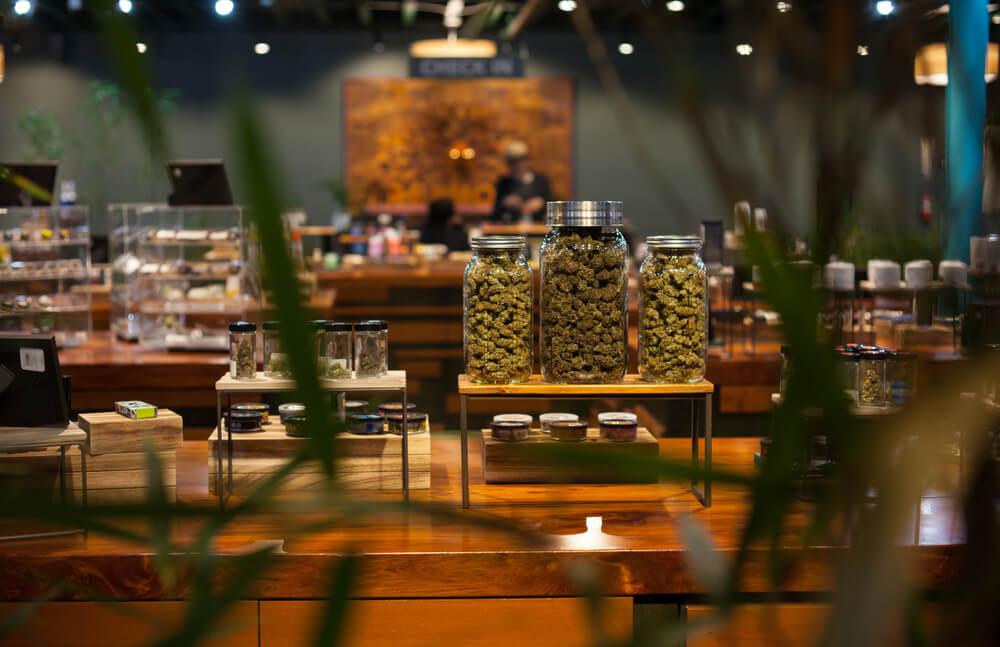
Merchandising a dispensary can be a daunting task. There are many components to consider; different brands, product types, customer needs, compliance, promo’s, and security are just a few. Product placement in a dispensary often determines the traffic low of the space. We know that certain products that require a longer “browse time” may also create traffic flow bottlenecks in the floor plan if not carefully planned and executed. But often in the design process, merchandising comes after the general front of house layout. Then, merchandising and product placement sometimes becomes a task left for the last minute, or worse, someone on the staff who has no experience.
Another tricky merchandising caveat is that it needs to lend itself to the vision of the brand and the overall customer experience. There are so many nuances to how merchandising effects the customer journey, that without vast knowledge in customer trends, store layout conventions, general marketing and design, hiring a professional is the only way to check all of those boxes.
There are some general guidelines that will help you and your team navigate merchandising your dispensary and getting a professional, cohesive feel to your cannabis dispensary.
‘Less is more’ applies here in a big way. Overloading your fixtures with multiples of each product creates visual clutter and removes the “specialness” of each package. I highly recommend no more than three of each SKU on a single display. If the packaging is large or tall you may want to reduce the quantity. Products should have ample space around each package to give visual breaks from product to product.
The ‘less is more’ strategy also applies to signage and info cards too. Font overload or forcing your customers to read or scan QR codes constantly detracts from the product, detracts from the implied budtenders connection to the customer and ultimately their unique expertise. This is why most digital menu boards are unsuccessful. Control what your rented shelf space looks like with your vendors. Make sure guidelines are put into contract that outline very clearly what their topper or display will look like. You don’t want to give them free reign of your carefully planned dispensary. Visual clutter and font overload is a common merchandising mistake.
Review your human scale. The heights and depths of fixtures are sometimes calculated to simply put as much product inside as possible, not how comfortably someone can view or reach something. This is very common with the vision type merchandise tables built for display and cash wrap vision cases. You usually have to move around a bit, stretch to see the middle or back up and lean over to look inside. Would your staff have to constantly bend or reach to access products? Or turn their backs on the customer? If the scale is correct, the customer will not have to be uncomfortable while looking at your products. This also goes for furniture. The scale of your seating, tables, reception desks are all crucial to the comfort level of your space.
Checking your profit margins by SKU’s is a great way to begin laying out your cases or shelves. A complete inventory list with markup percentages, top sellers and unique products will be needed to identify which products deserve the hottest locations in the cannabis dispensary. You may actually be surprised at what you find. Every individual fixture will also have a hot zone, or an area where customers gravitate to and typically select products from. You want to take full advantage of those top-selling sections.
Identify the ‘hot zones’ in your space. Interior store merchandisers will have a complete system in place for identifying these areas. But you can get a great snapshot for yourself if you look closely at your store on a busy Saturday. Watch how the customers enter. Did they go left or right? Where do they look and walk first? When they look at a wall display or into a vision case, which side are they looking at? What level? How long did they stand there? Make some notes and see if all of the customers entering are shopping in nearly the same convention. Are there areas of your dispensary that customers seem to be avoiding? Take notes on those too. What products are in those areas? Are they just not trending products? Ugly or awkward packaging? Or are the fixtures not well lit? Too much signage? Now compare that to what you see on a slower day and time. Are the results consistent?
This is commonly called journey tracking and will give you great insights into how well your fixtures and store floor plan is working (or not working) for you. Customer shopping habits are both fascinating and trackable, and very likely give you the info you’ll need to make any adjustments to your current shelf conventions or floor plan.
Make them meander. Often, dispensaries have a long and narrow footprint. The tendency is to put all the cases on the side walls and the checkout counter running across the back of the store, leaving your middle of the store empty. Runway-style floor plans can be extremely successful if you take deliberate steps to stop the customer at various points and encourage a meandering path of travel. If your customers are going straight to the back counter and straight back out the door, you are definitely not capturing sales you could be, and you’re wasting your real estate. Without cluttering the middle space, i do like to add staggered fixtures (table height as to not create a security sight blind) that display various products, impulse items and even merch when applicable. These meandering tables encourage the guest to move through the space in a zig zag pattern and more often than not they will walk in a zipper pattern. Which also means, the items that are on the outside walls where the meandering tables terminate will be hot zones. Use that to your full merchandising potential. Use LED light strips or spots to highlight these areas and products.
Finally, stop overcomplicating things. Every single product does not need museum- like merchandising, staging, lighting, or signage. Lay off the repetitive info and QR codes, neon, digital, and clutter. A great hint is to go to your favorite store. It doesn’t have to be a dispensary either, just a great shop or boutique that you enjoy shopping in. Do your own self-customer journey while you’re there. Revisit how you entered, where you walked and paused, and where specifically you purchased from. Think about how the product was presented to you, and ask yourself if the layout and merchandising encouraged you to buy more?
Thinking critically about your personal shopping experience and making some simple changes will help you shape the customer experience in your own dispensary. It’s also helpful to bring in a fresh perspective from time to time.
Setting a standard for merchandising practices across all of your locations is a great way to make sure that you’re implementing tried and true techniques to increase sales, food traffic and put your best image forward as an organized, beautiful and profitable dispensary.
 Melinda Yoo designs innovative, profitable and award-winning cannabis retail dispensaries across North America. Her work is inspiring, her clients are notable and her vision for the cannabis industry is unparalleled. She leads her team thoughtfully through the creative and technical processes of creating unique retail experiences that are both jaw dropping and profitable.
After over a decade at a traditional, residential interior design firm in Chicago, Melinda followed her curiosity to retail interior design and merchandising. She quickly fell in love with dispensary design and all the quirks and challenges that go with it.
Since then, she has grown and led Sungrown Studio, received press recognition with her magazine-worthy retail environments and thought leadership. Sungrown Studio was named Dispensary Design Master 2022 by mg Magazine. Melinda continues to design amazing retail stores that reflect her clients values and brand.
When she’s not leading her kickass team, you can find her spending time on the hiking trails with her dog or raising her three little humans.
Member Blog: 5 Visual Merchandising Tips for Today’s Cannabis Dispensaries

by Ray Ko of shopPOPdisplays
Retailers from all walks of life are trying to figure out how to merchandise products that, pre-pandemic, would be offered using “try before you buy” tactics to entice people to make a purchase. Clothing stores had dressing rooms. Makeup stores had countertop sampling displays. Food purveyors offered edibles from self-service bins.
In some ways, the heavily regulated nature of the cannabis industry has put its retailers at an advantage when it comes to visual merchandising—they’ve had to be creative because, especially with adult-use customers, they’ve never been able to set up any type of “try before you buy” scenario. In many states, it’s even illegal for shoppers to bring their own items to the checkout counter. That makes selling an inherently experiential product a game of sight instead of taste, smell, or touch.
With cannabis becoming ever more mainstream, cannabis purveyors have taken an increasingly sophisticated approach to store design. Here are a few things to consider when implementing or refreshing a visual merchandising approach.
 Consider the entire space
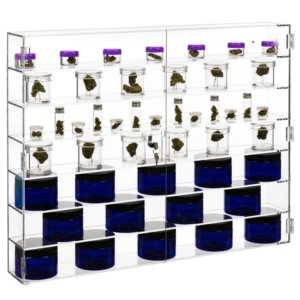
Floors, walls, ceilings, and countertops should all be utilized from a visual perspective, regardless of square footage. Wall-mounted shelving and wall-mounted pedestals make the most of vertical space. So do tall display cases. Waist-high displays that shoppers can walk around and look into from above work well in the center of a room. Locking display boxes and display cases can be used atop counters as space allows. Eye-catching and strategically placed signage, whether wall-mounted or suspended from the ceiling, can draw people to specific items or areas of the store and provide important educational information.
Consider the traffic flow
People tend to turn to their right when they enter a store, and cannabis retailers should be strategic about what they encounter there. It’s not the best place to put the budtender/checkout counter, because that only serves to bottleneck traffic and keep people from casting an eye about the rest of the shop. The goal in this space is to entice new customers to explore the store and give regular customers something new to think about. Signage that touts specials and intriguing products is a good choice, along with nearby displays of those items with adequate educational info for newcomers. Be sure there’s room for people to linger without impeding those who are coming in for a quick pick-up. That level of awareness is essential for every display in the store. No one wants to feel as if they’re infringing on another’s personal space, whether they’re there to browse or move right to the budtenders.
Make good lighting a priority
Since customers are often prohibited from picking up any cannabis-containing products in a dispensary on their own accord, the ability to examine them adequately without touching is paramount. Overhead lighting alone is not enough. For one, it will be blocked by the customer anytime they bend over to look inside a counter display. Many shelving units and product display cases come with, or can be outfitted with, lighting from above, beneath, or either side. Mirrors can also be incorporated to give people a 360-degree view. Consider what a person will want to know about a product and illuminate it accordingly—preferably inside a lockable display that doesn’t impede viewing. Displays made of optically clear acrylic are a good choice because they’re lightweight and shatter-resistant (especially as compared to glass).
 Use acrylic blocks to add interest
Arranging products at different heights and angles on shelves or under counters serves many purposes. Acrylic blocks are the Swiss Army knife of displays because they come in a wide variety of dimensions and can be used to call attention to small items, create groups of complementary items and add a level of cachet to any product placed atop them. Since acrylic itself is optically clear, it can be tinted any color to complement a brand or particular look. And, acrylic is infinitely malleable, so custom pieces can be designed to accommodate any product or space.
 Choose cannabis-specific displays
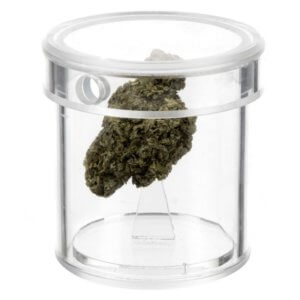
Cannabis shops can utilize a variety of cannabis retail displays to showcase the products they sell or have specific displays designed to suit their needs. Cannabis display pods highlight, preserve and protect buds while allowing customers to fully experience terpene aromas without handling the product itself. As well, there are cannabis display pod spikes that enable a full view of your product, enabling customers to see the fine details of each bud. Bud jars can be customized with colored spike inserts and/or placed in display pod holders showcasing multiple jars. We’ve also created displays shaped to hold vape products.
 Ray Ko has been creating effective visual merchandising strategies for retailers for more than twenty years. Today, he is the senior ecommerce manager for shopPOPdisplays, a leading designer and manufacturer of stock and custom retail displays that helps brick-and-mortar and ecommerce stores of all sizes, across all industries, showcase their products to drive sales.
Member Blog: 5 Steps to Set Record Profits on 420

by Gary Cohen, Cova Software
If increased consumer spending is any indication, April 20 has solidified itself as the ultimate cannabis holiday.
Average dispensary sales around last year’s high holiday experienced a 51% increase, beating 2017’s numbers by an impressive 30%. With more U.S. states having legalized cannabis since 2018, April 20 falling on a Saturday, and this year being Canada’s first as a legal nation, 420 is set to break even more records in 2019.
It’s not enough for cannabis retail owners to simply open the doors April 20 and wait for products to fly off the shelves. Everything from marketing and merchandising strategy, to ensuring your staff and operations are prepped, factor into how well your dispensary will perform. For cannabis retail owners wondering how to prepare for 420, Cova’s latest white-paper details 5 key ways to make April 20 your best business day all year:
Marketing Must-Haves: Customers expect dispensaries to offer deals and specials in celebration of the 420 holiday, but creative marketing is what helps bring the heat. For retail owners wondering how to boost sales on 420, learn how creative marketing initiatives can build early buzz, engage your customers, and take your sales from uptick to off-the-charts.
Prep Your Tech, Systems, and Processes: Is your POS ready for larger than usual weekend foot traffic? Find out which critical features your POS software should have to reliably and compliantly handle increased transactions, and how optimizing technology and store flow can help improve the customer shopping experience overall.
Square Away Inventory, Promotions, and Merchandising: On 420, dispensary owners have the opportunity to create an experience that’ll keep their customers coming back all year long. Discover how making key merchandising decisions on the sales floor and in the stockroom, and offering unique cannabis retail holiday promotions will make your 420 event unforgettable while also helping you move through inventory.
Empower Your Staff: Your dispensary team is invaluable, but especially so over the busy 420 weekend. Learn how communication, training, and the right technology can empower your employees, help them feel prepared, and set them up for success.
Review, Analyze, and Plan for Next Year: It’s never too early to start planning for next year. Discover why you shouldn’t procrastinate when it comes to reviewing and analyzing the 420 experience with your staff, how to make the conversation productive, and how to turn your findings into action items for next year’s 420.
Our white-paper details everything you need to know to host a 420 event that breaks records, and it’s yours for free! Download your copy of Cova’s “How to Nail 420 This Year: 5 Steps to Higher Sales and Happier Customers” today.

 Gary leads Cova’s charge into the legal cannabis space by guiding the vision, strategic development, ‘go to market’ plans and culture.
Before joining Cova, Gary was a principal in over a dozen tech start-ups in the mobile communications industry ranging from small VC funded companies to Fortune 100 firms, including Onavo, which was later acquired by Facebook. In those companies he led sales, marketing, business analytics and market expansions. He has also held a multitude of leadership roles with Verizon and AT&T.
Gary holds a degree in finance with a master’s in marketing from the University of Colorado.

Follow NCIA
Newsletter
Facebook
Twitter
LinkedIn
Instagram
News & Resource Topics
–
This Just In
Beyond Rescheduling: Inside NCIA’s 14th Annual National Cannabis Industry Lobby Days
DOJ Reschedules Medical Cannabis to Schedule III & Announces June 2026 Hearing on Broader Rescheduling