Committee Blog: A Novel Cannabinoid Conundrum – Loopholes, Liability, and Legislation
by Matthew Johnson and Doug Esposito members of NCIA’s Risk Management and Insurance Committee
For better or for worse, the cannabis industry is easily the most fascinating experiment in state regulation that this country has ever seen.
Rules vary widely from state to state.
Product testing requirements lack uniformity.
Packaging and labeling are a compliance nightmare.
State laws aren’t the only things that vary, though…
Product Liability definitions of what is even ‘covered’ by a cannabis insurance policy range widely between insurance companies. Now, a tidal wave of novel cannabinoid products threatens to upend the traditional American perception of cannabis – and possibly teach a few lackadaisical insurers an expensive lesson.
So, let’s delve into the issues associated with product liability and novel cannabinoids in the American cannabis industry…
American cannabis companies face a daunting task when it comes to navigating the complex and constantly evolving landscape of regulations governing the production, distribution, and sale of cannabis products. With 40 sets of rules governing different state markets, plus a handful of federally licensed businesses, ensuring compliance can seem like an insurmountable challenge.
One of the most significant issues facing cannabis companies is product liability, including the ongoing blight of product recalls. As with any consumer product, there is a risk of harm associated with the usage of cannabis products – things like adverse reactions, contamination, mislabeling, or improper dosage, to name a few. The legal and financial implications of product liability can be severe, including lawsuits, fines, and irreversible reputational damage. Given the complexity of the state-segregated cannabis supply chains and the lack of clear federal guidance, it is additionally challenging for companies to identify and mitigate potential risks.
Traditional cannabis companies must also contend with the emergence of novel cannabinoids. As researchers continue to explore the potential therapeutic benefits of cannabis, previously unknown cannabinoids are being discovered and brought into the mainstream. These compounds may have unique properties and potential therapeutic applications, but they also pose challenges in terms of safety and regulation. For example, some novel cannabinoids may be more potent or have different effects than traditional cannabinoids like THC and CBD. What’s worse, some novel cannabinoid products can even produce substances that are deleterious to human health (for example – the vaporization of THC-O Acetate produces toxic ketene gas).
The challenges associated with product liability and novel cannabinoids highlight the need for clear and consistent regulation of the cannabis and hemp industry. While some states have taken steps to create comprehensive regulatory frameworks for cannabis, the lack of federal guidance has created an incoherent patchwork of rules and regulations that can be difficult for even the most seasoned minds in compliance to navigate.
Without sensible and congruous regulations, companies may be forced to operate in a legal gray area, increasing the risk of non-compliance and potential harm to consumers. In fact, this is exactly what’s happening with the unregulated intoxicating cannabinoid market. A veritable alphabet soup of novel intoxicants like Delta-8 THC, THCP, THC-O Acetate, and others have sprung up to fill the gap in access perpetuated by the federal illegality of ‘normal’ marijuana products. Beyond that, some folks are synthesizing Delta-9 THC (the ‘normal’ THC molecule) from hemp and marketing it as if it were naturally occurring THC from marijuana.
These products are increasingly problematic for cannabis consumers. While intoxicating hemp-derived products are technically legal through a loophole in the Farm Bill, states have had to take action to ban or regulate novel cannabinoid products. The states that haven’t acted are effectively endorsing the sale of untested cannabis goods often derived from federally legal hemp. This means that novel cannabinoid products get a free pass in many areas for heavy metals, mycotoxins, pesticides, residual chemicals, and other contaminants that the regulated marijuana industry must monitor to maintain good standing with a state cannabis program.
As if varying state regulations weren’t enough, insurers’ definitions of what is considered ‘cannabis’ vary widely too. Some policy forms contemplate hemp-derived cannabinoids as ‘cannabis’ and some do not.
A few examples of policy wording are below:
Carrier A:
“Medical Marijuana means cannabis or marijuana, including constituents of cannabis, THC, and other cannabinoids, as a physician-recommended form of medicine or herbal therapy”
Carrier B:
Simple exclusion for ‘Hemp-Derived Intoxicating Cannabinoids’
Carrier C:
“Cannabis” means:
Any good or product that consists of or contains any amount of Tetrahydrocannabinol (THC) or any other cannabinoid, regardless of whether any such THC or cannabinoid is natural or synthetic.
The paragraph above includes, but is not limited to, any of the following containing such THC or cannabinoid:
(1) any plant of the genus Cannabis, or any part thereof, such as seeds, stems, flowers, stalks and roots; or
(2) any compound, byproduct, extract, derivative, mixture or combination, such as, but not limited to:
(a) Resin, oil or wax;
(b) Hash or hemp; or
(c) Infused liquid or edible marijuana;
Whether or not derived from any plant or part of any plant set forth in the paragraph above.
From the get-go, you can infer a few things from these definitions/exclusions:
Carrier A: not an adult-use cannabis company’s best choice as it only defines ‘medical marijuana.’ This could leave the door open for potentially uncovered claims from recreational products.
Carrier B: insurance company is looking to protect itself from issues with the new wave of novel cannabinoid products – but specifically, only the dozen or so intoxicating cannabinoids that can legally be synthesized from hemp (without testing mandates in most states). An important takeaway is that this definition would cover non-intoxicating cannabinoids like CBN or CBC, even if they were derived from hemp.
Carrier C: this language is/was commonly used across a number of insurance carriers who cover cannabis. Their policies may carry some restrictions, but this broad definition of cannabis includes synthetic cannabinoids and could expose the carrier to major lawsuits.
Those with broader definitions that include all cannabis-derived products often restrict their product liability coverage in other ways. All things considered, the industry has a long way to go until the available product liability coverage can truly be called comprehensive.
To address these challenges, policymakers, industry leaders, and consumers must work together to create a regulatory framework that protects public health and safety while supporting the growth of the cannabis industry. This should include clear guidelines for product labeling, testing, and dosing to ensure that consumers have access to safe and accurately labeled cannabis products. It should also include provisions for product recalls and liability to protect consumers in the event of unexpected quality control issues.
Additionally, the framework should support ongoing research into the therapeutic potential of cannabis, including novel cannabinoids. This research should be conducted in a manner that ensures the safety and efficacy of new compounds before they are introduced to the market. By creating a robust regulatory framework that balances innovation with consumer protection, we can ensure that the cannabis industry continues to grow and evolve in a responsible and sustainable manner.
As risk professionals in this field, it’s our duty to convey the urgency of these issues and the need for action. By working together to create a regulatory framework that supports both innovation and consumer protection, we can ensure that the cannabis industry continues to thrive while safeguarding public health and safety.
It’s time for policymakers, industry leaders, and consumers to come together to address these critical challenges and build a sustainable future for the American cannabis marketplace that is inclusive of all the various products that can be developed from cannabis.
Matt Johnson leads the Risk Services division for QuadScore, the nation’s leading cannabis insurer. Matt works to keep the cannabis industry safe from unexpected losses through all manner of risk mitigation techniques, ranging from facility security assessments to fire protection improvements.
Matt has the unique ability to study the claims activity for hundreds of cannabis operators across virtually every active state in the USA. Through this lens, he can offer unique insights into the most common claims and how to prevent them.
In addition to learning from past mistakes, Matt also keeps an eye on future claims drivers from emerging areas such as hemp-derived novel cannabinoids. Before starting with QuadScore, Matt spent a number of years working for a Berkshire Hathaway insurance company.
Doug Esposito has been a Property & Casualty Specialist with AssuredPartners and leads the firm’s Renewable Energy and Cannabis Practice with specific expertise in these industries. Doug’s current cannabis & hemp practice clients include indoor/outdoor cultivators, manufacturers, distribution companies, dispensaries, non-storefront delivery, labs and property owners, so he knows what challenges are facing the growing industry and is skilled at providing solutions. Doug is also one of AssuredPartner’s experts in alternative risk mechanisms including self-insured and captives programs.
Doug currently serves as the Co-Chair of the California Cannabis Industry Associations’ (CCIA) Risk Management committee and serves on the National Cannabis Industry Associations’ (NCIA) Risk Management & Insurance Committee. He understands the importance and need to educate the insurance carriers and the public on the benefits of cannabis and hemp both medicinally and economically. “I truly respect the spirit of the industry’s medicinal origins and I’m committed to helping build this industry to reach new levels of growth, success, safety and acceptance,” shared Doug.
Committee Blog: The New Licensee Insurance Checklist – Part 1
by NCIA’s Risk Management and Insurance Committee David Rahn, S2S Insurance Specialists
If you have a business in the cannabis industry, especially one that’s either newly operational or still in the pre-revenue stages, these businesses should have some sort of risk management plan put in place. Insurance is the cornerstone for any risk management plan if you want your business to recover after a financial or physical loss.
There are many types of insurance products to consider and it’s important for the business owner to have a knowledgeable Insurance broker who can help obtain tailored policies for your business. It’s important to consider the following questions below when seeking insurance for your business:
What types of insurance do I need?
When should I be getting insurance for my business?
What kind of claims are common in the cannabis industry?
What information does my insurance broker need to help me get an insurance quote?
Which types of insurance do I need?
Depending on your needs discussed with your insurance broker, all businesses should at least have some sort of property & casualty coverage. Whether the size of your business is starting in your own home, or you have a commercial or industrial space, it would be paramount to explore General Liability and Commercial property insurance, as well as Product Liability Insurance:
General Liability
A General Liability Insurance policy indemnifies against risks that nearly all business owners face. General Liability is the most critical basic coverage your business needs to protect you from a variety of claims including bodily injury, property damage, personal injury, and other situations that may arise including slander, libel, copyright infringement, and more.
Commercial Property
Commercial Property Insurance not only protects your place of business, but also its contents, including office furniture, computers and inventory, from common perils such as fire, lightning, explosion/implosion, riots, strikes and terrorism.
Product Liability
Product Liability Insurance is designed to protect your cannabis company from claims that can happen anywhere along the supply chain, including product contamination, mislabeled products, false advertising or defective products.
Once you have those three policies secured, additional types of insurance would include:
Crop Coverage
Crop Insurance is specifically designed to protect cannabis and hemp growers from natural disasters such as wildfires, hurricanes/heavy winds, and flooding/water damage. However, it can also cover incidents like theft, explosions, vandalism, and other unpredictable and uncontrollable events that result in an “interruption of service.”
Cyber Liability
Any business that has an online presence or stores customer data electronically needs Cyber Defense and Data Breach Insurance to protect yourself from legal liability and hefty fines. Given the vast amount of information that cannabis retailers and distributors are required by law to collect from customers, coupled with the fact that this is a rapidly growing industry with evolving regulations, the unfortunate reality is that cannabis businesses are prime targets for cybercrime.
Directors & Officers Insurance
Directors and Officers (D&O) Liability Insurance protects corporate directors and officers, as well as their spouses and estates, from being personally liable in the event your company is sued by investors, employees, vendors, competitors, customers, or other parties, for actual or alleged wrongful acts in managing the company.
When should I be getting insurance for my business?
It is very important to understand the right time to get your insurance. As always, it is important for you to build a good relationship with a knowledgeable insurance broker who can help you find the right time to buy insurance.
General Liability/Commercial Property
When Business owners rent or lease commercial property for their business, in the lease agreement, landlords almost always have an insurance clause stating the minimum limits the client needs to have on their GL policy in order to move in and conduct businesses. Usually around the same time you get your lease agreement is around the same time you should be considering GL and property insurance, so you know you are covered right when you move in and before your start business.
Product Liability/Crop
If you have a product-facing business, it is important to secure these policies before your product comes off the assembly line. As for Crop insurance, make sure you get your policy before you start planting and harvesting.
Cyber Liability
Typically before you launch your web presence and begin business transactions is the best time to secure your policy.
As your business grows and scales while you bring on outside investment, that’s the time when you should be considering your D&O and other management liability coverages.
What information does my insurance broker need to find an insurance quote?
It is important to always be honest and upfront with your insurance broker, especially when shopping for quotes. Your underwriting information needs to be accurate for you to obtain proper insurance coverage. You do not want to be underinsured or overinsured and pay for policies that you don’t need. A good place to start is with your business plan and projected revenues because that will help the insurance broker determine what products you may need. A well thought out business plan is the first step in being prepared in finding the right insurance.
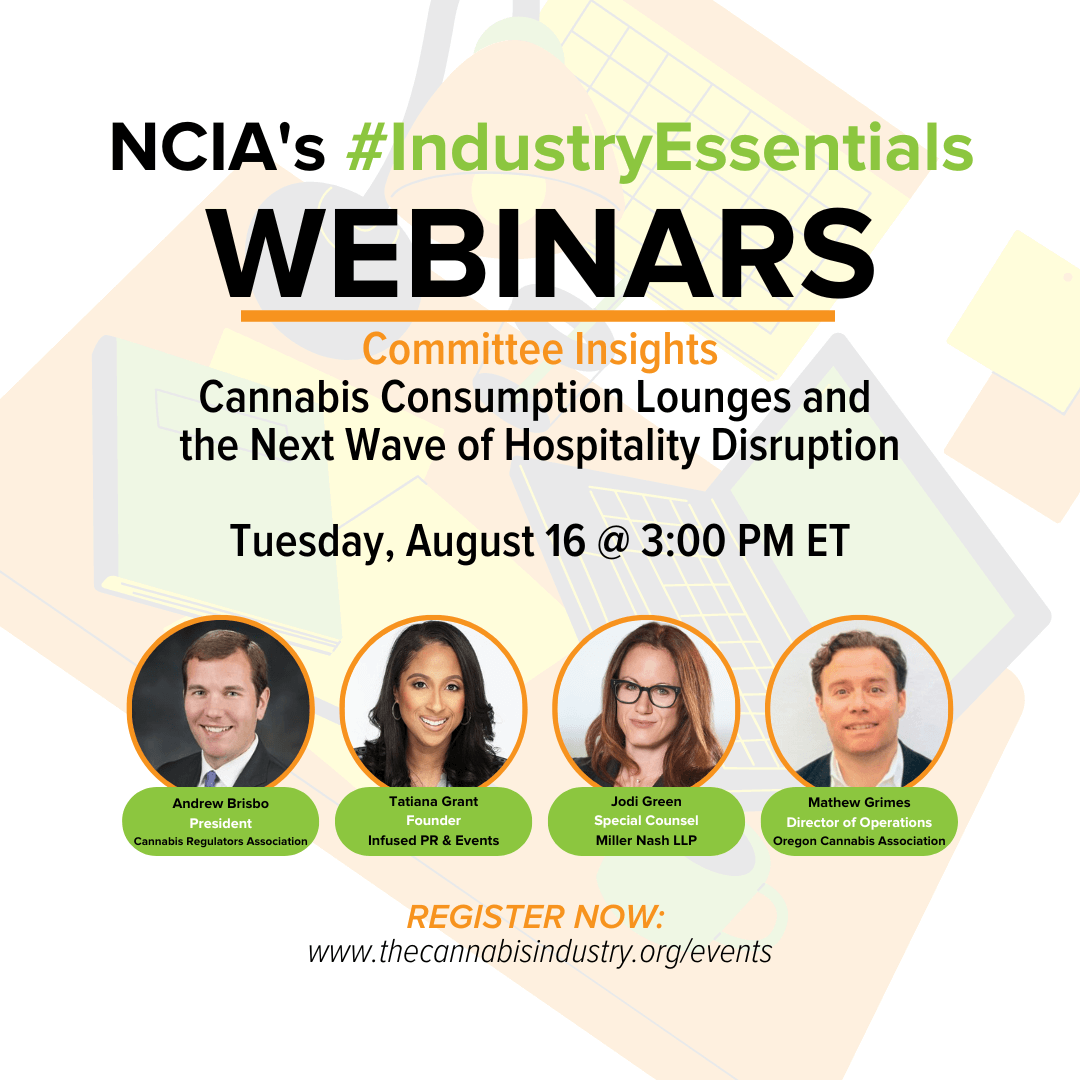
Committee Insights | 8.16.22 | Cannabis Consumption Lounges & the Next Wave of Hospitality Disruption
In this edition of our NCIA Committee Insights series originally aired on Tuesday, August 23, 2022 members of Risk Management & Insurance Committee convened a panel of cannabis regulators and legal experts alongside leading event and hospitality operators to provide cannabusiness professionals the inside scoop on new regulations being adopted to manage/establish cannabis consumption establishments.
Dive deep into the ins & outs of Michigan’s cutting edge regulatory structure and learn from those operating in the space across the country with our panel of experts.
Learning Objectives
• Review of leading edge regulatory framework providing a model for MI consumption lounges
• Highlight the license structure for temporary events – how do consumption, sales and/or both formats function within this framework?
• How have these regulations evolved since first adoption?
• Review dram shop liability and offer an educationally lensed analysis
• Discuss how that may or may not be a good framework to apply to cannabis?
Although the concept of state-legal cannabis has been around in some shape or form since 1996, cannabis remains illegal to consume in most public places. In other words, legal cannabis consumption remains relegated to back alleys, derailing efforts to “normalize” cannabis use. Tourists visiting popular cities where weed is legal are caught in the unenviable Catch-22 of being able to purchase, but not publically consume, the product. And those who attempt to use cannabis in public still face criminal penalties in some states, with minorities three times more likely to be targeted for arrest, perpetuating racial disparities at a tremendous social cost.
Enter the cannabis lounge. Cannabis lounges — also known as “consumption lounges,” cannabis cafes, or some variation on that theme — are in simplest terms the cannabis equivalent of a bar or restaurant. Depending on state and local regulations, lounges offer users the chance to congregate in a public place and smoke a joint, try out a $500 gravity bong, or sip on a cannabis drink. With any luck, consumers may enjoy their cannabis with a snack or dinner, but mixing with alcohol is typically not allowed.
As with any “new” risks, some cities, states, and insurers are… concerned. Despite some obvious tax and social benefits, detractors cite a host of reasons to prevent lounges from coming to a city near you, including at the forefront: fears of public nuisance (odors, theft, and disruption) and overconsumption — especially because most states insulate cannabis cafes from liability for harm caused by obviously intoxicated or underage users, unlike dram shop laws for alcohol.
As another NCIA member recently pointed out, even in states that do allow cannabis cafes, regulatory bodies continue to struggle with how to shape the laws and regulations governing lounges to afford adequate consumer protection while allowing businesses to thrive. Moreover, without a better understanding of the regulatory landscape, some insurers — whose business model hinges on the ability to accurately price a risk — may be unwilling to play in this new cannabis lounge market.
A Sampling of State Approaches to Cannabis Lounges
Alaska led the country in 2019 in licensing on-site consumption. A handful of states and localities have followed Alaska’s guide, and more are anticipated to join this year, including Michigan and New York. We compare a few regulatory schemes below and also consider the impact of dram shop legislation on risks faced by the industry.
California
California, governed on the state level by the Medicinal and Adult Use Cannabis Regulation and Safety Act, delegates to localities the right to open consumption lounges. Put simply, cities have to affirmatively “opt in” to allow lounges. With a few contingencies — including that patrons must be 21 or older and no alcohol or tobacco can be sold on premises — “a local jurisdiction may allow for the smoking, vaporizing, and ingesting of cannabis or cannabis products on the premises of a” licensed retailer. SeeBPC § 26200(g).
To date, only a few localities have opted in to allow cannabis lounges, including San Francisco, Oakland, and Palm Springs. West Hollywood, in efforts to create an epicenter for canna-tourism, plans to allow up to 16 lounges within its jurisdiction. Because state law provides little regulatory guidance for lounges, localities generally provide more specific guidance. As an example, West Hollywood’s local municipal code requires security guards on site, as well as within a two-block radius surrounding the business during operation, and allows the sale of cannabis to an individual “in an amount reasonable for onsite consumption.” West Hollywood Municipal Code §5.70.041. Only one lounge is currently open in West Hollywood, the Artist Tree’s Studio Cannabis Lounge, which offers not only lounge access but cannabis yoga, live music, and comedy shows, along with a revolving selection of local art. The Woods, another West Hollywood dispensary with a soon-to-open courtyard lounge space, is also slated to open in 2022.
Although California law significantly limits third-party liability for alcohol-related accidents, it does not afford cannabis owners the same protection. For example, California Civil Code §1714explicitly states that furnishing alcohol “is not the proximate cause of injuries resulting from intoxication,” which has essentially absolved bars, restaurants, party hosts, and most others of potential liability for selling or furnishing alcohol to customers and guests with an exception for liability arising from the furnishing of alcohol to an “obviously intoxicated minor.” SeeCalifornia Business & Professions Code § 25602.1. Without similar protections for cannabis lounges, injured parties could attempt to sue under a negligence theory if a business or employee serves an intoxicated patron who causes harm.
Colorado
As of January 1, 2020, local jurisdictions in Colorado can opt-in to the state’s cannabis hospitality business license regime (Colo. Rev. Stat. § 44-10-609), and as of March of 2022, the City of Denver has approved cannabis hospitality businesses for operation. Denver operators include the first social equity applicant in Denver approved for a hospitality license, the Tetra Lounge, although from its website Tetra Lounge’s website describes itself as “a private lounge,” requiring a monthly or annual membership fee and a liability waiver to gain access.
As to dram shop liability, although Colorado law authorizes damages against a licensee for willfully and knowingly selling or serving alcoholic beverages to a visibly intoxicated person, the Colorado Legislature caps liability at $150,000 (Colo. Rev. Stat. § 12-47-801 (3)(II)(c)). This damages cap improves (i.e., reduces) the ISO hazard grade, resulting in the improvement of insurance options available for liquor liability. The legislature has not adopted the same or a similar damages cap on liability for cannabis consumption establishments.
Nevada
In June 2021, Nevada’s Governor signed Assembly Bill 341 into law, authorizing the Nevada Cannabis Compliance Board (“CCB”) to license and regulate consumption lounges across the state, subject always to local approval. The State plans to issue up to 65 lounge licenses (40-45 for lounges attached to existing dispensaries, 20 for independent lounges) with 10 reserved for social equity applicants.
Most recently, on June 28, 2022, the CCB voted to unanimously approve a host of regulations for cannabis consumption lounges. Nevada’s extremely detailed state regulations prohibit the sale of “single use cannabis products” with more than 3.5 grams of “usable cannabis” and 10 mg of THC for edibles; prohibit the removal of any cannabis products from a lounge; require a mitigation plan for impaired driving and detailed employee training for overconsumption; and require consumer education and warnings to customers, among other things. As with other states, Nevada allows local jurisdictions to prohibit consumption lounges and to implement more stringent regulations than state law.
Unlike other states, however, Nevada law carves out protections for cannabis lounge operators just as it does for alcohol. Nevada law already protects businesses that serve or sell alcoholic beverages from injuries inflicted by an intoxicated person. And while any person who knowingly furnishes an alcoholic beverage to any person under 21 years of age is guilty of a misdemeanor, the law provides only for criminal penalties, not civil liability. The Nevada Supreme Court has repeatedly refused to impose responsibility on vendors selling alcohol absent a legislative provision. SeeSnyder v. Viani, 885 P.2d 610 (Nev. 1994) (holding consumption is the proximate cause of alcohol-related injuries and dismissing the negligence claim against a tavern owner for alcohol service). The same rules will apply to cannabis operators.
Illinois
Over two years after full legalization of adult-use commercial cannabis in Illinois, cannabis lounges in Illinois are still relatively rare, with the first Chicago-area marijuana consumption lounge opening on April 20, 2022. Like other states, the State of Illinois does not directly license lounges, but it allows local governments to opt in.
Illinois creates a cause of action against sellers for injury by an intoxicated person. § 235 Ill. Comp. Stat. 5/6-21. The standards for liability under the Illinois dram shop law include: (1) sale of alcohol to any person who, while intoxicated, causes injury, and (2) any person owning, renting, leasing, or permitting the occupation of any building or premises with knowledge that alcoholic liquors are to be sold therein, severally or jointly, along with the person selling or giving liquor. In Illinois, the Dram Shop Statute provides the exclusive remedy for alcohol related injuries. See Charles v. Seigfreid, 65 NE.2d. 154 (Ill. 1995). The Statute also provides stringent limitations on recovery of damages. There is no equivalent in Illinois for cannabis entities.
The Takeaway for Business Entities and Insurance Providers
As with cannabis law generally, lounge operators face a patchwork of state and local regulations that vary tremendously by jurisdiction. In most places, cannabis lounge owners are not protected by dram shop/gram shop laws that otherwise insulate bars and restaurants from liability for overconsumption. This means that companies must be vigilant in protecting themselves from liability by instituting compliance and risk-management procedures.
In some instances, such as California’s West Hollywood, which has far fewer safeguards and guidelines than Nevada, operators are largely left to their own devices in implementing adequate risk transfer and risk management, compliance, employee training, and consumer education to limit risk of liability. While the West Hollywood municipal code requires lounges to limit cannabis sales of cannabis “in an amount reasonable for onsite consumption,” the “reasonableness” standard is rife with ambiguity and could lead to disputes regarding liability and assumption of risk if a patron overconsumes.
Evaluating and preventing overconsumption and intoxication will be particularly difficult for cannabis when: patrons have varying experience levels with cannabis; products can be sold in more than a single serving, and no specific consumer education is required. Thus, even in locations that have more stringent regulatory oversight, companies would be wise to consult with experienced counsel and consultants to avoid or limit potential risks associated with regulatory uncertainty, civil liability, and government penalties for non-compliance.
This brings us full circle to the question of insurance. Even in the states that allow consumption lounges, very few insurance companies provide coverage for on-site consumption (although some do). If an exclusion prohibits coverage, the company may not have coverage for important and sometimes catastrophic events, such as property damage by fire, theft/robbery, cyber events, sexual harassment or discrimination claims by employees or others, and bodily injuries to, or caused by, patrons (on and off premises).
Most existing property, general liability, products liability, and other insurance policies — including those written for the cannabis industry — expressly exclude coverage for on-site consumption or bodily injury caused by intoxication. In fact, some existing cannabis insurance companies include a “health hazard” exclusion in their policies, which exclude coverage for any bodily injury arising in any way from the use of cannabis, including any health injury. Cannabis insurance policies may also exclude coverage for intentional or illegal acts, which some insurers may try to apply to any claim involving cannabis on the basis that the sale of cannabis violates federal law (the Controlled Substances Act), even if it is state legal.
For current licensees that are planning to open an attached or adjacent consumption space, current insurance policies may not cover injuries arising in the lounge space. Further, any failure to identify a change in business type could prompt an insurance carrier to deny coverage for subsequent claims based on a theory of misrepresentation.
In closing, cannabis owners should attempt to negotiate separate and/or broader coverage that carves out coverage for their cannabis-related activities, including on premise consumption, with their current insurer or seek to obtain coverage from a different carrier. Experienced insurance coverage counsel can assist with identifying reputable insurance brokers and negotiating policies that provide such coverage. Because of the limited options, companies would be wise to begin the process of identifying experienced insurance coverage advisors at the beginning of their licensing journey.
Committee Blog: Is American Cannabis Still the Wild West?
by NCIA’s Risk Management and Insurance Committee Matthew Johnson, Quadscore Insurance Services
Cannabis is America’s riskiest business.
Cannabis itself is a highly valuable commodity, but cannabis businesses also deal largely in cash – making them a prime target for thieves across the country. Recent headlines have reported a rash of unsolved robberies in the Bay Area and Washington State, not to mention the seizure of cash from Empyreal’s fleet of armored transport vehicles (fortunately, that cash has now been returned by the police).
This is a national problem, which begs the question… What should cannabis businesses do to stay safe during these trying times?
There are many different means of minimizing the risk faced by your modern cannabis business, but we’re going to focus on the big three today – security, technology, and compliance. Through careful consideration of these three tenets, cannabis businesses can take significant steps to mitigate risk and protect their employees. Appropriate investments can yield tenfold savings in the form of fewer stolen assets, lower insurance premiums, peace of mind, and safer employees.
SECURITY
Let’s start with the topic that gets the most attention during a crime spree – security. In cannabis, security means a number of things… video cameras, man traps, motion sensors, hardened glass, ID checks, and more. When building or retrofitting a facility for cannabis operations, it is crucially important to consult with security experts like Sapphire Risk Advisory Group or Cannabis Compliant Security Solutions.
“In many areas, it’s not a question of ‘if’ a cannabis business will be robbed – it’s ‘when,’” cautions Chris Eggers, CEO of Cannabis Compliant Security Solutions. With 13 years of experience as a law enforcement officer in the Bay Area – including several years working as an undercover narcotics officer – Chris is uniquely qualified to address the ongoing issues in Oakland and other areas along the West Coast. “There’s a question of how you navigate and survive an incident, but beyond that, how you ensure that your business will survive too.”
There’s an important distinction between security consultants like CCSS, security integrators, and vendors. To achieve best results, cannabis businesses should work with a security consultant who can identify ways to protect the business – without being tied to commission-based sales contracts or a specific ‘brand’ of security solutions.
TECHNOLOGY
Physical security aside, there are a number of high-tech security tools that can help cannabis business owners protect their operations. For example, let’s take a look at the biggest security company you’ve never heard of – an organization called 3SI Security.
3SI Security began their journey over 50 years ago as the original producer of dye and smoke packs intended to deter bank robbers in the 1970s. Technology has evolved over the years, and so has 3SI’s product offering – now, their GPS tracking tech is ubiquitous throughout banking, pharmaceuticals, luxury retail, and telecommunications.
As VP of Business Development for 3SI, Carlos Casas works to connect cannabis businesses with this tech to protect their assets and employees. “According to a Forbes report from July 2020, an estimated 70% of cannabis businesses are cash-based. This is a staggering statistic which shows the real risk to the industry is on an upward climb.” With the SAFE Banking Act still in the works, savvy business owners have to explore alternative solutions like 3SI’s technology to ensure their business stays safe.
Apart from 3SI, there are a number of technology companies that provide technology to make the cannabis industry a safer place. ADT Security has recently launched a cannabis-focused divison of ADT Commercial to provide critical security technology to cannabis businesses around the country. After spending three years keeping HERBL’s fleet secure on the west coast, Andy Fleet now leads ADT’s efforts to provide security solutions to the cannabis industry.
According to Andy, “Security planning is critical for any cannabis organization. Take the time to evaluate all the risks within your establishment and build a robust plan that ensures all areas of physical safety and security are considered and protected.” Underscoring the points above, Andy continues, “Working with a licensed, experienced consultant will ensure adherence with all relevant regulations and help keep your employees safe while having technology do the heavy lifting for you.”
COMPLIANCE & COVERAGE
Next up, everyone’s favorite topic: compliance. In this sense, we’re not talking about adhering to the myriad regulations imposed on cannabis businesses wherever they operate – but rather, making sure that your operation complies with the protective safeguard requirements in your insurance policy. Non-compliance with or material misrepresentation of your active protective safeguards could result in an uncovered or denied claim – and could even cause problems with your investors. If you’re buying insurance, you want to make sure that your policy will pay out when stuff hits the fan!
Theft Sublimit – Most cannabis insurance policies will only cover theft losses up to a certain ‘sublimit’ depending on the quantity of cash/cannabis being stored, the physical location of the cannabis business, and any relevant losses that the insured business may have sustained due to theft. Make sure that you are comfortable with the sublimit provided and, if you aren’t satisfied, work with your insurance broker to see if you can secure higher limits.
Protective Safeguards – Virtually all cannabis insurance policies carry some warranties around protective safeguards that can impact your coverage in the event of a claim. Make sure to read the Protective Safeguards endorsement and check that all of your security systems are functioning in compliance with these requirements.
Motor Truck Cargo – Similar to the protective safeguards warranty, make sure that you study your policy to ensure that any requisite safeguards are in place. For transportation operations, these safeguards are likely to include vehicular telematics, buddy systems for drivers, GPS tracking, and possibly even an escort vehicle to accompany the transport unit.
Security guards – When hiring security guards, it is recommended to employ a third-party guard service that carries appropriate limits of insurance. Make sure that your business is listed as an additional insured on their insurance policy to ensure coverage in the event of an altercation at your business!
Financing – Lenders and VC firms will often stipulate that the companies accepting their funds will need to adhere to certain requirements, like securing Directors & Officers insurance for the officers and executive board. Beyond insurance, it’s important to make sure you are actually doing what you promised to do in terms of safeguarding the property and not just so that you may be eligible for coverage, but also so that you are not held liable for losses suffered by third parties, such as lenders and investors.
Joseph Cioffi, chair of the Insolvency+Finance practice at the Davis+Gilbert law firm in New York advises, “Operators typically make certain representations to investors, lenders, and other capital providers, and undertake certain activities intended to preserve asset and collateral values. The operator is looking at default if it’s in breach of contract, but worse, the operator and its principals could be sued for misrepresentations made in obtaining funding – and be held liable for losses that flow from those misrepresentations.”
CONCLUSION
Like an onion, there are many layers to a risk management program for cannabis businesses. Through careful implementation of security measures and protective technology, many businesses will be able to prevent damage to their business with proper planning. In case all security measures fail, a comprehensive insurance policy should be able to help make a business whole again after a claim. Make sure to work with the proper insurance, security, and legal experts when building or restructuring a cannabis operation!
Committee Insights | 8.24.21 | Advanced Risk Mitigation for Cannabis: Best Practices and Policies
In this edition of our NCIA Committee Insights series originally aired on Tuesday, August 24, 2021 we were joined by members of our Risk Management & Insurance Committee for a discussion on how to reduce the overall risk facing cannabis businesses through the implementation of proactive risk management practices.
Join our panel of experts as they walk through a number of hot-button issues specific to the cannabis industry, including cybersecurity, product liability, marketing risks, and the protection of high-value assets.
Our team of cannabis professionals will guide you through real-life scenarios to help you learn from the mistakes of others. Although cannabis is still an emerging industry, there is a broad array of tools that business owners can use to protect their bottom line and maintain their business’s operations through an emergency.
Some of the various risk-reduction tools that will be discussed in this webinar include specialized insurance policies, contractual risk transfer, common-sense business practices, appropriate investment review, and cutting-edge technology that helps protect large quantities of cash and cannabis. These insights will help members prepare for the unexpected and ensure business continuity through the coming years.
Panelists:
Matthew Johnson
Vice President, Risk Services
QuadScore Insurance Services
Danny Bozzuto
Co-Founder
Cannabis Connect Insurance
Kevin Mullins
VP, Emerging Market Sales
3SI
Chris Payne
Treasurer/Board Member
CLIC Risk Retention Group, Inc.
Cimone Casson
Cannas Capital
Insurance Agent
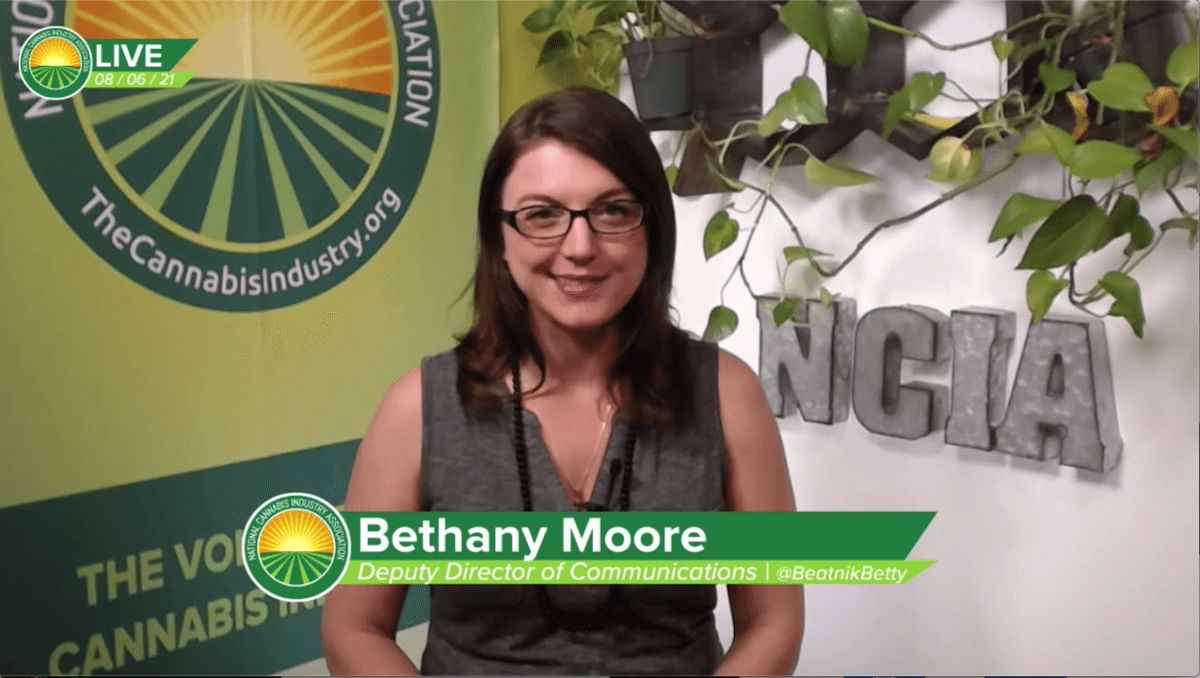
Video: NCIA Today – August 6, 2021
NCIA Deputy Director of Communications Bethany Moore checks in with what’s going on across the country with the National Cannabis Industry Association’s membership, board, allies, and staff. Join us every Friday on Facebook for NCIA Today Live.
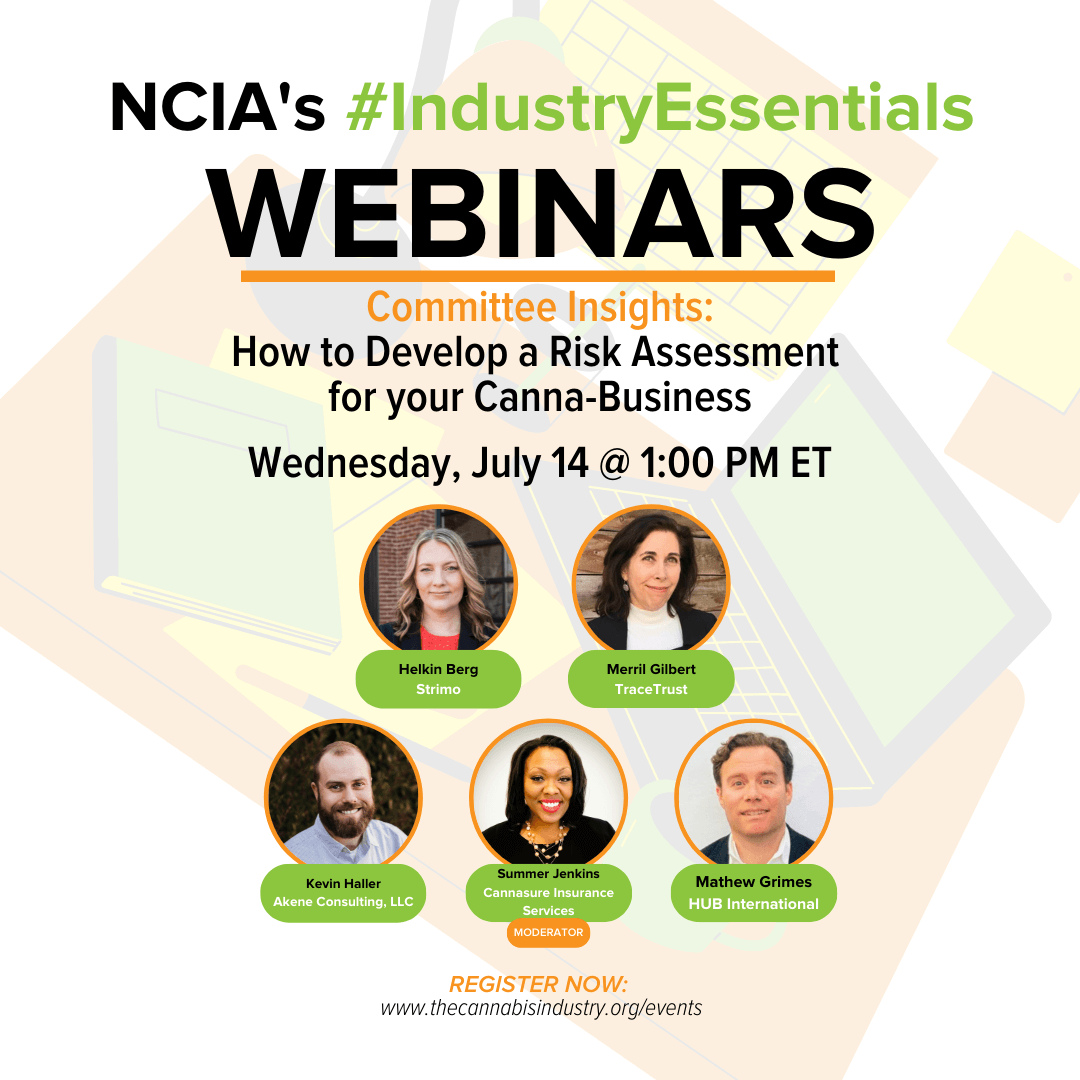
Committee Insights | 7.14.21 | How to develop a Risk Assessment for your Canna-Business
In this edition of our NCIA Committee Insights series originally aired on Wednesday, July 14, 2021 we were joined by members of our Risk Management and Insurance Committee for a discussion on how to evaluate and rank risks to your cannabusiness.
Our experts discussed the potential impact of risk to cannabusiness operations and how to effectively identify and rank them. The discussion included risks posed by product sales, partnership agreements and corporate culture. The expert panelists also shared insights gained from their respective areas of specialty which include; Legal, Financial, Manufacturing, Technology and Insurance. Their insights will arm YOU with the tools needed to fortify yout operational practices and minimize or avoid costly losses.
Mathew Grimes
Vice President – Cannabis Specialty Group
HUB International Limited
Summer Jenkins
Business Development Manager
Cannasure Insurance Services
Committee Blog: Why Insurance Companies Should Cover Medical Cannabis Now
by Carol Welch & Jim Gerencser NCIA’s Risk Management & Insurance Committee
Cannabis was legalized for medical use in California in 1996. Since then, 47 states, the District of Columbia, and three territories (Puerto Rico, Guam, and CNMI) have legalized some form of cannabis, leaving only three states with no legal use. Thirty-six states have an effective medical use law in place. The main reason insurance companies haven’t had to consider providing coverage for patients is because federally cannabis is still listed as a Schedule 1 drug. Even though the likelihood of cannabis being legalized nationally seems bound to happen within the next few years, insurance companies should start planning to incorporate new cannabis policies into their plans now.
Here are five great reasons to cover medical cannabis:
SAVES MONEY
Science has proven that cannabis helps over 60% of epilepsy patients decrease the frequency and severity of seizures. Cannabis products should cost less than traditional epilepsy medications, especially when taking into account the added prescriptions often needed to combat the side effects of currently available prescription drugs.
Compared to the traditional cost of cancer treatment, patients opting to skip conventional treatments for cannabis could save their insurance companies thousands in initial cancer treatment, and potentially will have less recurrence and costly maintenance prescriptions.
Insurance companies are paying billions in healthcare costs to include doctor visits, lab tests, hospital admissions and prescriptions for conditions that cannabis has shown to improve dramatically. Chronic pain, depression and PTSD are all treatable with cannabis, and cannabis is much less dangerous than the opioids that are commonly prescribed in chronic pain cases.
SAVES LIVES
There are no known deaths reported from cannabis consumption alone. According to the CDC, there were 70,630 deaths due to drug overdose in 2019. In addition, there are estimates of over 1.5 million hospitalizations per year from adverse drug reactions that don’t cause death but are still costly to many people. Insurance companies can avoid some of the negative PR, potential litigation and upset related to deaths caused by pharmaceuticals, while providing patients with a solution that works for many conditions.
Research is increasingly showing that certain strains and compounds within the cannabis plant can have a significant positive effect on several conditions. For instance, breast cancer responds very well to FECO (full extract cannabis oil), with lab tests showing how cannabis causes cancer cell death. More study is still needed, and that is currently being conducted in Israel where there are fewer legal barriers to research.
REDUCES MEDICARE SPENDING
Data from all prescriptions filled by Medicare Part D enrollees from 2010-2013 showed a significant decrease in prescriptions being filled for symptoms for which cannabis could serve as an alternative treatment. Overall reduction in Medicare spending in states that implemented medical marijuana laws were estimated to be $165.2 million per year (2013). This one difference alone could mean billions in savings for insurance companies in the coming years.
IMPROVES SATISFACTION RATINGS
Let’s face it, insurance is a competitive business. Several large health insurers cover most of the country and will likely be the last to jump on board to cover medical cannabis. But for the smaller, regional or state-specific insurers out there, adding cannabis to the coverage lineup in legal states can provide a competitive advantage with employers and group plans.
Medical cannabis is listed as an eligible expense in many Canadian companies’ HSAs and islisted as an eligible medical expense by the Canada Revenue Agency. Since our northern neighbors are starting to cover it, hopefully that will encourage U.S. insurers to do the same.
IT’S THE RIGHT THING TO DO
Cancer is the #2 leading cause of death in the United States and can cost several thousand dollars for treatment. Using cannabis as a complementary treatment to traditional cancer therapies could decrease the cost of treating cancer to the patient, to the insurance companies and in the end to all of the people across the United States that contribute to Medicare and Medicaid.
If you would like to take action, contact your legislators to push for the federal legalization of cannabis or sign this petition calling on all U.S. insurers to step up and cover medical marijuana for their patients. Here’s a link to the Care2 petition: Health Insurance Companies Should Cover Medical Marijuana Now.
 by Matthew Johnson and Doug Esposito
 Matt Johnson leads the Risk Services division for QuadScore, the nation’s leading cannabis insurer. Matt works to keep the cannabis industry safe from unexpected losses through all manner of risk mitigation techniques, ranging from facility security assessments to fire protection improvements.
 Doug Esposito has been a Property & Casualty Specialist with AssuredPartners and leads the firm’s Renewable Energy and Cannabis Practice with specific expertise in these industries. Doug’s current cannabis & hemp practice clients include indoor/outdoor cultivators, manufacturers, distribution companies, dispensaries, non-storefront delivery, labs and property owners, so he knows what challenges are facing the growing industry and is skilled at providing solutions. Doug is also one of AssuredPartner’s experts in alternative risk mechanisms including self-insured and captives programs.

 By Jodi Green, Miller Nash LLP; Shay Gilmore, The Law Office of Shay Aaron Gilmore
 by NCIA’s Risk Management and Insurance Committee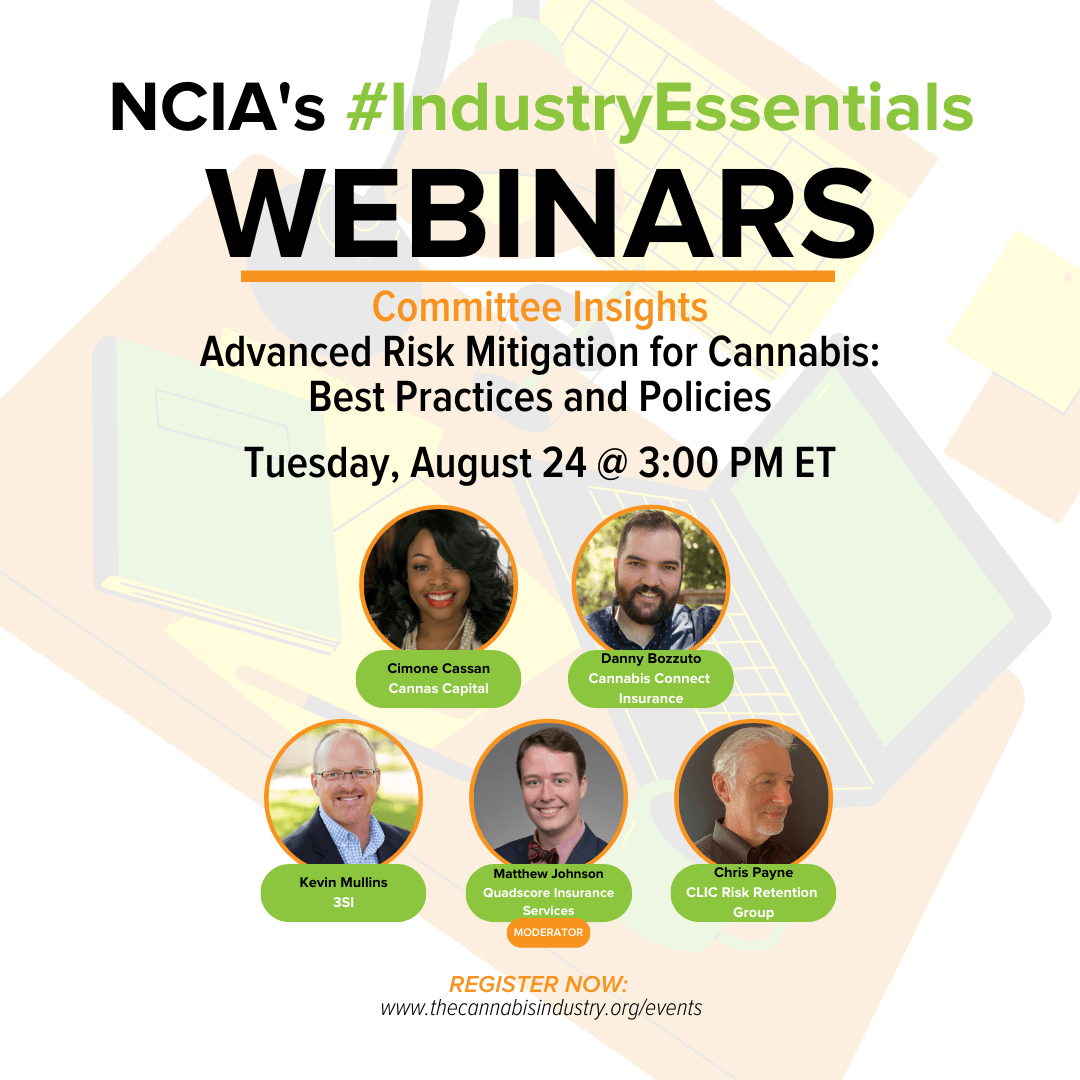

Follow NCIA
Newsletter
Facebook
Twitter
LinkedIn
Instagram
News & Resource Topics
–
This Just In
NCIA Applauds Reintroduction of SAFE Banking Following Lobby Days
Beyond Rescheduling: Inside NCIA’s 14th Annual National Cannabis Industry Lobby Days