Member Blog: Pre-Rolls are Poised to Become the #1 Category in Canada – Will the Same Trends Follow in the US?
Earlier this year, we predicted that pre-rolls were destined to be the top-selling cannabis product by the end of this decade, and a new deep dive into the Canadian market has only further convinced us that pre-rolls are not only a cornerstone of the current market, but a major driver for future growth not only North of the Border, but in a federally legalized U.S. cannabis market as well.
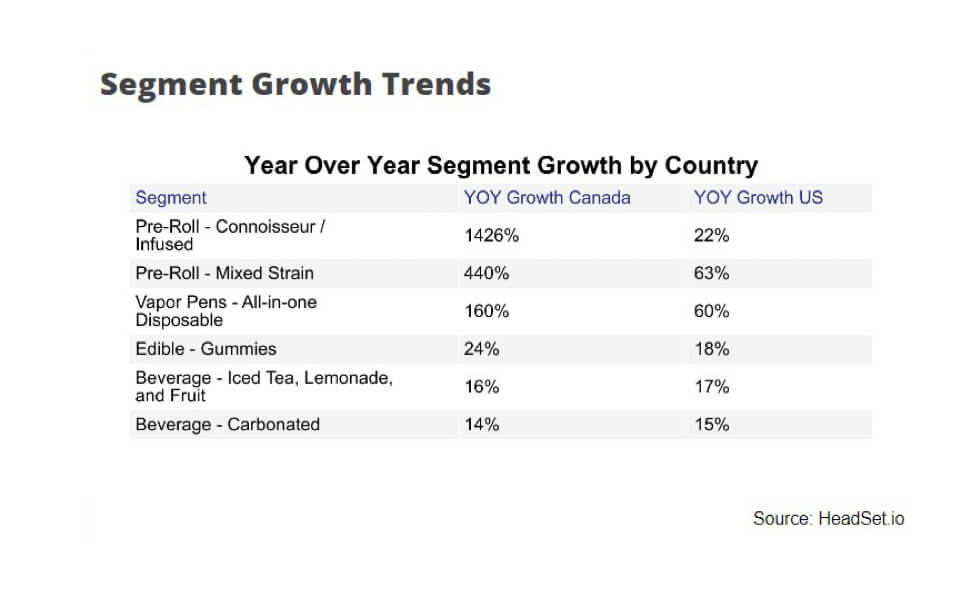
That’s because thanks in part to a staggering growth rate of 606% in infused pre-rolls from January 2022 to February 2023, pre-rolls are currently on the verge of overtaking flower as the top product category in Canada’s cannabis industry.
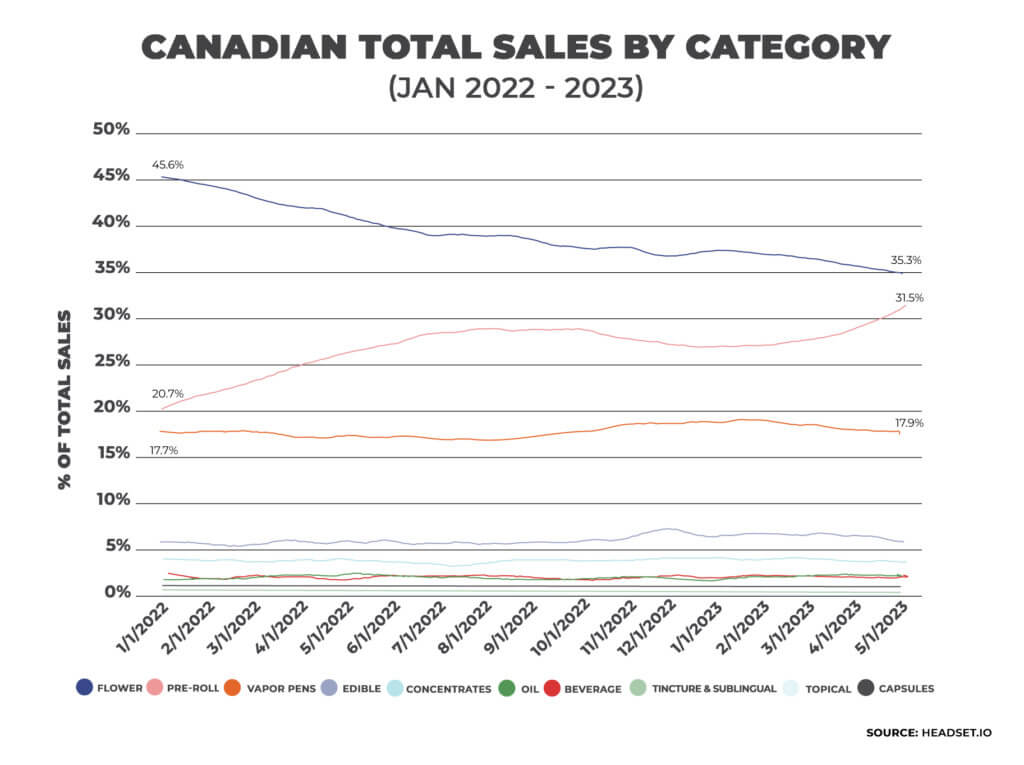
Using data from cannabis analytics firm Headset, our new White Paper, “Pre-Roll Growth in the Canadian Market,” details how pre-rolls in Canada have grown more than 50% over the past 18 months, from a 20.7% market share in early 2022 to a 31.5% total market share in May 2023, with total sales in the category topping CAD$1 billion in 2022. At the same time, flower sales in Canada continue to drop, falling to just 35% of sales in May 2023, compared to 31.5% for pre-rolls.
With federal legalization believed to be on the horizon for the United States, Canada’s data stands out as a national system and gives us some insight into how the American market could respond to a federal program, as opposed to one that is regulated state-by-state.
Growth in Every Market
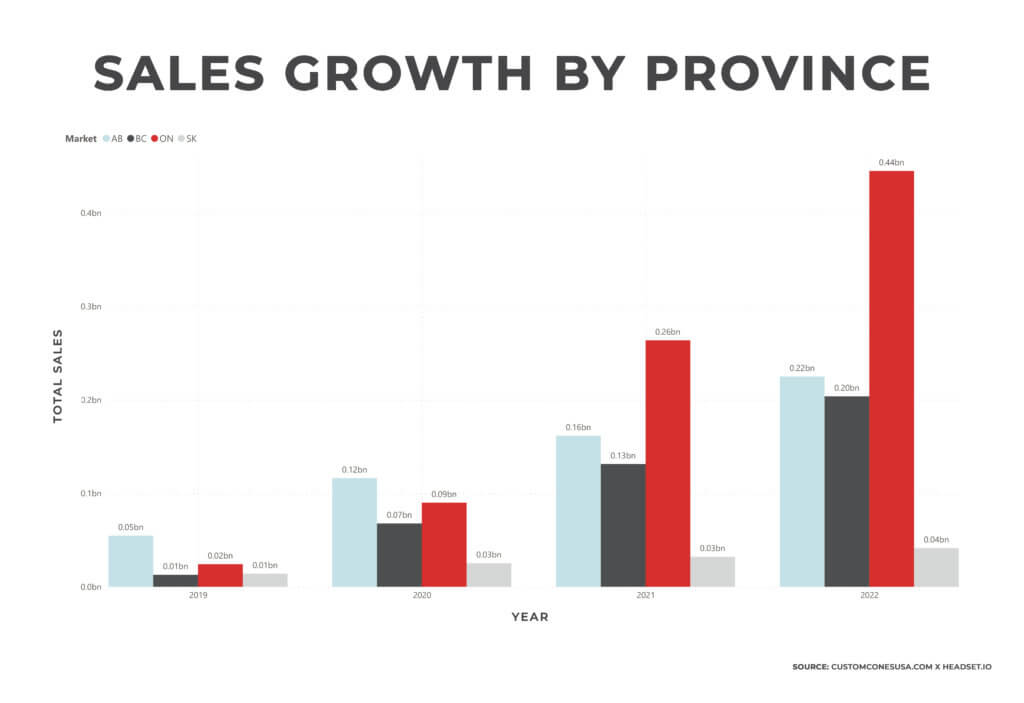
Sales of pre-rolls in all four of the provinces tracked by Headset saw large increases. Pre-roll sales saw 33% and 37% growth in Saskatchewan and Alberta, respectively, a nearly 54% growth in British Columbia and a whopping 69% increase in Ontario, the country’s most-populous province. In the U.S., pre-roll sales also continue to surge, growing to a 12.1% market share in the States.
The sales growth has been fueled in part by the rise of infused, or “connoisseur” pre-rolls, which combine a cannabis concentrate and flower into a single pre-roll cone. The result is a more potent pre-roll, often at a higher price point, which has helped push revenue totals even higher since Health Canada clarified its rules in late 2021 to clear the way for the product.
Consumers have responded, with infused pre-rolls seeing an eye-popping 1,426% growth rate from 2021 to 2022. The segment grew from just under 3% of the market at CAD$12.7 million in 2021 to nearly 30% and CAD$47.9 million by mid-2023. That’s more growth than any other pre-roll category except single-strain hybrids.
Keeping Price Points High
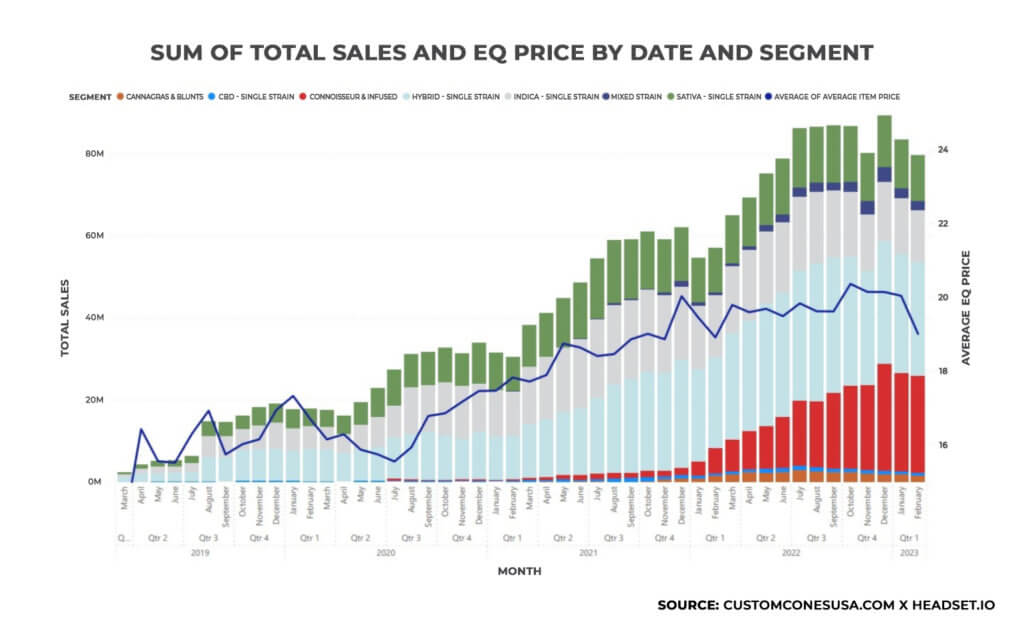
The rising popularity of infused pre-rolls, with their higher price point, has been a significant factor contributing to the increase in the average price of Canadian pre-rolls. Infused pre-roll sales jumped from 6.2% of total sales in January 2022 to 29.8% of sales by February 2023. This trend has been instrumental in maintaining the overall price of pre-rolls even as prices for flower and concentrates have decreased.
According to Headset data, in 2022, pre-roll products accounted for 27% of the new items introduced in the Canadian market, demonstrating a remarkable growth rate of 48.2% compared to 2021, second only to beverages. In response to the increasing demand in this category, a total of 1,870 new pre-roll products were launched in the Canadian market during that year.
The resilience of pre-roll prices can also partially be attributed to their manufactured nature and the unique attributes of infused pre-rolls. The demand for stronger pre-rolls, coupled with declining prices for flower and concentrates, has created a favorable environment for launching infused pre-roll products.
Additionally, automated pre-roll machinery continues to evolve, including new automated infused pre-roll machines, making it easier for manufacturers to produce large quantities of infused pre-rolls at a slight premium over regular pre-rolls, leading to the category’s rapid expansion.
Multi-Packs and Cross-Generational Appeal
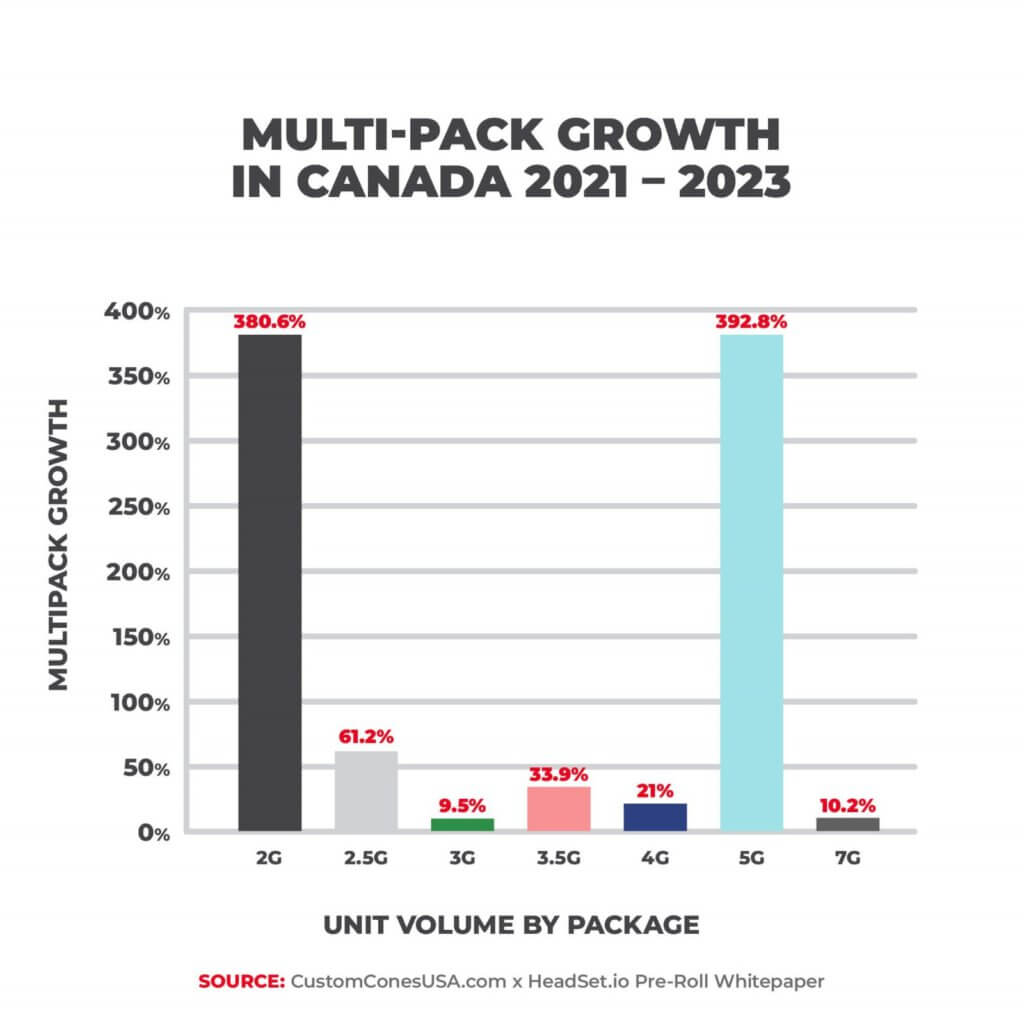
Other insights from our report include a surge in pre-roll multi-packs, with 2- and 5-gram packs seeing an almost 400% growth over the past two years, and that the pre-roll category shows less price compression than any other segment of the market, as it does in the U.S. as well.
Part of the strength of the pre-roll segment is its cross-generational appeal. For example, the Ontario market is the largest and fastest-growing of Canada’s provinces. With revenues reaching CAD$440 million in 2022, Ontario accounts for almost half of all sales in Canada. And within Ontario, the wallet share of pre-rolls grew within every generational group through 2021, with Gen X and Millennials seeing the largest growth, at around 45% each.
Within the fastest-growing group of consumers in the industry, Gen Z (which in Canada is a larger cohort than the U.S. due to a lower age restriction for cannabis purchases), pre-roll sales increased with both male and female consumers. The wallet share of pre-rolls among female buyers grew more than 4% to 20.4% in 2021. For males, the increase was even larger, growing from 14.6% of wallet share to 19.7%.
Final Thoughts on Pre-Roll Growth
The main factors driving the huge growth in pre-rolls are:
Increased pre-roll quality, as flower and concentrate prices drop, so companies can create a higher quality pre-roll at cheaper and cheaper prices.
Reduced labor costs, as advancements in pre-roll machinery help companies scale production and bring in automation.
Consumer buying patterns showing that customers want convenience and are consuming for recreational use, not health and wellness.
The next big trend in pre-rolls, which will push pre-rolls to the No. 1 sales category in the industry, is freshness. Competing in the future will mean better packaging and a better supply chain, so pre-rolls are always fresh at retail.
But with sales surging across both Canada and the U.S., now is the right time for producer/processors to launch or expand pre-roll lines, particularly infused pre-rolls and pre-roll multi-packs.
For more information on how you can capitalize on the latest trends in the pre-roll segment, contact the Pre-Roll Experts at Custom Cones USA.
Member Blog: Safeguarding Cannabis Businesses – Managing Product Liability and Ensuring Consumer Safety
The rapidly expanding cannabis industry presents unique challenges when it comes to managing product liability. As the sector continues to grow, businesses must prioritize quality control, labeling requirements, and consumer safety to protect their reputation and financial well-being. In this article, I will explore the various risks associated with product liability in the cannabis industry and discuss risk transfer strategies to safeguard businesses from claims related to cannabis products. One of the largest misconceptions I hear is that if a client is not making the product, they do not need product liability. Unfortunately, the reality in the industry is that in a product allegation, everyone through the entire supply chain could be named in a suit.
Quality Control and Labeling Requirements:
One of the key challenges in the cannabis industry is maintaining consistent product quality and ensuring accurate labeling. Product liability claims can arise if a consumer experiences adverse effects due to contaminated or mislabeled products. To mitigate these risks, cannabis businesses must implement robust quality control measures specific to what part of the supply chain.
From cultivation to manufacturing and distribution, every stakeholder should prioritize quality assurance practices. This includes regular testing for potency, contaminants, and pesticides. By adhering to rigorous standards, businesses can minimize the chances of their products causing harm to consumers and reduce the likelihood of product liability claims.
Accurate and compliant labeling plays a critical role in managing product liability risks. It’s vital for cannabis businesses to stay informed about the specific labeling requirements in their market, as laws and regulations vary across jurisdictions. Take California, for instance, where non-manufactured products have their own set of requirements, distinct from those for manufactured products. Whether it’s raw flower or gummies, each product category has its own labeling specifications.
Sadly, there have been instances where products were packaged to attract children or imitate popular snack brands. These cases highlight the deceptive packaging that misleads consumers and targets underage individuals. By ensuring proper labeling, businesses can offer transparency to consumers, building trust in their brand. Furthermore, accurate labeling of THC content is crucial to avoid potential product liability and advertising claims. By providing clear and precise information about THC levels, businesses can protect themselves while also meeting consumer expectations.
Consumer Safety and Education:
Cannabis businesses must prioritize consumer safety by providing clear instructions for product usage and appropriate warnings, especially for edibles and other products with specific dosage instructions. Consumers should be informed about potential risks, possible side effects, and any known allergens present in the product. Accessible information to consumers can help reduce the likelihood of product misuse and associated liability claims.
Insurance Strategies for Product Liability:
Product liability insurance is a critical component of risk management for cannabis businesses. The cost of insurance premiums is typically based on gross sales, meaning that the more products a company sells, the higher the associated risk. However, it is important to note that not all insurance policies cover product liability in the cannabis industry. Therefore, businesses should work with specialized brokers who understand the unique risks and challenges in this sector.
In addition to product liability insurance, implementing further risk transfer processes can play a significant role in reducing the likelihood of being involved in a lawsuit. Businesses should establish clear contracts and agreements between cultivators, manufacturers, and distributors, outlining each party’s responsibilities and liabilities. These agreements help allocate risks appropriately and provide a legal framework for dispute resolution.
Overall, managing product liability in the cannabis industry requires a proactive and comprehensive approach. By prioritizing quality control, adhering to labeling requirements, and ensuring consumer safety, businesses can minimize the risks associated with all aspects of the supply chain when it comes to product liability. Additionally, securing appropriate insurance coverage and implementing additional risk transfer processes can provide further protection and peace of mind. As the industry evolves, staying informed and proactive in risk management will be key to long-term success and sustainability in the cannabis market.
For more information, please reach out toValerie Taylor, Vice President, Liberty Company Insurance Brokers.
Video: NCIA Today – Thursday, February 10, 2022
NCIA Deputy Director of Communications Bethany Moore checks in with what’s going on across the country with the National Cannabis Industry Association’s membership, board, allies, and staff. Join us every other Thursday on Facebook for NCIA Today Live.
Member Blog: 2022 Cannabis Supply Chain Concerns Demand Creative Solutions
If there was ever a year that we all learned the importance of the supply chain and its impact on our daily lives, 2021 was it. For anyone who somehow hasn’t realized the effect, take a look at grocery prices the next time you shop. The cost of dairy, produce, and countless other items all highlight a fragment of the ongoing concern across the supply chain.
Heading into 2022, just about every company is pondering a similar question: How do we mitigate current and potential challenges for the next decade?
How did we get here?
The pandemic shined a light on numerous glaring issues and failures in the current supply chain.
COVID-19 spotlighted an aging infrastructure in a way it had never been before. Life moved us all into the 21st century years ago. Yet, U.S. ports remained stuck behind using software better suited in a museum as a relic rather than a relied upon, integral component. Instead of being put out to pasture, we continue to rely on this tech to handle shipping volumes that fail to align with today’s demand. With outdated, turn-of-the-century software, ports could not address the volume of daily imports.
Compounding the issue are manufacturing and inventory programs with zero flexibility or ready-to-implement fail-safes in case of dire situations like the one we’re in today. Companies with non-redundant sites like single-sourced manufacturing for an entire global production perfectly highlight this problem.
Infrastructure is far from the only significant factor. The pandemic upended just about every forecast possible. Furniture and appliance demand surged as people stayed home. Hard goods and eCommerce helped fuel a packaging demand spike, further impacting aged tech at ports. Meanwhile, the auto sector is expected to plummet. But, demand surged while companies slashed manufacturing orders. Meanwhile, tech development is months behind as it attempts to update critical tech infrastructure and other supply chain components.
Over the past two decades, a race to the bottom on production prices led many to offshore manufacturing. Once considered a viable option is now a significant pain point as stability wanes and tariffs increase. Then there are material shortages that halt production. This predicament is well on display for any goods made using materials like paperboard, resin-based materials, dyes, and adhesives.
The pandemic certainly did much of the damage, but domestic factors worsened matters, like the South Texas winter storms in the United States. Adding to the goods strains is the consolidation of manufacturers, limiting supply options during crucial times. This underlying industry concern kneecapped numerous sectors operating with just a few producers.
However, the most significant impact is the shortage of people. The tragic loss of lives, mandatory isolation orders, and full-site shutdowns limited the people power needed to sustain the marketplace. From ports to factories to transportation, every facet of the chain continues to struggle with a lack of people.
What is the current state?
The current state of affairs presents critical concerns. Like the year before, companies must contend with concerns that are substantial enough on their own. When coupled together, they create historical challenges.
Labor shortages continue to affect production. The Omicron variant has been the latest problem, just as optimism returned to many workplaces and organizations. The workforce dearth has once again slowed or stopped progress. Expect delays even when labor returns to full force.
The circumstances leave us in a dire time. Inflation has run rampant, impacting labor, transportation, substrate, and countless other costs. While the times are tough, we can remedy the problems with the right frame of mind and proper implementation.
A World Not Without Hope
The ample amount of adversity offers its slivers of silver linings. One of the brightest bits of optimism is the versatility of options available. Just about anything could be viable.
Think dynamically. Listen, consider, forecast, and plan for the days and years ahead. Success lies within your team and customers. Consider all opinions when planning your next steps. Knowledge is vital to ensuring that these issues never happen again. With insights gathered, find the software, suppliers, and other needed components to make your supply chain thrive.
Now may be a good time to consider production closer to home. If impossible, make sure that your partners match timelines and production plan milestones before beginning any relationship. Sustainability is another concern that can’t be overlooked, even if it often comes at an additional cost. Its importance often clashes with sourcing consumers and other critical points mentioned here. That said, packaging can and must do what it can to reduce its carbon footprint—source from eco-conscious companies with options for recycled and/or recycled materials, alternative substrates, and other sustainable options whenever possible.
We should expect inflation to continue growing for some time despite substrate cost stabilization expected to help to a degree. As such, ask how prepared your company is for the challenges ahead. Evaluate every process component, from production to packaging to branding. Taking time to account for every possible hurdle ahead should best position your company to keep costs at a minimum while creating sustainable, consumer-friendly products that won’t get held up in ports and additional shipping lanes.
While times are tough, we can progress in the right direction. Now is the time to streamline the production process to develop customer-friendly products that puts sustainability into action. It’s a tall task, but creative thinking and proper implementation will work, benefitting us all in the process.
Elizabeth Corbett, VP of Sales for AE Global, is on a mission to build sustainable packaging & supply chain programs for cannabis and CBD companies which honor their brand identity, drive revenue growth, protect the product and do so cost effectively. “CannaBeth”, as she is fondly known, entered the cannabis industry more than eight years ago after spending the first part of her career developing packaging solutions for significant players in the retail and health & beauty markets such as Starbucks, Tiffany and Estee Lauder. Based in Seattle and Miami, Beth is passionate about finding environmentally responsible and sustainable solutions no matter what the form or substrate.
Member Blog: How a Better Understanding of Data Can Propel Cannabis Companies
Propelled by new legalization easing the regulations and laws surrounding its use and distribution, the nascent cannabis industry has experienced unparalleled growth. Expected to expand at a CAGR of 26.7% from 2021 to 2028, the market is loaded with potential for up and coming businesses.
However, to realize this potential and maximize one’s ROI requires a thorough understanding of the industry and the flexibility to evolve with the market. Thankfully, the recent legalization of cannabis in many states has spurred a significant increase in available data for organizations to use in facilitating their decision-making.
Understand key market trends
Lacking a mature market history due to cannabis just recently being legalized, businesses within the cannabis industry can’t reflect on previous purchasing trends in strategizing their approach to consumers. Whether or not a product experiences success largely depends on it being positioned in the right market segment.
By leveraging transactional data based on a variety of factors (demographic, seasonality, delivery method, etc.), organizations can identify which products are selling and who they’re being sold to. The wide diversity of both available strains and consumer demographics means there is no one-size-fits-all solution to cannabis.
Additionally, the cannabis industry’s young age and heavy investment in product innovation has produced a relatively volatile market. Businesses have to be able to quickly adapt to the always-evolving consumer trends if they’re to remain successful.
Utilizing data in their decision-making can also aid executive administrators in creating long-term business strategies and identifying realistic goals.
Identify opportunities for improvement
Many organizations still guide their decision-making based on factors like gut feelings and prior experiences, which are prone to error and often fail to address the underlying causes in any given situation. Without access to the right metrics, it can be very difficult for both young and mature businesses to identify weak points in their enterprise.
Hidden in the data are countless opportunities for improvement from product design to customer processing. Organizations need a way to transform their data’s potential into meaningful insights if they’re to successfully scale their business.
Comprehensive data analytics systems are capable of employing automated business rules to generate useful metrics for determining what steps an organization needs to take to grow its enterprise. Many platforms come with a host of built-in KPI measures as well as self-service features that allows users to define their own business rules custom-tailored to their businesses’ needs. This means that organizations can apply analytics in a manner that best suits their own unique circumstances.
Comply with regulatory policies
The complex legal status of cannabis has led to an extensive list of regulations and laws that must be abided if the industry is to experience any long-term sustainability. Even in regions where cannabis has been legalized, governing bodies still maintain strict requirements in terms of product quality and distribution. Many of these challenges are only complicated by the fact that the different regions a business operates in all have their own set of unique rules.
Because most of these requirements are monitored and enforced through data collection systems, businesses have to implement a reliable analytics platform that can track product data all the way from cultivation to retail. In addition to handling information governance on an organization’s behalf, enterprise data solutions also employ automated features to mitigate the penalties incurred from human error.
Furthermore, by reducing the employee labor costs associated with ensuring regulatory compliance, businesses can free up time and energy for staff to focus on other business functions.
Optimize supply-chain operations
Supply chains, regardless of industry, have always depended on data to guide the transportation of products and ensure that inventories always reflect market demand. However, the short shelf-life and complex regulations of cannabis has made it even more critical that businesses turn to comprehensive analytics platforms.
Due to the volatile nature of the cannabis industry, businesses need real-time data reporting that can allow them to adapt to the always-evolving market trends quickly and efficiently. Every level of the supply chain is prone to a variety of risks and potential obstacles that businesses must be able to respond to at a moment’s notice. The ability to address a minor setback before it turns into an emergency can have profound implications for both the short- and long-term success of a business.
Outside of responding to potential accidents, data analytics can also optimize the more general functions of the supply chain and increase a business’s ROI. By coordinating schedules, maxing cargo loads, organizing inventories, and addressing other potential areas of weakness, businesses are able to reduce wasted time and resources.
John Kievit is Dimensional Insight’s Vice President of Goods and Services, Industry Strategy, and Business Development. In this role, Kievit helps Dimensional Insight understand customers’ needs and their use of its products. Kievit has nearly 40 years of experience in such a role, including working as an Administrative Vice President for sales and marketing. In addition, he has handled multi-million-dollar portfolios during his years in the goods and services industry, many of which involved using Dimensional Insight’s products, and spent many years in direct sales management.
Deciding how your organization implements data analytics depends entirely on the needs of your business and what your long-term goals look like. Solutions like Dimensional Insight’s CannaBI provide a comprehensive data governance package and manage your data at every step of the way, from integration to visualization. To learn more about how analytics can help your business grow, check out Dimensional Insight’s webpage on the cannabis industry.
Video: NCIA Today – Friday, December 10, 2021
NCIA Deputy Director of Communications Bethany Moore checks in with what’s going on across the country with the National Cannabis Industry Association’s membership, board, allies, and staff. Join us every Friday here on Facebook for NCIA Today Live.
Member Blog: Cannabis Supply Chain Roadmap – Control What You Can, Plan For The Rest
by Gary Paulin, VP of Sales and Client Services at Lightning Labels
In a world where instant gratification has run headlong into supply chain snafus and delays, something has to give. In the cannabis industry, the keys to success are to control what you can and plan for what you can’t.
Being proactive, creative, and resourceful are the keys. Cannabis purveyors are facing shortages of products and packaging. Shipping challenges, both from suppliers and to consumers, also are in the mix. And, with consumer demand through the roof, competition for fewer supplies available in a timely manner has become superheated.
What can cannabis companies do to maximize customer satisfaction while minimizing stress levels at this critical time?
The short answer can be found in the Serenity Prayer, which states in part: “God, grant me the serenity to accept the things I cannot change, courage to change the things I can, and wisdom to know the difference.”
In short, take and keep control of what you can realistically control, do contingency planning for occurrences out of your control, and know the difference between the two. One example of how to keep control: Companies facing potential shortages in many cases can build up inventory of available products, including labels, containers, and the like. Extra costs involved in doing this can be substantial, but compared to not being able to fulfill orders and having to deal with consequences — including falling revenues and workplace stress — it can be a relatively small price to pay.
One example of how to do contingency planning: Cannabis companies not in direct control of manufacturing everything that goes into a product need to figure out workarounds. In some cases, this may include advising consumers of potential looming shortages. In others, finding substitute sources that can step in if needed may be well worth the time it takes to do the research.
Again, this may cost more, but at this critical time, cannabis companies need to compare that to the cost of not doing it.
Following are specific steps cannabis companies can take to stay on top of supply chain snafus:
Determine what suppliers are clearly able and willing to meet your needs. In the label world, for example, talk with your supplier to look at likely needs through at least the first quarter of 2022. Make this company your proactive partner to offer insights about the best strategies to ensure you’ll have what you need when you need it. In some cases, this is as easy as knowing they will carry adequate supplies and perform well because they think and work ahead. In others, work with the supplier to figure out options that can substitute for something that may be in short supply.
Ramp up customer service efforts. No matter how supply chain challenges are impacting your company, spend extra time and effort to keep your customers happy. Often, frustrated or demanding customers can be made happier with sincere, empathic customer service. In addition, where possible, be proactive with customers about what they’re willing to tolerate (e.g., longer turnaround in exchange for lower price). By assessing, then fully addressing, customer needs, you can achieve positive reviews and enhance reputation by showing your ability to tune into their needs. Be real and follow through on commitments. There’s almost nothing worse than promising performance, then not delivering. If you tell them you’re going to do something, including contacting them back, do it when you say you will.
Make shipping as predictable as possible. Both for incoming and outgoing, figure out what you can expect (e.g., transportation directly under your control), and where you’ll need to rely on third-party shipping. Do some research about shippers to identify emergent issues, talk to your regular shippers about what to expect/plan for, and find substitute solutions if needed. You may also have to factor in higher shipping costs, at least through the first quarter of 2022.
Research buying trends into near-to-mid-term planning. High consumer demand is here to stay, at least for a while. As best you can, figure out what the next few months are looking like, factoring in buying demand specific to cannabis as well as the bigger global picture. Between the pandemic roller coaster, economic volatility, political and social upheaval, and proliferation of severe weather destruction and disruption, there is much beyond the realm of cannabis that may impact buyer demand and the supply chain for months, if not years.
Build in breathing room where possible. Such options as subscribe-and-save and discounts for orders with longer lead times are two measures that can take pressure off cannabis companies to a certain extent. Following the lead of such companies as Amazon, provide incentives for discounts when customers select longer lead times or commit to a regular ordering pattern.
Gary Paulin is VP of Sales and Client Servicesat Lightning Labels, a Denver-based custom label printer that uses state-of-the-art printing technology to provide affordable, full-color custom labelsand custom stickers of all shapes and sizes. Contact: sales@lightninglabels.com; 800.544.6323 or 303.481.2304.
Equity Member Spotlight: Endo Industries – Nancy Do
This month, NCIA’s editorial department continues the monthly Member Spotlight series by highlighting our Social Equity Scholarship Recipients as part of our Diversity, Equity, and Inclusion Program. Participants are gaining first-hand access to regulators in key markets to get insight on the industry, tips for raising capital, and advice on how to access and utilize data to ensure success in their businesses, along with all the other benefits available to NCIA members.
Tell us a bit about you, your background, and why you launched your company.
Endo Industries CEO & Co-founder, Nancy Do
I was raised in Eastside San Jose by parents who are Vietnam War refugees and moved to San Francisco 12 years ago where my cannabis entrepreneurship journey began. I started off as a grower in my garage in San Francisco and started to expand into grow houses, greenhouses, and warehouses to build what is now Endo Industries.
I built Endo Industries because despite living through some of the lowest times of my life such as getting raided, going to jail, and going through years of emotional roller coasters with the criminal justice system, I know my experience, passion, and background is what cannabis needs. Endo is grounded in science, elevated by culture. Endo represents equity, diversity, the hustle, and the grind and we are building something in cannabis that is exceptional and collaborative. I love this plant and everything plant medicine can represent. I’m not going to let this industry become one-dimensional.
What unique value does your company offer to the cannabis industry?
Endo is a queer female, legacy, and social equity-owned and operated parent company, which is a mouthful but also a unique value proposition in itself. I’ve seen legacy and equity cannabis companies come up with great ideas, passion, experience, and drive but are lacking in organization, upper management, high-level strategy for the long game, and key resources such as genetics, a reliable supply chain, and capital (including in Endo’s own experiences!). As a team, we deeply understand this plant and the creativity of what cannabis culture is and can be. We bring something different and fresh.
Endo provides a few unique things in our model:
Plants from tissue culture free of pests and diseases to our growers and tissue culture services to elevate and protect our brands and breeders
A strong stance of direct and real support for equity and legacy operators through our partnership with Locals Equity Distro to provide distribution services for over 25 equity, legacy, queer and women-owned brands in CA
Workforce and economic opportunity for the Re-Entry Community who have been formerly incarcerated
A tech, blockchain component to collect and share data
What is your goal for the greater good of cannabis?
Virus-free tissue culture plants at Endo’s lab in San Francisco
My greater goal is to create a platform and community that enables the normalization of safe, affordable access to cannabis while uplifting communities that have been affected by the war on drugs. I want to build a world in which we can celebrate art, culture, diversity, and cannabis all in one. And no, it’s not the idealist in me; I know this is the way the world needs to reconnect, compassionately with each other in spite of our differences. We’d certainly find that we have more in common than meets the eye if we let our walls down.
What kind of challenges do you face in the industry and what solutions would you like to see?
Being a queer women of color while also building a business that serves the greater good of our communities is no walk in the park. I would like to see investors and potential partnerships trust, respect, and invest in leaders like me. We need access to real capital and partnerships without undervaluing or controlling our businesses. We can build profitable, thriving businesses if we are just given the chance and there is no better place than the cannabis industry to start.
Why did you join NCIA? What’s the best or most important part about being a member through the Social Equity Scholarship Program?
I’ve always wanted to join NCIA but the membership fee was a barrier to entry. I’m grateful for the opportunity to be a part of an organization giving a voice and making space for equity and under-represented founders both on the legislative level and through NCIA’s channels.
Anything else: What is Endo’s growth plan for the next year?
We just launched a smaller raise of $1M and will be going for a larger round of $4M shortly thereafter. These funds will be used to expand our plant genetics offerings into new territories in the US and globally, which will allow us to foundationally launch the Endo model in every new territory. No doubt, Endo is going to make big waves this coming year to set ourselves up for the many years to come.
Member Blog: Eradicating Pesticide Use in the Cannabis Industry – Without Sacrificing Crop Quality
One of the direst, yet infrequently discussed, issues in the cannabis industry is the lack of federal guidelines regulating pesticide use. Despite the adult-use cannabis market consistently expanding on a state-by-state basis, as long as the crop remains illegal on the federal level, much-needed national oversight will continue to be limited.
The more states that legalize under a national prohibition, the more varying and convoluted state-by-state crop management regulations may become. Meanwhile, without standards firmly set in stone across the country, some cultivators have turned to hazardous chemicals to control pathogens and preserve their crop yields. Such cultivation solutions can compromise the safety of staff, the environment and, of course, the consumers.
Health Hazards of Pesticides in Cannabis
Even when shopping at a licensed adult-use or medical dispensary, consumers today still cannot be 100 percent confident that the cannabis they are purchasing is completely safe and free of contaminants and unwanted components, such as pesticides, harmful microbials, heavy metals, and solvents. Emerging research from Colorado State University shows that contaminants in cannabis, including pesticides, “are imminent threats that directly impact public health and wellness, particularly to the immunocompromised and pediatric patients who take cannabis products as a treatment for numerous human disorders including cancer patients and those suffering from epileptic seizures.” With many consumers turning to cannabis for its health benefits, and because it’s a natural alternative to heavily processed pharmaceuticals, the cultivation process should honor cannabis’ medical use by being as safe and accountable as possible.
The pesticide issue is compounded when we think about how cannabis is often consumed: through inhalation. Additional research has shown that nearly 70 percent of the pesticides used in cultivation remain in the cannabis flower that consumers smoke.
Even when these same pesticides are permitted in other types of American agricultural industries, this is a global anomaly. More than 25 percent of pesticides used in the U.S. are banned in other countries.
Moving Towards a Pesticide-Free Flower
So how do we work towards a pesticide-free cannabis industry? Licensed businesses, regulators, and consumers need to band together to set standards and guidelines for pesticide use across each legal state, and eventually on a federal level.
In 2020, Arizona took a page out of Oregon’s playbook by establishing a regulatory agency and adopting Oregon’s standards for limiting pesticide use in cannabis, setting a prime example for inter-state collaboration and accountability. Measures also need to be taken to lower the cost of testing cannabis products for pesticides and contaminants. And, of course, we need to embrace more sustainability and environmentally-minded education, and emerging technologies.
While testing does not necessarily prevent contaminants during the grow process, frequent, reliable, and standardized testing can help ensure contaminated products don’t make it to market. Unfortunately, testing requirements continue to differ by state, with some being more lenient than others. For instance, certain states only test for certain types of microbials, while others allow companies and cultivators to cherry-pick samples. This makes it easier for companies’ products to meet compliance, however, doesn’t ensure that the final products available for purchase will be safe for the consumer. Looking ahead towards inevitable federal legalization, testing requirements need to be uniform across all legal markets.
However, cultivators shouldn’t wait for federal oversight to hold themselves to the highest possible standards. There are inexpensive testing procedures currently available that cultivators can adopt before sending their cannabis products to the lab, which can help to better ensure what they are doing is working and catch a problem before it starts.
There are also non-toxic crop management technologies available now, and in addition to seeking out vendors offering innovation-driven solutions to replace conventional pesticides, cannabis companies and their cultivators can embrace simple, preventative measures to minimize outbreaks of bio-contaminants. This includes controlling humidity at the grow site, plant spacing, adequate air circulation, and implementing a strict chain of custody throughout the supply chain. Successful prevention mitigates the temptation to turn to potentially toxic pesticides to eradicate contaminants.
While federal legalization looms, it likely won’t happen this year. Therefore, state regulatory agencies should continue to be prepared with comprehensive outreach plans to communicate their pesticide and testing regulations to cultivators and their companies, ensuring that industry participants are fully informed. Planning and communication also sets the stage for the industry to have tried and true standards already in place by the time federal legalization does come to fruition.
The good news is the cannabis industry has the potential to lead a paradigm shift towards a safer agricultural sector as a whole. In years past, the amount of information shared between cannabis and other agricultural industries was limited, cutting cannabis cultivators off from reliable best practices for cultivation and crop management. However, this is changing quickly. Cannabis is also pushing the envelope towards more sustainable practices, with more cultivation sites moving indoors and into greenhouses, complete with LED lighting and additional sustainable practices. Cannabis cultivators are becoming more cutting-edge and setting an example for the broader agricultural community. The industry should continue these forward-thinking approaches by embracing pesticide-free solutions on a broad, scalable level.
Carlos Perea is the CEO and Co-founder of Terra Vera, an agricultural technology company offering innovative solutions to replace conventional pesticides and increase product safety and consumer confidence within the agriculture industry. Carlos is a serial entrepreneur with a focus on the intersection of technology and social impact. Prior to founding Terra Vera, he formed MIOX Corporation, a technology company that treats water in a variety of applications and is distributed in over 30 countries. He is active as an advisor and board member with several early stage companies and social enterprises including YPO, where is he an active board member. Carlos has an MBA from the Stanford Graduate School of Business, and an BS in Mechanical Engineering from the University of New Mexico.
Member Blog: As Cannabis Sales Rise, So Do Questions About Privacy and Security
Frank Nisemboum, Vice President of ERP Sales at c2b teknologies
Legal cannabis is a big business that handles big data. From personalized data to protected health information to cannabis information that requires regulatory compliance with cybersecurity and data privacy laws–the entire cannabis industry faces data privacy and cybersecurity challenges not faced by other sectors.
But wait, other sectors have to navigate data concerns, too right? Cannabis is different. Aside from adhering to all the typical privacy concerns, cannabis data comes with a layer of complexity for cannabis operators due to industry-specific data collection and mandatory retention requirements surrounding it.
Growing Cannabis Data Collection
A cannabis customer provides a vast amount of personally identifiable information every time they buy legal marijuana products. These individuals present a government-issued ID card to confirm they are at least 21 for adult-use purchases or prove they have a prescription to access medical marijuana. The data collected on each transaction includes customer or patient name, date of birth, address, phone number, driver’s license or medical ID card numbers as well as email addresses and signatures.
Cannabis dispensaries also provide equally large amounts of operations data to METRC (Marijuana Enforcement Tracking Reporting Compliance), used in 13 states and the District of Columbia. METRC is not the only government reporting company used to maintain cannabis compliance. For example, California relies on the CCTT (California Cannabis Track-and-Trace) system to report the inventory and movement of cannabis and cannabis products throughout the cannabis supply chain.
Cannabis legalization is expected to spread across the country to all 50 states now that adult-use cannabis is permitted in 11 states and Washington D.C. and 36 states allow medical marijuana. Many of those states require all cannabis licensees, both annual and provisional, to use METRC to track marijuana products through the entire supply chain.
Cannabis cultivators, manufacturers, retailers, distributors, testing labs, and micro-businesses need to manage and maintain those records for a minimum of seven years. It’s a tremendous amount of valuable data for cannabis companies to track, the precious data cybercriminals and hackers seek out, including combinations of protected personal and health data like social security numbers and diagnoses with supplemental information like addresses, copies of ID cards.
If a cannabis company dispenses medical marijuana to patients or supports one who does, they fall into the regulatory oversight of the Health Insurance Portability and Accountability Act (HIPAA) and the Office of Civil Rights (OCR).
Safeguarding Cannabis Data
Legal cannabis and the data security issues it creates form multi-prong challenges from a legal and technological perspective. The cybersecurity and data privacy requirements don’t come with a roadmap cannabis operators can borrow from other industries due to the massive repositories of personalized data that require regulatory compliance with cybersecurity and data privacy laws.
The collection, storage, and security of all this valuable data raise many privacy and security concerns, especially when guidelines for collecting the information vary by state. For example, Ohio and California must house personal data using third-party software to track inventory and retail point-of-sales, whereas Illinois dispensaries cannot store any personally identifiable information onsite and instead use cloud or other off-location services.
Healthcare companies make attractive targets for hackers and often suffer data breach more often due to their huge storage of protected health information (PHI). Medical dispensaries and supporting companies handle PHI too, but PHI is not all a cybercriminal may want from a cannabis operation.
Employee records often contain background checks and financial data along with personally identifiable information such as name, date of birth, and SSN, all in one nice package. And cannabis data has been breached several times in recent years.
Cannabis Data Breaches Happen
Even as a newly legitimized industry, cannabis organizations have already experienced high-impact data and security breaches. In early 2020, a database breach that impacted almost 30,000 people connected to the marijuana industry resulting from an unsecured Amazon S3 data storage bucket was reported. The data breach included scanned versions of government-issued ID cards, purchase dates, customer history, and purchase quantities.
In 2019, a Canadian cannabis company exposed the electronic medical records of over 34,000 customers.
Between 2016 and 2018, the cannabis-tracking software provider MJ Freeway endured significant data breaches where over 1,000 dispensaries in 23 states were hacked. Less than six months later, hackers stole a portion of MJ Freeway’s source code and posted it publicly to social media.
Prior to that, Nevada’s Medical Marijuana Program database was breached in 2016, exposing sensitive personal data of over 11,000 people involved in the Nevada cannabis industry. This breach included names, social security numbers, race, as well as home and business addresses.
Cannabis Operators Short on Cybersecurity Budgets
Cannabis companies are responsible for securing their data to protect their customers and staff. To prevent data leakage, point-of-sale machines need endpoint protection, encryption, secure backups with proper network segmentation.
Unfortunately, some cannabis organizations fall short of installing appropriate cybersecurity measures that could have far-reaching effects on a cannabis user. Leaked personal data could have negative personal and professional consequences for the cannabis patient whose workplace prohibits cannabis use.
To avoid becoming an easy target, cannabis companies need to focus on data privacy and security just as much marketing and sales. The penalties from having a customer or employee’s personally identifiable information and cannabis-related data exposed can be too expensive to ignore and fail to give confidence that their data is secure.
Vice President of ERP Sales, Frank Nisemboum,is a trusted advisor at c2b teknologies who has guided organizations of all sizes enabling them to establish a technology presence and expand their business through technology. His proven ability to analyze the current and future plans of a company and work with team members to subsequently bring technology solutions to the organization result in improved processes and controls that assure continued growth and profitability.
Frank has worked in the ERP and CRM software selection, sales and consulting industry for almost 25 years. His strong ability to understand, interpret and match the needs of an organization to the right solution make him an asset to all of his clients.
c2b teknologies integration and engineering experts have partnered with leading cannabis industry experts to develop a software solution that provides a complete cannabis operations system. The best-in-class solution not only handles tracking of seed-to-sale activities but encompasses your entire cannabis operations with compliance needs handles along the way. Our passion for solving problems drives us to deliver innovative solutions for everyone we work with. Visit c2btek.com for more information.
Operational Excellence is basically having a goal that looks far ahead to the future of what ultimate business plans should be while analyzing every aspect of the business itself. This is accomplished by using evidence-based results to achieve a higher level of function than any other company in the same market. Whether issues are found in lean supply chain, revenue control, processes that may be unnecessary or serve a lower function than what is needed, or other areas in which money is getting tied up, Operational Excellence is a management philosophy based on a constant method of refinement. It is taking all of the thinking, ethics, and ideology of Lean Thinking, Six Sigma, and Scientific Management, and putting them into one category to cover a broad range of improvements. In this article, we will delve into how Operational Excellence ties in the cannabis and hemp industry.
Why Is Operational Excellence Important?
A company that is employing Operational Excellence will outperform its competitors in many ways, even if they are using a similar business strategy. How resources are being used will often decide which company is going to perform better. The superior company will have much lower operational risks because it will have done a proper and thorough analysis. It will have a lower operating cost because of constant improvements to enhance the information and material flow. And, it will likely have more revenue because of efforts made in the interest of saving money, which will create a higher value for customers and the business itself. Companies utilizing Operational Excellence develop the right culture for their industry while managing their processes and business in a systematic, analytical fashion.
Applications In The Industry
There are several ways this can be applied to the cannabis industry. We could speak at length about any of these topics, so we will try to stick to the most important points to watch for and ways to operate. This is much more of a state of mind than a list of ways to improve the overall success of a company. And the whole team should have this same method of thinking when operating in their respective departments because this is something that should cover the business as a whole.
Lean Supply Chain
Controlling how much inventory you have on hand is important, not only fulfill orders but keep operations moving forward while minimizing waste. As an example, farmers often want to be paid for their material immediately. If they want to sell their whole yield, you would then have to store their entire crop in your warehouse. At the end of the day, this costs money and could possibly interfere with production while trying to process the material. A better solution would be to take the entire 500,000 lb processing deal but split it up into ten 50,000 lb shipments, or five 100,000 lb shipments. In this model, the farmer is paid sooner and you do not have an oversupply of product cluttering the warehouse and workspace.
Value Stream
A value stream map is a visual tool that displays all critical steps in a specific process and easily quantifies the time and volume taken at each stage. Value stream maps show the flow of both materials and information as they progress through the process. Within that value stream is the value-added processes and non-value added processes. For example, all machines need maintenance in one form or another; however, particular circumstances will determine whether or not maintenance on a given machine will be considered value-added, or non-value-added processes. If the maintenance required is a routine scheduled maintenance, then it is considered to be a value-added process. If it breaks down because the scheduled maintenance was subpar, however, that would likely deem the maintenance a non-value process. As a rule, it is beneficial to eliminate all non-value processes in your value stream.
The Invisible Killer
You can grow yourself out of business easily. In fact, this almost happened to our company. Because we were unable to wait 24 weeks for materials to arrive before we started manufacturing, we were pre-ordering to build up our inventory. As more orders start coming in, it is still necessary to have cash available to continue manufacturing – otherwise, it is not feasible to have a surplus of inventory. Bankers told us that we might have strangled ourselves with inventory. Fortunately for us, that did not happen, and since we have been using Operational Excellence to enhance the business, growth has never been greater.
As a business owner you should always have an insight into how the operations are running. This takes it a step further by recording and analyzing the information of your cannabis operation and making decisions that are going to have the most benefit for continuous growth. Operational Excellence means you should be using a Business Execution System that efficiently and harmoniously incorporates the following components: Process Excellence, Performance Management, and Strategy Deployment.
Dr. Jon Thompson, Ph.D., Chief Executive Officer of extraktLAB is a separations scientist, entrepreneur, and inventor. As a scientist, he has a strong technical background and industry experience in analytical instrumentation, in-vitro diagnostics, biotech, mining, and homeland security markets. During his cannabis industry career, Dr. Thompson has earned a strong track record of winning and implementing medical cannabis licenses in well-regulated, medically-modeled states. Dr. Thompson has assisted numerous companies to attain their goals in cannabis and hemp manufacturing, as well as market development, strategic marketing, and worldwide business-to-business alliance formation (including international markets). He received a Bachelor of Science degree in Biochemistry, Master of Science degree in Chemistry and a Doctor of Chemistry degree–all from the University of Minnesota.
Committee Blog: Interstate Commerce – Breaking the Laws of Economics (Part 3)
Legal cannabis, for all of its promise, has failed – in some markets spectacularly – to live up to its economic potential. But while each self-contained state market faces its own combination of political and regulatory challenges, the core of the problem everywhere is basic economics. Legal markets exist to efficiently move goods from where they are best produced to where there is the greatest demand. But cannabis, straddling the line between emerging state regulation and the remnants of federal prohibition, has negotiated that legal chasm by violating the inviolable laws of supply and demand, with predictably disappointing results. Perhaps now, in the face of a disastrous recession, with legal and legalizing states in desperate need for jobs and economic stimulus, is the time to get it right by allowing licensed commerce between legal markets.
The inability to move cannabis across state lines creates myriad problems for legal cannabis market operators that have far-ranging effects for all stakeholders in the cannabis industry, from investors to employees down to the patients and consumers who use the end products. The hindrance to economic activity also slows economic growth, employment, and tax revenues to states that have legal cannabis sales.
Oversupply Vs. Undersupply
Oversupply of cannabis in states like Oregon, which has excellent growing conditions and a favorable regulatory environment, are completely artificial and created not by the true excess of cannabis, but by the current inability to export to more populous states. This oversupply causes prices to plummet, which benefits consumers in the short term but is disastrous for small and medium-sized businesses and has far-reaching impacts on the communities that rely on this agricultural cash crop. Long term, the effect of these artificially low prices is that small businesses fail and large businesses take their assets to scale, which reduces employment and revenues in the communities that produce cannabis and extract the profits for investors in the large firms. This reduces competition and diversity in the industry, which hurts the same consumers in the long run who briefly benefited from the low prices. This is not a theoretical or academic argument, as we have seen these exact dynamics play out in Oregon over the past three years, with a staggering failure rate and rapid consolidation across the industry. Hundreds of millions of dollars of local capital have been eradicated as small businesses funded by friends and family have been forced to sell out to larger operators just to cover the worst of their debts.
In states which experience undersupply of cannabis, whether due to poor growing conditions or unfavorable regulations (or both) prices rise, hurting legal customers and patients of state-legal operators right away. Businesses can ultimately suffer losses of potential revenue, even as prices climb when consumers turn to cheaper cannabis from the illicit market. This undermines the legal systems set up by these states and pushes consumers to less-safe, unregulated products. As consumers drift from the legal to the illicit market, again the small and medium-sized businesses that currently represent the majority of the industry become financially unsustainable will suffer most, with the same end result to cannabis stakeholders as an oversupplied market.
Meanwhile, the artificial boundaries make scaling a business nearly impossible without access to an unlimited pool of capital. If a company from Washington, for example, wished to scale up and access new markets, they would have to completely recreate their entire supply chain, and most of their administrative operations, equally increasing their overhead with physical space and labor, for each new state that they wanted to enter. Effectively, they would have to create a brand-new small business in each state instead of scaling their operations efficiently and just expanding sales efforts to new territories. This is complicated in the extreme, both logistically and financially. What is worse, those redundant operations will become completely obsolete when cannabis is de-scheduled and interstate commerce allowed. This will almost certainly lead to a mass lay-off in the cannabis industry for all multi-state operators seeking to consolidate their operations. This will improve their cost competitiveness and further accelerate price drops that particularly hurt small businesses and stakeholders across the industry.
In fact, the extreme difference between the current state of the industry and a future in which interstate trade is allowed creates perverse incentives to investment, as opportunities that may be attractive in the short-term will ultimately prove disastrous long term. For example, massive energy and water-intensive indoor growing operations would be needed for New York to supply its population locally, and those facilities would require billions in investment dollars. These investments would look fantastic if one could be assured that the current regulatory environment would not change. But, if de-scheduling or other federal action allows for interstate trade, these facilities would have only a few years to reap the benefits of high margins before having to compete on cost with cannabis grown outdoors in the fertile Emerald Triangle of Northern California and Southern Oregon, which can produce much larger quantities of high-quality cannabis with a fraction of the inputs.
Newly legal net consumption states like New York and New Jersey will struggle to match supply to demand for years after initial legalization, resulting in millions of dollars of lost revenue, lost employment opportunity, and lost tax collections as the state struggles to develop the capacity to meet demand in a place that has no history of large scale production. If states that have historically been net importers plan for interstate trade from the outset, they can have a thriving retail industry with fully stocked shelves by taking high-quality products from producer states like California, Oregon, and Colorado within months of being able to import. The rapid change from essentially no legal industry to a robust, rich, and diverse retail environment would provide immediate economic stimulus in the form of jobs, thriving small businesses, and tax revenues. If new states are forced to rely solely on cannabis that is grown, harvested, processed, and distributed within state lines, it could take many years to develop the full economic benefits that a legal market could bring to bear.
All of these issues can be avoided, or at least mitigated, by a shrewd approach to incremental interstate trade instead of an instantaneous switch from 25 or more siloed industries to one national, or potentially international, market. The dynamics of how different state regulations interact can be tested and worked out thoughtfully, allowing for a more seamless transition and a clear roadmap for federal regulation when cannabis is de-scheduled. Successful interstate trade on any scale, between even just two states, will clearly signal to investors that the future of interstate trade is of pressing urgency to incorporate into their investment strategy. An investor in New York could then focus on opportunities related to local product development with the promise that affordable raw materials would be available from California and skip investing in indoor agriculture. Consumers and patients in states that allow for trade across their borders will instantly have access to a wider array of products, and as the size of the market that the industry has access to increases the dramatic supply and demand swings will be dampened by a larger and more diverse base of both consumers and producers.
Ultimately, the purpose of markets is to maximize the efficiency and utility of the flow of goods. They should move from the places where they are cheapest to produce to the places where the demand is highest. This is most effective with commodities and consumer goods, like cannabis. The current restrictions against moving cannabis across state lines completely hobble the market’s ability to perform this critical function. The result is bad for producers, consumers, regulators, and state governments. Interstate commerce for cannabis means better markets for producers, more choice for consumers, and a massive economic stimulus for all participating states in the form of job creation and increased tax revenues.
Gabriel Cross is a Founder and CEO at Odyssey Distribution, LLC, a distributor for locally-owned craft cannabis producers and processors in Oregon. Gabe worked in the sustainable building industry for a decade before starting Odyssey and brings his experience with sustainability and systems thinking to his work in the cannabis industry. Odyssey manages logistics, sales and marketing for boutique producers so they can focus on creating great craft cannabis products for the Oregon market.
Gary Seelhorstof Flora California has a passion for developing high-quality cannabis products so their most therapeutic effects can be realized. His 25 years in pharmaceuticals and medical devices helps him bring scientific rigor to the cannabis industry. Gary is very active at both the State and Federal level as an advocate for policy reform/higher quality standards. He enjoyed lengthy stints at Eli Lilly and Pfizer (in clinical development and corporate development) and worked with several start-ups developing corporate and compliance strategies. Gary has a B.S./B.A. from UC San Diego in Biochemistry/Psychology, an M.S. in Clinical Physiology from Indiana University, and an MBA from the University of Michigan.
Member Blog: ‘New Normal’ Dictates Label And Packaging Printer Review
by Gary Paulin, VP of Sales and Client Services at Lightning Labels
In a world of uncertainty, reliability and timeliness rule
COVID-19 is altering the landscape in ways unimagined a few weeks ago. With new realities, fears and uncertainties running rampant, it’s time for cannabis and CBD manufacturers and purveyors to recheck their label and packaging protocols right along with products. When it comes to printing and fulfillment, it’s wise to stay as “close to home” as possible.
“Close to home” encompasses two major areas in label/packaging custom printing: They are country of origin and centralized process control.
Country of origin is fairly straightforward. If at all possible, it’s a good time to be “made in the USA.” The uncertainties and disruptions in a number of foreign countries, complicated by the pandemic, make custom label printing abroad a dicey proposition at best.
Centralized process control has to do with how printing, fulfillment, and shipping are managed. The more that is done under one roof, the better. While shipping requires using an outside third party in most cases, everything else can be completed in-house.
Brokering printing and/or fulfillment to outside entities can present a version of the same problem that occurs with foreign countries. Anything done out-of-house is more subject than ever to delays and disruption. Even after COVID-19 subsides, this is a lesson to be learned well going forward.
Summed up, develop, manage and reinforce a reliable supply chain where getting high-quality cannabis labels and packaging printing quickly and economically is Job #1.
Cannabis and CBD companies wanting to confirm that they’re getting the best quality, price and turnaround time consistently and reliably can review options below. Everyone deserves a predictable, quality-driven and customer service-obsessed printer all the time. Right now, it’s even more important with the added pressures stemming from COVID-19 and resulting stressors.
Review factors within and beyond a printer’s control.
Make sure that what’s claimed in the way of processes and workflow is actually practiced. To confirm validity, this is a great time to conduct a virtual tour of the facility to see it in full operation. Video call platforms that make this easy and efficient have proliferated. Don’t hesitate to ask your printer for a tour. As an essential business, printers can remain open to handle all needed functions. So, the virtual tour of operations should show some level of normalcy. Account/sales/customer service teams, however, are likely working from home — so ask to have them chime in on a video conference. That way, you can see the plant in action and assess how well the remote employees are performing in their new “offices away from the office.”
Besides confirming claims, doing a virtual tour will provide insights about workforce stability and morale. Optimally, it’s pretty much business as usual. However, if there are signs of low morale or lagging productivity, check it out further.
Also check to see that operations numbers match up to expectations. Are printing and fulfillment stations manned as expected? How is staffing matching current demand, which for some label and packaging printers may actually be surging?
If something seems askew, such as a printer claiming healthy volume when the plant is almost deserted, keep asking questions. These may be early drops of rain on the windshield, portending a coming storm.
Conduct a problem-solving and contingency-planning meeting with your printer.
In addition to assessing what’s going well, address what could go wrong and how the printer will handle it. As COVID-19 impact has shown, there well may be challenges ahead that—under normal circumstances—wouldn’t be considered high priority. Now, on top of potential twists and turns in the regulatory and various jurisdictional environments, there’s the added challenge of a pandemic.
In cannabis and CBD, the focus for the foreseeable future may well be on increasing versus faltering product demand. How a printer can be nimble and scale to coming challenges on all fronts will likely dominate a variety of discussions for awhile.
Other contingencies may involve direct impact of COVID-19 itself. How well can a printer backstop employees who get sick? How will this be done? Will it be primarily substituting present employees, already well familiar with the company and operations, who have capabilities crossing a number of areas? Or, will new people need to be brought in? If so, where will they come from? What other ways can printers maintain productivity amid these challenges?
Look for present performance in readily documentable areas.
Is turnaround consistent with previous orders? How is the quality? What about customer service availability and timeliness? Are you dealing with the same people as before? Are people acting consistently with pre-pandemic expectations? (If not, you may want to give a bit of grace, as everyone is dealing with unusual stresses.) If everything is essentially business as usual, and you’re getting everything you want and are accustomed to, that’s a win. If there are problems, find out why and problem-solve with the printer. Even if it involves a problem beyond direct printer control, such as a shipping snafu, it deserves troubleshooting for workarounds.
Obviously, this is not an exhaustive list — but it will help ensure that product manufacturers and purveyors continue to get the quality, turnaround, and price they deserve. If there’s an issue that may be COVID-19 related, and the label/packaging printer has been a longtime stellar performer, consider figuring out a solution before going elsewhere. If, however, there’s a systemic, attitude or customer-service problem that looks to be long-term, look for another printer that checks the right boxes.
Gary Paulin is VP of Sales and Client Servicesat Lightning Labels, a Denver-based custom label printer that uses state-of-the-art printing technology to provide affordable, full-color custom labelsand custom stickers of all shapes and sizes. Contact: sales@lightninglabels.com; 800.544.6323 or 303.481.2304.
Member Blog: Cannabis Software Solutions – The Case for Connectivity
In the cannabis industry, it is critical for cultivators to track crops throughout their production. Traceability benefits and protects cannabis companies, state governments, and the consumer. Without proper tracking systems in place, it would be impossible for states to tax businesses appropriately, it would be dangerous for consumers, and the burden of risk is placed almost entirely on the operator.
To combat this risk, states have mandated certain systems to track cannabis products called track-and-trace or seed-to-sale systems. There are a few leaders in the space – Metrc, MJ Freeway, and BioTrack. All three provide tracking software solutions for operators and contract their software to state governments.
These systems are designed for regulators, not cultivators. Growers instead have to purchase a second system to manage their operation. We’ve highlighted why it’s important for growers to implement a cultivation management platform (CMP) in the past, but it’s important to note how difficult it is to implement a CMP in the current market.
Growers are second class citizens in the cannabis world – and that’s a major failure of the industry right now. Growers are the backbone of this industry and we, as innovators, should be making it as easy as possible to track products through the supply chain. This is not just because it’s a good business decision or because it makes it easier for governments to tax products, but because it’s good for the industry. It’s good for the consumer. It’s the right thing to do.
However, the industry is disconnected. For Metrc required states, it takes weeks before you will hear from the company regarding connectivity and months before integration can happen. The regulatory systems all tout their API as a way for other software companies to integrate into their systems, but in reality, it’s not that simple.
Here’s what that means for growers. Growers are mandated to use regulatory systems to record weights and plant IDs (as well as other data) for the benefit of the regulator and the chosen software provider, but they cannot use those tools to their advantage. Instead, they have to choose to purchase a third-party system that may or may not be able to integrate into the regulatory system or they are forced to purchase the cultivation software from the same regulatory software provider, which again, may or may not fulfill their needs. If the grower chooses a system that they like but cannot integrate, it means they have to enter information twice. This is a costly burden and often leads to unnecessary data entry errors.
Most of the regulatory systems on the market today are ill-equipped to provide enterprise-ready software in the first place, but it’s not the fault of those software providers. This is a new industry. Most of the software companies on the market are undercapitalized and many are outsourcing development as a result. This leads to serious security issues and system outages, like we’ve seen in Washington and Pennsylvania.
A better way to handle the growth of this industry would be to regulate in a connected and open environment. Instead of mandating a particular software solution, mandate traceability and let the grower decide how to meet that requirement.
For example, under the Controlled Substance Act, the DEA requires certain reporting requirements and these are submitted to the DEA database ARCOS (Automated Reports and Consolidated Ordering System). However, a company could choose to use Microsoft NAV for its management solution and sync to ARCOS for submittal of reports.
In food, the USDA governs food safety requirements under FSMA (the Food Safety Modernization Act). FSMA mandates food producers create and maintain a food safety plan, however it does not require a specific format or content. There is guidance for how to create a plan, but FSMA also allows for flexibility in operations and there is trust that operators will create a plan that is right for their operation.
This idea of trust in the grower and a unified framework of requirements is missing in the cannabis industry. Some software providers have tried to close that gap, but relying on mandatory software and changes on a state-by-state basis will only hurt the industry. We need to enable growers to scale efficiently and legally. We should support growers and provide tools that make it easier for them to implement new regulatory requirements, not harder. Our industry should consider opening up the software market for regulatory reporting and at a minimum should encourage data integrations, not limit them.
Allison Kopf is the Founder and CEO of Artemis, the market-leading Cultivation Management Platform serving the fruit, vegetable, floriculture, cannabis, and hemp industries. Artemis won the highly coveted Disrupt Cup at TechCrunch Disrupt in San Francisco. Kopf was recently named one of Forbes 2019 30 Under 30 as well as one of New York Business Journal’s 2019 “Women of Influence.” Allison is an Investment Partner at XFactor Ventures and serves on the boards of Cornell University’s Controlled Environment Agriculture program and Santa Clara University’s College of Arts and Sciences. She is a Techstars Farm to Fork mentor and holds a BS in Physics from Santa Clara University.
Artemis provides a world-class Cultivation Management Platform that enables owners and managers of enterprise horticulture facilities to drive efficiency, profits, and growth while ensuring security and regulatory compliance. With Artemis, users can manage workflow and daily tasks, register crop batches, trace food safety issues, manage workers, and leverage data insights to increase workforce efficiency and crop productivity. Read our software buyer’s guide for more information.


 With federal legalization believed to be on the horizon for the United States, Canada’s data stands out as a national system and gives us some insight into how the American market could respond to a federal program, as opposed to one that is regulated state-by-state.
  The sales growth has been fueled in part by the rise of infused, or “connoisseur” pre-rolls, which combine a cannabis concentrate and flower into a single pre-roll cone. The result is a more potent pre-roll, often at a higher price point, which has helped push revenue totals even higher since Health Canada clarified its rules in late 2021 to clear the way for the product.
  Keeping Price Points High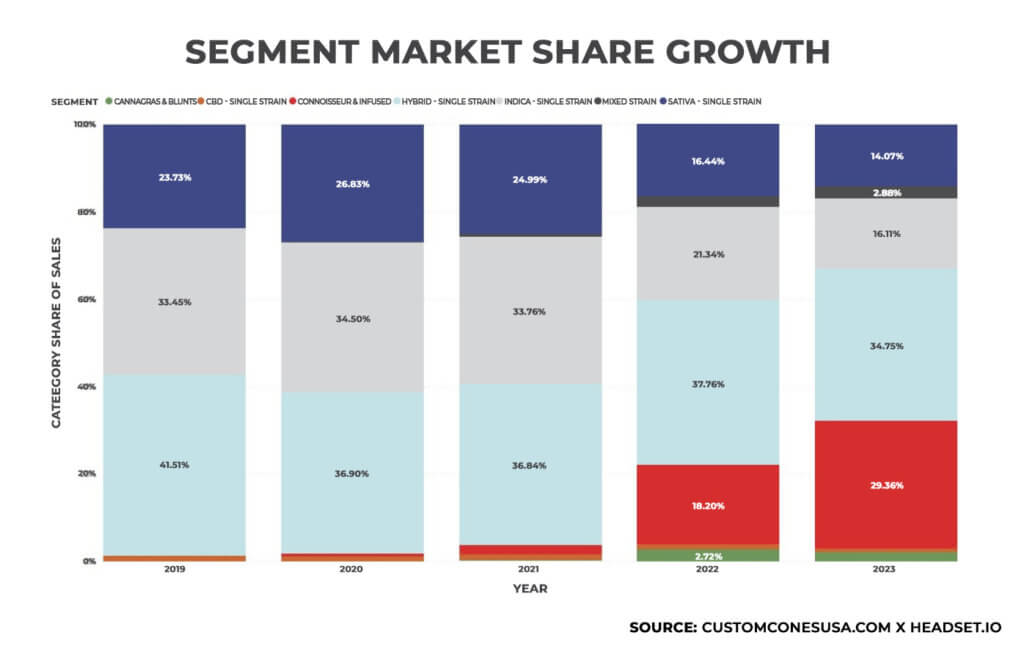


 Elizabeth Corbett, VP of Sales for
 John Kievit is

 Gary Paulin



 Carlos Perea is the CEO and Co-founder of
 Vice President of ERP Sales, Frank Nisemboum,


 Gabriel Cross is a Founder and CEO at
  Gary Seelhorst
 Allison Kopf
Follow NCIA
Newsletter
Facebook
Twitter
LinkedIn
Instagram
News & Resource Topics
–
This Just In
Committee Blog: Budtenders Make or Break Your Business – A No-Nonsense Guide to Cannabis Retail Staffing
Member Blog: Guaranteeing the First Loan